Tag: jesus

  • Honor Your Inner Light, But Don’t Forget to Open a Window

    Honor Your Inner Light, But Don’t Forget to Open a Window

    In the early seventies, when Kung Fu flickered across American televisions, my family and our Berkeley friends spent two weeks each summer at Berkeley Tuolumne Camp—a “rustic getaway” that was really just Yosemite-adjacent squalor with better lighting. We slept in glorified tents, shared public latrines, and dined communally on food that could have been mistaken for field rations. I liked to think of myself as a young Caine, the barefoot monk of Kung Fu, wandering the wilderness in contemplative solitude. Sadly, my Zen aspirations were constantly interrupted by counselors who mistook joy for a group activity.

    Every hour they corralled us for something: forced sing-alongs, talent shows, and “athletic contests” such as tug-of-war, which was neither athletic nor a contest so much as an exercise in rope burn. One counselor resembled Bernadette Peters in both hair and chaos. Another, a sun-bleached folk singer in patched jeans and a tunic, looked unsettlingly like a California Jesus. He roamed the camp with his guitar and a homemade theology he called the Divine Point System. Every act earned or lost “Jesus Points”: ten off for littering, fifteen on for picking up trash, thirty off for talking during the talent show. He doled out morality like a camp accountant for God.

    I privately dubbed him Berkeley Camp Jesus, and his system wormed its way into my psyche like a pious parasite. Soon I was mentally awarding and deducting points from myself all day long. Back home, I picked a plum from our tree, ate it, and flicked the pit into the neighbor’s yard. Immediately, I heard the voice: “Ten points deducted, you littered.” Then came my rebuttal: “No, you planted future nourishment for your neighbors—plus twenty.” Thus began my lifelong facility for creative moral bookkeeping—a skill that would serve me well in future ethical entanglements.

    That same summer, my real education came not from campfire sing-alongs but from a contraband paperback: Herman Raucher’s Summer of ’42. While my peers hiked and swam, I stayed inside my tent reading about Hermie’s torrid affair with a married woman. I’d already seen the movie with Jennifer O’Neill, so my imagination was well supplied. Nature, with all its pines and chirping insects, couldn’t compete with adolescent desire and literary scandal.

    When I finished the novel, I didn’t rejoin the living; I began my private religion: Dice Baseball. Armed with two dice, stat sheets, and a Panasonic tape recorder, I simulated entire baseball seasons—162 games of pure obsession. I played both teams, announced every pitch in my best Monte Moore voice, conducted post-game interviews as Reggie Jackson, Catfish Hunter, and myself, and recorded it all. My church was a canvas tent, my congregation a stack of baseball cards.

    One morning, my father—having eaten steak and eggs in the communal mess hall—entered the tent, surveyed my sanctuary, and decided I was going feral. “I didn’t bring you to the wilderness to sit inside all day,” he said. Then, in a gesture that still burns in my soul, he used my Bert ‘Campy’ Campaneris baseball card to floss steak gristle from his teeth. “Get out and play,” he ordered, leaving me spiritually shattered and morally cleansed.

    I trudged to the lake in silent protest and asked Master Po, my ever-patient inner guru, why I preferred solitude.

    “Solitude, Grasshopper,” he said, “is the forge of your Inner Light.”

    “So my father was wrong to kick me out?”

    “I did not say that. The Inner Light must be balanced by the Outer Radiance of the world. You cannot discover one without glimpsing the other. Your father was right to deliver what you call a ‘kick in the pants.’ Balance, Grasshopper. Always balance.”

    And so I learned the paradox of enlightenment: seek inner peace, but occasionally go outside before your father uses your baseball cards as dental tools.

  • The Double-Minded Man on His Exercise Bike

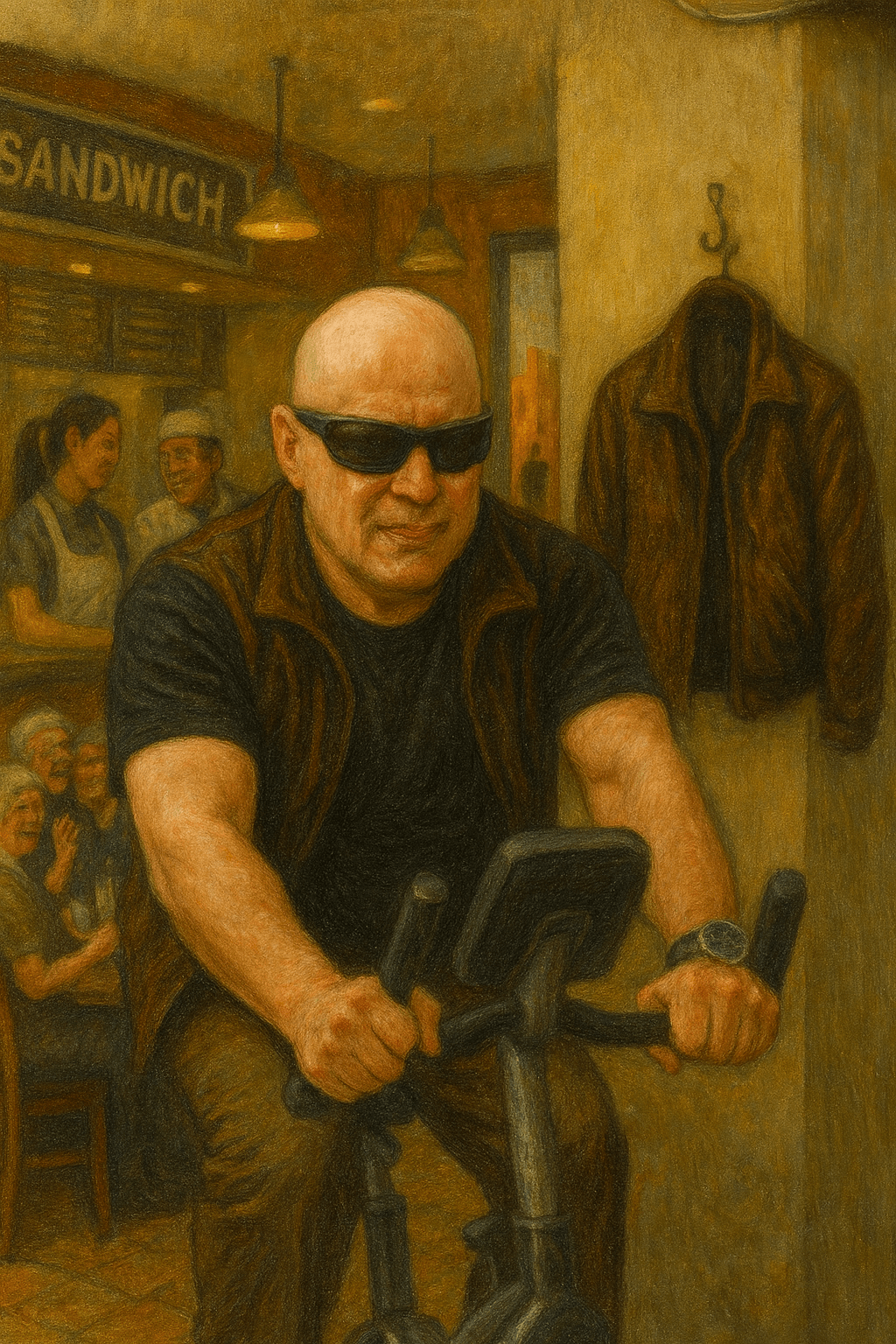
    The Double-Minded Man on His Exercise Bike

    Thoughtful theists often find themselves backpedaling from the most odious doctrines of their faith until what remains is no longer recognizably orthodox. Some manage this theological detour while keeping their faith intact. Others slide further down the slope until their religion becomes something more universal, even Unitarian—a faith stripped of dogma and distilled to moral simplicity: love thy neighbor, serve the poor, practice charity, and call it good.

    Within Christianity, the spectrum is wide. On one end stand the infernalists of the Augustinian school, firm in their vision of eternal punishment. On the other are the universalists who, following Origen, imagine purgatory as a place of cleansing rather than damnation, with the possibility of post-mortem salvation. Some, like Martin Gardner and H. G. Wells, found orthodoxy itself to be a spiritual illness in William James’s sense—a sickness of the soul that required liberation. Others, like Dale Allison, hold to faith but jettison the Augustinian vision of perdition. And then there is philosopher Elizabeth Anderson, who takes orthodoxy at its word and concludes that if God authored it, He cannot be moral.

    As one nears death, it would be comforting to have these matters settled—to face eternity with the theological equivalent of a neatly tied bow. But such closure eludes those of us who remain agnostic, chastising ourselves as James’s “double-minded man, unstable in all his ways.”

    I do, however, possess a few fragments of certainty. I reject Rousseau’s sentimental fantasy that human nature is innately good and can serve as our moral compass. I’ve seen enough of humanity to know we are corrupt, self-deceiving creatures who must wrestle with our yetzer hara—our bad inclination, as Jewish tradition calls it. Yet I’m not entirely convinced, as Paul was, that we are hopelessly depraved. Perhaps Paul and I are lost causes, but that doesn’t make the condition universal. The Jewish notion of meeting God halfway—using the strength He gave us—differs sharply from Paul’s portrayal of helpless man collapsing before the mercy seat. One path is desperate; the other is disciplined.

    Whether I write these reflections out of genuine spiritual torment or simple procrastination before an hour on the exercise bike is unclear. Either way, I’ll mount the Schwinn Airdyne, pedal furiously, and try not to think too much about eternal damnation.

  • Pumpkin Pants and the Stolen Nectar

    Pumpkin Pants and the Stolen Nectar

    Last night I dreamed my dresser had a secret tier for magical pants—trousers that could rewind age, inject vitality, and reboot my identity on command. I slipped into a pair of pumpkin-orange linen specials and, poof, a mastiff materialized: a melancholy titan who brightened under my hand and wilted the moment I stopped petting him, like a living barometer for attention.

    I conjured my brother to act as the dog’s surrogate owner—someone to manage the mastiff’s emotional weather—then set off on a quest for the nectar of the gods. My route was wonderfully bureaucratic: I walked into a museum, stepped into a glass case of Roman centurions, and revived one. Together we climbed Mount Olympus and stole the gods’ food—a heist movie scored by thunder. The soldier, alabaster white and eternally pleased with himself, proved cocky, selfish, and deeply agenda-driven.

    We returned from Olympus, bounty in tow, and stopped by a beach picnic where my friends were sprawled across blankets. That’s when the centurion confessed he’d hidden the nectar, claiming it was reserved for “the people God had planned,” which apparently did not include my friends. We argued—he with smug fatalism, me with wounded entitlement. If anyone had earned a sip of immortality, surely the guy in magic pants who resurrected marble and burgled Olympus had.

    My plan was simple: share the nectar, dazzle my friends, and be canonized as the man with enchanted trousers, a mystical mastiff, and a knack for raising statues from the dead before shopping the divine pantry. It was less generosity than PR. But my uncooperative companion killed the campaign. By hoarding the nectar, he blocked my ascent in the friend-group hierarchy and forced an unflattering verdict: no elevation for me—just a man in orange linen, standing next to a sulking dog and an even sulkier demigod.

  • My Lifelong Marriage to Convenience

    My Lifelong Marriage to Convenience

    There is much to admire about centering our lives on convenience. We save time and resources, avoid wasted effort, and maximize efficiency in the name of what is too often called “optimization.” A life built around convenience often becomes a quest for “life hacks.” But if our behavior is less inventive, we don’t call it a hack at all—just a preference.

    For example, I refuse to go to the gym. It’s inconvenient, time-consuming, costly, and exposes me to airborne illnesses. I prefer to work out in the garage. That’s not a life hack—it’s just easier. The same goes for meals: having a bowl of oatmeal with protein powder and soy milk instead of lunch or dinner isn’t clever or innovative. It’s simply what I do when my family is out and I’m eating alone. Spending more than five minutes on a meal under those circumstances feels unnecessary. Calling a bowl of steel-cut oats or buckwheat groats a “life hack” would be grandiose.

    During the pandemic, three-fourths of my classes moved online through Canvas, a Learning Management System (LMS). Hard copies disappeared. Graded documents were uploaded to the platform, which was remarkably efficient. I didn’t have to drive to campus. The college saved on electricity. That was five years ago, and my classes remain online. I now drive less than 3,000 miles a year. Online classes have made me very efficient. Once you taste efficiency, it’s nearly impossible to go back to inefficiency.

    I admit I’m a less than admirable parent. I don’t like driving my teen daughters to their social functions—birthday parties, football games, dance practices, amusement parks. I find it all inconvenient. That’s my choice. If I were truly devoted to convenience, I wouldn’t have become a parent at all. And certainly not a cat owner. Kitty litter, flea control, vet visits, and travel arrangements are an affront to any serious commitment to convenience.

    As desirable as convenience is, some personalities—mine included—turn it into a pathology. We center our lives around it, and any violation of our convenience policies breeds resentment. Many of these resentments are unreasonable. I resent old age and death, primarily because they are inconvenient. Doctor appointments and funerals interfere with my routine.

    Convenience culture also makes us adore routine. I suspect routine is the groom to the bride of convenience.

    Even my worldview is infected by this impulse. I am an agnostic, which I despise, because it is inconvenient. Agnosticism demands reading and constant reflection. I’ve consumed books by agnostics, atheists, universalists, infernalists, and the post-mortem-salvation curious. While Elizabeth Anderson’s critique of scripture has many compelling points, her notion of morality as nothing more than evolution feels inadequate. Paul’s vision of humanity as fallen and divided is more persuasive and mirrors my own psychology. I wish I could settle happily into Anderson’s worldview. It would be so convenient.

    Speaking of religion, Jesus preached a gospel of inconvenience. His willingness to sacrifice his life in such a manner stands as the very opposite of convenience. For devotees of the gospel of ease, following Jesus is nearly unthinkable—a path that demands nothing less than a Damascus-level upheaval like Paul’s.

    When I think of convenience, I’m reminded of Chris Grossman, a wine salesman I worked with in the 1980s. He was brilliant and affable but had no close relationships. He admitted he didn’t care much for life. He had tried having a girlfriend once and said it was awful—not because of her, but because it was too inconvenient. By his late thirties, he was a bachelor. He ate the same foods every day for simplicity’s sake and once a year drove his Triumph to a car show in Carmel. I loved him for it, because I knew we were both soulmates in convenience culture.

    Some of us are more diseased by this devotion to convenience than others, and it often lowers our standards. I am appalled by factory farming and would like to be vegan. Perhaps if I lived alone, I could do it. But in a family of omnivores, that move would not go over well. I could prepare plant-based meals for myself, but I don’t—partly because of the inconvenience. Vegans I’ve spoken to say the hardest part isn’t the food but the social ostracism.

    I’m already the black sheep in my family—the anti-social shut-in whose quirks are laughed at on good days and resented on bad ones. If I imposed a vegan diet, I fear it would alienate me further, and I’d have to grovel my way back into some semblance of connection.

    As a lifelong neurotic who already alienates people more than I’d like, I know that repairing frayed relationships is an excruciating, arduous task. And it’s so inconvenient.

  • False Neutrality: Reading Armand Nicholi’s Debate

    False Neutrality: Reading Armand Nicholi’s Debate

    I’m about a third of the way through the Audible of Armand Nicholi’s The Question of God: C. S. Lewis and Sigmund Freud Debate, in which Nicholi argues that the single largest life decision — whether to accept or reject belief in God — carries the heaviest consequences. He paints Lewis as modest, serene, and living in a state of grace (the fruits of the spirit, if you like), while he casts Freud as intoxicated with his own genius, dismissing God as a childish projection.

    I have several objections. First, Nicholi leans on a rhetorical pose I find disingenuous: “I’m not trying to persuade anyone — just look at the facts.” He presents himself as a neutral referee while quietly aligning with Lewis. The result is a parade of straw-man treatments that caricature Freud and flatten the debate into tidy contrasts the evidence doesn’t support.

    Second, Nicholi’s central frame is an either/or fallacy: you either believe in God or you don’t. That binary elides the vast internal variety within religious traditions. One person’s God can be another person’s devil — and not across religions but within the same text. Christianity alone supplies wildly different conceptions: the Calvinist God versus a Universalist God; a God who offers post-mortem purgatorial salvation versus one who does not. Even accounts of the Crucifixion diverge: some Christians see it as substitutionary atonement, others categorically reject that reading. As Jerry Walls notes, the God who plans substitutionary atonement is not the God who doesn’t.

    Nicholi also ignores how different beliefs about God imply different beliefs about human nature. Are we, as Paul suggests in Romans, depraved and helpless? Or, as Hyam Maccoby argues from a Jewish perspective, did God create us with the capacity to meet Him halfway? The kind of God you endorse carries with it a theory of human wiring — and Nicholi refuses to engage that complexity.

    Those omissions aren’t accidental; they’re convenient. Reducing belief to a binary choice lets Nicholi render one side salutary and the other contemptible without wrestling with the theological and anthropological thickets that make the question genuinely hard.

    The tone of the book compounds the problem. A Harvard psychiatrist writing in a creamy, intellectual register, posing as an impartial guide through this existential choice, slides easily into what feels like a polished little tract. The surface civility—measured analysis, calm diction—camouflages rhetorical sleights of hand that, to my mind, undermine the work’s seriousness.

    I want to be fair. I’m trying. But once you notice the frauds and fallacies — the imposture of neutrality, the forced binary, the flattened portrayals — they don’t unsee themselves. So I’m forcing my way through the remaining two-thirds of the book, partly out of duty and partly to see whether Nicholi can salvage his argument when he has to meet the harder questions he’s been avoiding.

  • Religion Is No Kevlar Vest Against the Fear of Death

    Religion Is No Kevlar Vest Against the Fear of Death

    My mother’s people were Ashkenazi Jews from Poland; my father’s, Roman Catholics from Scotland and Ireland. Yet both treated religion like a dusty attic trunk filled with moth-eaten lace. When a TV preacher with the face of a sour prune croaked on about sin, my parents would smirk, as if watching a vaudeville relic wheeze out his final act.

    I wasn’t so quick to sneer. At Castro Valley High, a white-haired Mrs. Hanson, seventy if a day, handed us the Book of Job, and I was caught like a fish. God, suffering, celestial wagers—it was grotesque, terrifying, delicious. I’d drive my Ford Maverick to the gym, sunrays slicing through storm clouds, and briefly imagine a divine presence scanning my biceps. I didn’t know biblical doctrine from dog food, but I felt sure there was an afterlife waiting—an enchanting lounge where the velvet ropes always parted. For a short stretch of adolescence, I even stopped fearing death.

    Then came my Christian classmates, thrusting paperback apocalypse manuals into my hands. Rapture. Beasts. Eternal torment. Overnight my buoyant heaven curdled into a horror show where my Jewish relatives burned forever. Some Christians reassured me that such cruelty wasn’t “real Christianity.” But the deeper I read, the more Paul’s letters stood like theological battering rams against Jews who wouldn’t bend the knee. Supersessionism, they called it—a polite term for spiritual eviction.

    The Church Fathers weren’t gentler. Augustine’s take on eternal damnation? Justice, pure and simple. Billions in flames, and he shrugs: they had their chance. Forgive me if I don’t find that a winning sales pitch.

    Which is why I keep returning to Dale Allison’s Night Comes. Barely 200 pages, but packed with the force of a midnight storm. A Christian, Allison treats hell not as a theological curiosity but as a moral obscenity that collapses under its own weight. He doesn’t stitch loopholes into doctrine—he pokes holes until the absurdity gushes out.

    His stories haunt me. His teenage daughter found annihilation worse than hell; she feared nothingness more than flames. His son, in an email of raw honesty, mourned the idea that “the museum of his mind will be closed.” Not death, but the erasure of memory—the bulldozing of everything tender and beloved—that was the real terror.

    As a teen I believed our cherished moments had permanent residence in some cosmic vault. Allison doesn’t smash that hope, but he makes it more fragile, more complicated. He notes—accurately, grimly—that saints and mystics, when Death shows up in the doorway, often beg and claw like the rest of us. Religious devotion, it seems, is no Kevlar vest.

    And so, in old age, I sit with a religious ambivalence as stubborn as arthritis: no doctrine, no creed, no “blessed assurance” makes the thought of extinction less ghastly. Maybe the fear of death is not a flaw to be cured but a mirror—one that forces us to stop pretending we’re eternal and finally face the finite with our eyes wide open.

  • Old Age and Father Time’s Frenemies

    Old Age and Father Time’s Frenemies

    I often think back to the summer of 2019 when my wife and twin daughters were vacationing in Maui. There, on the beach, I spotted a short, compact man in his mid-seventies parading around in dark-blue Speedos with a woman at least fifty years his junior — a striking Mediterranean beauty in her twenties. The guy was trim, well-manscaped, scampering confidently on the sand like a millionaire who spends half his life in boardrooms and the other half trying to outrun the Grim Reaper. He dove into the waves with the vigor of someone convinced that as long as he keeps moving, Father Time can’t catch him.

    You could smell the wealth on him. He was probably a CEO with a portfolio big enough to buy the illusion of eternal youth. He worked hard and played harder, to borrow Hugh Hefner’s mantra. Now, I’m not here to pass moral judgment on a man who chooses a partner young enough to be his granddaughter — that’s his business. What fascinates me is the fantasy: money, discipline, and a little manscaping used as talismans against aging, as if youth were a rare potion you could sip to stay forever young.

    The whole tableau, though, felt wrong. He and his youthful companion were mismatched puzzle pieces jammed together by brute will. It was as if two jagged halves of a broken mirror had been glued into place; every forced smile and awkward embrace chipped another sliver off, until all that remained was a pile of glittering shards — the perfect image for the futility of trying to cheat time.

    This rich, fit man is Father Time’s frenemy — the one who insists they’re on friendly terms while secretly plotting a hostile takeover. He may have sold himself a “perfect picture,” but the public sees the mismatch as plainly as a traffic cone in a tuxedo. The spectacle exposes his poverty: an inability to relinquish something that no longer belongs to him, a clinging to youth that reveals fear rather than confidence. That fear, in turn, sabotages his aspiration to curate an enviable life; the attempt to perform eternal youth only underlines the loss he refuses to admit.

    I’m reminded, uncomfortably, of Joe Ferraro from Netflix’s Mafia: Most Wanted. Born in Ecuador in 1962 and raised in Toronto, Ferraro turned to bodybuilding, gambling, and organized crime as a teenager, hungry for money, women, clothes, and respect. He got it all — a Rolex Daytona, gold necklaces, designer sunglasses large enough to require their own zip code — until seven months in prison and eventual deportation stripped him of his infrastructure. In his sixties, he’s a sculpted caricature: tank top, ostentatious sport coat draped like a cape, and penetrating melancholy eyes that reveal he knows the score. He says he wants his life back, but knows he’s too old for the young man’s game and can’t look away from it.

    Both the rich man in Maui and Ferraro in exile put me in mind of Lot’s wife. They cannot relinquish the lifestyle that defines them; youth is their identity, and the thought of being disconnected from it registers as a kind of death. Unable to let go, they calcify into pillars of salt — frozen monuments to a self that no longer exists.

  • The Gospel of the Liver King

    The Gospel of the Liver King

    Brian Johnson, better known as the Liver King, is a steroidal cartoon who tried to sell himself as a prophet of “ancestral living.” In reality, he was just another hustler juicing his body with over a hundred grand a year in growth hormones and anabolic steroids. He strutted around Instagram in animal skins, bellowing like a berserk Viking, gnawing raw liver on camera, and flogging overpriced supplements. His entire empire collapsed the moment it was revealed that his shredded physique was less the fruit of caveman purity and more the handiwork of pharmacy-grade science.

    Instead of bowing out in disgrace, he doubled down. Unable to detach from the narcotic glow of internet celebrity, he documented his own unraveling in real time—YouTube became his padded cell, each video another entry in the world’s strangest public diary. He wanted to be remembered as a leader, a liberator from modern malaise, but he became a parody of himself, a sideshow Rambo gone rancid.

    Raw meat became his metaphor—masculinity, toughness, a primal rejection of processed life. But it was also cosplay, a carnival act built for the algorithm, because nothing feeds clicks like a maniac tearing into a bull testicle with his teeth. And young men, starving for meaning, saw not a fraud but a messiah: the steroidal savior who would flex them into the promised land.

    This was kayfabe 2.0. Vince McMahon taught wrestlers never to break character, and Liver King took that gospel straight to Instagram. Only he forgot the cardinal rule: kayfabe consumes you. Live in the gimmick long enough and the gimmick swallows the man. By the end, Liver King wasn’t selling a mask—he was the mask, devoured whole by his own performance.

    His collapse is bigger than one delusional influencer. It’s a commentary on the culture itself: a society so anesthetized by spectacle that it mistakes bombast for wisdom. Idiocracy predicted a wrestler-president peddling electrolytes; we got a shirtless Texan chewing raw liver and pushing HGH cocktails disguised as authenticity. Mike Judge wasn’t satirizing the future—he was reporting it early.

    And yet, there is something deeply American in the Liver King’s fall: the grift, the spectacle, the refusal to relinquish the stage even when the show is over. His tragedy is that of a man who wanted love, found instead an algorithm’s approval, and now cannot escape the cage of his own creation.

  • The Warm Bath and the Higher Forces

    The Warm Bath and the Higher Forces

    Therapist Phil Stutz, in Lessons for Living: What Only Adversity Can Teach You, identifies the most insidious adversity we face daily: the lure of immediate gratification. This dopamine-charged, compulsive, addictive pull consigns us, he says, to “the lower channel,” the “Warm Bath,” the comfort zone. Its source is the inner saboteur he calls Part X.

    In Steven Pressfield’s The War of Art, the same force appears as “The Resistance,” the invisible enemy that diverts us from lives of creativity and meaning. Sometimes it takes the form of “unwholesome activities”—scouring the internet for smut or indulging in materialistic temptations that pull us away from hard work. Cal Newport warns that when we return from such addictive detours, our brains are still coated in “lower channel” residue—mental detritus that dulls our clarity and compromises our work.

    Confronting Part X—or the Resistance—is not a one-time victory. We never ascend to a nirvana where the demon vanishes; it is always nearby, waiting for an opening.

    Rejecting the endless circuit of traditional talk therapy, Stutz arms his patients with Tools—practical methods to counter the bad habits born of Part X. His patients are often “either trapped in a past that no longer existed or living in fantasy about a future that hadn’t arrived yet—and might never.” The Tools, he says, “open the door to the infinite wisdom of the present.”

    His therapy hinges on three elements:

    1. Homework—daily exercises outside of sessions.
    2. Forward Motion—steps away from the past and repetitive stagnation toward a new life.
    3. Connection to Higher Forces—a necessary change, not an optional one, to avoid the self-destruction that leads to death.

    “We are only a tiny part of an infinite universe,” he writes. “On our own we can do nothing. But, in a silent miracle, the universe puts its energies at the service of human evolution.” Higher Forces help us escape personal hell and learned helplessness. When his patients connect with them, they find hope and the power to change—here, in the present.

    Before going further, I have to pause and unpack this. First, I believe Stutz’s framework offers a real way out of the wide path to self-destruction and onto the narrow path of meaning. Second, I can’t help but think of Christianity, Judaism, and A.A.

    In Christianity, especially Pauline theology, we are compulsive creatures, helpless before our sinful drives. Only surrendering to Higher Powers—in this case, the cosmic Christ—can break our demonic impulses. Paul spells this out in the Epistle to the Romans.

    Judaism, at least as Rabbi Hyam Maccoby describes it in The Mythmaker: Paul and the Invention of Christianity, rejects this helplessness. We do have self-agency. When we cry to God for rescue from our self-destruction and abasement, He meets us halfway—we move toward Him, and He moves toward us.

    In A.A., the principle is stripped to its core. Comedian Marc Maron has spoken about his recovery from substance abuse: every day, he got on his knees and told a Higher Power he could not free himself from addiction alone.

    Across these three traditions, I see more similarities than differences. I’m confident that anyone who sincerely applies these principles will improve.

    But here’s the sticking point: belief in a Higher Power without religious baggage is not the same as belief in a specific deity. The Jewish God—open to debate, vague about the afterlife—is quite different from the Christian God who, under Pauline influence, recasts Judaism into a universal religion for gentiles, condemns Jews as cut off from the vine, and adopts Augustine’s stark vision of eternal paradise or eternal damnation.

    Three notions of deity—each with profound implications.

    As an addict and an agnostic, I wonder: am I letting these theological questions distract me from the urgent need to connect with Higher Powers so I can face my own demons? This question burns in me. Will these Higher Powers help me navigate my dense jungle of doubts? Will they help me find clarity?

    Stutz notes that many of his patients backslide. Why? Because they stop using the Tools. Why stop? Complacency. Or disbelief in the stakes.

    Which brings me to the core of my own struggle: faith in a doctrinal God versus a personal God without doctrine. The doctrinal God comes with teachings—eternal perdition, the Virgin Birth, a literal resurrection—that can be difficult to swallow. For a fuller exploration of the problems with doctrine, see Elizabeth Anderson’s essay “If God Is Dead, Is Everything Permitted?”

    The personal God without doctrine might be more palatable, but perhaps lacks the high-stakes edge that some people need to stay committed to their daily battle with Part X, the Resistance, or whatever name we give this destructive force.

    So what’s the path forward? Should I call life a nihilistic joke and live recklessly? Certainly not. Even with my doubts, I must press ahead, use the Tools, and seek communion with Higher Powers. I can only hope such a life will yield answers—and remind myself that giving in to immediate gratification only strengthens the lower channel, leading, inevitably, toward darkness, confusion, and death.

  • Kierkegaard in a Gold’s Gym Tank Top

    Kierkegaard in a Gold’s Gym Tank Top

    During my junior year of high school, I spent a weeknight cruising East Fourteenth—the gritty artery that runs through San Leandro and Hayward—until one in the morning. I was in the passenger seat of Martino’s tomato red Ranchero, the two of us flexing imaginary muscles and real teenage bravado. Martino was my bodybuilding partner, my brother-in-biceps, and together we patrolled the boulevard like suburban centurions on a mission to kill time. And we succeeded.

    When I finally crept back into my house under the cover of darkness, I wasn’t met by a parent’s scolding. No raised voices. No lectures. Just a deafening moral hangover. A private throb of guilt that came from inside—the inner thermostat dialed to “waste detected.”

    That night, the dissonance hit me hard: I had thrown away hours of my finite life, not with rebellion or passion, but with asphalt apathy. 

    Some people never feel that throb. For them, life is a sandbox without rules. Morality is performative, calculated just enough to avoid arrest or awkward silences. These are the functional nihilists—those for whom nothing is sacred, so nothing is squandered. There are no stakes, no salvation, no damnation. No trembling because there’s nothing to tremble about.

    But Kierkegaard wouldn’t have cruised East Fourteenth. He’d have stayed home, in existential dread, kneeling before the void, trying to work out his salvation with fear and trembling. Not a metaphor. A mandate. A gun-to-the-temple kind of urgency.

    And that gun? I’ve felt it every morning. Not the literal kind, but a cold steel thought pressing behind the eyes: Work or be worthless. Create or decay. Hustle or rot. I didn’t coast through college because I loved knowledge. I ground through it because I feared poverty, failure, and the humiliation of becoming a soft tomato with four toothpicks sticking out—Kierkegaard in a Gold’s Gym tank top.

    Fear built my body. But can fear build a soul?

    That’s the hard part, isn’t it? Muscles are visible. Measurable. The soul, by contrast, is a ghost that flinches from mirrors. What makes a good soul? Is it, as philosopher Elizabeth Anderson suggests, acts of reciprocal kindness—a kind of moral evolution, godless but decent? Or do we still need to shake in our boots, to feel that Kierkegaardian quake that says tend to the soul or become monstrous?

    Then there’s modern self-care, the secular sacrament of our time. Meditation, hydration, positive affirmations—pampering routines dressed up as spiritual growth. But is self-care just aromatherapy for the abyss? What if the soul needs something harder than scented candles?

    And what of the artist, the compulsive maker? Is the act of creating a form of salvation—or just another idol, a beautiful golden calf carved in your own image?

    Forgive me. I’m in my sixties now. The questions don’t resolve; they just echo louder. I know indulgence makes me miserable and discipline brings fleeting peace. But that’s not the kind of salvation Kierkegaard meant. That’s just emotional maintenance.

    So I remain agnostic, trembling not from conviction, but from having more questions than answers.