Tag: literature

  • Manuscriptus Rex: My Life as a Delusional Writing Addict

    Manuscriptus Rex: My Life as a Delusional Writing Addict

    I am a writing addict, at least in part, because I was indoctrinated by the twin cults of positive thinking and unrelenting perseverance. Never quit. Fight like hell. Success is inevitable if you just want it badly enough. And if it doesn’t come? Well, then you’re just not a real American.

    By the time I hit kindergarten, I was a true believer in the gospel of hard work. My worldview was a Frankenstein’s monster stitched together from children’s books, Charles Atlas bodybuilding ads wedged between comic book panels, and the propaganda of Captain Kangaroo. The formula was clear: effort equals triumph. I swallowed this doctrine whole, with the blind conviction of a kid who thought that eating all his vegetables would one day grant him the ability to fly.

    My optimism knew no bounds. It was untethered, soaring on the helium of pop-culture platitudes. The Little Engine That Could had me whispering “I think I can” like a monk chanting a holy incantation, convinced that sheer willpower and enough push-ups could bulldoze any obstacle. It didn’t occur to me that sometimes you think you can, but you absolutely cannot—and that no amount of stubborn persistence will turn a delusion into destiny.

    And then came the night of October 16, 1967—a date I would later remember as the day the universe gave me a cosmic swirly. Twelve days before my sixth birthday, I sat cross-legged in front of the TV, ready to revel in another episode of my favorite show, The Monkees. But what played out before me was a betrayal so deep it made Santa Claus feel like a Ponzi scheme.

    The episode, “I Was a 99-lb. Weakling,” featured my hero, Micky Dolenz, getting steamrolled by Bulk, a slab of human granite played by Mr. Universe himself, Dave Draper. Bulk wasn’t just big—he was the walking embodiment of every Charles Atlas ad come to life, the muscle-bound colossus I had been taught to revere. And right on cue, Brenda, the bikini-clad goddess of the beach, ditched Micky for Bulk without so much as a backward glance.

    This was a crisis of faith. How could the Monkees’ resident goofball, my spiritual avatar, lose to a guy who looked like he bench-pressed telephone poles for fun? Desperate to reclaim his dignity, Micky enrolled in Weaklings Anonymous, where he endured a training montage so ludicrous it made Rocky Balboa’s look like a casual Pilates class. He lifted weights the size of Buicks. He chugged fermented goat milk curd—a punishment so grotesque it could only be described as liquefied despair. He even sold his drum set. His very essence, his identity, was on the chopping block, all in pursuit of the almighty muscle.

    But the final twist? Brenda changed her mind. Just as Micky was emerging from his trial by whey protein, she dropped Bulk like a bad habit and swooned over a pencil-necked intellectual—a guy who looked like he could barely lift a library book, but there he was, nose buried in Marcel Proust’s Remembrance of Things Past. Brenda, the same woman who had once melted for a walking slab of muscle, now found transcendence in a man contemplating lost time in a cork-lined room.

    It was then that the tectonic plates of my worldview shifted. Muscles weren’t the real source of power—books were. The secret wasn’t in deadlifts or protein shakes but in the right combination of words, strung together with enough elegance, insight, and authority to bend the universe to your will. The revelation landed with the force of a divine decree: if you wanted to shape the world, you didn’t need biceps—you needed prose.

    That night, my inner writing demon was born. It didn’t arrive with fanfare but stealthily, like an assassin—hijacking my ambitions, whispering to me that if I truly wanted to matter, I needed to trade in my devotion to squat racks for an obsession with syntax. The real alphas weren’t the ones flexing on the beach; they were the ones commanding attention through the written word, weaving sentences so powerful they made bikini-clad goddesses switch allegiances overnight.

    ***

    Picture a five-year-old boy glued to The Monkees, absorbing every absurd twist and turn, when suddenly—a revelation. Not from a heroic feat, a rock anthem, or a daring stunt, but from a pencil-necked geek buried in Remembrance of Things Past. The sheer audacity of it! This bookish weakling wasn’t just reading—he was brandishing literature like a weapon, as if cracking open Proust conferred an instant intellectual throne.

    That moment rewired my brain and began my transformation into Manuscriptus Rex. I wanted that kind of power. I wanted to be indelible, undeniable, and necessary—a man whose words carried weight, whose sentences etched themselves into the fabric of cultural consciousness. And when, at twenty-three, I read A Confederacy of Dunces, my mission crystallized. It wasn’t enough to be intelligent or insightful. No, I had to be a satirical novelist, an ambassador of caustic wit, a statesman of irony, and just self-deprecating enough that people wouldn’t hate me for it. I saw myself as a literary assassin, razor-sharp, unignorable, the kind of writer who forces the world to take notice.

    What the writing demon conveniently failed to mention—what it actively conspired to keep from me—is the vast and merciless chasm between the actual process of writing and the seductive fantasy of literary fame. To ignore this gulf is to court a special kind of stupidity, the kind that can waste an entire lifetime.

    Writing is a protracted act of self-torture, an endless loop of revision, self-doubt, and existential agony. J.P. Donleavy, author of The Ginger Man, had no idea what fresh hell awaited him as he wrestled his novel into something that met his own impossibly high standards. The process was not romantic; it was a war of attrition. Tedium, solitude, mental torment—these were his constant companions. But he and his book trudged forward, bloodied but breathing, as if the act of creation itself were some cursed form of survival.

    Meanwhile, I was high on a much glossier hallucination. I wasn’t going to be some embattled craftsman drowning in rewrites—I was going to be the genius, the confetti-drenched literary deity, basking in the ovation of an enraptured public. This was the demon’s cruel joke. The more reality smacked me in the face, the deeper I dug into the delusion. It wasn’t just self-deception; it was a pathology, a spiritual affliction.

    F. Scott Fitzgerald mapped this sickness in “Winter Dreams,” the tale of Dexter Green, a man who squanders his entire existence chasing Judy Jones, a capricious cipher onto which he projects all his longings. She isn’t a goddess—she’s an empty shell, a faithless mediocrity. No matter. His fantasy of perfection keeps him shackled to his own vanity, blind to the fact that life is passing him by.

    Dexter Green is a sucker. He doesn’t know how to live—only how to worship an illusion. He believes in moments frozen in time, in pristine, untouchable ideals, instead of the mess and movement of real life. And that, of course, is the problem. As therapist Phil Stutz puts it in Lessons for Living, “Our culture makes the destructive suggestion that we can perfect life and then get it to stand still… but real life is a process.” The ideal world is a snapshot—a slick, frozen fantasy that never existed. But still, these images are intoxicating. There’s no mess in them. And that’s precisely why they’re a trap.

    I cannot overstate the self-imposed destruction, loneliness, and sheer dumb misery that comes from being seduced by these moments frozen in time. To underscore my point, let’s rewind to 1982—a memory buried so deep in my psyche it took writing a book about the dangers of writing a book to dig it up.

    Back then, I was in college, drowning in an evening statistics course taught by a professor who looked like he’d been yanked straight from the pages of Dickens. His wild white hair defied gravity, his darting blue eyes seemed permanently lost in a private existential crisis, and his nose—aggressively red—suggested a longstanding love affair with whiskey. His aura? Pure, unfiltered eau de liquor. But he was kind, in the way that only deeply tragic people can be.

    The class itself was a slow-motion car crash. By week four—when the sadistic monster known as “standard deviation” reared its head—half of us were openly contemplating dropping out. Among my classmates was an elderly African American couple, dressed for church every single day, like they had wandered into the wrong building but decided to stay out of sheer politeness. The husband, Clarence, announced on day one that this was his seventh attempt at passing statistics. His wife, Dorothy, wasn’t even enrolled—she was there as his Bible-toting, knitting, long-suffering support system.

    Clarence’s approach to learning was… improvisational. While the rest of us shrank into our seats, he would leap up mid-lecture, cane clattering to the ground, and hobble to the chalkboard. Pointing an accusatory finger, he’d declare, “That’s not the answer I got! Let me show you!” Then he’d scrawl his “solution”—a series of indecipherable symbols that looked more like an alien distress signal than math.

    The professor, possibly fortified by whatever he had stashed in his desk, took these interruptions with monk-like patience. Dorothy, meanwhile, would bow her head and whisper prayers to “sweet Jesus,” presumably asking Him to either deliver her husband from his statistical afflictions or at least save her from public humiliation. The rest of us stifled laughter behind our hands. I sat there, torn between secondhand embarrassment and the creeping realization that this was pure comedy gold, something straight out of Saturday Night Live.

    After class, I’d drive home, pop in a cassette of The Psychedelic Furs or Echo and the Bunnymen, and drown in existential dread. I’d replay the scene over and over: Clarence’s quixotic battle with numbers, Dorothy’s quiet suffering. And then, like clockwork, I’d start crying. Not because I was flunking statistics or because my social life was a wasteland, but because that couple had shown me something profound: the power of love.

    Not the saccharine kind from movies, but the kind that trudges alongside you through seven failed attempts at statistics. The kind that withstands public embarrassment, dashed hopes, and sheer futility. The kind that endures.

    And here I was, wasting my life chasing a mirage. I was too caught up in my grand illusion of literary immortality. In my fevered fantasy, writing wasn’t grueling labor—it was divine alchemy. I would conjure brilliance with effortless flair, radiate tortured genius with an insouciant smirk. The world would see. The world would know. I would be whole. Complete. Immortal.

    But, of course, none of that happened.

    Decades passed. The literary world remained profoundly unaffected by my absence. The holy grail I had obsessed over wasn’t stolen—it simply… never materialized. And so, left standing in the wreckage of my own delusion, I did the only logical thing: I started writing a book about how foolish it is to write a book.

    And in that act of failure, I dug deep. In this memoir, which I am forbidden to write according to the terms of my sobriety, I excavated my past, peeling back layers of delusion, tracing the origins of this writing demon, this unquenchable hunger to be heard, to be distinct, to matter.

    Now, with some clarity (if not closure), a bigger question looms: What threatens me now?

    My war isn’t just with obscurity. It’s with a world surrendering to algorithms, generative AI, and the hollow dopamine drip of social media engagement. As a college writing professor who lives in the shadow of Manuscriptus Rex, I see my own relevance dangling by a thread, held hostage by an era where a bot can churn out a passable essay in seconds, where language itself is becoming disposable.

    So here we are. If I’m to survive, if my voice is to matter in this algorithmic wasteland, I must confront the existential question:

    How do you assert your presence in a world that is actively erasing the need for presence at all?

  • 3 College Essay Prompts for a Comparison of Frederick Douglass and Malcolm X

    3 College Essay Prompts for a Comparison of Frederick Douglass and Malcolm X

    Here are three essay prompts tailored for a 1,700-word comparative analysis of Frederick Douglass and Malcolm X as literary heroes whose transformation through language empowered them to resist “The Sunken Place” and lead others toward justice:

    1.
    Prompt Title: Rewriting the Self: Douglass and Malcolm X as Architects of Liberation
    Prompt:
    Both Frederick Douglass and Malcolm X underwent radical personal transformations through their acquisition and use of language. In a well-developed essay, compare how Douglass in Narrative of the Life of Frederick Douglass and Malcolm X in The Autobiography of Malcolm X use reading, writing, and oratory as tools to escape what might be called “The Sunken Place”—a psychological and social condition of internalized oppression and learned helplessness. How does language serve as a weapon of self-reinvention and, ultimately, as a vehicle for leading others toward liberation?

    2.
    Prompt Title: From Silence to Speech: The Heroic Voice in Douglass and Malcolm X
    Prompt:
    In both Douglass’s and Malcolm X’s narratives, the journey from silence to speech marks the beginning of their heroism. Analyze how each man’s relationship to language—books, writing, and especially public speech—transforms them from passive subjects of oppression into active agents of change. How do their stories function as “literary transformations,” and how do they use their voices not just to escape the Sunken Place but to pull others out as well?

    3.
    Prompt Title: The Language of Resistance: Literary Heroism in Douglass and Malcolm X
    Prompt:
    Consider Douglass and Malcolm X as literary heroes whose weapon is not brute force but rhetorical and intellectual power. Both men begin in different forms of social invisibility and voicelessness, and both rise through literacy and speech to become revolutionary figures. In a comparative essay, explore how their mastery of language allowed them to diagnose the despair of systemic racism and to create a compelling counter-narrative of dignity, resistance, and hope.

  • The Urge to Write Is the Urge to Dominate

    The Urge to Write Is the Urge to Dominate

    Looking back, I’m torn between admiring my audacity and filing a restraining order against my judgment. How, exactly, did I manage to pin so much hope on novels that, despite their half-decent opening chapters, quickly spiraled into the literary equivalent of a stalled elevator—going nowhere and deeply uncomfortable for everyone involved?

    In contrast, my short essays were clearly sharper, more potent—but I refused to let reality intrude on my mission. No, I was going to write the comic novel.

    This compulsion was never about art. It was about pain—the kind so deep that Jonathan Franzen famously coined Ache to describe the existential condition of adulthood: the rude awakening that we are not, in fact, the center of the universe and that our desires will always outrun our ability to satisfy them.

    Manuscriptus Rex feels this Ache acutely and has embarked on a fool’s errand to silence it with literary fame. But why this brand of glory? Why not build a real estate empire, become a movie heartthrob, or invent the perfect bed that guarantees twelve uninterrupted hours of blissful, coma-grade sleep? Because Manuscriptus Rex is too much of a narcissist for mere wealth, beauty, or utility. Writing a book—one that matters—offers something more intoxicating: the power to hijack people’s brains.

    And that’s what you really crave—not just admiration, but full cognitive occupation. You want your words burrowed into the minds of millions, your dream world dictating their thoughts. Your need for validation is so bottomless that only mass literary infiltration will mollify you. That this ambition is wildly improbable, driven by pathology, and guaranteed to bring more suffering than satisfaction? Irrelevant. The mission is all that matters. And the mission is literary dominance.

    My wife once observed that men, with their colossal egos, often wake up with sudden revelations, epiphanies so grand they feel compelled to start religions. She’s not wrong. The novelist, the polemicist—what are they really doing but trying to ignite a movement, disrupt the world, and bask in the glow of their own importance? Their gospel isn’t about some grand truth—it’s about them, standing center stage, ablaze with self-appointed brilliance.

    Religion is the ultimate expression of literary dominance. I think of the Apostle Paul himself, scribbling his epistles in a manic frenzy, waging rhetorical war in the bustling marketplace of spiritual ideas, demolishing rival orators, and confessing his own unhinged nature in Romans—his theological magnum opus, a mini-Bible inside the Bible. Only eighty pages in total. That was the sum of his obsessive writing, and yet his literary dominance is established. He’s been the talk of the town for over two thousand years. Whether they like him or not, people still want to hear what he has to say about the human condition. 

    This was the novelist’s role five decades ago, back when novelists were secular prophets, summoned to The Dick Cavett Show to pontificate on the issues of the day—because, once upon a time, their opinions mattered.

    And that’s what I loved about Cavett. Even as a ten-year-old, I grasped the show’s implicit assumption: the intellectual life was its own parallel universe, just as electrifying as Paul’s eschatological one—except with better punchlines.

    Perhaps Cavett planted the seeds of my literary delusion, setting the stage for a demon that would fully blossom into madness a decade later when I read A Confederacy of Dunces—then Portnoy’s Complaint and The Ginger Man. If I could write something as riotously funny as those masterpieces, I wouldn’t just be funny—I’d be brilliant, important, part of the conversation. My name would be etched into the pantheon of literary wit, my shattered self-esteem miraculously restored. I would find completion.

    And lest you think this was mere posturing, let me be clear: my aspirations weren’t some carefully curated cool pose. I was, without question, funny—not in the “guy who recycles late-night monologue jokes” way, but in the gimlet-eyed, take-no-prisoners way that slices through the world’s absurdities like a scalpel. I was an ally of Kafka, wielding my literary axe to shatter the frozen ocean of human folly. My quest was real, my voice authentic, my success inevitable.

    Except, of course, it wasn’t.

    I failed. Repeatedly. The novels kept coming, and to my credit, they got better—sharper, wittier, good enough to attract literary agents, which was dangerous because it fed the delusion. This wasn’t a phase. It became a lifelong affliction. In my twenties, thirties, forties, fifties—hell, even my sixties—the novels kept churning, like those chocolates on the conveyor belt in I Love Lucy, coming faster than I could process, devour, or even appreciate.

    The demon was still in business.

    And how good were these books as the result of all my literary effort? “Just okay.” Which, in an attention economy, is about as useful as a dial-up modem in the age of fiber optics. “Just okay” might sell 300 copies—a number so pitiful that the editor who championed your book could lose their job over it.

    But sure, let’s keep the dream alive.

    Having failed to write my grand, world-shaking book and having let A Confederacy of Dunces derail my life, I am left standing amid the wreckage of my literary ambitions, clutching at whatever scraps of wisdom I can salvage. Something must be redeemed, after all. And what better way to salvage a wreck than by turning it into yet another book? The Confessions of a Recovering Writing Addict.

    But of course, that’s just the demon running its mouth again. The same devious little imp that once whispered sweet nothings about my inevitable literary greatness now insists that my failure is my brand, my gimmick, my golden ticket to the book that will finally rock the world.

    And what is this seismic masterpiece, this literary game-changer? Oh, just a book about aspiring writers so starved for attention that they write not as artists, but as junkies, chasing the next fix of validation. A cautionary tale wrapped in a confession, packaged as a sales pitch—because irony, it seems, is the one thing I have mastered.

    Writing with an ego hellbent on domination, we writing junkies reveal an uncomfortable truth—we all have a little Paul in us. We insist we write out of sincerity, fueled by a pure, burning need to communicate something true. But let’s not kid ourselves. Deep down, what we really crave isn’t truth—it’s importance. Recognition. Veneration. And, above all, relevance.

    We aren’t just stringing words together; we’re mounting a last-ditch offensive against oblivion, hammering out prose as if sheer verbosity might hold off the reaper a little longer.

    In the end, we place our hope in something as fragile as a glue-and-paper book in the digital age, believing—despite all evidence to the contrary—that it will elevate us, transcend us, and make us immortal.

  • 95% of books are just bloated short stories and essays with unnecessary padding

    95% of books are just bloated short stories and essays with unnecessary padding

    As part of my rehabilitation from writing novels I have no business writing, I remind myself of an uncomfortable truth: 95% of books—both fiction and nonfiction—are just bloated short stories and essays with unnecessary padding. How many times have I read a novel and thought, This would have been a killer short story, but as a novel, it’s a slog? How often have I powered through a nonfiction screed only to realize that everything I needed was in the first chapter, and the rest was just an echo chamber of diminishing returns?

    Perhaps someday, I’ll learn to write an exceptional short story—the kind that punches above its weight, the kind that leaves you feeling like you’ve just read a 400-page novel even though it barely clears 30. It takes a rare kind of genius to pull off this magic trick. I think of Alice Munro’s layered portraits of regret, Lorrie Moore’s razor-sharp wit, and John Cheever’s meticulous dissections of suburban despair. I flip through my extra-large edition of The Stories of John Cheever, and three stand out like glittering relics: “The Swimmer,” “The Country Husband,” and “The Jewels of the Cabots.” Each is a self-contained universe, a potent literary multivitamin that somehow delivers all the nourishment of a novel in a single, concentrated dose. Let’s call these rare works Stories That Ate a Novel—compact, ferocious, and packed with enough emotional and intellectual weight to render lesser novels redundant.

    As part of my rehabilitation, I must seek out such stories, study them, and attempt to write them. Not just as an artistic exercise, but as a safeguard against relapse—the last thing I need is another 300-page corpse of a novel stinking up my hard drive.

    But maybe this is more than just a recovery plan. Maybe this is a new mission—championing Stories That Eat Novels. The cultural winds are shifting in my favor. Attention spans, gnawed to the bone by social media, no longer tolerate literary excess. Even the New York Times has noted the rise of the short novel, reporting in “To the Point: Short Novels Dominate International Booker Prize Nominees” that books under 200 pages are taking center stage. We may be witnessing a tectonic shift, an age where brevity is not just a virtue but a necessity.

    For a failed novelist and an unapologetic literary wind-sprinter, this could be my moment. I can already see it—my sleek, ruthless 160-page collection, Stories That Eat Novels, four lapidary masterpieces gleaming like finely cut diamonds. Rehabilitation has never felt so good. Who says a man in his sixties can’t find his literary niche and stage an artistic rebirth? Maybe I wasn’t a failed novelist after all—maybe I was just a short-form assassin waiting for the right age to arrive.

  • It’s impossible to overestimate Hugh Hefner’s Influence on 70s Culture

    It’s impossible to overestimate Hugh Hefner’s Influence on 70s Culture

    Mario Vargas Llosa opens his memoir about Flaubert’s masterpiece Madame Bovary with a startling confession: fictional characters have shaped his life more than real people. And among these literary phantoms, none has haunted him like Emma Bovary.

    He first encountered her as a broke student in Paris in 1959, reading Madame Bovary in his cramped, dimly lit apartment, where the novel consumed him like a “magic spell.” This wasn’t just a passing literary crush—Flaubert’s novel hardwired his taste in fiction. Llosa craves symmetry, structure, and bold architecture—stories that begin, unfold, and close like a perfectly executed aria, not those meandering, open-ended narratives that wander aimlessly like a lost tourist in a foreign city. He wants novels that sum up an entire existence, not ones that leave you guessing where the rest of the pages went.

    But his obsession with Madame Bovary isn’t just about its structural perfection. Llosa delights in its savage portrayal of stupidity, hypocrisy, cowardice, and self-complacent mediocrity. He sees Emma Bovary as a tragic hero, a woman who refuses to rot inside the coffin of bourgeois chastity, instead reaching for sensuality, opulence, and a life less suffocating. She fails, of course—spectacularly—but Llosa admires the rebellion even as he watches it collapse.

    His connection to Madame Bovary runs deeper than admiration. He sees himself in Emma. He shares her “stubborn despair, a profound distaste for life,” and her reckless excesses as an emotional counterattack against a cruel, indifferent world. Reading about Emma’s slow, agonizing suicide didn’t just illuminate the novel’s merciless social critique—it gave Llosa a new understanding of his own misery. In that sense, the book wasn’t just a masterpiece—it was a form of catharsis, a lifeboat thrown to him in turbulent waters.

    I recognize this kind of literary possession all too well. I had my own Madame Bovary moment—except it came in the form of A Confederacy of Dunces. When I read it, I saw the excesses of a young man crushed by his own emotional impoverishment, who built a fortress of grandiosity to shield himself from reality. Like Llosa with Emma, I saw a grotesque reflection of my own worst instincts. And, like him, I couldn’t look away.

    Recognizing the worst instincts in others—and in myself—was the fuel behind my ill-fated quest to be a comic novelist, a misadventure that, sadly, yielded nothing but abandoned drafts and existential nausea.

    Still, like Llosa, I found a perverse kind of clarity in my compulsion to chronicle human excess—a knack for spotting the gaudy, the grotesque, and the tragically misguided, then trapping it on the page like a butterfly pinned to a display case.

    If nothing else, I could always recognize an Emma Bovary type—vulgar, kitschy, overdosing on fantasies of grandeur—and I knew how to turn their delusions into cautionary tales, even if my own delusions proved immune to the lesson.

    I’m thinking of Playboy media magnate Hugh Hefner who fancied himself a rebel against bourgeois prudishness. Hugh Hefner, the prophet of smarmy male entitlement and silk-robe swagger. Hefner preached a gospel of unrepentant pleasure-seeking and Playboy-approved cosplay, designed to hypnotize women and soothe fragile male egos.

    And in the sweltering summer of 1977, I met one of Hefner’s most devout disciples: Glenn Leidecker.

    Every Saturday that summer, I practically melted into the scorched earth at Cull Canyon Lake, basted in Hawaiian Tropic Dark Tanning Oil—SPF Zero, because back then skin cancer was just a rumor. The sticky perfume of coconut and bananas was the scent of youth and poor decisions.

    Then there was Leidecker.

    Late twenties. Wavy brown hair, feathered to perfection. A thick, manicured mustache that could have been insured for thousands. An even, leathery tan stretched over a frame wearing nothing but blue Speedo briefs, a gold chain, and a white puka shell necklace draped over his hairy chest. His arsenal of seduction included a white Frisbee, a Playboy-logo cooler, and a boombox blasting the smooth seduction of Foreigner, Fleetwood Mac, and K.C. and The Sunshine Band.

    His moves were choreographed to the point of absurdity. Every Saturday, Leidecker ran the same pickup script on an endless rotation of bikini-clad women. I knew every line by heart: the $500 custom paint job on his Camaro, the humblebrag about his dad’s Bay Area clothing stores, the claim that he’d been managing those stores since high school, and the cherry on top—he was this close to landing a role in a Hollywood martial arts movie. Oh, and let’s not forget the constant invocation of “Parsons Estates,” which he dropped like it was some enchanted kingdom instead of a generic middle-class neighborhood.

    Leidecker wasn’t just a cliché. He was a valedictorian of Smarmy Male University, graduating magna cum laude in Playboy Posturing. His thesis? A cover-to-cover study of Eric Weber’s How to Pick Up Girls!, a sleazy manifesto that encouraged men to relentlessly harass women under the delusion that persistence equals success.

    Week after week, Leidecker reeled in a fresh catch, tossing Frisbees on the grassy knoll with women who didn’t yet realize they were extras in his sad little production. He wasn’t a man; he was a walking Playboy advertisement, the answer to that smug caption, “What sort of man reads Playboy?” Apparently, the kind of man who thinks speedos and gold chains are a mating call.

    I watched the mating ritual from my towel, pretending to read my parents’ dog-eared copy of The Happy Hooker while keeping a close eye on Leidecker. He was mid-Frisbee toss with two blonde girls in matching white bikinis when he let out an alarming, almost comical howl.

    “Oh my God, you stepped on a bee!” one of the girls gasped.

    Sure enough, the poor insect spun helplessly in the grass, stinger spent. But it was Leidecker who was spiraling. Sweat beaded on his bronzed skin, his Playboy cool starting to crack.

    But of course, he couldn’t just admit he was in agony. The kind of man who reads Playboy doesn’t crumble over a bee sting.

    “No big deal,” he puffed, wobbling on his rapidly swelling foot. “Just a little bee sting.”

    By now, his foot had ballooned into something resembling a Christmas ham, and a shiny coat of sweat slicked his once-confident swagger. Still, he insisted, “I’m fine. Really. Let’s keep playing.”

    Because the kind of man who reads Playboy is a warrior. He doesn’t show weakness. He doesn’t feel weakness.

    Until he did.

    Leidecker’s tough-guy act evaporated in an instant. His eyes bulged with panic, his breath turned ragged, and then—like a poorly written action hero meeting his karmic comeuppance—he crumpled to the ground, hyperventilating into anaphylactic shock.

    Did he survive? No idea. But if this were fiction, he’d be stone-cold dead—a sacrificial lamb on the altar of poetic justice: Death by vanity, wrapped up with a neat moral bow. 

    Like Llosa, I’ve always gravitated toward narratives with crisp, decisive endings—no ambiguity, no loose threads, no “life just goes on” cop-outs. I crave stories with bold structures and brutal symmetry, because, deep down, I need them. I need fables, cautionary tales, and tragic blueprints to ward off the self-destructive instincts swirling inside me. If life refuses to provide a clean conclusion, then dammit, fiction will.

  • Interrogating the Motivations to Write

    Interrogating the Motivations to Write

    Alice Flaherty opens The Midnight Disease: The Drive to Write, Writer’s Block, and the Creative Brain with a quote from Roland Barthes: “A creative writer is one for whom writing is a problem.”

    Problem? That word hardly does justice to the affliction. A problem is misplacing your car keys or forgetting to pay the water bill. What I have is more like a life swallowed whole, a case study in obsession so severe it borders on the pathological. Writing isn’t just a habit; it’s an all-consuming parasite, a compulsion that, in a just world, would require a 12-step program and a sponsor who confiscates my pens at night.

    But since no one is shipping me off to a remote cabin with nothing but an axe and a survival manual, I’ll have to settle for less extreme interventions—like seeking solace in Flaherty’s musings on the so-called writing “problem.”

    As it turns out, my affliction has a clinical name. Flaherty informs me that neurologists call this compulsion hypergraphia—the unrelenting urge to write. In their view, I suffer from an overactive communication drive, a neurochemical malfunction that ensures my brain is forever churning out words, whether the world wants them or not.

    Yet Flaherty, a physician and a neuroscientist, doesn’t merely dissect the neurology; she also acknowledges the rapture, the ecstasy, the fever dream of writing. She describes the transformative power of literature, how great writers fall under its spell, ascending from the mundane to the sacred, riding some metaphorical magic carpet into the great beyond.

    For me, that moment of possession came courtesy of A Confederacy of Dunces. It wasn’t enough to read the book. I had to write one like it. The indignation, the hilarity, the grotesque majesty of Ignatius J. Reilly burrowed into my psyche like a virus, convincing me I had both a moral duty and the necessary delusions of grandeur to bestow a similarly deranged masterpiece upon humanity.

    And I wasn’t alone. Working at Jackson’s Wine & Spirits in Berkeley, my coworkers and I read Dunces aloud between customers, our laughter turning the store into a kind of literary revival tent. Curious shoppers asked what was so funny, we evangelized, they bought copies, and they’d return, eyes gleaming with gratitude. Ignatius, with his unhinged pontifications, made the world seem momentarily less grim. He proved that literature wasn’t just entertainment—it was an antidote to the slow suffocation of daily life.

    Before Dunces, I thought books were just stories. I didn’t realize they could act as battering rams against Plato’s cave, blasting apart the shadows and flooding the place with light.

    During my time at the wine store, we read voraciously: The Ginger Man, One Hundred Years of Solitude, Moravia’s Contempt, Camus’ Notebooks, Borges’ labyrinthine tales. We never said it out loud, but we all understood—life was a dense fog of absurdity and despair, and books were our MREs, the intellectual rations that kept us alive for another day in the trenches.

    Books were our lifeline. They lifted our spirits, fortified our identities, and sharpened our minds like whetstones against the dull blade of existence. They turned us into a ragtag band of literary zealots, clutching our dog-eared pages like relics, singing the praises of Great Literature with the fervor of the Whos in Whoville—except instead of roasting beast, we feasted on Borges and Camus.

    Which brings us to Flaherty’s lament: the Internet is muscling books out of existence, and when books go, so does a vital piece of our humanity.

    What would my memories of Jackson’s be without the shared reverence for literature? It wasn’t just a passion; it was the glue that bound us to each other and to our customers. The conversations, the discoveries, the camaraderie—none of it could be replicated by an algorithm or a meme.

    How can I not think of this in the context of a country still staggering through its post-pandemic hangover of rage, paranoia, and despair? Where the love of books has been trampled beneath an endless scroll of digital sludge, and where human connection has been reduced to strangers launching spiteful grenades at each other across social media—those lawless arenas ruled by soulless tech lords, their pockets fat with the profits of our collective decline?

    Flaherty confesses that her need to dissect the spark of writing—the thing that makes it so irrepressibly human—was an uncontrollable urge, one that made her question whether she suffered from hypergraphia, postpartum mania, or some deeper compulsion to explore what she calls the “Kingdom of Sorrow” after the devastating loss of her prematurely born twin boys. Her search for the root of her writing obsession reminded me of Rainer Maria Rilke’s advice in Letters to a Young Poet: the only writing worth doing is that which one cannot not do.

    Beyond hypergraphia—an affliction rare enough to keep it from becoming a trendy self-diagnosis—Flaherty also tackles the more mundane but far more common malady of writer’s block. She attributes it to mood disorders, procrastination, repressed anxieties, and perhaps a sprinkle of nihilism. I used to wrestle with writer’s block myself, particularly between short stories, back when I entertained the delusion that I might carve out a name for myself in literary fiction. But whenever I think of writer’s block, I think of the one person I’d most like to share a meal with: Fran Lebowitz.

    Lebowitz’s writer’s block has lasted for decades, so long, in fact, that she’s upgraded it to a “writer’s blockade.” If Blaise Pascal was an acid-tongued intellectual defending faith, Lebowitz is the sharp-tongued patron saint of the New York literati, delivering high-caliber cultural commentary with the precision of a diamond-tipped drill. That she doesn’t write is a cosmic joke. That people care she doesn’t write is part of her legend. That her off-the-cuff witticisms are more electrifying than most books in print makes her, without question, my literary idol.

    And yet, my devotion to Lebowitz only reveals the terminal nature of my writing affliction. If a genie granted me the chance to swap lives with her—to tour the world, bask in standing ovations, and deliver effortless, unfiltered cultural critique to sold-out crowds—but on the condition that I could never write another book, I would turn it down without hesitation. This refusal confirms the depths of my sickness. In this hypothetical scenario, books themselves are mere shadows compared to the brilliance of Lebowitz’s conversation. And yet, here I am, clinging to the shadows, convinced that somewhere in those pages, I will find the thing that makes existence bearable.

    Surely, no specialist can diagnose a disease like this, much less cure it.

    Reading Flaherty’s sharp and introspective book, I found myself circling a familiar question: is the urge to write both a pathology and a gift? This led me straight to The Savage God, A. Alvarez’s bleak yet compelling account of depression, suicide, and literature. Across history, writers afflicted by melancholy, madness, or sheer existential despair have been cast as tragic geniuses, indulgent sinners, or misunderstood romantics, depending on the prevailing religious and literary winds.

    Take Sylvia Plath, the confessional poet who sealed her fate at thirty, or John Kennedy Toole, the tortured author of A Confederacy of Dunces, who asphyxiated himself at thirty-one. Conventional wisdom holds that Toole’s despair stemmed from his inability to publish his novel, but Tom Bissell, in “The Uneasy Afterlife of A Confederacy of Dunces,” suggests a more tangled story—one of creeping paranoia and the pressures of academia, where Toole, at twenty-two, was the youngest professor in Hunter College’s history.

    Like his doomed creator, Ignatius J. Reilly is possessed by the need to write. His screeds, stitched together from the wisdom of Boethius, function less as arguments and more as the existential flailings of a man convinced that writing will bring him salvation. He writes because he must, the way a fish swims—to stay alive.

    Bissell’s most cutting insight isn’t about Toole’s life, but about his novel’s fundamental flaw: Dunces is riddled with indulgences—flabby with adverbs, allergic to narrative structure, and populated with characters so exaggerated they teeter on the edge of cartoonhood. He argues that Dunces is “a novel that might have been considerably more fun to write than it is to read.” This line stopped me cold.

    Why? Because Dunces was my Rosetta Stone, my gateway drug to the idea of becoming a comic novelist. And yet here was the brutal truth: the very book that set me on this path was a wreck of undisciplined excess. If Dunces ruined my life, it did so not because it failed, but because I absorbed its flaws as gospel. I inhaled its bloated exuberance, its unshackled absurdity, and made it my literary template.

    To undergo a religious experience from a flawed book is to risk a kind of artistic contamination—you don’t just inherit its brilliance, you inherit its sins. My writing compulsion is perhaps nothing more than Dunces’ worst tendencies metastasized in my brain.

    And so, as a recovering writing addict, I am forced to sit with this painful revelation and digest it like a bad meal—one that demands an industrial-strength antacid.

    At the beginning of this book, I claimed that A Confederacy of Dunces ruined my life. It was a ridiculous, melodramatic statement—fatuous, even. But after considering its messy influence over my work, I can’t help but think: there’s more truth in it than I’d like to admit.

  • Revisiting Alan Judd’s The Devil’s Own Work

    Revisiting Alan Judd’s The Devil’s Own Work

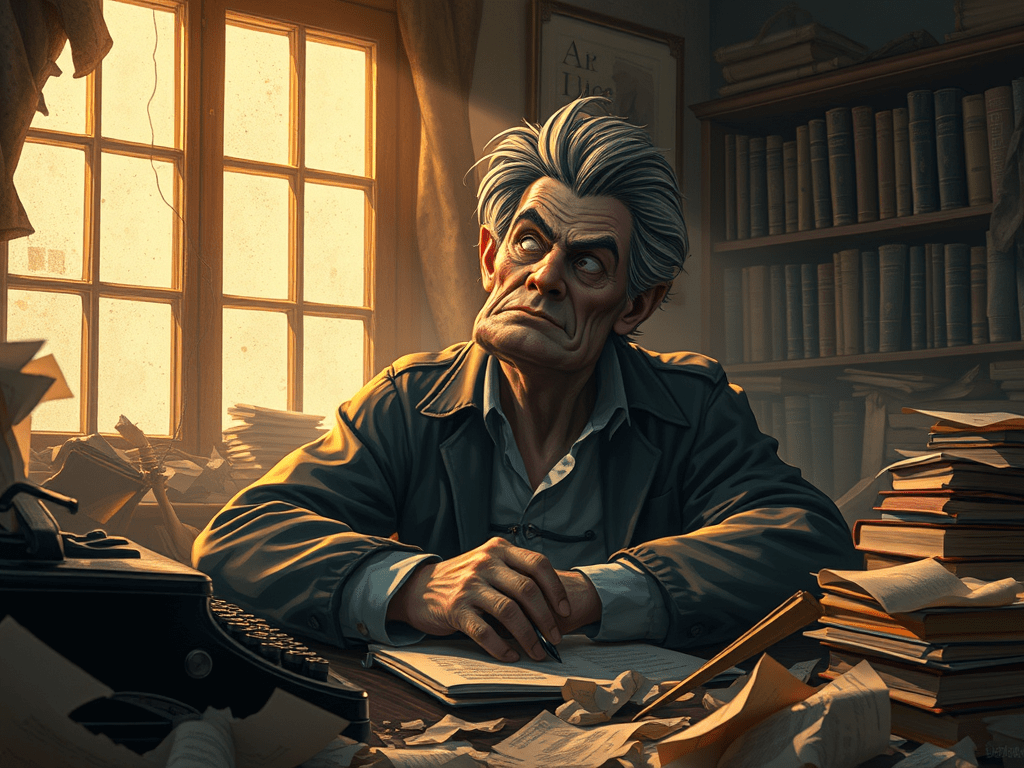
    As a recovering member of Write-a-holics Anonymous, I am contractually obligated—by my own neuroses—to scrutinize my bad habits and the deep-seated delusions that keep them alive. If you’re unfamiliar with my affliction, allow me to introduce myself: I am Manuscriptus Rex, an evolutionary dead-end of the literary world, a creature that compulsively transforms mundane existence into unsolicited book proposals. Where others see a casual conversation, I see Chapter One. Where others experience a fleeting moment of anxiety, I draft a preface. Writing isn’t just a passion; it’s my go-to coping mechanism, my panic button, my self-inflicted curse. While normal people unwind with a drink, I relax by plotting out a three-act structure. Some people journal. I accidentally draft trilogies.

    There’s ongoing debate over whether people like me willingly morph into Manuscriptus Rex—the scowling failed writer pacing his lawn and muttering about “kids these days”—or if the transformation is as unavoidable as hair loss and rising cholesterol. Maybe it’s some grim milestone on the aging checklist, or maybe it sneaks up, the natural side effect of realizing your cultural currency has expired while the youth livestream their way into the future. I’ll leave that existential puzzle for the philosophers to untangle.

    Desperate for rehabilitation, I revisited Alan Judd’s The Devil’s Own Work, a novella that reads like a cautionary tale for every starry-eyed writer who thinks talent alone will crack open the literary Olympus. The story follows Edward, a smug, silver-spooned upstart who barters his soul for literary greatness, only to discover that selling out isn’t nearly as effective as selling your soul. Judd’s cynicism is deliciously savage, peeling back the genteel façade of the literary world to expose it for what it truly is—a brutal, Darwinian circus where desperate souls claw their way up the ladder of editors, columnists, and curators, schmoozing with all the grace of a used car salesman at an estate auction.

    These hopefuls cling to the delusion that if they just network hard enough, flatter the right people, and craft the perfect blend of self-importance and faux humility, they’ll eventually ascend to greatness. But Judd knows better. The truth is, most of them will age out of relevance, their grand ambitions reduced to a handful of bitter op-eds, a smattering of unpaid guest lectures, and an attic full of unpublished manuscripts that smell faintly of despair. In the end, The Devil’s Own Work isn’t just a novella—it’s a scalpel, slicing through the bloated corpse of literary ambition to reveal the grotesque machinery inside.

    Edward is not your typical literary striver. While others claw and hustle their way up the greasy pole of literary success, he lounges at the base of it, certain that greatness will fall into his lap simply because he exists. He radiates a kind of effortless entitlement, convinced that the universe has preordained his ascent to literary immortality. Unlike the desperate social climbers around him, who at least put in the work, Edward is a narcissist of the purest strain—so enamored with his own exceptionalism that he sees ambition as beneath him.

    But Edward’s arrogance isn’t just about believing he’s destined for greatness—it’s about redefining what that greatness should look like. He is determined to strip his writing of any moral compass, crafting fiction that exists in a vacuum of pure, detached aestheticism. No lessons, no redemptions, no conscience. Just words untethered from anything resembling a soul.

    Meanwhile, the legendary O.M. Tyrrel, the region’s most revered novelist, is preparing to publish his final work before slipping into retirement. His magnum opus? A variation on the Faustian myth—a fitting coincidence, given the dark turn Edward’s life is about to take. In an act of staggering hubris, the insufferable upstart Edward pens a blistering review of Tyrrel’s novel, a hit job so scathing it should have burned any bridge between them. But instead of outrage, Tyrrel extends an invitation—dinner at his lavish villa in the south of France. There, over fine wine and literary banter, Tyrrel hands Edward a manuscript of ominous origin.

    What follows is a shortcut to literary fame that quickly warps into a descent into madness. Edward’s name skyrockets into the literary stratosphere, but his triumph is laced with terror. First, a persistent scratching sound haunts him whenever he writes—like something clawing its way out of the pages. Then, a malignant presence begins to stalk him, whispering the truth he’s been trying to drown in champagne and self-congratulation: he is a fraud. He has built his career on stolen words, and now those words have turned against him.

    By the time he realizes his fame is nothing but a gilded curse, it’s too late. Whatever twisted deal he unknowingly made, it has hollowed him out, leaving behind a man unrecognizable even to himself. His success is a mockery, his genius a sham, and his fate—a lifetime of torment, forever pursued by the spectral condemnation of the very thing he sought: greatness.

    As I sifted through the grim moral reckonings of The Devil’s Own Work, trying to extract some life lesson from Edward’s Faustian bargain, my inner writing demon—never one to miss an opportunity to heckle—chimed in.

    “Nice try, pal,” it sneered. “But this book won’t cure you. First off, you’re not Edward. He’s a smug layabout with a superiority complex. You, on the other hand, actually believe in morality tales. Second, Edward expects success to land in his lap like a butler delivering his morning tea. You, meanwhile, obsess over your subjects like a madman, descend into your characters’ fever dreams, and suffer through their torments just to wring out a halfway decent paragraph. Admit it—you’re a real novelist.”

    What a load of self-aggrandizing nonsense. Even if all that were true, there are plenty of people who observe the human condition with a keener eye than mine, and they don’t write novels. They work construction. They write poetry, fables, children’s books. They tell stories in bars, on factory floors, in courtrooms. Insight alone doesn’t make one a novelist.

    But damn that writing demon—it had a point. I wasn’t Edward. The novella didn’t apply to me. And if The Devil’s Own Work didn’t condemn me to a fate of fraudulent literary fame, then maybe—just maybe—I wasn’t doomed to failure either.

    Clearly, the writing demon still lives inside of me. My rehabilitation must continue. 

  • Interrogating the impulse to achieve literary dominance

    Interrogating the impulse to achieve literary dominance

    Looking back at 5 decades of writing dozens of failed novels, I’m torn between admiring my audacity and filing a restraining order against my judgment. How, exactly, did I manage to pin so much hope on novels that, despite their half-decent opening chapters, quickly spiraled into the literary equivalent of a stalled elevator—going nowhere and deeply uncomfortable for everyone involved?

    In contrast, my short essays were clearly sharper, more potent—but I refused to let reality intrude on my mission. No, I was going to write the comic novel.

    This compulsion was never about art. It was about pain—the kind so deep that Jonathan Franzen famously coined Ache to describe the existential condition of adulthood: the rude awakening that we are not, in fact, the center of the universe and that our desires will always outrun our ability to satisfy them.

    Manuscriptus Rex feels this Ache acutely and has embarked on a fool’s errand to silence it with literary fame. But why this brand of glory? Why not build a real estate empire, become a movie heartthrob, or invent the perfect bed that guarantees twelve uninterrupted hours of blissful, coma-grade sleep? Because Manuscriptus Rex is too much of a narcissist for mere wealth, beauty, or utility. Writing a book—one that matters—offers something more intoxicating: the power to hijack people’s brains.

    And that’s what you really crave—not just admiration, but full cognitive occupation. You want your words burrowed into the minds of millions, your dream world dictating their thoughts. Your need for validation is so bottomless that only mass literary infiltration will mollify you. That this ambition is wildly improbable, driven by pathology, and guaranteed to bring more suffering than satisfaction? Irrelevant. The mission is all that matters. And the mission is literary dominance.

    My wife once observed that men, with their colossal egos, often wake up with sudden revelations, epiphanies so grand they feel compelled to start religions. She’s not wrong. The novelist, the polemicist—what are they really doing but trying to ignite a movement, disrupt the world, and bask in the glow of their own importance? Their gospel isn’t about some grand truth—it’s about them, standing center stage, ablaze with self-appointed brilliance.

    Religion is the ultimate expression of literary dominance. I think of the Apostle Paul himself, scribbling his epistles in a manic frenzy, waging rhetorical war in the bustling marketplace of spiritual ideas, demolishing rival orators, and confessing his own unhinged nature in Romans—his theological magnum opus, a mini-Bible inside the Bible. Only eighty pages in total. That was the sum of his obsessive writing, and yet his literary dominance is established. He’s been the talk of the town for over two thousand years. Whether they like him or not, people still want to hear what he has to say about the human condition. 

    This was the novelist’s role five decades ago, back when novelists were secular prophets, summoned to The Dick Cavett Show to pontificate on the issues of the day—because, once upon a time, their opinions mattered.

    And that’s what I loved about Cavett. Even as a ten-year-old, I grasped the show’s implicit assumption: the intellectual life was its own parallel universe, just as electrifying as Paul’s eschatological one—except with better punchlines.

    Perhaps Cavett planted the seeds of my literary delusion, setting the stage for a demon that would fully blossom into madness a decade later when I read A Confederacy of Dunces—then Portnoy’s Complaint and The Ginger Man. If I could write something as riotously funny as those masterpieces, I wouldn’t just be funny—I’d be brilliant, important, part of the conversation. My name would be etched into the pantheon of literary wit, my shattered self-esteem miraculously restored. I would find completion.

    And lest you think this was mere posturing, let me be clear: my aspirations weren’t some carefully curated cool pose. I was, without question, funny—not in the “guy who recycles late-night monologue jokes” way, but in the gimlet-eyed, take-no-prisoners way that slices through the world’s absurdities like a scalpel. I was an ally of Kafka, wielding my literary axe to shatter the frozen ocean of human folly. My quest was real, my voice authentic, my success inevitable.

    Except, of course, it wasn’t.

    I failed. Repeatedly. The novels kept coming, and to my credit, they got better—sharper, wittier, good enough to attract literary agents, which was dangerous because it fed the delusion. This wasn’t a phase. It became a lifelong affliction. In my twenties, thirties, forties, fifties—hell, even my sixties—the novels kept churning, like those chocolates on the conveyor belt in I Love Lucy, coming faster than I could process, devour, or even appreciate.

    The demon was still in business.

    And how good were these books as the result of all my literary effort? “Just okay.” Which, in an attention economy, is about as useful as a dial-up modem in the age of fiber optics. “Just okay” might sell 300 copies—a number so pitiful that the editor who championed your book could lose their job over it.

    But sure, let’s keep the dream alive.

    Having failed to write my grand, world-shaking book and having let A Confederacy of Dunces derail my life, I am left standing amid the wreckage of my literary ambitions, clutching at whatever scraps of wisdom I can salvage. Something must be redeemed, after all. And what better way to salvage a wreck than by turning it into yet another book? The Confessions of a Recovering Writing Addict.

    But of course, that’s just the demon running its mouth again. The same devious little imp that once whispered sweet nothings about my inevitable literary greatness now insists that my failure is my brand, my gimmick, my golden ticket to the book that will finally rock the world.

    And what is this seismic masterpiece, this literary game-changer? Oh, just a book about aspiring writers so starved for attention that they write not as artists, but as junkies, chasing the next fix of validation. A cautionary tale wrapped in a confession, packaged as a sales pitch—because irony, it seems, is the one thing I have mastered.

    Writing with an ego hellbent on domination, we writing junkies reveal an uncomfortable truth—we all have a little Paul in us. We insist we write out of sincerity, fueled by a pure, burning need to communicate something true. But let’s not kid ourselves. Deep down, what we really crave isn’t truth—it’s importance. Recognition. Veneration. And, above all, relevance.

    We aren’t just stringing words together; we’re mounting a last-ditch offensive against oblivion, hammering out prose as if sheer verbosity might hold off the reaper a little longer.

    In the end, we place our hope in something as fragile as a glue-and-paper book in the digital age, believing—despite all evidence to the contrary—that it will elevate us, transcend us, and make us immortal.