Tag: luxury-watches

  • From Luxury Dreams to G-Shock Atomic Reality

    From Luxury Dreams to G-Shock Atomic Reality

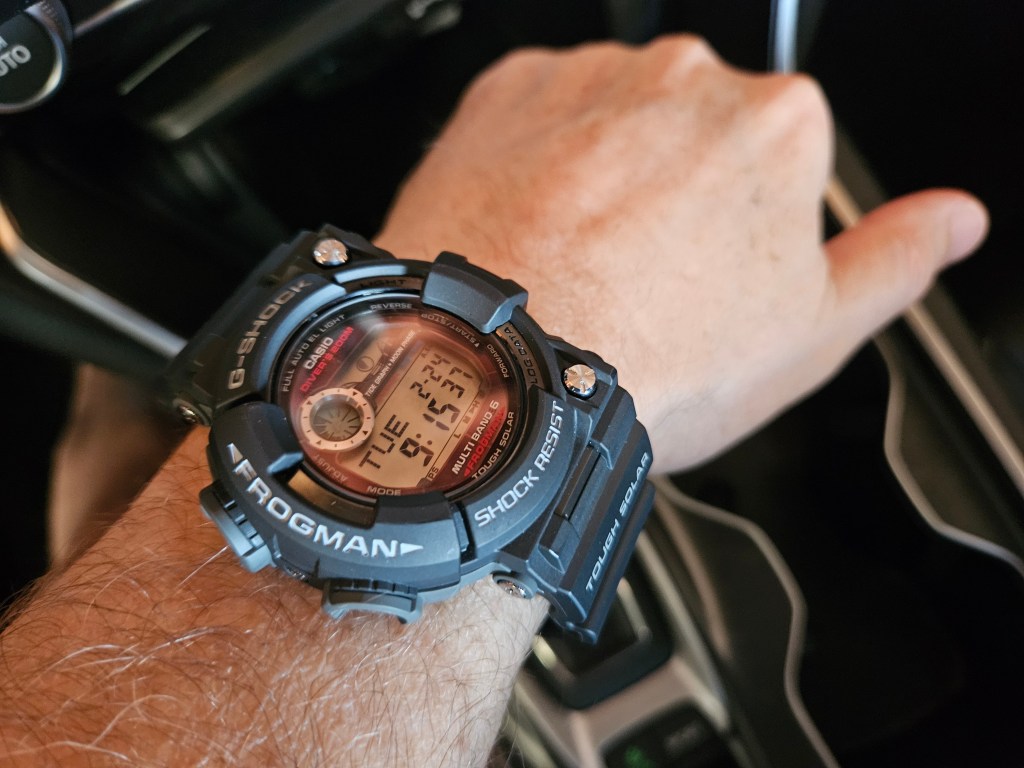
    I made a YouTube video about my G-Shock Frogman and my growing inability to take it off my wrist. The response was immediate and disproportionate. The video drew ten times the comments I typically get when I talk about mechanical watches.

    That told me something important.

    The passion inside the G-Shock world isn’t just strong. It’s combustible.

    What surprised me even more was the pattern many viewers described. It ran directly against the standard collector narrative—the familiar climb from inexpensive watches up the luxury ladder, the gradual refinement that ends with an Omega, a Tudor, and the quiet satisfaction of having “arrived.”

    Many G-Shock owners reported the opposite trajectory.

    They did climb the ladder. They bought the Swiss pieces. They tasted the luxury world. And then something happened.

    They discovered atomic time.

    One comment captured the shift perfectly: the plan had been to move from entry-level divers into Tudor. But after experiencing the precision of a radio-controlled G-Shock, mechanical watches stopped making sense. The Tudors remained—for weddings, formal events, the occasional appearance—but daily life belonged to the digital watch.

    The romance didn’t fade gradually.

    It collapsed.

    What replaced it wasn’t thrift or minimalism. It was something colder and far more powerful: precision, efficiency, optimization. The watch was no longer a story. It was a system.

    This transformation deserves a name: Precision Conversion.

    Precision Conversion is the moment a collector crosses an invisible line. He stops wearing watches for heritage, craftsmanship, or the poetry of miniature machinery and starts wearing them for one unforgiving reason: they are correct.

    It often begins quietly. One morning, the atomic watch has synchronized overnight. No drift. No adjustment. No uncertainty. The time is simply right—down to the second, without effort, without supervision.

    After that, the mechanical watch changes character.

    What once felt soulful now feels approximate. What once felt charming now feels like a pleasant but unreliable narrator. The convert doesn’t lose respect for craftsmanship. He loses tolerance for romance that runs five seconds fast.

    Accuracy begins to feel like moral clarity. Self-correction feels like intelligence. A watch that needs adjusting starts to look less like a companion and more like a hobby that forgot its primary responsibility.

    And here’s the important part.

    Money never came up.

    Not once.

    These comments weren’t about saving cash or avoiding luxury. For true G-Shock converts, the affordability is incidental—almost accidental. The lower price isn’t the motivation. It’s simply a pleasant side effect.

    In this world, G-Shock isn’t the budget choice.

    It’s the rational one.

    The price, as the believers would say, is just icing on the cake.

  • From Wrist to World: The Long Climb Out of Gollumification

    From Wrist to World: The Long Climb Out of Gollumification

    At a certain depth, the watch obsessive stops merely owning watches and begins inhabiting them. He lives in beat rates and power reserves, dreams in lume, and speaks a dialect composed entirely of tolerances, metallurgy, and micro-adjustments. This language becomes his native tongue—and everyone else’s becomes a foreign one. Instead of translating himself back into ordinary conversation, he doubles down. Why speak about people, work, or weather when there are case coatings, anti-magnetism ratings, and the eternal question of 20mm versus 22mm?

    This is Gollumification: the slow psychological narrowing that occurs when a hobby expands to occupy the territory once reserved for identity, emotion, and social life. The enthusiast begins to interpret the world through horological logic. Reliability matters more than warmth. Precision outranks connection. Conversations become monologues disguised as education. Over time, the technical vocabulary hardens into a private dialect that excludes anyone not fluent in the faith.

    The social consequences arrive quietly. Friends feel the intensity and step back. Family members nod politely, then change the subject, then eventually stop asking. Their distance confirms the collector’s growing suspicion that the outside world lacks depth or appreciation. The loop closes: fewer people, more watches; more expertise, less range as a human being.

    Advanced Gollumification produces a curious asymmetry. The collection becomes refined, curated, museum-worthy. The collector becomes narrower, guarded, and faintly brittle—capable of explaining torque tolerances at length but uncomfortable with ordinary emotional exchange. He manages mechanisms with surgical care while neglecting the untidy maintenance of relationships.

    Some drift into this state gradually, the behavioral accretion so slow they don’t notice the cave forming around them. Others embrace it knowingly, wearing their social withdrawal like a badge of purity. If the world doesn’t understand watches, the problem must be the world.

    Rarely, something interrupts the descent. A spouse’s fatigue. A child’s indifference. The uneasy realization that the collection is thriving while the rest of life is running on reserve. This is the beginning of De-Gollumification.

    De-Gollumification is the difficult return from horological exile—the moment the collector recognizes that memorizing every movement specification is not the same as being present in his own life. The shift begins with a painful inventory: relationships neglected, conversations hijacked, attention diverted into stainless steel and sapphire. The enthusiast steps back from the private dialect of lume performance and lug geometry and relearns the language of ordinary human exchange.

    The watches remain, but their jurisdiction shrinks. Identity migrates back to where it belongs. The collector stops leading with the wrist and starts leading with attention. The transition is humbling and occasionally disorienting, like emerging from a quiet bunker into daylight.

    Successful De-Gollumification does not require selling the collection. It requires abandoning the bunker. The pieces stay. The spell breaks. There are fewer lectures and more listening, fewer unboxings and more presence. The whisper of my precious gives way to something healthier and far more difficult: our life.

  • From Watch Nirvana to Strap Hell and Back Again (a Short Story)

    From Watch Nirvana to Strap Hell and Back Again (a Short Story)

    I’m nearing sixty-four, and you’d think the resume of my life would say it all: married man, father of twin teenage daughters, lifelong weightlifter, and full-time college writing instructor pushing four decades in the trenches. Yet none of those titles define me quite like the pathology that has consumed my last twenty years: an obsession with diver watches.

    The disease began in 2005, when I bought my first “Hero Watch,” a Citizen Ecozilla. I was a suburbanite with all the aquatic daring of a backyard kiddie pool, but strapping that hulk of steel on my wrist turned me into a fantasy adventurer. The Ecozilla was my passport into adventurist cosplay, proof that even if my only dive was into Costco’s frozen food aisle, I could still play Jacques Cousteau in my imagination.

    For nearly two decades, I clung to bracelets and dismissed rubber. Rubber straps were sticky, sweaty, and cheap—the footwear of wristwear. But then, in 2024, a fellow enthusiast on Instagram whispered the gospel of Minotaur, a boutique strap company out of Houston. Their FKM rubber was no ordinary rubber—it was luxury-grade, accordion-style, fat spring bar holes, the kind of strap that doesn’t just hold a watch but weds it. Think craft brewery meets haute horology.

    When I slipped a Minotaur onto my Seiko diver, it was a conversion experience. Think Paul in Damascus. The strap was supple yet firm, sleek yet rugged. It was the hand-in-glove perfection every watch collector secretly craves.

    Suddenly, my seven Seiko divers weren’t just watches—they were sacraments. I no longer needed to fuss with bracelet links or endure the daily annoyance of micro-adjustments. The Minotaur straps brought equilibrium to my collection, and by extension, to my life.

    I became the town crier of Minotaur. Instagram posts, YouTube videos, flowery effusions of praise—my strap evangelism knew no bounds.

    I even struck up a friendship with Ron Minitrie, the Minotaur founder himself, who sent me models to showcase. For a while, I was living the influencer’s dream: watch bliss, strap perfection, hobby fulfillment so complete I worried it might be dangerous.

    But what happens when you reach nirvana? Do you close the YouTube channel, ride off into the sunset, and live happily ever after? Of course not. That’s when the gods get bored and send you a curse.

    The curse arrived in the form of a comment from a viewer named Infiniti-88. He linked to a Notre Dame study that accused FKM rubber straps of being Trojan horses of doom. According to the study, FKM bled PFAS “forever chemicals” into the bloodstream, potentially wrecking organs, scrambling hormones, and sowing cancer. Because watch straps are worn all day—sweat, heat, friction, even while sleeping—the risk was presented as constant exposure.

    Infiniti-88’s question was simple: “What are you going to do?”

    Cue the descent into madness. I read the study, panicked, and stripped all my Minotaur straps, replacing them with silicone and vulcanized rubber. Immediately, my watches felt diminished, like Ferraris stuck on snow tires. They lost their soul.

    I made a YouTube confessional and discussed the finer points of the Notre Dame Study. Half the viewers thanked me for raising the alarm; the other half mocked me for peddling paranoia. They insisted FKM risk was bottom-tier, a blip in the PFAS risk hierarchy. My response? Oscillation. I switched from Minotaur to silicone and back again—sometimes eight times in a single day. I was a man possessed, toggling straps like a lab rat on amphetamines.

    Desperate for clarity, I appealed to the digital oracles: Gemini, Claude, ChatGPT. Their verdict was unanimous: the study was flawed. The researchers had tortured the straps—soaked them in solvents, scorched them with heat, abraded them into pulp. In short, conditions no wristwatch strap would ever endure on a human arm. The Minotaur straps, they said, were stable, inert, safe.

    I breathed relief. For about three minutes. Then paranoia struck again. Were the AI platforms telling me the truth, or, as the dutiful sycophants they are, just feeding me the reassurance I craved? Was I clinging to wishful thinking dressed up as “analysis”?

    Meanwhile, fellow watch obsessives chimed in from YouTube and Instagram, their chorus split evenly between “Don’t worry” and “Panic with me.” Their voices joined the cacophony in my head. Certainty dissolved. Once you’ve pictured poison seeping into your wrist, you can’t unsee it.

    I began to hate the hobby itself. Hate the straps, hate the watches, hate the endless cycle of worry. It wasn’t about horology anymore—it was about risk management as a form of neurosis. I even considered selling everything and defecting to Tudor, whose bracelets come with the T-fit clasp–a miracle of quick adjustment that eliminates the fuss of links and tools. No chemicals, no rubber, no paranoia. Just a slide-and-click mechanism that promises freedom from my madness.

    When I think of my complicated relationship with Minotaur straps, the potentially-flawed Notre Dame Study, the fear of forever chemicals, and thoughts of a T-fit clasp, an image comes to mind that defines the insanity of my current situation:

    I’m thinking of the Balrog in The Lord of the Rings: The Fellowship of the Ring.

    In Moria, Gandalf confronts the Balrog on the Bridge of Khazad-dûm. They fall together into the abyss, and after an epic battle that spans mountains and caverns, Gandalf is mortally spent. It’s not a literal tail piercing—Tolkien describes Gandalf being dragged down by the Balrog’s whip after he breaks the bridge. The trauma of the battle kills him in his “Gandalf the Grey” form, but he is later sent back, transfigured, as Gandalf the White.

    Gandalf is never the same again, not because of the wound, but because his role changes: he comes back more powerful, more detached from the mortal world, and closer to a messenger of the divine.

    If I’m to survive my Minotaur strap crisis, I must follow the trajectory of Gandalf : I have to let the old self fall into the abyss. Like Gandalf, I must die to the madness and come back reborn, detached, stronger, armed with perspective. Because at this point, it’s not just about straps. It’s about what kind of man I am when the watch box stares back at me.