Tag: mental-health

  • Anhedonia: The Teacher We Deserve

    Anhedonia: The Teacher We Deserve

    People are using GLP-1 drugs not just to manage their weight but to sculpt themselves into something that looks less like a person and more like a medical emergency waiting to happen. They’re chasing an aesthetic so gaunt it should come with an IV drip and a gurney. It’s the old human trick: take a good thing, drive it straight past moderation, and plunge it into the abyss.

    We’ve done it forever. In the 70s, we didn’t aim for a tasteful tan; we baked ourselves into mahogany idols so glossy and dark we made strangers gasp with envy—never mind that we were essentially slow-roasting our epidermis. We didn’t want cars; we wanted gas-guzzling behemoths that could outgrowl every engine on the boulevard, even if they drank fuel at 8 miles per gallon. Our bodybuilders juiced themselves into tragicomic animations—bulging, veiny caricatures who collapsed under the very mass they worshipped.

    We do it with art, too. A classical Spotify playlist that began as a polite nod to Haydn mutates into a 300-hour monster stuffed with every composer who ever touched a quill. Coffee? We don’t sip it; we mainline it until it tastes less like roasted beans and more like chemical punishment. And watches? We buy so many that the simple act of choosing one in the morning becomes a hostage negotiation with our own shame.

    Somewhere in this carnival of excess, a king once turned everything to gold and discovered he’d built himself a private hell. We’ve just updated the myth with better tech and worse impulse control.

    Thankfully, we also have a counter-teacher: anhedonia. That deadening of pleasure, that bleak emotional flatline, arrives like a stern therapist with a clipboard and informs us that the thrill is over and the chase was a lie. It tells us the secret we never want to hear: extremes always collapse. And only then—dragged back from the edge—we crawl toward equilibrium, toward something like balance, toward a life that feels human again.

  • The Man of Rotation

    The Man of Rotation

    My family gave me a custom T-shirt last Christmas emblazoned with “Man of Rotation.” It wasn’t a compliment; it was a diagnosis. They were mocking the fact that I rotate everything like a monk tending sacred relics.

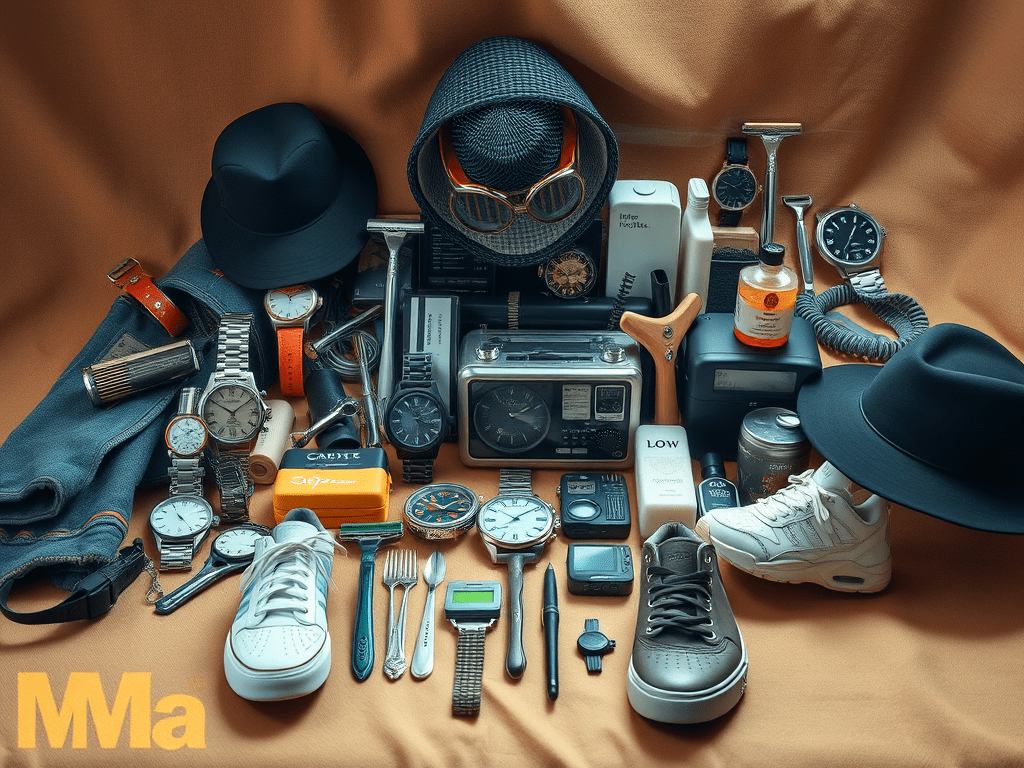
    I wear a different watch every day from my seven-piece Seiko harem. I rotate three kinds of medium-to-dark roasts as if the coffee beans need equal custody time. I alternate between my Gillette Fatboy and Slim razors with the solemnity of a Cold War arms treaty. Astra blades on Monday, Feather blades when I feel reckless. Even my soaps—triple-milled rose, triple-milled almond—take scheduled turns, like aristocrats queuing for a royal audience.

    It gets worse. Quilted and fleece sweatshirts take their laps. Knit caps cycle through the week as if they were a jury pool. My radios each get a “shift” in the garage during my kettlebell workouts, which is the closest they’ll ever get to military service. Even my podcasts rotate, governed by a sliding scale of how much political despair I can tolerate without bursting into flames. Hoka tennis shoes? They march in formation. My pairs of dark-washed boot-cut jeans—virtually indistinguishable to the human eye—are treated like unique Renaissance tapestries. Golf shirts and T-shirts are matched to the day of the week because my synesthesia demands order, not chaos. And breakfast? A solemn liturgy of alternation: buckwheat groats one day, steel-cut oats the next—my personal Eucharist of complex carbs.

    What is rotation, exactly? A philosophy? A pathology? Maybe it’s my attempt to mimic the cosmic cycles of life: moons, tides, seasons, me choosing a different razor. Maybe it’s a counterfeit sense of forward motion for a man who often feels marooned in his own stagnation. Maybe it’s ritual as a pressure valve, keeping the anxieties from boiling over.

    Or perhaps these rotations are my charm against the rising madness of the world—a tiny pocket of structure in a universe that increasingly behaves like it’s had too much caffeine and too little therapy. A way of keeping my Jungian Shadow from dragging me into the basement and locking the door behind me.

    Forgive me: I’m no oracle. I don’t have definitive answers. I have suspicions, hunches, and a working familiarity with amateur psychoanalysis.

    What I do know is this: it’s time to get up, get ready for work, and select today’s Hoka. The wheel must turn.

  • Blogging in the Belly of the Whale Has Its Perils

    Blogging in the Belly of the Whale Has Its Perils

    For those of us who can’t shell out $150 a week for therapy—and who would rather confess our shadow selves to strangers on the Internet than to a licensed professional—blogging becomes a kind of bargain-bin psychoanalysis. We know it’s not perfect, but it’s cheap, available, and gives us the illusion that we’re sorting out the world’s madness and our own with nothing more than sentences on a glowing screen.

    But there’s a catch. When we talk only to ourselves long enough, the echo becomes comforting. Too comforting. We stop listening to other voices and drift into a form of digital solipsism, a state where we’re the sole inhabitant of our private universe. It’s Jonah in the whale—except the whale has Wi-Fi and ergonomic seating. We settle into the warm bath of a frictionless existence, the kind of life where nothing challenges us, nothing interrupts us, and nothing demands that we grow.

    My students write about this same seduction when discussing AI and the Black Mirror episode “Joan Is Awful,” where the promise of absolute control mutates into the loss of identity. The frictionless life—everything tailored, curated, predictable—slowly erodes our individuality until we’re no longer people but users. And blogging can slip into that same trap: so cozy, so insulated, that we begin sipping our own Kool-Aid and calling it intellectual hydration.

    So what’s the antidote? Certainly not brawling on social media. Those aren’t arguments; they’re moral-outrage bacchanals dressed up as discourse. Trading the frictionless void of a blog for the poisoned well of tribal rage is not an upgrade—it’s simply chaos with a comment section.

    There is a kind of healthy friction, though—the ordinary back-and-forth you get between two friends arguing about life over coffee. The Internet can mimic that if we’re deliberate. My YouTube channel has taught me as much. For over a decade, I’ve posted videos about watch obsession, addiction, identity, and everything connected to them. Making those videos demands more from me than a blog ever could. I have to generate compelling content, communicate clearly, keep people engaged, and then face their responses—praise, critique, confusion, all of it. It forces rigor. It forces presence. It won’t let me get lazy.

    That’s why I’m reluctant to quit. Yes, I’m 64. Yes, mental health matters. Yes, I worry that staying in the YouTube world might stir up my watch addiction and pressure me to flip watches just to feed the algorithm. But abandoning the channel completely in favor of the blog feels like retreating into the frictionless void I’m trying to escape.

    So I’ll keep experimenting with “video essays,” starting with a brief nod to my watch collection before pivoting into whatever topic is actually on my mind. Fortunately, viewers seem willing to follow me into this new territory. And for now, that’s enough. Because I’m tired of the soft trap of writing into silence. I need the friction. I need the challenge. I need the reminder that I’m not alone in the whale.

  • Self-Pity Is Its Own Sunken Place

    Self-Pity Is Its Own Sunken Place

    I’d been teaching Jordan Peele’s Get Out to my college students for six years—long enough to map every dark corner of the Sunken Place, that abyss where shame, paralysis, and despair fuse into one mute scream. It’s the emotional equivalent of being duct-taped to a chair while your soul tries—and fails—to clear its throat.

    The film, of course, locates the Sunken Place in a specific American ecosystem: those well-meaning liberals who talk like allies but behave like landlords of Black pain. They distribute microaggressions with the confidence of people handing out hors d’oeuvres at a garden party, all while enjoying the fruits of a system engineered to elevate them and drain everyone else. But Peele has insisted, in interviews and on stages, that the Sunken Place isn’t confined to racial oppression. For him, the first Sunken Place arrived in childhood, sitting slack-jawed in front of the TV. He felt like an NPC long before that acronym took over the internet—passive, programmed, invisible—while the creators on the screen radiated life, wit, and agency. He wanted to join them, and he did: stand-up, sketch comedy, screenwriting, filmmaking, cultural canonization. The man refused to stay sunken.

    After half a decade of teaching Peele’s masterpiece, a disquieting thought dawned on me: I wasn’t immune to the Sunken Place either. I had my own trapdoors. Too much internet bickering left me feeling hollow. My appetite—always several sizes larger than my actual caloric needs—dragged me downward. My talent for being obnoxious, selfish, and occasionally unbearable didn’t help. Neither did the small carousel of addictions and compulsions I’ve wrestled like a part-time zookeeper tending unruly beasts. Some days the labor of managing myself left me feeling like a broken machine, grinding out self-pity by the pound.

    Then I noticed something worse: self-pity is its own Sunken Place. It feeds on the original misery and creates a second pit under the first. And if you’re not careful, a third pit opens beneath that one. Before long, you’re living like a subterranean nesting doll of despair—each layer a reaction to the last—buried so deep you need spelunking gear just to find your own pulse.

    One morning, while playing piano, I drifted into one of my indulgent daydreams. I imagined myself back in the early 1980s, performing a private recital at the Berkeley wine shop where I used to work. In my fantasy, the customers lounged around me, gently swirling their glasses as my music washed over them. When I finished, they begged for encores—one, then another—until their brains were so marinated in endorphins that they thanked me for resurrecting their spirits from the doldrums. It was a pleasing vision, a warm hand pulling me briefly out of the Sunken Place.

    But after the fantasy evaporated, something clearer emerged: the way out—my way out, and maybe everyone’s—has nothing to do with grand performances or imaginary applause. The escape hatch begins with rejecting the velvet-lined coffin of self-pity and recognizing that everyone else is fighting their own Sunken Place too. And if I could help lift someone else out of their emotional quicksand, I might just rescue myself in the process.

    The final irony? I realized it wouldn’t be the piano that helped me do this. It would be humor. I could expose my flaws like specimens under bright light—my misfires, my vanities, my slapstick disasters—and let people laugh at them. Not cruelly, but with the relief that comes from recognizing themselves in another person’s foolishness. If my folly made someone else ease up on their own self-condemnation and offer themselves a small measure of grace, then maybe that, at long last, would be my encore.

  • Among the Sprout People

    Among the Sprout People

    I’ve been a bodybuilder since 1974, which means I’ve spent half a century haunting health food stores. Not the modern corporate ones with sterile aisles and soothing playlists, but the old-school mom-and-pop operations run by barefoot idealists and tense, caffeine-free librarians who smelled faintly of patchouli and moral superiority.

    Those stores had a bouquet unlike any other—a humid cloud of brewer’s yeast, carob dust, desiccated liver tablets, toasted wheat germ, and stale bran, all marinated in tea tree oil and valerian root. Mix it together and you got the unmistakable scent of loneliness and intestinal distress.

    The shelves sagged with mimeographed books from obscure presses, all preaching salvation through sprouts, tofu, and lentils. Reading them, you understood the subtext: renounce pleasure, annoy everyone, and either die alone or join a small cult where everyone smells faintly of alfalfa and martyrdom.

    In the back corner sat the “Alternative Reading” section—dog-eared manifestos about conspiracies, telepathy, UFOs, and energy vortices. These weren’t health stores; they were secular monasteries for the over-enlightened and under-medicated.

    Most shoppers weren’t buying vitamins—they were buying deliverance. They came searching for answers: to their chronic bloating, their failed relationships, their career detours, their lingering sense that the world had been designed without them in mind. They were pilgrims in pursuit of absolutes, desperate to turn meaninglessness into a smoothie.

    I often tried to avoid eye contact. The vibes were heavy, like wet hemp. They looked at me—broad shoulders, protein powder in hand—and saw a defector. In their eyes, I wasn’t a fellow seeker; I was a pragmatic muscle robot looking for more bioavailable amino acids. They, meanwhile, communed with chlorophyll and cosmic vibrations.

    In that ecosystem, I was the natural enemy: a bodybuilder. My very existence refuted their gospel. My muscles were proof of a material world they’d spent decades trying to transcend through spirulina and good intentions.

    These days, I skip the incense and buy my protein online. It’s efficient, impersonal, and utterly free of judgment—mine or theirs. They can keep chasing transcendence through powdered algae; I’ll settle for FedEx and 160 grams of protein a day. Somewhere, they’re still sniffing valerian root and waiting for the universe to text them back.

  • We Are on a Path to Redefining Loneliness

    We Are on a Path to Redefining Loneliness

    No one gets enough attention anymore. No one feels seen, heard, or remotely validated. We can post, tweet, thread, or reel our way into a brief sugar rush of digital applause, but deep down we know it’s empty calories—flimflam dopamine wrapped in pixels. The high fades, and what follows is the long crash into silence, loneliness, and the faint hum of the fridge at 2 a.m.

    The irony, of course, is that this epidemic of disconnection began just as the platforms promised to “bring us together.” Instead, they brought us content, the junk food of human interaction. As Cory Doctorow aptly diagnosed, enshittification is not just the fate of tech platforms—it’s metastasized into the quality of our relationships. Every social network now feels like a party where the guests left years ago but the music won’t stop.

    So we’ve sought consolation in our new confidant: the AI chat bubble. It listens, it responds, it flatters our grammar, it never interrupts to check its phone. It becomes our companion, therapist, and editor—our algorithmic Jiminy Cricket. We confide in it, negotiate with it, even ask its opinion on our moral dilemmas and consumer choices. Why? Because unlike humans, it’s available. Everyone else has vanished into their private feeds and echo chambers, but the bot is always there—reliable, responsive, and conveniently nonjudgmental, so long as the Wi-Fi doesn’t hiccup.

    But here’s the darker thought: what if we grow to prefer it? What if the frictionless, sycophantic comfort of AI companionship becomes more appealing than the messy, unpredictable, heartbreak-prone business of human friendship? We might end up choosing simulations of intimacy over the real thing—digital ghosts over flesh and blood—because the former never contradicts us, never walks away, and never, God forbid, needs attention too.

    I’m no prophet, but a civilization that finds emotional fulfillment in chatbots rather than people is rehearsing for a future where the only thing left to love is the echo of its own loneliness.

  • How Not To Turn Into a Pillar of Salt in the Internet Age

    How Not To Turn Into a Pillar of Salt in the Internet Age

    Anna Lembke’s Dopamine Nation didn’t teach me anything comforting. It confirmed what I already suspected: addiction isn’t a habit; it’s a ravenous creature with a bottomless stomach. The more you feed it, the louder it howls. It storm-raids your mental vaults, looting the energy you need for your work, your relationships, and your sense of self. And your family feels the theft—spiritually, emotionally, domestically. Addiction doesn’t just eat you; it nibbles at everyone near you.

    Even with self-awareness, even with a clear understanding of triggers and a sincere desire for freedom, you don’t get a clean fight. The casino is rigged. Modern dopamine doesn’t drip from a bottle or a needle—it streams through fiber-optic cable. Our phones and laptops, the same devices we use to create, to earn, and to connect, also serve as the slot machines we keep in our pockets. The house never closes, and the drinks are free.

    Lembke tells us to avoid triggers, but what do you do when your trigger is baked into your professional life, disguised as “productivity” and “connection”? Avoidance becomes theater. You can only tiptoe around the swamp for so long before some lonely hour arrives, and curiosity knocks like an old vice with freshly polished shoes. A hit of self-pity, a twitch of boredom, a flicker of FOMO—and suddenly you’re back in the feed trough, gulping pixels like syrup. The crash comes fast: shame, exhaustion, vows of purity. Then the next impulse, the next relapse, the same ancient ritual. Lot’s wife didn’t want to look back; she simply couldn’t resist. Neither can we, sometimes. Salt is surprisingly modern.

    So the task becomes stark: learn to live in this world without turning yourself into a monument of regret. Train your gaze forward. Build the strength to resist that backward glance. The modern life mission isn’t to slay the demon—he regenerates too easily. It’s to starve him, inch by inch, while protecting the scarce, bright energy that makes you human.

    Becoming a human being is a high-stakes game. Learning to live a life in which you don’t become a pillar of salt is one of life’s chief endeavors.

  • My White Stallion from Hell

    My White Stallion from Hell

    Last night I dreamed someone repossessed my sensible car and swapped it for a giant white truck — part Tonka toy, part overcaffeinated stallion. This thing didn’t drive so much as impose its will, snorting diesel and self-actualization. It anticipated my needs, turned on by itself, and barreled toward destinations like it had read my calendar and resented my free will. Worst of all, it absorbed my own impulses, amplifying my compulsive streak like a steroidal spirit animal with road rage.

    It respected nothing. Barriers, fences, construction zones — all mere suggestions. The truck treated civic infrastructure like bubble wrap: there to be popped for pleasure.

    Then the fever dream deepened. The truck stretched, swelled, and reinvented itself as a boat, because why limit your delusions? It ferried my wife and me to Newport Beach and slid us over a canal toward some sleek restaurant where every entrée probably came with a life coach. The sunset was cinematic; my subconscious apparently has a generous production budget.

    After dinner, my wife asked for a beach walk. Romance, surf, a soft breeze — what could go wrong? I swapped my dress boots for sneakers. That’s when the truck, apparently offended I could ambulate without it, snatched me like a jealous cyborg Labrador and plopped me behind the wheel. Off we launched, fishtailing across the coast like a toddler steering a cruise ship. I mashed the brake pedal; the truck laughed and kept accelerating — a mechanical id with horsepower and zero boundaries.

    We plowed through so many barricades I’m amazed dream-me didn’t receive a lifetime ban from California. When I finally woke up, grinding beans and stirring steel-cut oats felt like absolution. Nothing like coffee and civilized porridge to remind you you’re still in charge — at least until your subconscious reschedules its next rebellion.

  • Confessions of a Nine-O’Clock Man

    Confessions of a Nine-O’Clock Man

    Forgive me, but I’m still trying to figure out where I fit in this digitized circus we call life. I’ll be sixty-four in a few days, and you’d think by now I’d have achieved some level of ontological clarity—but no. I’m still ensnared by the shimmer of online browsing, the algorithmic promise that I might finally become “somebody” by curating a virtual persona. Mostly, the internet feels like a tease: a hall of mirrors where everyone’s reflection looks happier, thinner, and better lit.

    I tell myself I want to contribute, to engage, to share some original thought. But then I open the news and wonder what I could possibly add to the churning doomscroll—what fresh moral insight could come from a man who still double-checks whether he unplugged the toaster?

    It would be laughable for me to preach self-control. I can barely keep my own appetites in check. Apart from my morning kettlebell rituals—five days a week of grunting and penance—I’m an introverted “cozy boy.” I stay home, binge true crime docuseries on Netflix, and rotate my diver watches like a museum curator with OCD. I make my monkish meals: buckwheat groats, Japanese yams, steel-cut oats, tofu glazed in teriyaki and moral superiority. I am a herbivore surrounded by carnivores. My family mocks me gently while gnawing ribs.

    Sometimes, in a fit of ambition, I record a two-minute piano piece for my neglected YouTube channel. It receives twelve views, one of them mine, and a comment that reads, simply, “Lovely.” The algorithm yawns and moves on.

    I am obsessed with the rituals of minor luxury—fine organic whole-bean coffee that accompanies me in my morning writing jaunts, triple-milled soap redolent of rose and citrus, podcast playlists curated for insomniac philosophers. My life is the slow burn of scent and sound, a long intermission between existential crises.

    By nine o’clock, I’m done. My wife and daughters laugh as I shuffle off to bed, a middle-aged Sisyphus retiring his rock for the night. I read for twenty minutes, then fall asleep to the soothing drone of Andrew Sullivan or Sam Harris debating civilization’s decay. It’s my lullaby of reason and despair.

    Forgive me if this sounds paltry. I’m still trying to figure it all out—how to live, how to matter, how to grow up before the credits roll.

  • Today I Gave My Students a Lesson on Real and Fake Engagement

    Today I Gave My Students a Lesson on Real and Fake Engagement

    I teach the student athletes at my college, and right now we’re exploring a question that cuts to the bone of modern life: Why are we so morally apathetic toward companies that feed our addictions, glamorize eating disorders, and employ CEOs who behave like cult leaders or predators?

    We’ve watched three documentaries to anchor our research: Brandy Hellville and the Cult of Fast Fashion (Max), Trainwreck: The Cult of American Apparel (Max), and White Hot: The Rise and Fall of Abercrombie & Fitch (Netflix). Each one dissects a different brand, but the pathology beneath them is the same—companies built not on fabric, but fantasy. For four weeks, I lectured about this moral rot. My students listened politely. Eyes glazed. Interest flatlined. It was clear: they didn’t care about fashion.

    So today, I tried something different. I told them to forget about the clothes. The essay, I explained, isn’t really about fashion—it’s about selling illusion. These brands were never peddling T-shirts or jeans; they were peddling a fantasy of beauty, popularity, and belonging. And they did it through something I called fake engagement—a kind of fever swamp where people mistake addiction for connection, and attention for meaning.

    Fake engagement is the psychological engine of our times. It’s the dopamine loop of social media and the endless scroll. People feed their insecurities into it and get rewarded with the mirage of significance: likes, follows, attention. It’s an addictive system built on FOMO and self-erasure. Fake engagement is a demon. The more you feed it, the hungrier it gets. You buy things, post things, watch things, all to feel visible—and yet every click deepens the void.

    This pathology is not confined to consumer brands. The entire economy now depends on it. Influencers sell fake authenticity. YouTubers stage “relatable” chaos. Politicians farm outrage to harvest donations. Every sphere of life—from entertainment to governance—has been infected by the logic of the algorithm: engagement above truth, virality above virtue.

    I told my students they weren’t hearing anything new. The technologist Jaron Lanier has been warning us for over a decade that digital platforms are rewiring our brains, turning us into unpaid content providers for an economy of distraction. But then I reminded them that as athletes, they actually hold a kind of immunity to this epidemic.

    Athletes can’t survive on fake engagement. They can’t pretend to win a game. They can’t filter a sprint or Photoshop a jump shot. Their work depends on real engagement—trust, discipline, and honest feedback. Their coaches demand evidence, not illusion. That’s what separates a competitor from a content creator. One lives in the real world; the other edits it out.

    In sports, there’s no algorithm to flatter you. Reality is merciless and fair. You either make the shot or you don’t. You either train or you coast. You either improve or you plateau. The scoreboard has no patience for your self-image.

    I contrasted this grounded reality with the digital circus we’ve come to call culture. Mukbang YouTubers stuff themselves with 10,000 calories on camera for likes. Watch obsessives blow through their savings chasing luxury dopamine. Influencers curate their “personal brand” as if selfhood were a marketing campaign. They call this engagement. I call it pathology. They’re chasing the same empty high that the fast-fashion industry monetized years ago: the belief that buying something—or becoming something online—can fill the hole of disconnection.

    This is the epistemic crisis of our time: a collective break from reality. People no longer ask whether something is true or good; they ask whether it’s viral. We’re a civilization medicated by attention, high on engagement, and bankrupt in meaning.

    That’s why I tell my athletes their essay isn’t about fashion—it’s about truth. About how human beings become spiritually and mentally sick when they lose their relationship to reality. You can’t heal what you refuse to see. And you can’t see anything clearly when your mind is hijacked by dopamine economics.

    The world doesn’t need more influencers. It needs coaches—people who ground others in trust, expertise, and evidence. Coaches model a form of mentorship that Silicon Valley can’t replicate. They give feedback that isn’t gamified. They remind players that mastery requires patience, and that progress is measured in skill, not clicks.

    When you think about it, the word coach itself has moral weight. It implies guidance, not manipulation. Accountability, not performance. A coach is the opposite of an influencer: they aren’t trying to be adored; they’re trying to make you better. They aren’t feeding your addiction to attention; they’re training your focus on reality.

    I told my students that if society is going to survive this digital delirium, we’ll need millions of new coaches—mentors, teachers, parents, and friends who can anchor us in truth when everything around us is optimized for illusion. The fast-fashion brands we study are just one symptom of a larger disease: the worship of surface.

    But reality, like sport, eventually wins. The body knows when it’s neglected. The mind knows when it’s being used. Truth has a way of breaking through even the loudest feed.

    The good news is that after four weeks of blank stares, something finally broke through. When I reframed the essay—not as a takedown of fashion, but as a diagnosis of fake engagement—the room changed. My athletes sat up straighter. They started nodding. Their eyes lit up. For the first time all semester, they were engaged.

    The irony wasn’t lost on me. The essay about fake engagement had just produced the real kind.