Tag: movies

  • ANDREW SCHULZ IS NOSTALGIC FOR A BYGONE ERA OF STREETWISE AMERICANA

    ANDREW SCHULZ IS NOSTALGIC FOR A BYGONE ERA OF STREETWISE AMERICANA

    Andrew Schulz’s Netflix comedy special Life is a raw, ribald, and unfiltered chronicle of his and his wife’s grueling journey to have a child. It’s a ride that careens between lewd confessionals, streetwise swagger, and sentimental catharsis. For an hour, Schulz prowls the stage like a wisecracking, mustachioed throwback to an old-school gangster film, his booming presence equal parts stand-up comic and mob enforcer. At six-foot-two, broad-shouldered, and built like a guy who settles arguments with a left hook, he radiates a menace rarely seen in stand-up. This is not a comedian you heckle. You laugh, or you keep quiet.

    I had never seen Schulz’s stand-up before, but I knew him as a popular podcaster, so I figured I’d see what all the fuss was about. It didn’t take long to realize that the hype is well-earned. He’s a master wordsmith, a virtuoso of sarcasm, persona, and hyperbole, wielding his sharp tongue like a switchblade. But what really sets him apart is his ability to straddle two opposing forces: he is both a blistering satirist of the old-school street tough guy and a full-throated champion of it. Watching him, you feel like you’ve been dropped into a smoky Brooklyn steakhouse circa 1975, where the grizzled patriarch of a blue-collar family is holding court at the dinner table, explaining—with obscene embellishments—how the world really works.

    His comedy plays like a high-stakes game of verbal poker. As he launches into brutally unfiltered takes on relationships, sex, and masculinity, he flashes an ambiguous grin, as if daring you to figure out whether he’s mocking the persona or reveling in it. The joke is always half on him, half on you, and entirely in his control. But beneath all the bravado and shock humor, Schulz betrays a sentimental streak. He adores his wife. He’s obsessed with his newborn daughter. By the end, he ditches the swagger for a moment of sincerity, showing a video montage of his family and telling his audience that for all the struggles, the reward is worth it.

    Schulz isn’t just nostalgic for a bygone era of streetwise, no-nonsense Americana—he’s built his entire persona around it. And somehow, in a world of algorithm-driven, sanitized comedy, it works.

  • WATCHING PRESTIGE TV IN THE PRE-ALGORITHM DAYS

    WATCHING PRESTIGE TV IN THE PRE-ALGORITHM DAYS

    Between 2002 and 2010, my wife and I lived in the golden age of unfiltered, algorithm-free television consumption—a fleeting, pre-social media era when discovery felt organic, unmanipulated by streaming services shoving their “curated” picks down our throats. We had no children yet, which meant our evenings weren’t dictated by bedtime battles or the soul-crushing exhaustion of parenting twins. Instead, we devoured TV with the kind of single-minded intensity usually reserved for law students cramming for the bar. This was our time, our indulgence, our untamed expedition into the wilderness of prestige television.

    The years between 2002 and 2010 had a peculiar aftertaste, like the lingering fizz of a decade that refused to fully dissolve. The glow of ’90s perpetual adolescence still clung to the air, a warm haze of dial-up nostalgia and post-ironic optimism. Blogs, those digital soapboxes for the unpublished and the deluded, sprouted like toadstools after a storm, each one feeding the fantasy that we were just one viral post away from literary immortality.

    Social media existed, but it had yet to metastasize into the roiling cesspool of disinformation and rage farming it would become. Back then, the Internet still wore the mask of a utopian dream—an egalitarian promised land where access to knowledge would liberate us all. The idea that democracy could be strengthened through connectivity wasn’t yet the punchline to a cruel joke.

    And then there was television, freshly anointed with the label of “prestige,” its best offerings treated like high art. To binge a drama wasn’t an act of sloth but a cultural event, akin to devouring a novel in a single fevered sitting. It was the golden age of TV, before algorithms herded us like cattle into the content farms of endless, joyless streaming. We watched with reverence, believing that television had finally transcended its popcorn past and entered the realm of literature. Little did we know, the binge model we worshipped would soon turn us all into passive, glassy-eyed gluttons, gorging on content as if it might fill the growing void.

    Back then, finding a new show felt like a voyage of discovery, an expedition guided not by an algorithm but by word-of-mouth and gut instinct. Watching TV was like perusing a farmer’s market, sampling the produce ourselves, choosing what looked freshest, most intriguing, most promising—rather than having some all-knowing digital overlord shove a preselected “Because You Watched” playlist in our faces. My wife and I felt like Magellan charting unknown waters, sailing into TV’s vast, uncharted depths, unsure if we would encounter sea monsters, mermaids, or islands teeming with enchantment. It was thrilling. It was dangerous. And most importantly, it was ours.

    Of all the shows we binged, three stood out as cultural gold mines we felt like we alone had unearthed: Six Feet Under, The Wire, and Lost. Each had its own gravitational pull. Six Feet Under wasn’t just about a dysfunctional funeral home—it was about risks of individual freedom in a family that disregarded societal conventions. The Wire was a sprawling, devastating essay on the fight for dignity in a rigged system. And Lost? It was Gilligan’s Island meets Sartrean nihilism, a fever dream of redemption and existential dread where the only certainty was uncertainty itself.

    Then came 2010—and with it, the seismic shift of having twins. Overnight, TV ceased to be a grand expedition and became a survival mechanism, a warm bath to sink into after the daily combat of child-rearing. Gone was the immersive, existential drama-watching experience. Now, TV became a battlefield medic, stitching us back together, offering temporary relief before the next round of exhaustion. We weren’t discovering new worlds anymore. We were licking our wounds, bracing for tomorrow.

  • THE BEEKEEPER: ALPHA MALE COSPLAY AT ITS FINEST

    THE BEEKEEPER: ALPHA MALE COSPLAY AT ITS FINEST

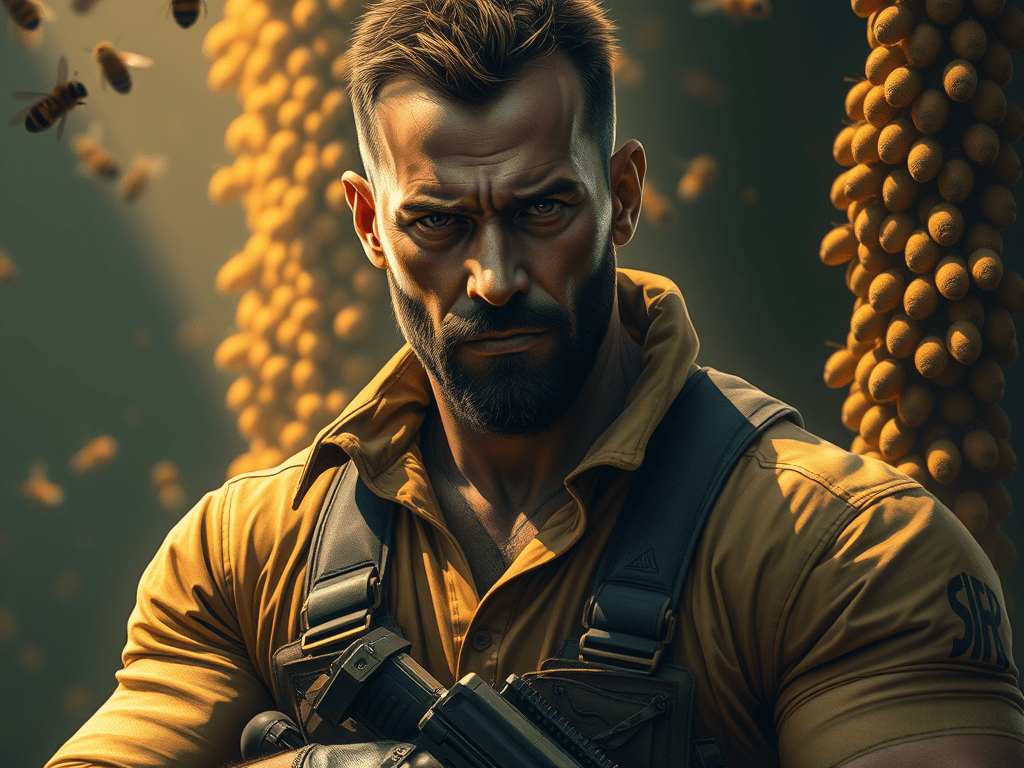
    Every so often, a movie swaggers onto the screen with such unshakable confidence in its own purpose—an unspoken contract between filmmakers and audience—that I can’t help but admire the sheer bravado. The Beekeeper, an Amazon Prime testosterone spectacle starring Jason Statham, is precisely that kind of film: a brutal ballet of vengeance so perfectly engineered for maximum chest-thumping satisfaction that it practically deadlifts itself.

    Our hero, Adam Clay, is a man of few words and many well-placed punches. His backstory? Nonexistent—because real action heroes don’t need exposition. They exist in a realm where stoicism equals strength, silence signals imminent violence, and full sentences are for the weak. Clay has chosen a life of peace, tending to bees on the estate of a kindly old woman, harvesting honey, and bestowing jars of liquid gold upon her as an act of gratitude. How exactly beekeeping prepares a man for high-level assassination remains a mystery, but the implication is clear: Adam Clay would rather live in the Edenic tranquility of clover honey, but if you disturb the hive, you will suffer his wrath.

    And, predictably, the hive is disturbed. A predatory phishing scam wipes out his landlady’s life savings, pushing her to despair and suicide. In that moment, Clay transforms from beekeeper of bees to beekeeper of vengeance, waging a holy war against smirking tech bros and their cabal of government-protected elites. His righteous fury catapults the audience straight back to the glory days of 1970s revenge-fueled ass-kickery, when heroes like Billy Jack and Buford Pusser solved systemic corruption with sheer brute force.

    The film’s producers deserve a standing ovation for their keen understanding of the bottomless demand for Alpha Male cosplay. This is pure cinematic pre-workout, a high-octane fantasy designed to spike aggression, validate every grueling hour in the weight room, and keep disaffected young men hypnotically tethered to their gym memberships. You, too, can be Jason Statham, if you only commit to your macros and the “warrior’s path.”

    Which brings us to the real fantasy at play here: the Monk Bro mythos—that lone, protein-fueled ascetic who carves himself into a Greek statue through sheer discipline and disdain for the modern world. The Monk Bro isn’t just a guy who lifts; he’s an ideology. He renounces traditional paths to adulthood—homeownership, relationships, emotional depth—and instead devotes himself to the only thing he can control: his body, his regimented diet, and his simmering resentment toward a world that doesn’t recognize his sacrifice.

    And here’s where The Beekeeper becomes more than just another revenge thriller: it’s a full-throated endorsement of the Monk Bro ideal. Statham’s character is the Platonic ideal of monkish masculinity—solitary, disciplined, lethal, utterly uninterested in romance, and powered entirely by righteous fury and lean proteins. This is not just an action movie; it’s a recruitment poster for every disaffected young man who has ever traded human connection for a relentless pursuit of muscle definition.

    Which brings me to the question I can’t shake: Why the bees? The movie is called The Beekeeper, yet the titular occupation has virtually nothing to do with the plot. Yes, “Beekeepers” is the name of an elite shadow organization of ex-special-ops agents, but that hardly explains the lovingly shot sequences of Statham methodically tending to his apiary. Why the rustic honey jars? Why the solemn reverence for beekeeping as a metaphor for… what, exactly? It’s as if someone spliced together John Wick and a National Geographic special on pollinators. Pooh Bear goes Punisher.

    And yet, for all its bizarre choices, the movie delivers exactly what it promises: a masterclass in stoic masculinity, a symphony of shattered bones, and a power fantasy where the hive is safe, the villains are obliterated, and every gym bro watching goes home dreaming of their own righteous war against the smug, tech-savvy forces of evil.

  • ROAD HOUSE IS A 2-HOUR INFOMERCIAL FOR TESTOSTERONE

    ROAD HOUSE IS A 2-HOUR INFOMERCIAL FOR TESTOSTERONE

    My pride as a lifelong bodybuilder took a glorious nosedive one recent evening when, sprawled on the couch like a man who had long abandoned ambition, I decided to indulge in the cinematic opus that is Road House. This film—if we must use that term generously—stars a Jake Gyllenhaal so sculpted he looks like Michelangelo, midway through carving David, got bored and said, Screw it, let’s make him a UFC fighter instead.

    Gyllenhaal plays a brooding, sinewy bouncer in Key West, grinding out a living by doing what all action heroes must—protecting a bar and its stunning owner, played by Jessica Williams, from the looming threat of corrupt mob bosses. Naturally, this leads to an inevitable showdown with their number-one enforcer: Conor McGregor, sporting the physique of a shaved grizzly bear on clenbuterol, his veins bulging like he’s one flex away from detonating. His performance lands somewhere between rabid pit bull and man who hasn’t blinked since 2019, and frankly, it’s magnificent.

    The plot? Barely there—thinner than a gas station receipt and about as consequential. It’s the classic Western trope: a stranger rides into town, cleans up the mess, and leaves behind a trail of broken bones and smoldering stares. But let’s not kid ourselves—the storyline exists solely as an excuse to showcase glistening, heaving slabs of muscle in slow motion. The camera caresses each bicep, each rippling lat, with the kind of reverence usually reserved for Renaissance art. It’s not an action movie so much as a two-hour infomercial for pre-workout supplements, high-intensity interval training, and whatever unregulated substance has been making its way through underground fight gyms.

    Somewhere between Gyllenhaal’s 47th shirtless moment and McGregor snarling like a man whose only source of hydration is pure testosterone, I found myself reaching for my phone—not to check the time, but to Google Conor McGregor’s diet plan. Because Road House isn’t just a film—it’s a flashing neon sign reminding you that you are, at best, a sentient pudding cup compared to these granite-hewn demigods. This isn’t entertainment; it’s an intervention. And the message is clear: drop the remote, pick up a kettlebell, and try to reclaim your dignity before it’s too late.

    When the credits finally rolled and I peeled myself off the couch, I had a revelation—if I wanted my memoir, Cinemorphosis: How I Become the Hero of Every Show I’ve Ever Watched, to thrive in today’s ruthless marketplace, it too needed a marketing tie-in. Just as Road House is a Trojan horse for fitness supplements and gym memberships, my book needed its own branded merchandise. But considering my subject matter—living vicariously through TV characters—the only viable promotional tie-in would be a chain of Self-Flagellation Chambers™, where disillusioned TV addicts could atone for their wasted lives. Or perhaps a TV Watcher’s Repentance Kit, complete with a burlap sack, an artisanal cilice, and a deluxe “discipline” whip for those long, dark nights of the soul.