Tag: news

  • How We Outsourced Taste—and What It Cost Us

    How We Outsourced Taste—and What It Cost Us

    Desecrated Enchantment

    noun

    Desecrated Enchantment names the condition in which art loses its power to surprise, unsettle, and transform because the conditions of discovery have been stripped of mystery and risk. What was once encountered through chance, patience, and private intuition is now delivered through systems optimized for efficiency, prediction, and profit. In this state, art no longer feels like a gift or a revelation; it arrives pre-framed as a recommendation, a product, a data point. The sacred quality of discovery—its capacity to enlarge the self—is replaced by frictionless consumption, where engagement is shallow and interchangeable. Enchantment is not destroyed outright; it is trivialized, flattened, and repurposed as a sales mechanism, leaving the viewer informed but untouched.

    ***

    I was half-asleep one late afternoon in the summer of 1987, Radio Shack clock radio humming beside the bed, tuned to KUSF 90.3, when a song slipped into my dream like a benediction. It felt less broadcast than bestowed—something angelic, hovering just long enough to stir my stomach before pulling away. I snapped awake as the DJ rattled off the title and artist at warp speed. All I caught were two words. I scribbled them down like a castaway marking driftwood: Blue and Bush. This was pre-internet purgatory—no playlists, no archives, no digital mercy. It never occurred to me to call the station. My girlfriend phoned. I got distracted. And then the dread set in: the certainty that I had brushed against something exquisite and would never touch it again. Six months later, redemption arrived in a Berkeley record store. The song was playing. I froze. The clerk smiled and said, “That’s ‘Symphony in Blue’ by Kate Bush.” I nearly wept with gratitude. Angels, confirmed.

    That same year, my roommate Karl was prospecting in a used bookstore, pawing through shelves the way Gold Rush miners clawed at riverbeds. He struck literary gold when he pulled out The Life and Loves of a She-Devil by Fay Weldon. The book had a charge to it—dangerous, witty, alive. He sampled a page and was done for. Weldon’s aphoristic bite hooked him so completely that he devoured everything she’d written. No algorithm nudged him there. No listicle whispered “If you liked this…” It was instinct, chance, and a little magic conspiring to change a life.

    That’s how art used to arrive. It found you. It blindsided you. Life in the pre-algorithm age felt wider, riskier, more enchanted. Then came the shrink ray. Algorithms collapsed the universe into manageable corridors, wrapped us in a padded cocoon of what the tech lords decided counted as “taste.” According to Kyle Chayka, we no longer cultivate taste so much as receive it, pre-chewed, as algorithmic wallpaper. And when taste is outsourced, something essential withers. Taste isn’t virtue signaling for parasocial acquaintances; it’s private, intimate, sometimes sacred. In the hands of algorithms, it becomes profane—associative, predictive, bloodless. Yes, algorithms are efficient. They can build you a playlist or a reading list in seconds. But the price is steep. Art stops feeling like enchantment and starts feeling like a pitch. Discovery becomes consumption. Wonder is desecrated.

  • When Distrusting Experts Becomes Its Own Dogma

    When Distrusting Experts Becomes Its Own Dogma

    In his Atlantic essay “Everyone Hates Groupthink. Experts Aren’t Sure It Exists,” David Merritt Johns challenges the reflexive idea that groupthink is always harmful. He notes that Robert F. Kennedy Jr. and the MAHA movement accuse public-health experts of groupthink in order to undermine trust in institutions. Their narrative is familiar: elite scientists misled the public on masks and lockdowns, so now vaccines must be suspect too. But this rebellion against “consensus” doesn’t eliminate groupthink—it simply creates a rival version of it, one driven by conspiracy, resentment, and selective skepticism.

    Johns argues that not all group alignment is created equal. Sometimes consensus forms because experts evaluate evidence and converge on the best available guidance. Other times, conformity produces catastrophic choices. The trick is to distinguish disciplined collaboration from unthinking obedience. Irving Janis gave groupthink its negative reputation as the enemy of independent thought, but scholars like Sally Riggs Fuller and Ramon Alday complicate the picture, noting that what we often label “groupthink” may actually be bureaucratic opportunism—people following political incentives, not blind loyalty.

    The term has since been weaponized. Political commentators now dismiss peer-reviewed science as “groupthink” whenever it clashes with their ideology. Johns argues this is sloppy and dangerous. Blaming pandemic missteps on a mystical force called groupthink distracts from real causes, while assuming “lonethink”—the rebel outsider posture—automatically produces better decisions is equally foolish. Expertise demands rigorous debate, scrutiny, and correction, not reflexive suspicion or anti-institution bravado.

    Following conspiracy movements like MAHA and their crusade against vaccines reveals the stakes. Lives saved through immunization are treated as evidence of corruption, and public-health systems are condemned for doing exactly what they are designed to do: evaluate data, revise strategy, and protect citizens. When political identity replaces critical thinking and “groupthink” becomes a lazy insult for any professional consensus, the result is not liberation—it is reckless decision-making disguised as independent thought.

  • The Shock Jock Who Forgot to Pivot

    The Shock Jock Who Forgot to Pivot

    I still tune in to Howard Stern now and then, but most of what I hear these days sounds like a half-hearted reprise of his old shtick—sophomoric gags, body-function chatter, and adolescent innuendo that once jolted the airwaves but now just sag. In his prime, Stern was combustible: he blended pranks, irreverence, and enough genuine insight to keep his circus from collapsing. He earned his Radio Hall of Fame status by kicking down doors no one else dared touch.

    Now, as rumors of his retirement bubble and I endure his weary, autopilot banter with Robin, three thoughts claw at me. First: they don’t sound like they’re having fun anymore. This is a zombie act, plodding through the motions. Second: filling three hours of airtime every single day is a Sisyphean curse—nobody has that much worth saying without stuffing the sausage with sawdust. Third: we all have a shelf life. Relevance expires, and dignity demands a graceful exit.

    Stern’s curse is worse than most. His career persona—edgy, raunchy, forever pandering to prurience—has gone stale, but he’s trapped in it. The irony is brutal: a man smart enough to evolve chose to calcify. A decade ago, he could have pivoted, shed the shock-jock skin, and re-emerged as the wise veteran with conversations that mattered. Instead, while podcasts multiplied like caffeinated rabbits, he let himself be left behind.

    But maybe it isn’t too late. Imagine Howard 2.0: no longer the carnival barker of Sirius, but the philosopher-in-residence of his own café, sipping coffee and musing about culture, mortality, and meaning. Not fifteen hours of filler a week, but four hours of distilled insight—an hour twice a week, sharp and substantive. Podcasting is radio’s heir, and radio is in his DNA. Reinvention is the only antidote to irrelevance, and if he can summon the nerve, Stern could still surprise us.

  • The Tecsun PL-880 Fulfills My Expectations

    The Tecsun PL-880 Fulfills My Expectations

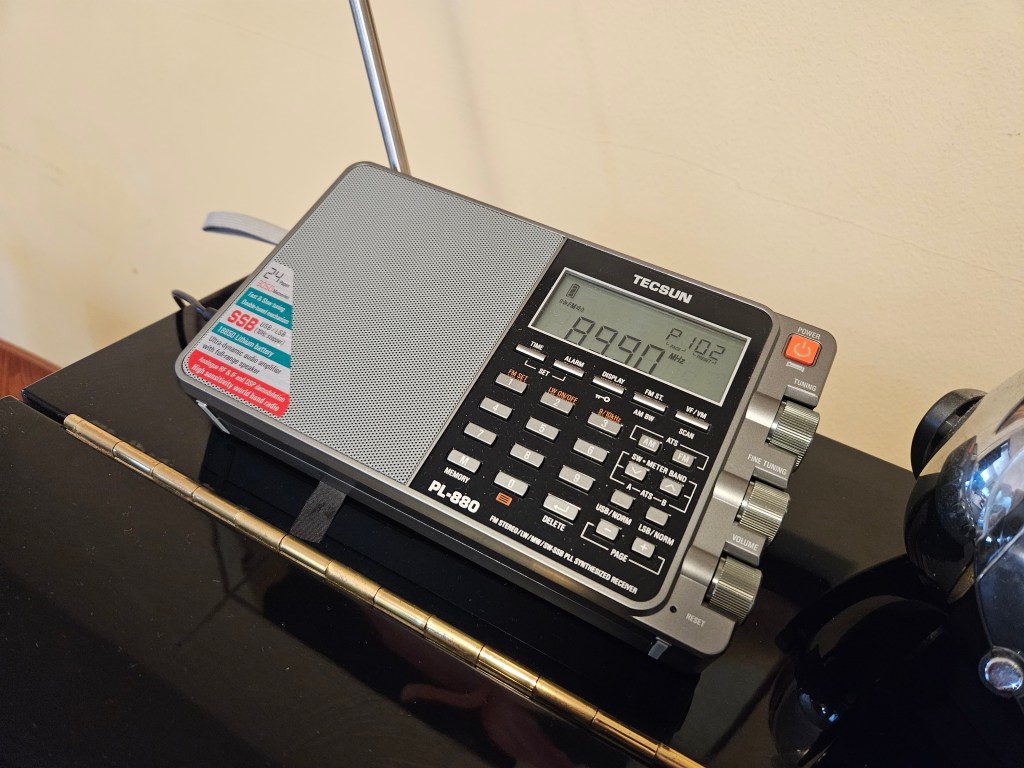
    20250122_144605

    I wanted a Tecsun in my bedroom—not some soulless streaming device, but a real radio, one with warmth, charm, and that inexplicable magic that only live broadcasts can offer. The idea was simple: a companion for afternoon naps and late-night reading sessions set to the soothing sounds of classical or jazz. After all, what better antidote to our algorithm-driven existence than the analog embrace of a good radio?

    Back in my radio-obsessed heyday around 2008, I foolishly sold my beloved Tecsun PL-660. Call it hubris, call it a lapse in judgment, but I’ve regretted it ever since. To atone, I snagged a used PL-660 for the kitchen and, for my bedroom sanctuary, opted for a Tecsun PL-880—a model lauded as a minor deity among radios.

    Now, let’s talk about my brief but painful dalliance with the PL-990. I ordered it from the reputable Anon-Co, expecting greatness, only to be greeted by an AM band as dead as a doorknob. Heartbreaking. Back it went, and in its place came the PL-880, slightly used but fully tested. And let me tell you, the speaker on the 880 is a revelation—warmer and more inviting than the 990’s. It’s like stepping into a cozy jazz club versus a sterile concert hall.

    The 880 arrived ready for action, with AM and FM defaults already set to North American standards—no fiddling required. On “DX” mode, the AM band delivers stunning clarity with zero floor noise or interference. It’s a joy to listen to, unlike 95% of the radios cluttering the market that barely rise above the status of glorified paperweights. FM performance is similarly impressive, though 89.3 gave me a little attitude when placed too close to the wall. A quick relocation to the bed or a spot away from the wall solved that, but the rest of the FM dial? Flawless. KCRW 89.9, in particular, comes through like it’s broadcasting from my nightstand, even while the battery charges.

    Speaking of AM, charging compromises its pristine reception, so I stick to battery power for those late-night AM sessions. Setting presets and navigating pages took a bit of patience—about 15 minutes of trial and error—but the interface is intuitive enough that even if you mess it up, direct entry is a breeze.

    In short, the PL-880 does exactly what I hoped it would: it fills my room with rich, crystal-clear sound, providing a listening experience that feels both luxurious and intimate. Sure, the PL-990 looks great and has fantastic build quality, but for my purposes, the 880 checks every box at a fraction of the cost. Why throw extra cash at a feature set I don’t need?

    Here’s the thing about being radio-obsessed: a radio isn’t just a gadget. It’s a companion, a quiet presence that connects you to a wider world while anchoring you in your own space. The PL-880 is just that—a welcome friend who’s already earned its place in my home.

    20250122_144540
  • Camry vs. Accord: A Meditation on Spec Sheets, Obsession, and the Art of Manspreading

    Camry vs. Accord: A Meditation on Spec Sheets, Obsession, and the Art of Manspreading

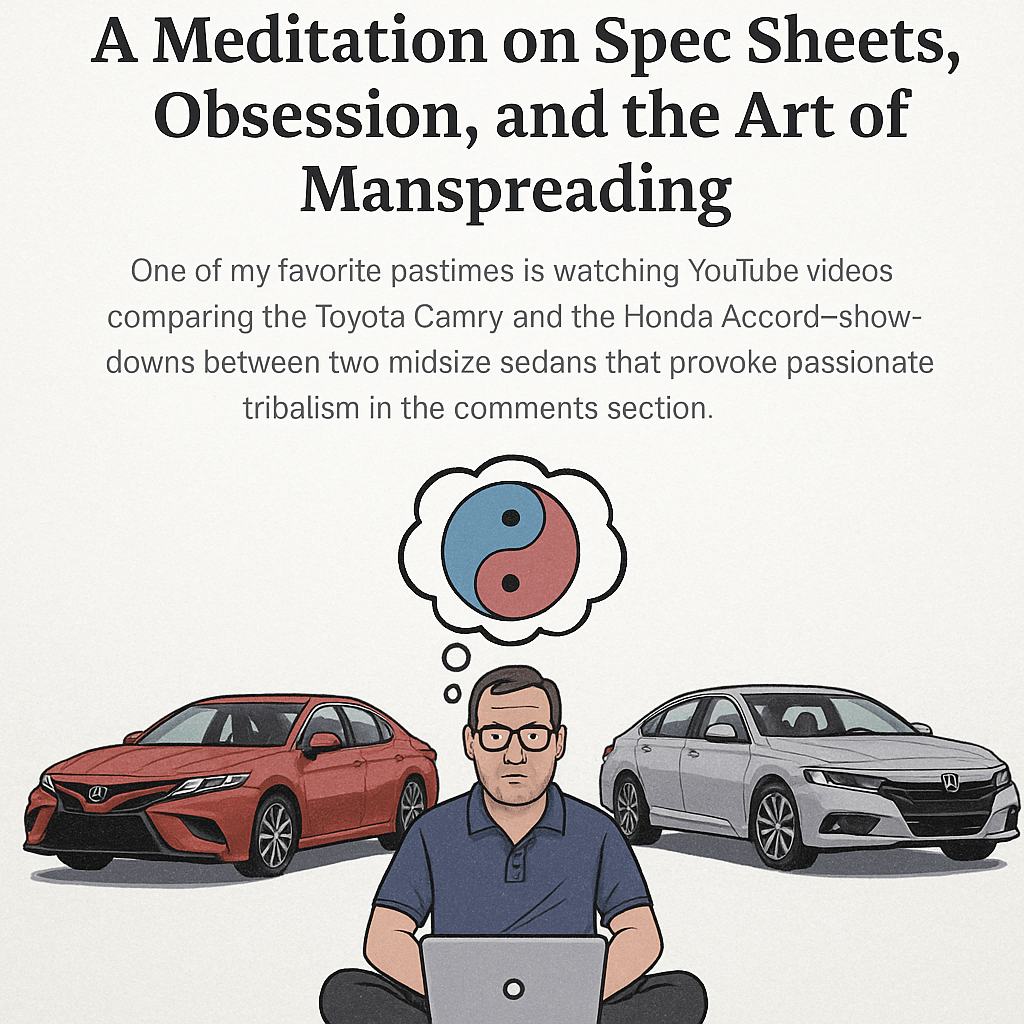
    One of my favorite pastimes—oddly specific and strangely soothing—is watching YouTube comparison videos of the Toyota Camry vs. the Honda Accord. I’m not car shopping. I don’t need a car. I may never buy another car. But these videos are my digital comfort food. They’re as satisfying to me as fine wine is to a sommelier or apple pie tastings are to a pastry chef—only instead of tasting notes, I savor engine specs and torque curves.

    There’s something singular about the Camry-Accord rivalry. In the sedan world, these two are the Goliaths. It’s not just another car comparison. It’s the comparison. Watching these two go head-to-head year after year is like seeing the best Steelers team take on the peak Patriots in a Super Bowl that never ends. Everything else—BMW vs. Mercedes, Rolex vs. Omega—feels less pure. BMW and Mercedes aren’t in the same pricing tier. Rolex exists in a brand vacuum. And while coffee maker comparisons have their niche charm, they lack the existential gravity of Camry vs. Accord.

    No rivalry inspires more content—or more heated debate. YouTube is flooded with these matchups, and if you scan the view counts, it’s clear: Camry vs. Accord is the king of consumer showdowns. Reviewers comb over the details with forensic intensity—fuel economy, powertrain specs, road noise, trunk space, rear-seat legroom, infotainment ergonomics, ride comfort, styling. They break it down like seminary students parsing Greek New Testament syntax.

    But what really fascinates me is the comments section, where strangers proclaim their loyalty with righteous conviction. Owners justify their purchase with religious fervor, deploying cherry-picked data to reinforce their superiority. It’s a textbook case of post-purchase rationalization: that psychological reflex where we inflate the virtues of what we bought to feel smarter, savvier, and self-assured.

    One commenter might praise the Accord’s refined cabin and roomier interior—but add that its exterior is so bland, driving one is akin to living as an NPC. Another insists Camry’s superior sales figures are proof of its aesthetic and mechanical dominance. Some dismiss the Accord entirely, predicting its extinction in five years. Others proudly declare they’re on their fifth generation of the same car, with brand loyalty woven into the fabric of their identity. For these drivers, the car isn’t a tool—it’s family.

    Ultimately, this rivalry isn’t really about cars. It’s about identity, tribalism, and the human need to choose a side and be right. It’s a Dr. Seussian fable in metallic paint: one team wears Honda badges, the other wears Toyota, and both believe their side represents reason, taste, and truth.

    For those of us with no appetite for political tribalism, this is our outlet. Camry vs. Accord is safer ground—less polarizing than politics, but don’t tell that to a diehard on either side. Watch how they argue: calmly, firmly, methodically—as if their livelihood depends on selecting the superior midsize sedan. They approach the debate with the solemnity of theologians discussing substitutionary atonement or post-mortem salvation.

    And me? I’m both relaxed and riveted. The debate calms my nerves and sharpens my focus. For a glorious hour, as I parse suspension tuning and rear-seat headroom, my worries dissolve. My thoughts narrow into something blissful. I study the specs like they’re verses from Leviticus. And in that deep focus, my anxiety lifts.

    Then it hits me: I don’t actually want the car—I want the focus. The Camry and Accord are just proxies for obsession. They’re placeholders in the temple of hyper-attention. Some people do yoga. I watch two middle-aged men compare infotainment systems like Cold War arms inspectors.

    And I do this with full self-awareness. I said earlier I might never buy another car. That wasn’t entirely true. My wife owns a 2014 silver Honda Accord Sport. I drive a 2018 gunmetal gray Accord Sport. We’re a two-Accord household. When it comes to car-buying, I’m conservative by nature—and what’s more conservative than buying a Camry or an Accord?

    I’m nearly certain our next car—whether hers or mine—will be one of the two. Likely an Accord, given that I’m six feet tall, 230 pounds, claustrophobic, and deeply committed to driver’s seat manspreading. The Accord gives me room to sprawl. The Camry? Not so much. I know this because, during a San Francisco vacation, an Uber driver picked us up in a brand-new Camry. It looked sleek from the curb, but once inside I felt like I was strapped into a fetal position. The experience ruined the car for me.

    And yet, I want to love the Camry. I really do. In my ideal life, my driveway would have both: the Camry and the Accord parked side by side like yin and yang. One the smooth operator, the other the sensible sibling. Their competition makes each better. Their rivalry sustains them both—and keeps me obsessively circling the rabbit hole.

    Because in the end, the Camry vs. Accord battle isn’t just about choosing a car. It’s about longing for clarity in a world of noise. It’s about choosing sides, rationalizing decisions, and pretending—for a few hours on YouTube—that the world makes sense if you can just pick the right sedan.

  • Crying at the Sink: The Dishwashing Grammy Awards

    Crying at the Sink: The Dishwashing Grammy Awards

    Don’t ask me why, but there’s something about doing dishes after dinner that turns me into a soft-focus emotional wreck. Somewhere between the soap suds and the rinse cycle, I cue up Rickie Lee Jones’s “Living It Up”—one of my all-time favorite songs—and without fail, it punctures the heart like a stiletto dipped in nostalgia. Tonight, it brought on another weepy micro-moment, which means it’s time to officially give it The Most Likely to Make Me Cry from Too Much Beauty Award.

    This of course sent me spiraling into my own kitchen-sink Grammy ceremony, where I began handing out awards like a deranged emotional sommelier.

    • Todd Rundgren’s “Can We Still Be Friends” wins The Song That Makes You Recommit to Being a Half-Decent Human Being Award. It’s the sonic equivalent of an awkward apology after ruining Thanksgiving.
    • The Isley Brothers’ “Living for the Love of You” earns The Track Most Likely to Be Playing in Heaven When You Arrive Award—assuming heaven has good speakers and excellent taste.
    • Yes’s “And You and I” takes home The Sounds-Like-It-Was-Composed-by-Angels-on-a-Mountain-Top Award. I don’t know what dimension that song came from, but it wasn’t this one.
    • John Mayer’s “No Such Thing” is given The Makes You Happy to Be a Living, Breathing Fool Award. It’s that rare pop song that makes you want to fist-pump your own mediocrity.
    • The Sundays’ “You’re Not the Only One I Know” walks away with The Makes Sadness So Gorgeous You Forget to Be Upset Award. It’s a musical sigh pressed between lace and rain.

    I could keep going—my brain has a whole red carpet lined up—but I’ve got another episode of Sirens on Netflix to cry through. Turns out the best part of my day is a cross between dish soap, beautiful songs, and low-level existential unraveling. What a life.

  • Trapped in the Sauna: When Bro Talk Becomes Brain Fog

    Trapped in the Sauna: When Bro Talk Becomes Brain Fog

    I’m 63, I live in the suburbs, and I like to sweat, laugh, and think—ideally all in the same day. I’ve got a soft spot for health and fitness talk, well-produced comedy, and podcasts where the ideas land harder than the punchlines. Back in the day, I gave Joe Rogan some ear time—especially when he had guests like Michael Pollan who could string together a sentence without referencing elk meat or hallucinogens. The show scratched a certain male itch: that longing for a tribal fire pit where you could grunt, swap kettlebell routines, and talk nonsense without getting side-eyed.

    I got it. I really did. There was a certain charm in the early years—the man cave as refuge, not bunker. A place for unapologetic masculinity that wasn’t trying to sell you a four-pack of testosterone supplements and a tactical flashlight.

    But then something changed. The man cave didn’t evolve—it ossified. It turned into a walled-off compound of grievance, smug anti-intellectualism, and half-baked conspiracy theories passed around like a tray of stale edibles. What once felt like a mixed bag of bro-science and genuine curiosity devolved into a middle-aged lunch table where the same unfunny comedians riff about whiskeys, bow hunting, and whether they’d survive a bear attack armed only with sarcasm and nicotine gum.

    So when I stumbled across Ghost Gum’s YouTube essay “The Collapse of the Joe Rogan Verse,” I hit play with morbid curiosity—and found it eerily validating. Turns out, I wasn’t alone in sensing that Rogan’s podcast had turned into a predictable, self-congratulatory echo chamber, where counterarguments go to die and every guest seems contractually obligated to flatter the host.

    The video’s roast of Tom Segura was especially brutal—and fair. Once the chubby, relatable everyman, Segura now floats in orbit around Planet Rogan, sneering at the unwashed masses like a guy who did keto once and now thinks he’s better than you. His comedy used to punch up; now it just punches down and preens.

    Comedy rooted in tribal loyalty becomes fan service, then becomes boring, then becomes embarrassing. What began as a countercultural clubhouse has curdled into a locker room thick with stale air and self-importance.

    Maybe Joe Rogan was once a necessary irritant to polite discourse, a reminder that the man cave had value. But too much time in that space without fresh air—and you forget it was never meant to be a throne room.

    Perhaps Joe Rogan’s unraveling podcast is just another cautionary tale of what happens when someone marinates too long in their own echo chamber and starts mistaking the sound of agreement for the sound of wisdom. Spend enough time surrounded by yes-men and protein powder, and eventually, you’re just getting high on your own supply—delirious with self-importance and blind to the rot setting in.

  • Brains for Glory: How Football Became the Lottery of the Left Behind

    Brains for Glory: How Football Became the Lottery of the Left Behind

    In Alana Semuels’ “The White Flight from Football,” we meet Shantavia Jackson, a single mother working the night shift at Home Depot. With three sons—ages 11, 12, and 14—she turns to youth football not just for recreation but as a form of structure, mentorship, and protection. Coaches become surrogate father figures, teaching discipline and teamwork. For her son Qway, who lives with a mental disorder, football provides a stabilizing force: a team that functions as his support system.

    For Shantavia, football isn’t just a sport—it’s an escape hatch. She can’t afford to send her sons to college, and she sees football as the only viable route out of a life circumscribed by poverty. It’s a desperate gamble, but in communities like hers, desperate gambles are often the only kind available.

    Against this backdrop, research continues to pile up showing that tackle football can cause severe and irreversible brain trauma. In response, many parents—particularly white and affluent—are pulling their children out of youth leagues. The ability to make that choice is, at its core, an expression of privilege. While white participation in youth football declines, Black participation remains disproportionately high: 44 percent of Black boys play tackle football, compared to just 29 percent of their white peers. This racial divide plays out on the national stage: today, Black athletes make up nearly half of all Division I college football players, up from 39 percent in 2000, while white athletes have dropped from 51 percent to 37 percent.

    The implication is grim: Black children are more likely to accept long-term risks because they have fewer short-term options. White children, cushioned by economic security and broader educational opportunities, can afford to walk away. The more the science reveals about the dangers of early head trauma, the more it becomes clear who is left holding the risk.

    And the science is damning. A 2017 Boston University study found that athletes who began playing tackle football before age 12 were twice as likely to develop behavioral problems and three times as likely to suffer from clinical depression. A separate study by Wake Forest University revealed that boys who played just one season of tackle football between the ages of 8 and 13 showed diminished brain function. The greatest fear is CTE—chronic traumatic encephalopathy—a degenerative brain disease caused by repeated hits to the head, not just concussions. Even subconcussive blows can cause lasting damage. In 2017, researchers examined the brains of 111 deceased NFL players. They found CTE in 110 of them.

    In response, some former players and medical experts now advocate delaying tackle football until high school, when bodies are more physically mature and kids are better able to understand and implement safe tackling techniques. But the sport is growing, not shrinking, and its profitability only reinforces the risk. At Texas A&M University, football generates $148 million a year. That revenue stream depends on a constant influx of young talent—often from families like Shantavia’s—eager for a scholarship and a shot at something better.

    The decision to play football, or not to, has become yet another expression of America’s racial wealth divide. As of 2021, the median wealth of white households was $250,400—about 9.2 times that of Black households, which stood at just $27,100. Though there have been modest gains in Black wealth, the gap remains vast. In 2022, the median wealth for Black households rose to $44,890—still far behind the $285,000 median for white households. This disparity isn’t merely numerical; it’s structural, baked into the opportunities people can or cannot access.

    In this context, football becomes less a sport and more a bloodletting ritual—one that disproportionately brutalizes the bodies of those with the fewest alternatives. For children growing up in neighborhoods with failing schools, limited healthcare, and short life expectancies, football isn’t just a game. It’s a high-stakes wager: risk your brain for a future, or settle for no future at all.

  • Welcome to the Age of the Algorithmic Snake Oil Salesman

    Welcome to the Age of the Algorithmic Snake Oil Salesman

    In her clear-eyed and quietly blistering essay, “The ‘Mainstream Media’ Has Already Lost,” Helen Lewis paints a picture that should make any old-school news anchor break out in hives: a world where Joe Rogan has more political leverage than the sitting Vice President of the United States. Days before the 2024 election, Kamala Harris reportedly wanted to appear on Rogan’s podcast. He declined. Not out of spite or political protest, but simply because he could. That’s power. That’s the media landscape now.

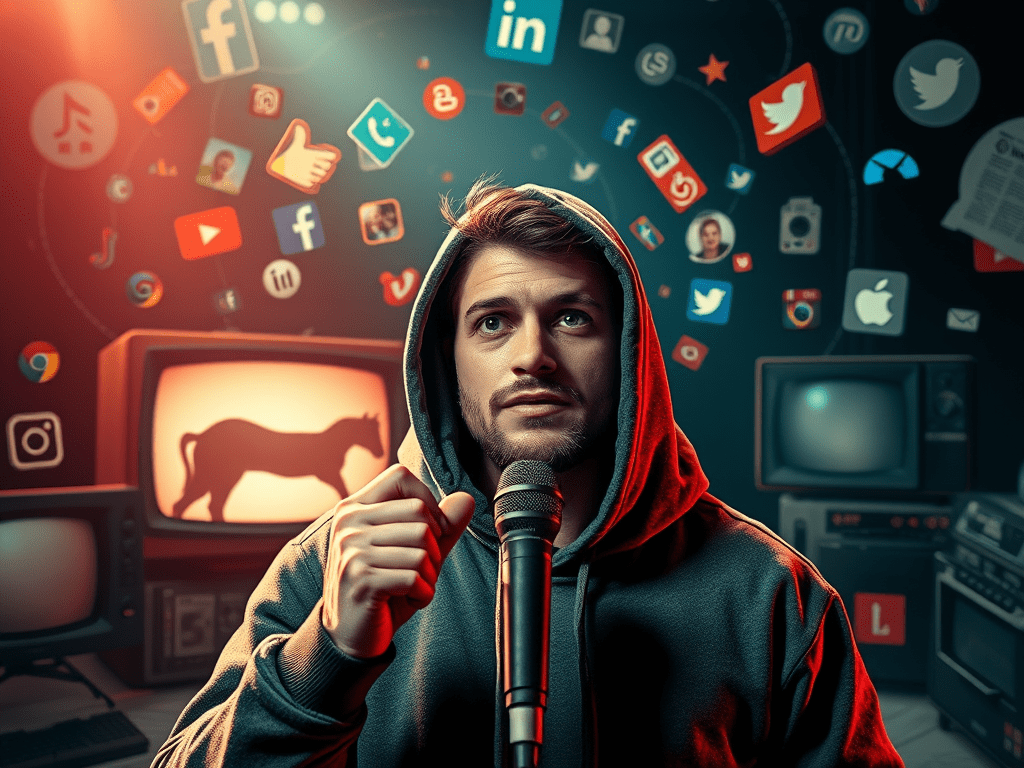
    The term “mainstream media” has become a wheezing relic, a dusty VHS tape of a bygone era. The networks that once shaped public consensus now resemble aging bodybuilders—still flexing, but under the blinding fluorescents of a Planet Fitness instead of the Mr. Olympia stage. Meanwhile, Rogan and his ilk bench-press audiences of millions, all while wearing hoodies and sipping from branded tumblers. He doesn’t need legacy media. Legacy media needs him—and it’s already too late.

    Lewis reports that 54 percent of Americans now get their news from social media. Let that sink in. More than half the country is being spoon-fed their worldview by apps designed to addict, outrage, and silo. Instead of objective reporting, people now binge infotainment curated by opaque algorithms trained to fatten engagement at any cost. These feeds aren’t delivering news; they’re cultivating dopamine dependency.

    Welcome to the Age of the Algorithmic Snake Oil Salesman. The modern grifter doesn’t stand on a soapbox in a public square—he livestreams in 4K from a ring light-lit garage, selling supplements, conspiracies, and cultural resentment like they’re Girl Scout cookies. Facts are irrelevant. Performance is king. These charlatans don’t have to be right—they just have to be loud.

    Irony of ironies: these influencers wrap themselves in the cloak of “authenticity.” They curse, they rant, they “tell it like it is,” but their every inflection is calibrated for virality. Rage isn’t an emotion—it’s a marketing strategy. Performative outrage now passes for truth, and click-through rates replace credibility.

    As the mainstream media limps into irrelevance, it takes with it a few other quaint notions—like science. In this brave new world, you don’t need peer review when you have followers. Why believe the CDC when a ripped guy with a ring light and an Instagram handle ending in “.truth” tells you that vaccines are a globalist plot? The return of diseases like measles and tuberculosis—once considered conquered—are just collateral damage in the war on expertise.

    And with the fall of old-school journalism, our already threadbare civic discourse has collapsed into a gladiator arena of smug narcissists screaming at each other with all the subtlety of a demolition derby. Politeness is for chumps. Nuance is for cowards. The algorithm doesn’t reward thoughtful dialogue—it feeds on belligerence. Online, the dumbest guy in the room often gets the biggest microphone, because ignorance is loud, confident, and apparently good for ad revenue.

    Let’s not forget critical thinking, that delicate orchid now trampled under the steel-toed boots of clickbait and tribal rage. The marketplace of ideas has become a black market of weaponized talking points. People are no longer consuming information—they’re huffing ideological fumes. And like any good addict, they don’t want to quit. They want a stronger hit.

    Lewis doesn’t offer false hope. There’s no tidy ending where the media reclaims its place and truth triumphs in a feel-good montage. Instead, she suggests the comeback of reason, of trust in science, of civil discourse—will only happen the way all painful recalibrations happen: through crisis. It will take something even more catastrophic than COVID-19 to shock us back into reality. Only when the fantasy scaffolding collapses and we’re left staring at real, unfiltered chaos will the fever break.

    Until then, we scroll. We rage. We share. We follow. We spin deeper into silos. And we continue pretending that Joe Rogan isn’t the new Cronkite.

    But he is.

  • Dumbbells and Demagogues: The Bizarre Battle for the Bros

    Dumbbells and Demagogues: The Bizarre Battle for the Bros

    In “The Battle for the Bros,” Andrew Marantz dons his flak vest and ventures into the testosterone-slicked minefield of online masculinity, where disenfranchised young men are drifting rightward faster than a Joe Rogan cold plunge. Bro culture, Marantz argues, isn’t just real—it’s a booming cottage industry of rage, raw meat, and red pills. It thrives on podcasts, YouTube channels, and Instagram feeds soaked in motivational bile, where carnivore diets, deadlifts, and conspiracy theories all count as self-improvement.

    At the center of this digital flex-off is the Rogan Industrial Complex, which has evolved from left-leaning curiosities like The Young Turks to its current stance of muttering about immigrants while gnawing on elk jerky and praising Vladimir Putin’s virility. Rogan isn’t just an influencer—he’s a cultural battering ram who can probably swing a presidential election with a few bro-ish shrugs and an anecdote about DMT. Meanwhile, the left is left blinking in the dust, coming off to many young men as smug, brittle, and somehow both humorless and condescending—like a human resources memo with a sociology degree.

    Marantz interviews Hasan Piker, a foul-mouthed socialist Twitch-streamer with cheekbones sharp enough to cut through the culture war. Piker wants to offer a leftist alternative to the Bro pipeline, but despite his 1.5 million subscribers, he’s still playing catch-up to Rogan’s podcast empire. Piker gets it: if you tell a broke 23-year-old living in his parents’ basement that he’s “privileged,” don’t be shocked when he rage-clicks his way into the arms of Andrew Tate.

    The tragedy—and farce—of this ecosystem is that much of it runs on ersatz authenticity. Grifters wear the costume of “real talk” while peddling warmed-over xenophobia and junk-science self-help. Marantz muses on whether the left can produce its own no-nonsense avatar of male angst—someone with enough swagger, wit, and working-class rage to compete. Though not mentioned in the essay, Bill Burr came to mind as I pondered a possible counterforce to the bro culture from the right. Burr is pissed off, principled, and perpetually exasperated—a man who could roast Elon Musk and filet toxic masculinity in the same breath. But Burr is sui generis, not a manufactured product. As Marantz rightly notes, you don’t summon authenticity with a PR team and a protein shake.

    The real kicker? In a post-truth world, what matters isn’t truth—it’s vibes. And right now, the right’s vibes are winning the war for the bros.