FOMO is never stronger than in childhood, when imagination stretches farther than reality can reach and the world feels just beyond our grasp. To a child, magic is real, enchantment is tangible, and some hidden paradise always seems just out of reach—close enough to see, impossible to touch. And nothing stings quite like realizing that somewhere, right now, a better world exists, and you are not in it.
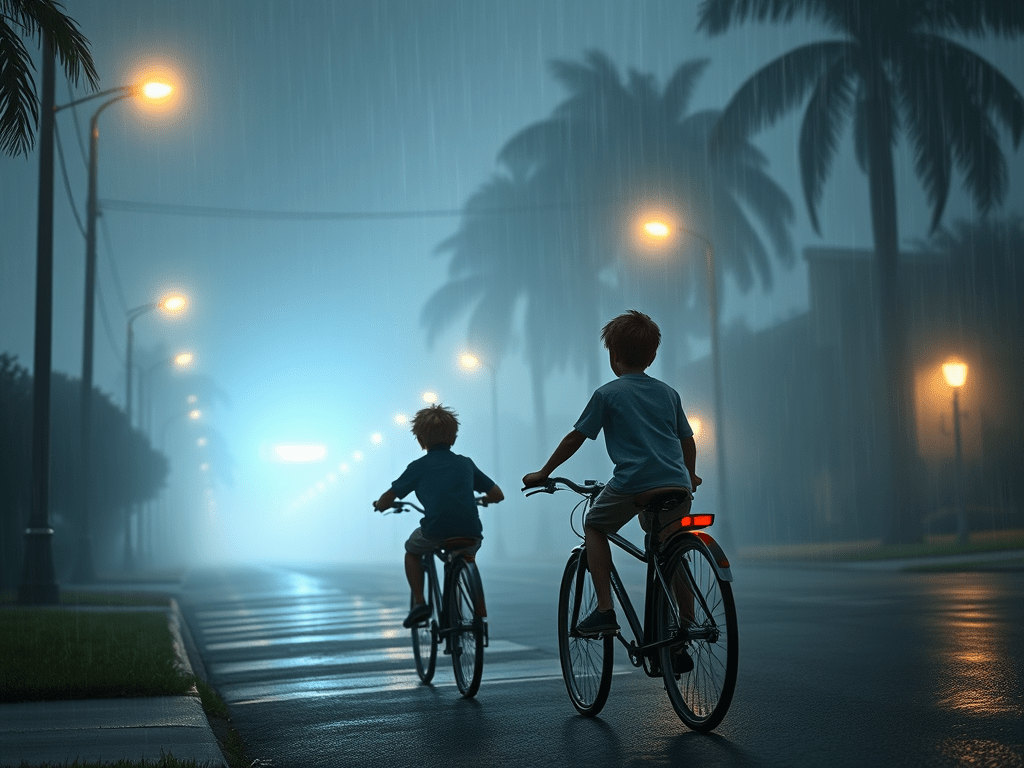
I learned this lesson in the summer of 1968 in San Jose, California, while riding bikes with my neighbor, Billy Cantambay. We were two six-year-olds, circling Venado Court as a fine mist of summer rain fell around us, making the streetlights glow and the air smell like wet pavement and possibility.
Then we saw it:
A single blue light flickering in the distance, hovering above the unfinished housing developments at the edge of the neighborhood. It twinkled through the fog like a Christmas bulb detached from time, a spectral glow that neither of us could explain.
“Christmas lights!” one of us shouted.
“Christmas lights!” the other echoed.
But why was Christmas happening over there and not here? Whose house was that? What kind of people lived beneath that glow? In my mind, I pictured a lone man inside—not lonely, just content—waking up to Christmas every day.
For a week, Billy and I worshipped the light, riding our bikes in endless circles, pointing, speculating, longing. Then one evening, it was gone. No explanation. No goodbye. Just a vanishing act, leaving behind nothing but an ache—an inexplicable sadness, as if we had been denied entry into something greater than ourselves.
Four years later, another dream slipped through my fingers, and this time, I cried about it.
My fifth-grade friend Marc Warren had invited me to Piper’s Smorgasbord in San Leandro, California—a kingdom of pizza, fried chicken, and blueberry pie, where gluttony was not just encouraged but a sacred ritual. By the time we left, we were bloated with triumph.
Driving home, still drunk on sugar and grease, we talked about our flying dreams.
Not figurative flying—not ambition, not success—actual flying. The kind where you jump off a cliff and just go, gliding over the ocean, effortless, weightless, free.
The dreams were so vivid—we could remember the wind in our faces, the rush of air under our arms, the certainty that we would never fall.
And then, reality crashed down.
We weren’t flying. We would never fly.
The grief was immediate, existential, crushing.
Two fifth-graders, staring out the car window, weeping over the cosmic injustice of gravity.
That’s the cruelty of FOMO—it isn’t just about missing an event. It’s about missing a world, a place so real inside your imagination that its absence hurts like a phantom limb.
Every culture has its own version of this unreachable paradise—a place forever close but forever out of reach.
For me, it was Bali Ha’i.
The song, sung so hauntingly by Juanita Hall in South Pacific, tells of an island just across the water—visible, tantalizing, but never quite attainable.
I first heard it as a toddler in the Flavet Villages—a cluster of old military barracks repurposed as student housing in Gainesville, Florida, where my family lived near an alligator swamp and a stretch of forest.
Most people would have found the place bleak. I found it enchanted.
At dusk, my father and I would walk to the edge of the forest to visit a Mynah bird, which perched on the same branch every evening, watching us with an intelligence I couldn’t explain.
The swamp smelled of alligator dung, a rank, pungent stench that somehow filled me with a sense of cosmic belonging.
One night, as we stood beneath the Mynah bird, a distant radio played “Bali Ha’i.”
The melody wove itself into the moment, perfectly harmonizing with the humid night air, the bird’s quiet watchfulness, and the unseen creatures shifting in the darkness.
For the first time, I understood the ache of paradise lost.
In 1965, another world out of reach found me.
Her name was Barbara Eden.
She lived inside a genie bottle—a glowing jewel of a home, lined with pink and purple satin, circular sofas, and mother-of-pearl inlays.
To five-year-old me, this was the peak of human civilization.
I didn’t just want to watch I Dream of Jeannie. I wanted to live inside that bottle.
I imagined myself curled up on the velvet cushions, bathed in the warm glow of genie magic, whispering secrets with Jeannie as the outside world became irrelevant.
When it hit me—really hit me—that I would never live in that bottle, that the closest I’d ever get was a TV screen and my own relentless imagination, I felt crushed in a way I had no words for.
Even crueler?
That gorgeous genie home was just a painted Jim Beam whiskey decanter.
That’s what FOMO really is: intoxication by illusion.
And long before Instagram, long before airbrushed vacations and curated feeds, I was already intimately familiar with its sting.



 Cinemorphosis