Tag: podcast

  • Posting Ennui and the Rise of Podcast Land

    Posting Ennui and the Rise of Podcast Land

    It’s a small miracle that Kyle Chayka’s New Yorker piece, “Are You Experiencing Posting Ennui?”, wasn’t published five years ago. The argument feels overdue—like an obituary written long after the corpse started to stink. Chayka observes what most of us have already felt in our scrolling bones: the golden era of amateur posting—your breakfast photo, your blurry concert shot, your moody-filtered selfie—has gone the way of the lava lamp and the Livestrong bracelet. What was once dubbed “valorized amateurism” now reads like cringe-inducing narcissism.

    In its place, we have the glossy perfection of influencers and the manic edge of doom content. It’s either an unboxing of a $5,000 Japanese toaster or a clip forecasting economic collapse by Tuesday. There is no middle.

    Some of this is generational. Millennials have aged out of thirst traps and into soft lighting and privacy. Gen Z, including my daughters, treat public self-aggrandizement with the kind of disgust once reserved for timeshare pitches and chain emails. To them, most online posting isn’t just unnecessary—it’s embarrassing.

    Chayka diagnoses the affliction as posting ennui—the existential fatigue of shouting into a void dominated by micro-celebrity algorithms and brand-filtered banality. We used to post in order to share something real; now we post to survive the algorithm’s cold indifference. And the algorithm doesn’t even show our friends anymore. So what’s the point? The casual post is now a ghost of its former self—undone not by controversy, but by irrelevance.

    Then there’s AI, which hangs over this whole landscape like a digital grim reaper. Now, even authenticity feels manufactured. Who made that caption? Who edited that face? Is that even a real voice? The uncanny valley has extended to your Instagram feed.

    Chayka predicts we may be headed toward what he calls Posting Zero—a post-social media state of blissful digital silence, where the compulsion to perform evaporates, and nobody’s life is reduced to a grid of curated lies.

    And honestly? I’m here for it.

    Let the pixelated word salads and beige hotel mirror selfies die a quiet death. Let the algorithm cannibalize itself. But here’s where I’ll add a wrinkle Chayka overlooks: even as posting dies, Podcast Land thrives.

    The podcast isn’t dead. It’s ascendant. While selfies wilt, microphones multiply. I know people—and I count myself among them—who have fully relocated to Podcast Land. Sam Harris talks to me for two hours a day. I fall asleep to history podcasts. I nap with AirPods in. I swing kettlebells to longform interviews about Stoicism and dopamine. I am deep in Podcast Land. I’ve got residency status.

    So yes, let the Instagram Stories dry up. Let the TikTok dances lose their rhythm. But don’t mistake this silence for disengagement. We’re still listening. We’re still absorbing. We’re just done performing.

    Welcome to Posting Zero. Now please keep your voice down—I’m trying to hear what Sam Harris is saying about the AI Takeover.
  • Podcrash

    Podcrash

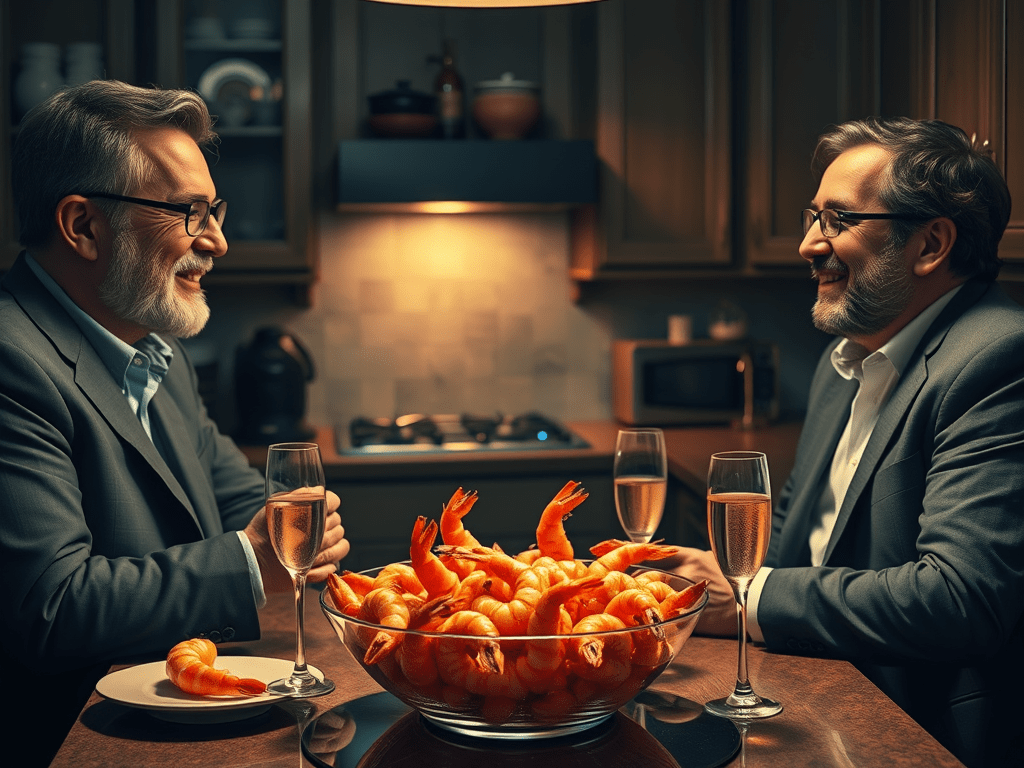
    Last night, I was in my kitchen, casually sharing shrimp, cocktail sauce, and champagne with public intellectuals Andrew Sullivan and Reihan Salam. As one does. We dove headfirst into the big topics: public policy, identitarianism, the collapse of critical thinking in echo chambers, and the shaky health of democracy. Between bites of shrimp and sips of champagne, we reveled in our status as lifelong learners, trading stories about childhood, lost pets, first crushes, and bouts of existential despair. The shrimp bowl magically replenished itself, and the champagne glasses never emptied. It was glorious—three intellectual heavyweights, solving the world’s problems, toasting to friendship and intellectual curiosity. For a fleeting moment, I felt like I’d reached peak existence: camaraderie, enlightenment, and a deeply inflated sense of self-worth, all in one glorious, shrimp-fueled evening.

    Only it didn’t happen.

    I was dreaming, my subconscious hijacked by The Dishcast. This is my nocturnal routine: When I go to bed at night, I fall asleep to a podcast and, before long, I’m the star guest. There I am, delivering profound manifestos about the human condition, my opinions urgently needed and universally admired.

    When I woke up, the camaraderie still lingered, as if Andrew and Reihan had just slipped out the back door, leaving only a faint echo of laughter.

    This happens all the time. In my dreams, I’m not just a listener—I’m part of the podcast universe, slapping backs, sipping champagne, and dropping truths no one dared to utter. Reality, by comparison, is disappointingly quiet.

    Clearly, podcasts are taking too much bandwidth in my brain. I’m not alone. Like millions of others, I’ve practically taken up residence in the world of podcasts. My life runs on a steady soundtrack of conversations and monologues, piped directly into my ears while I swing kettlebells, pedal my exercise bike, grade uninspired writing assignments, cook, eat, and scrub the kitchen into submission. Podcasts are my companions for post-workout naps, my co-pilots on the commute, and my salvation during middle-of-the-night insomnia—the kind where you wake up at 2 a.m., stare at the ceiling, and hope a familiar voice can lull you back to sleep before dawn.

    In total, I must rack up over a hundred hours of podcast listening every week. I spend more time in the podcast multiverse than in the real one, and inevitably, these voices have taken up permanent residency in my brain. Some of these parasocial relationships I welcome with open arms; others, I tolerate with the resigned grumbling of a bad roommate. And then there are the hosts who commit unforgivable sins—becoming smug, tedious, or worse, preachy—earning themselves a one-way ticket to oblivion. In this universe, the delete button is my only weapon, and I wield it without mercy.

    Living in the podcast world as I do—where most of my waking and sleeping hours are dominated by disembodied voices—I’ve started asking some uncomfortable questions. Have I, like millions of others, surrendered my brain to the podcasters, letting them hijack my mental real estate to my own detriment? Am I so immersed in podcast life that I’ve lost all perspective, like a fish in water, oblivious to how wet it is?

    What am I really after here? Entertainment? Wisdom? A surrogate friend? Or just noise to drown out the endless chatter in my own head? Why do some podcasts stick while others fall by the wayside? Are my favorites truly brilliant, or just slightly less irritating than their competition? Is it their buttery voices, sharp wit, or the fact that they don’t seem to realize they’ve become permanent fixtures in my inner monologue?

    Could I live without podcasts? Would the silence reveal things about myself I’m not ready to confront? What do I call that blissful, cozy state when I’m wrapped in the warmth of a trusted voice? Podcastopia? Earbud Nirvana? Sonic Solace? And is it possible to “love” a podcaster too much, like when I know their pet’s name but can’t remember my sibling’s birthday?

    Am I escaping something? Is this obsession a creative pursuit or an elaborate scheme to avoid existential dread? And most importantly, does this insatiable consumption mean something is deeply, hilariously wrong with me? Or does it point to something more profound—a need for a new word to describe the bottomless, soul-deep immersion of chasing episode after episode like a digital hunter-gatherer?

    Yeah, I’ve got questions. But it might be too late. I may already be The Man Who Loved Podcasts Too Much.

  • Writing a Blog in the Performative Hangover Era

    Writing a Blog in the Performative Hangover Era

    For over a decade, I ran a YouTube channel — a modest operation born in my late forties. Calling it a channel might be too grand: there were no edits, no soundtracks, no backgrounds, no clever image inserts. Just me, my watches, and a stubborn refusal to pretend I knew anything about video production. It was, in essence, a podcast that forgot it was supposed to be seen.

    I built a small but loyal audience — over 10,000 subscribers, steady commenters, familiar names. Within the narrow but fervent watch community, I was a known entity: a man chronicling the eternal scuffle with watch addiction.

    But now, staring down my sixty-fourth birthday this October, I’m stepping away — and not with a heavy heart, but with something closer to relief.

    First, I have no desire to become an influencer. The idea of monetizing my channel, hawking brands I barely tolerate, feels as alien as joining a boy band at my age. Second, I have zero interest in learning the sacred arts of Final Cut Pro wizardry. The polished, professional YouTuber life was never my ambition. Third — and most importantly — the fire that once drove me is gone. And good riddance. Fire, in my case, has always been another word for addiction — the old need for validation, the parasocial buzz of comment sections and endless watch chatter. I don’t want the fire back. I want peace.

    Does this retreat from YouTube mean a pivot to podcasting?
    No.
    I’m not looking for a new mirror in which to admire or define myself. I don’t need the hustle of relevance, or the 3 a.m. panic about subscriber counts. A podcast requires not just a theme but conviction — a genuine need to say something the world hasn’t already heard. Right now, my life is full of smaller, quieter things: amateur piano practice, kettlebell workouts in my garage, a general interest in health and fitness. None of these scream “launch a weekly show.”

    Sure, I could bang out a fitness video for people over fifty — it would take thirty seconds: Stay active, love people, eat real food, prioritize protein, lay off the booze. There, fitness empire built.
    But combing through the absurdly granular debates of the diet-industrial complex? No thanks.

    Truthfully, most social media feels unbearable to me now — bloated with performative sincerity, vibrating with empty gestures. I’m done performing. Like many, I have full-blown social media fatigue.

    And then there’s the nagging ghost of my old literary ambitions — the dream of publishing memoir, fiction, or some slippery hybrid of the two, the sort of “autofiction” the novelist Emmanuel Carrère perfected. That ghost finds me now, not on YouTube, not on a podcast, but on my blog.

    The blog is where I now quietly reign.
    Not as a digital emperor counting clicks, but as a stubborn craftsman hacking away at the weeds of complacency. I don’t know if my writing will “take off” or “storm the world.” I only know it helps me process the madness, fight entropy, and stay alert to the real battle — the one against mindless consumerism and numbing repetition.

    So here I am, in what I suppose I could call the next chapter.
    The Performative Hangover Years.
    The Post-COVID Malaise.
    The Be Brave in Your Sixties Project.

    I’ll get back to you with the final title once I’ve lived it a little longer.

  • The Man Who Loved Podcasts Too Much

    The Man Who Loved Podcasts Too Much

    Last night, I was in my kitchen, casually sharing shrimp, cocktail sauce, and champagne with public intellectuals Andrew Sullivan and Reihan Salam. As one does. We dove headfirst into the big topics: public policy, identitarianism, the collapse of critical thinking in echo chambers, and the shaky health of democracy. Between bites of shrimp and sips of champagne, we reveled in our status as lifelong learners, trading stories about childhood, lost pets, first crushes, and bouts of existential despair. The shrimp bowl magically replenished itself, and the champagne glasses never emptied. It was glorious—three intellectual heavyweights, solving the world’s problems, toasting to friendship and intellectual curiosity. For a fleeting moment, I felt like I’d reached peak existence: camaraderie, enlightenment, and a deeply inflated sense of self-worth, all in one glorious, shrimp-fueled evening.

    Only it didn’t happen.

    I was dreaming, my subconscious hijacked by The Dishcast. This is my nocturnal routine: When I go to bed at night, I fall asleep to a podcast and, before long, I’m the star guest. There I am, delivering profound manifestos about the human condition, my opinions urgently needed and universally admired.

    When I woke up, the camaraderie still lingered, as if Andrew and Reihan had just slipped out the back door, leaving only a faint echo of laughter.

    This happens all the time. In my dreams, I’m not just a listener—I’m part of the podcast universe, slapping backs, sipping champagne, and dropping truths no one dared to utter. Reality, by comparison, is disappointingly quiet.

    Clearly, podcasts are taking too much bandwidth in my brain. I’m not alone. Like millions of others, I’ve practically taken up residence in the world of podcasts. My life runs on a steady soundtrack of conversations and monologues, piped directly into my ears while I swing kettlebells, pedal my exercise bike, grade uninspired writing assignments, cook, eat, and scrub the kitchen into submission. Podcasts are my companions for post-workout naps, my co-pilots on the commute, and my salvation during middle-of-the-night insomnia—the kind where you wake up at 2 a.m., stare at the ceiling, and hope a familiar voice can lull you back to sleep before dawn.

    In total, I must rack up over a hundred hours of podcast listening every week. I spend more time in the podcast multiverse than in the real one, and inevitably, these voices have taken up permanent residency in my brain. Some of these parasocial relationships I welcome with open arms; others, I tolerate with the resigned grumbling of a bad roommate. And then there are the hosts who commit unforgivable sins—becoming smug, tedious, or worse, preachy—earning themselves a one-way ticket to oblivion. In this universe, the delete button is my only weapon, and I wield it without mercy.

    Living in the podcast world as I do—where most of my waking and sleeping hours are dominated by disembodied voices—I’ve started asking some uncomfortable questions. Have I, like millions of others, surrendered my brain to the podcasters, letting them hijack my mental real estate to my own detriment? Am I so immersed in podcast life that I’ve lost all perspective, like a fish in water, oblivious to how wet it is?

    What am I really after here? Entertainment? Wisdom? A surrogate friend? Or just noise to drown out the endless chatter in my own head? Why do some podcasts stick while others fall by the wayside? Are my favorites truly brilliant, or just slightly less irritating than their competition? Is it their buttery voices, sharp wit, or the fact that they don’t seem to realize they’ve become permanent fixtures in my inner monologue?

    Could I live without podcasts? Would the silence reveal things about myself I’m not ready to confront? What do I call that blissful, cozy state when I’m wrapped in the warmth of a trusted voice? Podcastopia? Earbud Nirvana? Sonic Solace? And is it possible to “love” a podcaster too much, like when I know their pet’s name but can’t remember my sibling’s birthday?

    Am I escaping something? Is this obsession a creative pursuit or an elaborate scheme to avoid existential dread? And most importantly, does this insatiable consumption mean something is deeply, hilariously wrong with me? Or does it point to something more profound—a need for a new word to describe the bottomless, soul-deep immersion of chasing episode after episode like a digital hunter-gatherer?

    Yeah, I’ve got questions. But it might be too late. I may already be The Man Who Loved Podcasts Too Much.

    After waking up from my dream of hanging out with Andrew Sullivan and Reihan Salam, I crept into the kitchen for breakfast–a self-inflicted atrocity of overnight oats. Not just any overnight oats, mind you, but a Trader Joe’s variety touting “ancient grains,” as if the endorsement of long-dead civilizations could somehow redeem the experience. Spoiler: it didn’t. Despite my best attempts at culinary CPR—vanilla protein powder, a smattering of berries, and a dusting of pumpkin spice—the result was still cold, gluey sludge, the breakfast equivalent of a wet handshake.

    Each spoonful felt like a personal affront, a betrayal by my own hands, as though I had willingly prepared the kind of gruel Dickensian orphans would revolt over. The texture was an abominable mix of paste and gravel, and the cold temperature screamed “punishment” rather than “sustenance.” By the end, I wasn’t just eating; I was enduring. Mental note: next time, boil this nonsense into something remotely edible—or toss it and make a proper breakfast for a self-respecting adult.