Last night I took my family to the wildly popular Din Tai Fung at Del Amo Fashion Center. The restaurant is so sought after that reservations are practically mandatory. We arrived at 5:15, where the hostess handed me one of those vibrating plastic squares whose sole purpose is to inform you that civilization has deemed you worthy of a table.
The place hummed with confidence.
While countless restaurants sit half-empty, echoing like abandoned aircraft hangars, Din Tai Fung radiates the quiet swagger of a business that knows people will happily wait an hour for dumplings. Crowds are persuasive. We instinctively trust a line.
Let me say at the outset that I have nothing but respect for the restaurant. The food was fresh, the service polished, and the operation impressively efficient.
I probably won’t return.
The restaurant isn’t the problem.
We are.
More specifically, our method of eating.
The pilgrimage began a month ago when my teenage daughter announced that we had to go. I immediately suspected the true maître d’ behind this reservation.
TikTok.
She already had the menu mapped out on her phone like General Patton preparing the invasion of Sicily. We surrendered command without resistance.
Soon the table filled with cucumber salad, soy noodle salad, chicken dumplings, spicy chicken wontons, garlic string beans, sesame noodles, and spicy noodles.
Then came dessert.
Naturally, dessert wasn’t merely consumed.
It was documented.
My daughter carefully filmed her chocolate-and-mochi xiao long bao with sea salt cream, followed by a mountain of mango shaved ice, ensuring that posterity—and TikTok—would know she had participated in this important cultural event.
The food was certainly good.
But I never experienced the culinary epiphany I had been promised.
Instead, I found myself eating an astonishing quantity of carbohydrates swimming through enough sauce to lubricate heavy machinery. Every dish seemed to plead for a dinner roll that never arrived. By the end of the meal I was pleasantly full but oddly unsatisfied, as though my body kept asking,
“Where exactly was the protein?”
The service, though gracious, occasionally drifted into theater.
Our server—a delightful young woman—carefully demonstrated how to combine vinegar, soy sauce, and chili oil with the solemnity of a physicist unveiling the double helix. Her instructions were earnest and impeccably delivered.
I couldn’t help wondering whether I was preparing dumplings or splitting the atom.
Then came the part I liked least.
Family-style dining.
In theory, it is wonderful.
Everyone samples everything.
Conversation flows.
The table becomes a communal celebration.
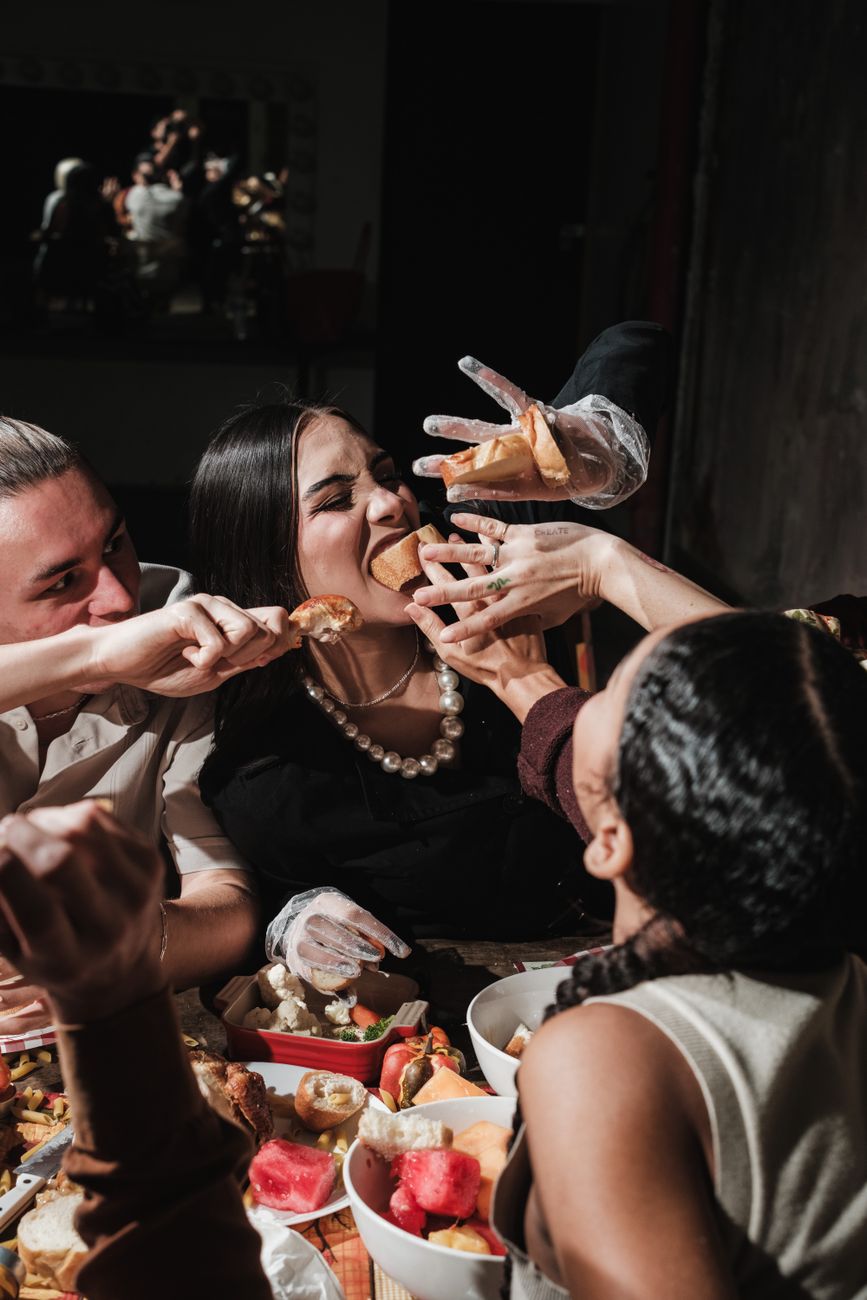
In practice, our table resembled an Olympic qualifying event.
Chopsticks lunged in every direction.
Bowls crossed paths.
Sauce migrated across plates, fingers, sleeves, and probably several neighboring ZIP codes. I found myself wishing I’d packed a HAZMAT suit.
Adding to the chaos, my TikTok-inspired daughter attacked the shared dishes with the urgency of someone preparing for hibernation, leaving her twin sister, my wife, and me politely negotiating whatever remained.
The meal became less about eating than about strategic timing.
Should I grab another dumpling now?
Will there still be string beans in thirty seconds?
Has anyone actually tasted the sesame noodles, or have they already disappeared?
After paying the bill, a staggering $200, and we finally arrived home, my wife quietly toasted herself a protein pancake, spread peanut butter on top, drizzled it with honey, and ate what amounted to her real dinner.
Then she made an observation that explained the entire evening.
“I never relax during shared meals,” she said. “It always feels like an eating competition, and I end up with the short end of the stick.”
The moment she said it, I realized I felt exactly the same way.
The problem wasn’t Din Tai Fung.
The problem was our assumption that communal eating automatically creates communal joy.
Sometimes it creates scarcity.
Scarcity creates competition.
Competition is not particularly relaxing.
I’ve reached a simple conclusion.
Next time, everyone orders their own entrée.
Everyone eats at their own pace.
Everyone leaves satisfied.
Family-style dining remains a lovely idea. It promises abundance, togetherness, and the pleasure of sampling half the menu.
Sometimes it delivers exactly that.
Other times it turns dinner into a low-grade food draft where you’re calculating dumpling trajectories instead of enjoying your family’s company.
When that happens, I can’t help asking myself a simple question.
Why didn’t I just walk next door to Frida, order a platter of rib-eye tacos, sip a mango margarita, and let everyone else fight over the last dumpling?


 Cinemorphosis