Tag: review

  • The Clean Split: Seiko Romance vs. G-Shock Precision

    The Clean Split: Seiko Romance vs. G-Shock Precision

    For more than two decades, I lived inside the cathedral of Seiko divers—mechanical, muscular, faintly mythic. Then, without warning, I developed a taste for G-Shock. Not the entire sprawling catalog—just a narrow, almost doctrinal subset: Tough Solar, Multiband-6, digital display. Precision without ceremony. Time as a solved problem.

    Strangely, this new fixation didn’t dethrone the old one. If anything, it refused to engage it. My Seikos–SLA051, SLA023, SLA055, SBDC203, the Tuna SBBN049–continue their analog romance, ticking away with artisanal stubbornness. The G-Shocks, by contrast, operate with cold, atomic certainty. They don’t drift; they don’t charm; they don’t ask for admiration. They simply tell the truth. I find myself wearing them more often, yet the two categories never compete. They inhabit parallel realities, each complete unto itself.

    What used to be a single, coherent hobby has split into two clean domains. Not a conflict–more like a continental drift. The G-Shocks don’t diminish the Seikos, and the Seikos don’t dignify the G-Shocks. They coexist without conversation. The complication, if it can be called that, has the feel of an upgrade: a second language acquired late in life, one that doesn’t replace the first but sharpens your sense of what each can do.

    And once you see the line, you want to ink it in.

    I’ve started returning my Seikos to their bracelets, restoring them to their native uniform—steel on steel, no ambiguity. Only the Seiko SLA051 gets a pass; it belongs on a waffle strap the way certain truths belong in plain speech. The rest will click back into their bracelets like soldiers resuming formation. The goal isn’t function; it’s taxonomy. I want the collection to declare itself in two voices, not one muddled chorus.

    This is the quiet compulsion at work: the need to clarify, to separate, to keep categories from bleeding into one another. Call it Horological Bifurcation Syndrome–the clean split of a once-unified obsession into two ecosystems with incompatible logics and equal appeal. On one side, mechanical romance: weight, history, the seduction of imperfection. On the other, digital precision: light-powered, atom-synced, immune to drift. They don’t compete. They refuse to integrate. And the more I indulge them, the more I prefer it that way.
  • Unless You’re Certain Your G-Shockification Is Permanent, Keep Your Mechanical Divers

    Unless You’re Certain Your G-Shockification Is Permanent, Keep Your Mechanical Divers

    My mechanical watches sit in their box like retired athletes—well-kept, occasionally exercised, no longer in the game. Every so often I take one out, give it a few dutiful shakes, wind it like a ritual I don’t quite believe in, and return it to its padded cell. The magic has evaporated. In its place: the afterimage of a fever swamp—a mind that mistook obsession for discernment, a man who let proportion slip while calling it passion.

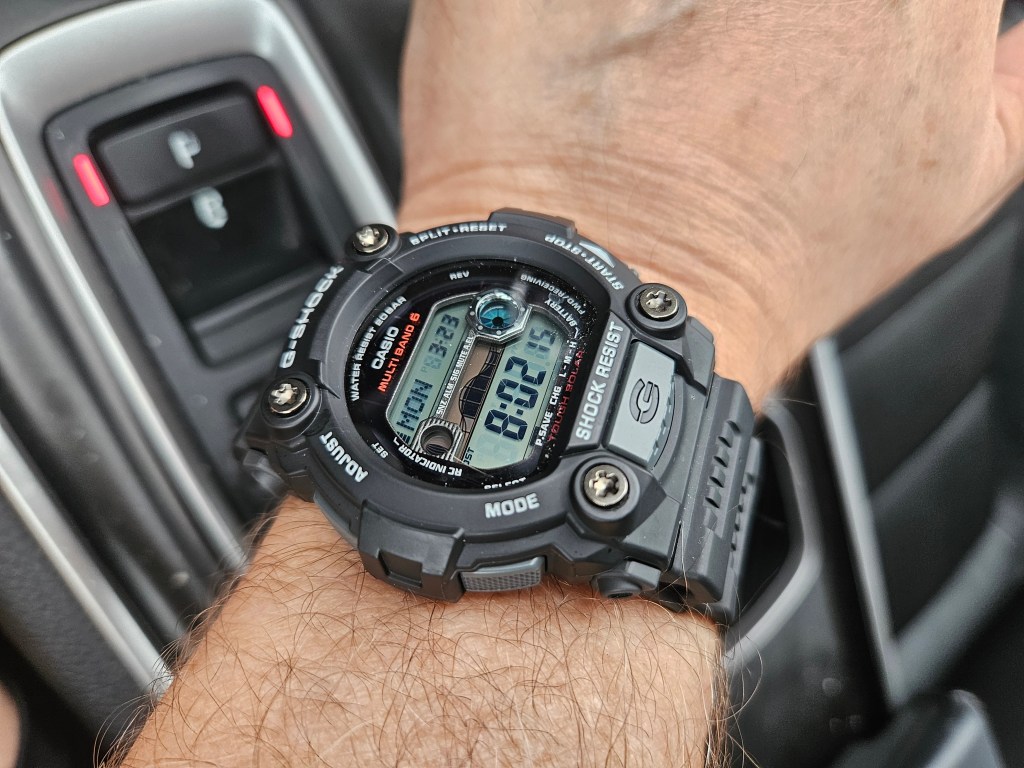
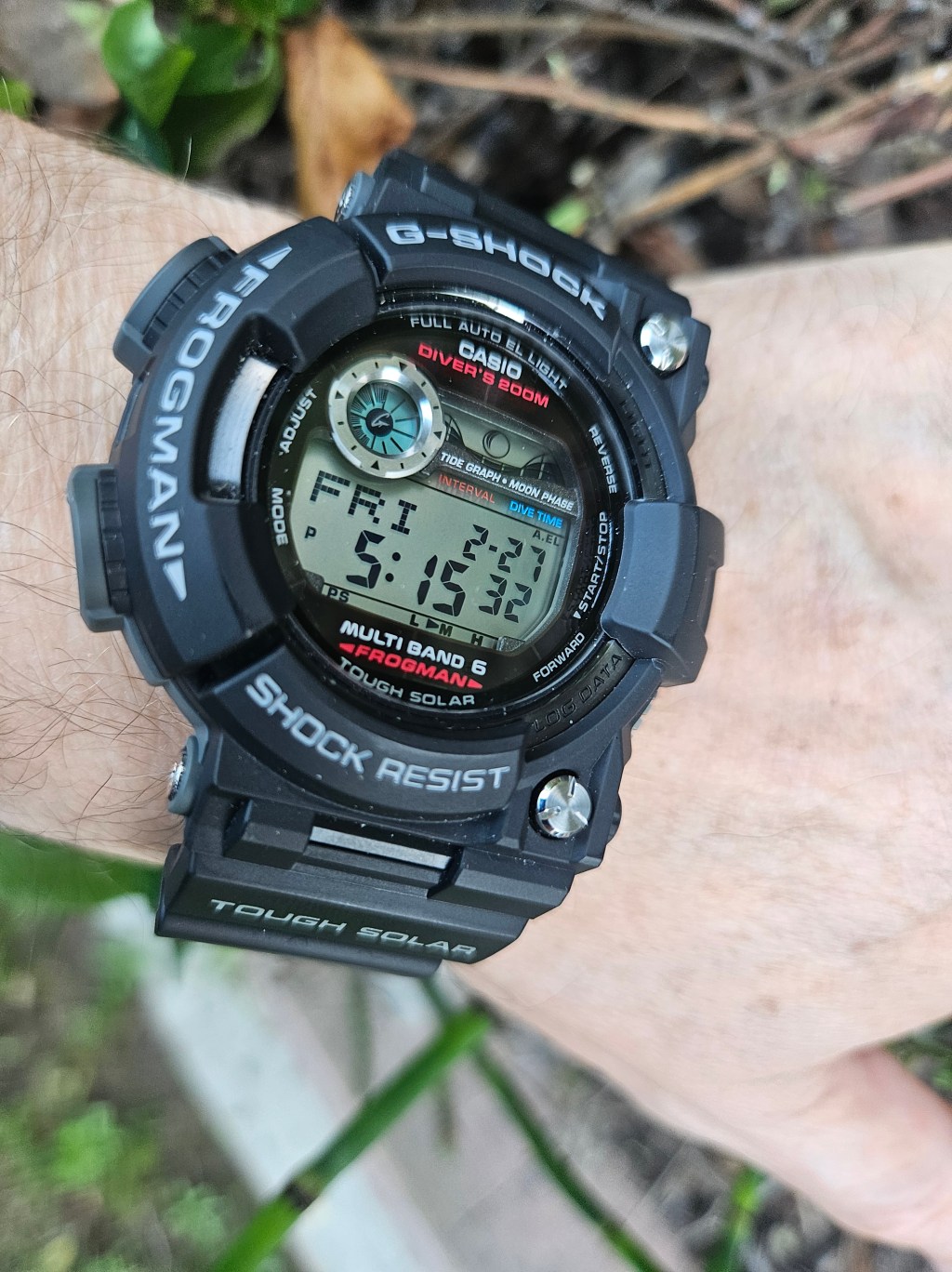
    Did I quit watches? No. I still strap one on every day. I rotate between two Tough Solar, Multiband-6 G-Shocks—the Frogman and the Rescue—and they do the one thing I apparently wanted all along: tell the correct time without drama. Precision, delivered nightly from a radio tower, not coaxed from springs and sentiment.

    The question nags: are these G-Shocks the nicotine patch—same habit, fewer toxins? A maintenance dose that keeps the shakes at bay while I detox from romance? Or have I simply traded one dependency for another, swapping lacquered nostalgia for resin certainty? I can imagine a small, sane G-Shock lineup—four, maybe five—but I recoil at the thought of a sprawling collection that demands wardrobe changes, spreadsheets, and a personality built around rotation schedules.

    I’m not selling the mechanicals. Not yet. A month is not a verdict; it’s a mood with good PR. I’ve undergone what I’m tempted to call a conversion—G-Shockification—but I don’t trust conversions. They arrive like thunder and leave like weather. If this holds, time will tell me so—accurately, for once.

    There’s also the quieter force at work: the sunk-cost instinct dressed up as dignity. When you’ve poured money, hours, and a piece of your identity into something, you don’t walk away—you renegotiate with yourself. You call it loyalty. You call it patience. You call it anything but regret.

    Let’s keep perspective. I own four mechanical divers and one quartz. This isn’t a warehouse liquidation. I’m not torching a museum. I’m a man with a small box and a slightly embarrassed past.

    So the divers stay—for now—on the shelf to my upper left as I type. They used to summon me: strap changes, wrist rotations, the ceremonial wipe-down. Now they sit in a quiet that feels less like neglect and more like clarity. The box hasn’t moved. I have.

  • Frogman Monstrosity Acceptance

    Frogman Monstrosity Acceptance

    I’ve tried to be candid about where my watch hobby is headed. For years I lived in the land of mechanical divers—those charming little machines that require winding, adjusting, and periodic visits to a watchmaker who looks at you the way a veterinarian looks at a sick horse. Lately, however, I seem to be drifting toward a different ecosystem: Multiband 6 atomic time delivered by my G-Shock Frogman, a watch that feeds on sunlight and quietly synchronizes itself with atomic clocks while I sleep. It is difficult to compete with a device that performs its duties with the calm efficiency of a Swiss train conductor who never needs coffee. The responses to this confession have been varied. Some readers nod knowingly and say they went through the same conversion. Their mechanical watches now sit motionless in drawers like retired prizefighters who once thrilled crowds but now spend their days remembering the old days. One friend is currently wandering around Thailand with a GW-5000U on his wrist and reports a level of contentment normally associated with Buddhist monks. Others have taken the opposite path and begun collecting Frogman models the way medieval villagers stockpiled shields before a siege, as if surrounding themselves with these massive amphibious contraptions might repel the chaos of modern life.

    And then there are the critics. They inform me—sometimes gently, sometimes with theatrical alarm—that I have lost my mind, contracted a disease, and strapped a grotesque monstrosity to my wrist. I concede every point. I am indeed crazed with enthusiasm, and the Frogman is unquestionably a monstrosity. But it is the most magnificent monstrosity I have ever encountered. I appear to have entered what might be called Frogman Monstrosity Acceptance: the psychological stage in which the owner stops apologizing for the watch’s outrageous proportions and instead embraces them with pride. Yes, it is enormous. Yes, it looks like a small amphibious armored vehicle designed by engineers who distrust gravity. But once you surrender to its scale, the Frogman ceases to be embarrassing and becomes something far better—a gleefully excessive titan among polite timepieces.


  • The Exit Watch That Blew the Exit

    The Exit Watch That Blew the Exit

    There comes a moment in every watch influencer’s career when he announces, with ceremonial gravity, that he has found his Exit Watch. This watch, he assures his audience, is different. It stands apart from the rest of the collection not merely in design, but in destiny. It promises completion. Closure. A sense that the long pilgrimage through steel and lume has reached its ordained end.

    The watch is so magnificent that it demands narrative consequences. The influencer hints at “big changes.” New content. A reimagined channel. Perhaps fewer uploads, perhaps deeper reflections. The implication is clear: the Exit Watch has not merely ended a collecting phase—it has matured the man.

    Then the watch arrives.

    It is flawless. Better than expected. The case sings. The dial radiates authority. The bracelet feels engineered by monks. The unboxing video trembles with reverence. For approximately forty-eight hours, the influencer experiences peace.

    Then something goes wrong.

    The watch does not quiet desire. It amplifies it. Instead of satiation, there is hunger—acute, feral, unprecedented. The Exit Watch behaves less like a sedative and more like a stimulant. New watches begin to haunt his thoughts. He starts browsing late at night. He rationalizes. He reopens tabs he swore were closed forever. The collection multiplies wildly, untethered from logic or restraint.

    Within months, the spiral is complete. The influencer is on the brink of losing his sanity, his marriage, and his house—saved only by a merciful uncle who wires sixty thousand dollars to send him to a rehab facility in the Utah desert. There, stripped of his collection, he learns to play the flute, hunt his own food, and live without Wi-Fi. He emerges thinner, quieter, and reconciled to a solitary G-Shock Frogman, worn not for pleasure but for survival.

    This is Exit Watch Reversal: the affliction in which a watch intended to conclude a collecting arc instead detonates it. The subject does not experience closure, but acceleration—as though the watch has unlocked a previously dormant appetite and handed it the keys.

  • Gunmetal, DLC, and the Case Against Babying a Watch

    Gunmetal, DLC, and the Case Against Babying a Watch

    If you’re a watch collector, you’ve probably flirted with the idea of a black watch. At some point, the monochrome seduction gets you. A black case on a matching bracelet has a severity to it—stealthy, self-contained, faintly militant. I’ve fallen for it more than once. I’ve owned some genuinely beautiful black watches.

    I no longer own any of them.

    Such is life in the fever swamp of watch addiction, where flipping is not a behavior but a temperament. Watches arrive. Watches depart. Attachments form briefly and dissolve without ceremony.

    Take me back to around 2012. I owned two PVD-coated Seiko kinetic divers: the SUN007 and the SKA427P1. They were handsome, purposeful, and—contrary to every online hand-wringing session about coatings—remarkably resilient. I never scratched them. Not once. And yet they’re gone, casualties of some forgotten bout of restless dissatisfaction.

    Here’s the dangerous part: you can still find them brand new on eBay. I know this because I went looking. The prices are tempting. I felt the familiar tightening in the chest as I typed the model numbers. Relapse always begins with “just checking.”

    Another repeat offender from my past was the Citizen Promaster Sky BY0084-56E. I owned that watch no fewer than seven times over a decade. That’s not ownership—that’s a custody arrangement. Unlike PVD, the Citizen used Super Titanium treated with Duratect—often described as DLC. Marketing aside, the material difference is real. Stainless steel sits around 200 on the Vickers hardness scale. DLC-coated Super Titanium pushes north of 1,000. That’s not invincible, but it’s not cosplay either.

    In real life, that translates to this: the clasp will show desk-diver scuffs, because clasps always do. The rest of the watch? It shrugs off normal wear with indifference.

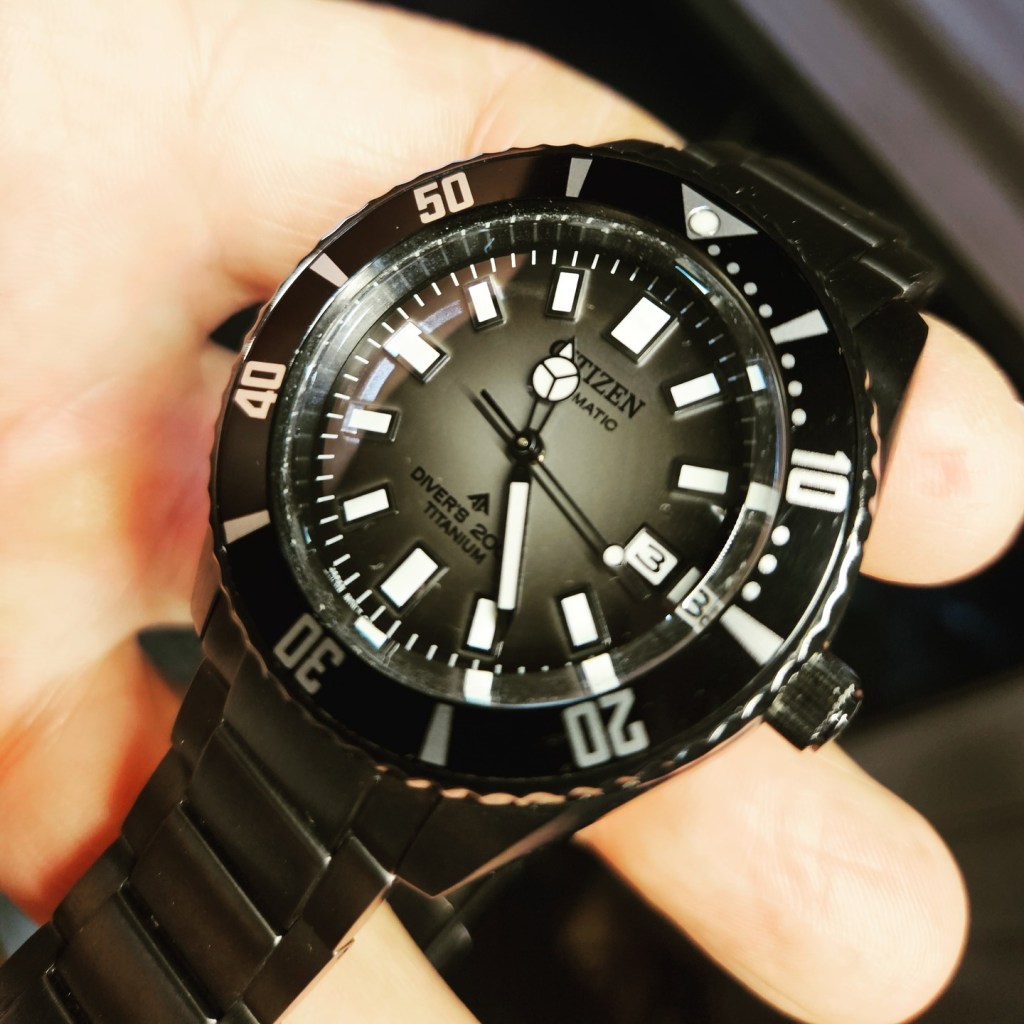
    Which brings me to the present. In a couple of days, the Citizen Super Titanium Gunmetal Diver NB6025-59H will return to my collection. Its DLC coating reads more dark gray than true black—an advantage, frankly. I plan to take it traveling. Miami. Hawaii. Heat. Salt water. Airport bins. Sunscreen. Sweat. This watch is not entering witness protection. It’s not being boxed, babied, or preserved for a future auction. It’s being worn.

    I’m glad to have one black—or gunmetal—watch in the rotation. It’s a welcome disruption from stainless steel, a visual reset. But there’s a caveat worth stating. Black watches are all about proximity. Up close, the details are rich and seductive. From a distance, they collapse into silhouette—lume floating in darkness. If you need your watch to announce itself across a room, black may frustrate you.

    For me, that quiet severity is the point.

  • Blast from the Past: Angelo’s Review of the Montgomery Ward Airline GEN-1494A Vintage Radio

    Since the very first time I saw this model listed on E-Bay a couple years ago, I’ve wanted one of these:  The Montgomery Ward Airline GEN-1494A.

    I guess the thing that attracted me to this radio the most is the handsome looks.  I like the symmetry of the dual tuning dials, divided by the power meter.  I like the contrast of brushed aluminum and charcoal color plastics, encased in clear acrylic dial covers.  I like the large but not huge size of the receiver.  Simply, I like everything about this radio’s styling.  I wouldn’t change anything—not even the orange and white frequency information, which looks great on the dark gray/black. 

    The materials are not quite up to Sony or Panasonic standards, but there’s nothing to be ashamed of here.  It’s good quality stuff, certainly comparable to any Sharp or Sanyo of a similar vintage.  It’s in that Toshiba/Hitachi category as far as I can tell.

    Performance wise, it’s a winner.  I was astounded by the shortwave reception—very, very close to matching the Sony ICF-5800 that I recently sold.  It picks up shortwave signals that most of my other radios are unable to track.  FM sound is strong, AM crisp.  It’s very capable of getting the full compliment of AM-FM stations that my other good radios can receive.  After the stellar shortwave performance, I was surprised that it didn’t perform well on the PSB 1 or PSB 2 options.  They were pretty dead—and my old Arvin radios generally get activity on these bands.  Maybe it’s just the night and the location.

    Speaker sound is another high grade.  While it’s not as powerful as the Panasonic 888, it has a pleasing sound.  The “tone” adjustment actually does its job too.  It’s equally good for talk or music.

    This is a well balanced radio that I can heartily recommend.  I have seen several of these over the years, and have bid on a few of them.  I was never able to wrangle one until this one failed to cross the $30.00 mark, and I snatched it up in the closing minutes.  It needed a little cleaning—and to get it to work on batteries, I had to use steel wool to remove corrosion from the battery compartment contacts—-but aside from those minor issues, it’s pretty darn nice.  Perfect antenna, no major dings and a real player.

    Is it a keeper?  For me, there aren’t many keepers.  I generally buy radios at what I consider a value price.  After cleaning them up and playing with them for a few months, I’m willing to throw them back to keep funding my hobby and charting new territory—such as a very recent interest in old tube radios.  But I have to say, the great shortwave performance, on this Ward model will make it a tough decision to let this go.  Like my Panasonic 888, Zenith Trans-Oceanic 7000 and Grundig Ocean Boy 820, this Ward Airline 1494 has virtues that might make it a permanent fixture.  That’s pretty strong company that this radio finds itself in.

  • SZA in Our House: Why My Daughters and I Sigh When Taylor Swift Comes On

    SZA in Our House: Why My Daughters and I Sigh When Taylor Swift Comes On

    In my freshman writing class, I recently staged a little spectacle about thesis statements. To illustrate contrast, I pulled out two cultural heavyweights: SZA and Taylor Swift. Hyperbole was the hook. My admiration for SZA was real; my critique of Swift was exaggerated for theatrical effect. Still, my tirade sounded more like a roast than a teaching tool:

    “While Taylor Swift may rack up 25% more Spotify streams than SZA, numbers don’t tell the whole story—unless, of course, you mistake a stadium chant for art. SZA sings with depth and raw emotion, while Swift wheezes through her catalog like an underfed Victorian orphan. SZA’s sound is bold, kaleidoscopic, and alive, drawing from the lush soul of the ’70s. Swift, meanwhile, serves up limp sonic garnish—music with the texture and excitement of a wilted celery stalk rescued from beneath the fridge. SZA makes adult art; Swift makes musical mac and cheese for the kid’s menu at Chili’s.”

    In reality, I don’t think Swift is a wasteland of celery stalks and Victorian wheezing. I admitted to my students that Swift is likely a good person, a competent artist, and that I wish her well. My guilt lingered, though. Bombast is a teaching trick, but sometimes the fire singes the wrong target.

    That guilt sharpened when I stumbled across Spencer Kornhaber’s “How Did Taylor Swift Convince the World That She’s Relatable?” over morning coffee. One line hit me like a cold shower: “The most consequential American singer of the past 20 years, Swift can claim commercial achievements that equal or surpass those of the Beatles, Madonna, and Michael Jackson.”

    Relatability is her true superpower. Swift has broadcast her heartbreaks, doubts, and longings in ways that make her sound like a big sister or Greek chorus to her fans’ lives. Her brand isn’t just pop—it’s therapy with a backbeat.

    Kornhaber nails it: “Listening to a Swift song is like eating a candy bar that transmits a personal essay into your memory. If you eat enough candy bars, it becomes a novel, and then a series of novels, and then (this is when you become a Swiftie) a virtual-reality, open-world video game you play with friends and strangers.” It’s a metaphor that could apply to any great artist. I thought of The Truman Show, where daily life becomes the commodity, the spectacle, the art.

    Swift deserves her accolades. She is a master craftsman of polished, radio-ready memoir-pop. But her songs still strike me as a touch bland, like a dependable frozen dinner—satisfying but forgettable. My twin daughters agree. When a Swift track seeps out of SiriusXM Coffee House, we sigh in unison and silently wish it were SZA.

  • There Is No Such Thing as a Holy Grail Watch

    There Is No Such Thing as a Holy Grail Watch

    The watch-obsessive’s quest for the so-called Holy Grail of watches is not heroic—it’s theatrical, maudlin, and embarrassingly earnest. He speaks of it with reverence, as if he’s Sir Galahad in a NATO strap. But what he’s chasing isn’t a singular object of desire—it’s a shapeshifting chimera, a delusion dressed in brushed stainless steel.

    Today’s grail is a bronze diver with gilt indices. Tomorrow it’s a minimalist field watch with a sandwich dial. By the weekend it’ll be a 41mm titanium chronograph with a “stealth” finish. Each new acquisition is preceded by the familiar declarations: This is it. The one. The final piece. And yet, within weeks—days, even—that “final piece” becomes just another stepping stone in a never-ending wrist safari.

    There is no grail. There is only motion sickness.

    The watch obsessive, in his tortured enthusiasm, is less knight and more Tantalus. In Greek mythology, Tantalus is doomed to stand waist-deep in a pool of cool water beneath a tree dripping with ripe, fragrant fruit. But as he reaches out—just a bit more—the water recedes, the fruit retreats. His thirst is never quenched. His hunger never satisfied. Only the illusion of satisfaction persists.

    And so it goes with the watch addict. His fingertips brush the bezel. His nostrils catch a whiff of Horween leather. His YouTube thumbnails promise “GRAIL ACHIEVED” in all caps. But it’s never real. The moment fades. The watch, once unboxed and adored, begins its quiet drift into mediocrity. It no longer sings. It just ticks.

    And like a fool with a ring light, he’ll sit in front of his camera, describing the myth of Tantalus with tragic flair—his voice trembling as if he’s reciting Homeric verse—while wearing a watch he no longer loves, but can’t yet admit has failed him.

    Because admitting that would mean facing the truth: the grail isn’t late—it’s a lie.

  • The Sundays Can’t Come Back—They Never Wanted to Be Here

    The Sundays Can’t Come Back—They Never Wanted to Be Here

    I estimate there are maybe 50,000 diehard fans of The Sundays left on Earth—middle-aged romantics who imprinted on their music in their twenties like baby ducks and have carried that delicate soundscape in their bones ever since. These are the ones still haunting Reddit threads and aging fan forums, half-pleading, half-praying for Harriet Wheeler and David Gavurin to reemerge from their English countryside exile and record something—anything—before they fully dissolve into myth.

    I count myself among them. I think “You’re Not the Only One I Know” is the most beautiful song ever written, full stop. And yes, I have complicated feelings about its sudden afterlife on TikTok. On one hand, I’m glad new ears are discovering it. On the other, I want to slam the door and shout, “Get off my lawn—it’s my song.” Like any relic of private beauty, it feels stolen once it trends.

    But here’s the thing: The Sundays aren’t coming back. And they shouldn’t. Their music is a love letter to solitude. It’s woven from the threads of retreat, quiet heartbreak, and the refusal to participate in the world’s noisy charade. Every line aches with the voice of someone who’d rather be home. A comeback would be a contradiction—like resurrecting Greta Garbo to guest on a reality show. Their brilliance was their withdrawal.

    Take “You’re Not the Only One I Know”—the narrator, calmly stationed in a chair, shooing people away like pigeons. Or “Here’s Where the Story Ends,” where every attempt at connection curdles in the air. Or “My Finest Hour,” which ends not in triumph but in a gentle surrender to domestic retreat. These aren’t anthems for a reunion tour. They’re hymns of hibernation.

    The Sundays were never built for comebacks. Their art was a form of aesthetic convalescence, a music of shy resilience. Their narrators, like the band itself, are Edward Scissorhands types—fragile, inward, best left unbothered in their Victorian turret. If they returned, they wouldn’t be The Sundays. They’d be Tuesday Afternoon.

  • The Curdling Effect: How Great Songs Die in Grocery Stores

    The Curdling Effect: How Great Songs Die in Grocery Stores

    There was a time—long before streaming services, algorithmic playlists, and “sonic branding agencies”—when “Dark Side of the Moon” could take you on a soul-melting trip through space, madness, and time. In high school, Pink Floyd was our sonic sacrament. The cymbals shimmered like cosmic omens, and we let the guitars dissolve our angst into astral vapor.

    Then Circuit City got its grubby corporate mitts on it.

    Some goons in a boardroom decided that Pink Floyd’s transcendent opus would make a great jingle for discount televisions. The song was diced, commodified, and stuffed into every radio and TV break until what once felt like a journey into the abyss became the soundtrack to buying a laser printer. “Dark Side: didn’t just sell out—it was dragged through the spin cycle of capitalism and emerged shriveled and stained, like a silk shirt forgotten in a laundromat dryer.

    Same thing happened to U2. “I Still Haven’t Found What I’m Looking For” once carried a biblical ache, a spiritual yearning that made you want to climb a desert mountain and cry. Then one fateful day in 1989, I was in a fluorescent-lit supermarket, watching the vegetable misting system descend on some limp romaine, when I heard it—Muzak’d into oblivion. Bono’s ache had been lobotomized and looped over damp eggplant. I felt like I’d witnessed a holy relic turned into a toilet brush.

    There’s a name for this: The Curdling Effect. When a song becomes so omnipresent, over-marketed, or backgrounded that it curdles—its soul separating from its sound, leaving only a sentimental sludge.

    Sometimes entire bands curdle. Take Coldplay. They’re talented, sure, but somewhere along the way they became the official band of stadium urinals and car commercials. Every note now drips with forced uplift and corporate synergy. Once they soared; now they slosh around in the shallow end of their own overexposure.

    But here’s the miracle: some songs are immune. Some endure. Some never curdle.

    Take “Fade Into You: by Mazzy Star. It drips with longing, and its beauty doesn’t spoil, even after decades. This morning, driving my twin daughters to school, I heard Victoria Bigelow’s cover. It stopped me. Time slowed. The song had lost none of its haunting gravity. It was still a velvet fog of romance and surrender.

    And then came a moment of musical resurrection. Olivia Dean’s “Touching Toes” played on the car stereo. It reminded me of Maria Muldaur’s “Midnight at the Oasis,” a song I hadn’t thought of in years. Both had that sultry, half-smile sway that drops your blood pressure and restores your faith in kindness. I let people merge in traffic. I was chill. I was enlightened.

    I’m now curating a playlist: Olivia Dean, Maria Muldaur, and any song that keeps me from flipping off fellow drivers. I call it The Chill Driver Playlist—a sonic antidote to the Curdling Effect.