Tag: romance

  • Bachelor of Denial: The Speedo Messiah of Bakersfield

    Bachelor of Denial: The Speedo Messiah of Bakersfield

    Chief among my apartment acquaintances was Leonard Skeazy, an attorney from Santa Monica who was lured to the Bakersfield desert by a fat signing bonus and a monogrammed office, yet couldn’t shake the resentment of having been exiled to this cultural wasteland. He was the sort of guy who treated “style” like a religion. He sported custom-made Speedos that were purchased at a specialty boutique in Santa Monica—yes, he would actually drive back to the city to replace them whenever the chlorinated pool water faded the jewel tones of his spandex. His long, curly hair and eerie blue eyes made him look like a lounge singer who never quite made it out of the Holiday Inn circuit.

    Leonard was a man of eccentric habits and questionable hygiene. Despite being well into his 30s, he clung to the bachelor dream of finding “the right girl,” although his standards seemed laughably out of place in a town where having a high school diploma was considered highbrow. This was a guy who’d lounge poolside for hours, skin glistening like a buttered croissant, all while blasting Kenny G from his boombox as if smooth jazz were somehow his secret weapon. His breath, tinged with the distinct aroma of last night’s Chardonnay, matched his penchant for sneaking sips from boxes of white wine he kept stashed in his fridge.

    Curiosity (and a lack of better options) led me to visit Leonard at his apartment one day. It was a bachelor pad in the most tragic sense. Despite the fact that he was swimming in cash, his apartment was as bare as a prison cell. The living room housed only a lone couch, a TV balanced on cinder blocks, and—wait for it—an ironing board. Apparently, ironing his endless supply of gaudy silk ties was the only domestic task he took seriously. The walls were completely devoid of art or decor, just barren expanses of beige that made the flickering TV light cast ghostly shadows over the snake-like drape of his ties.

    His bedroom was even more pitiful: no dresser, no closet system—just three open suitcases serving as makeshift storage. It was as if he refused to fully unpack, a subconscious protest against ever settling into this armpit of a town. The fridge, naturally, was a barren tundra except for—what else—more boxes of white wine. Here was a man who had chased the scent of money into the middle of nowhere, only to refuse to acknowledge he’d actually arrived. Leonard was a ghost of himself, haunting his own life, clinging to the notion that he was just “visiting” until he could escape back to the big city. 

    What kind of man, I wondered, gets seduced by a fat paycheck only to spend his days living in a self-imposed purgatory, where the only things thriving are his excuses and his growing collection of faded Speedos? I suppose it was easier for Leonard to pretend he was just passing through than to face the fact that he’d become a permanent fixture in this desolate corner of nowhere, a relic clinging to the fading glamour of a life he never truly had.

  • Remembering the 90s when Seinfeld made existential apathy a form of cultural resistance

    Remembering the 90s when Seinfeld made existential apathy a form of cultural resistance

    I’ve always been a lousy sleeper—a lifelong insomniac, night-thinker, ceiling-staring obsessive. So when my brain, usually a humming engine of late-night anxieties, surprises me by downshifting into a silky semi-sleep, I take notice. I don’t just enjoy those moments—I archive them in some velvet-lined folder in my mind, filed between “Miracles” and “Rare Weather Patterns.”

    One such miracle happened in the summer of 1991 in the gloriously tacky suburb of Buena Park, California. I had recently relocated from the Bay Area to Bakersfield, that Central Valley of hot wind and dust, to teach composition at the university. It was a job that paid me in respect and barely enough money to keep me in burritos and gas.

    Weekends were spent visiting Nicole, the girlfriend of my ex-student Mike, a real-deal Navy SEAL with shoulders like boulders and a heart that thumped exclusively for her. We’d drive south, Mike and I, and wind up at Nicole’s parents’ place not far from Knott’s Berry Farm—California’s budget Disneyland, where roller coasters and churros come with a faint scent of desperation.

    Dinner with Nicole’s folks was always home-cooked, polite, and meatloaf-heavy. But the real magic happened later in the den, where the three of us would settle in for prime-time America’s Funniest Home Videos, back when Bob Saget’s voiceovers made even mild concussions look charming.

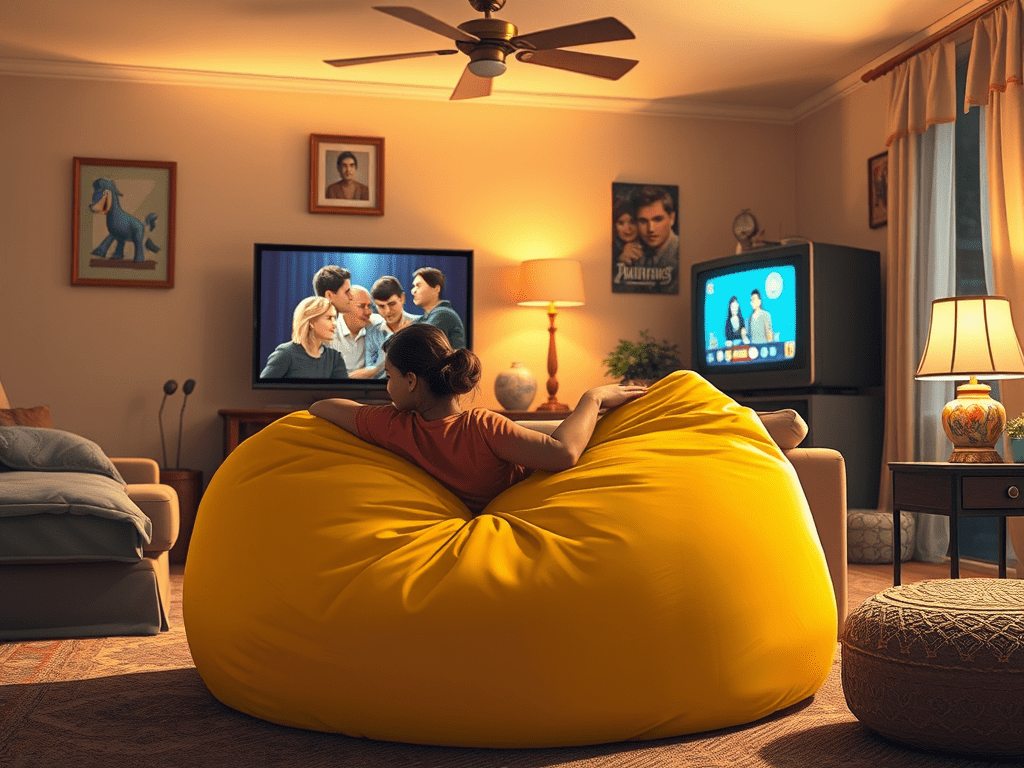
    Mike and Nicole snuggled on the sofa, whispering sweet nothings or planning some SEAL Team Six domestic mission. I would sink into a bloated yellow bean bag chair like a man slipping into a warm pond of polyester and forgotten dreams.

    As I floated somewhere between reruns and REM, Nicole’s mom would be doing laundry in the adjacent room, and the floral scent of freshly tumbled linens—fabric softener with notes of lilac and vague suburban joy—would drift in and intoxicate me. The TV flickered. The lovers whispered. I, utterly ignored, entered a state of transcendence usually reserved for monks or the chemically enhanced.

    In that half-dream, I’d rocket through constellations, revisit my childhood neighborhood where everyone still had knees that worked, and rendezvous with a mysterious dream woman who always met me at sunset on a Hawaiian beach. I was twenty-nine, single, unburdened, and lazy in a way only the early ‘90s allowed—when Seinfeld made existential apathy a form of cultural resistance.

    Looking back now, from the sagging perch of sixty-three, it’s easy to sigh at the sheer, stupid comfort of it all. I no longer live in that bubble-wrapped world where being a third wheel was a blissful kind of freedom, where responsibility was just a concept in other people’s lives.

    Still, on a quiet afternoon, stretched out on my modern couch, if the narrator of a nature documentary starts detailing the mating habits of sea otters in a sonorous British whisper, something in me softens. The air thickens. I begin to drift. And for a flickering moment, I’m back in that bean bag—yellow, ridiculous, sublime—floating on the fabric-softened breeze of a world that no longer exists.

  • The Accountant, the Hotpants, and My First Taste of Rejection

    The Accountant, the Hotpants, and My First Taste of Rejection

    The summer of 1972, I was ten years old, flying solo from LAX to Miami, parked in the coveted window seat. Next to me, in the middle, sat a blonde woman in her mid-twenties, bronzed to an unnatural, almost radioactive orange, legs crossed confidently beneath pink hotpants with purple and white racing stripes that suggested speed, danger, and an implied warning to stay in my lane.

    In the aisle seat: her conversational hostage, a lean, dark-haired man of about the same age—an accountant, he would later reveal, which felt like foreshadowing.

    For five hours, I listened as they engaged in a dialogue so lively, so animated, I assumed I was witnessing the early chapters of a great love story. She was in dental hygiene school. He had a degree and a steady job. She exuded the kind of effortless confidence that made her gum seem like a gift from the gods when she passed us each a stick of Dentyne, explaining that it would help pop our ears. A public service announcement, delivered with charm.

    The accountant was decent-looking, well-spoken, clearly trying his absolute best—and for five relentless hours, he kept her engaged. They laughed, they shared stories, they existed in a pocket of perfect airborne intimacy. To my ten-year-old brain, this was an ironclad courtship ritual. The chemistry was undeniable.

    Then, the landing. The taxi to the gate. The moment of truth.

    He asked her out.

    She declined. Politely. Firmly. Efficiently.

    My ten-year-old self was staggered. How was this possible? Hadn’t they just shared an entire cinematic romance arc? The witty banter? The shared laughter? The synchronized gum chewing? And yet—nothing.

    I tried to crack the mystery. Maybe he was too bland. Maybe she had a boyfriend. Maybe she just needed to kill five hours before she got back to real life. Whatever the reason, I, a mere child, absorbed his rejection as if it were my own.

    To this day, I remain personally wounded that she turned him down. She turned us down. And for what? Some other guy in tighter pants?

    That flight should have been a lesson in the arbitrary brutality of romance, but all I really learned was that rejection hurts, even when it’s not technically yours.

  • Magical Thinking #5: The Delusional Art of Repeating the Same Disaster and Expecting a Miracle

    Magical Thinking #5: The Delusional Art of Repeating the Same Disaster and Expecting a Miracle

    If insanity is doing the same thing over and over while expecting different results, then we are all a little insane—especially when it comes to our worst habits, our most toxic relationships, and our dumbest obsessions.

    Take the vampire relationship—a toxic, soul-sucking romance that drains you dry every time, yet you keep crawling back, convinced that this time it will be different. It never is. The fangs sink in, the life force drains out, and you’re left staring at the ceiling at 3 a.m., wondering how you let yourself get bit again.

    And if love isn’t your particular poison, maybe watch collecting is.

    Watch guys (myself included) have perfected a very specific brand of lunacy—thinking that selling a watch will cure our addiction. We convince ourselves: If I sell this, I’ll be free. This is the last one. I’m done. But before the ink on the eBay transaction dries, we’re rebuying it. And then reselling it. And then rebuying it again. It’s a closed-loop system of self-inflicted torment, a never-ending maze of false hope and regret.

    Dude. You need help. Read Phil Stutz, escape the Maze, and put your life in Forward Motion before your retirement fund turns into a pile of resale receipts and buyer’s remorse.

    If you think this brand of self-destruction through repetition is new, think again.

    F. Scott Fitzgerald saw it decades ago in Winter Dreams, where Dexter Green is hopelessly addicted to the walking emotional Ponzi scheme that is Judy Jones. She is his drug, his illusion, his vampire. She is untrustworthy, indifferent, and incapable of meaning what she says, yet he keeps coming back for more.

    Dexter isn’t just in love with Judy Jones—he’s in love with the idea of her, the fantasy that someday she’ll become what he wants her to be. She won’t. And as he wastes years orbiting her gravitational pull of destruction, real life passes him by. By the time he wakes up from the dream, it’s too late.

    Sound familiar? It should.

    Because whether it’s a vampire relationship, a doomed watch-buying cycle, or a delusional romance straight out of Fitzgerald’s nightmares, the result is always the same: life keeps moving forward while we stay stuck, trapped in our own bad decisions.

  • Father Time’s Frenemy

    Father Time’s Frenemy

    I often think back to the summer of 2019 when my wife and twin daughters were vacationing in Maui. There, on the beach, I spotted a short, compact man in his mid-seventies parading around in dark blue Speedos with a woman at least fifty years his junior—a striking Mediterranean beauty in her twenties. The guy was trim, well-manscaped, and scampering confidently on the sand like a millionaire who spends half his life in boardrooms and the other half trying to outrun the Grim Reaper. He dove into the waves with the vigor of someone convinced that as long as he keeps moving, Father Time can’t catch him.

    You could smell the wealth on him. He was probably some CEO with a portfolio big enough to buy the illusion of eternal youth. He worked hard and played hard, to quote Hugh Hefner’s mantra. Now, I’m not here to pass judgment on the guy for choosing a partner young enough to be his granddaughter—that’s his business. What fascinates me is this idea that money, discipline, and a little manscaping can somehow hold age at bay, like youth is a rare potion you can sip on to stay forever young.

    But the whole scene was off. He and his youthful companion looked like mismatched puzzle pieces being forced together by sheer willpower. It was as if they were two jagged halves of a broken mirror, stubbornly pressed together despite clearly not fitting. And with each attempt to make it work, the edges chipped away a little more, until all that was left was a pile of shattered glass—a perfect metaphor for trying to cheat time.

    This rich fit man is Father Time’s Frenemy–a guy who pretends he’s on good terms with aging while secretly plotting to outwit it. He may have fooled himself with the “perfect picture” he created, but the eyesore is as plain as day to the rest of us. 

  • INTERROGATING THE ALTER EGO OF RACHEL BLOOM IN CRAZY EX-GIRLFRIEND

    INTERROGATING THE ALTER EGO OF RACHEL BLOOM IN CRAZY EX-GIRLFRIEND

    Rachel Bloom weaponizes her alter ego, Rebecca Bunch, to dissect her neuroses with surgical precision, laying bare her obsessions, compulsions, and complete disregard for boundaries. Rebecca isn’t just self-destructive—she’s a human wrecking ball, alienating friends, terrifying acquaintances, and steamrolling her own well-being with reckless abandon. And yet, despite all the chaos, she remains irresistibly lovable, armed with good intentions and a heart too big for her own good.

    Rebecca is a whip-smart New York attorney drowning in success-induced existential despair when fate—or perhaps something more deranged—intervenes. A chance sighting of her old summer camp crush, Josh Chan, sends her into a tailspin of romantic delusion. Suddenly, the only logical course of action isn’t therapy, self-reflection, or even a stiff drink—it’s packing up her entire life and moving to West Covina, California, in pursuit of a man who barely remembers her. What follows is less a fairytale romance and more an operatic descent into obsession, complete with full-blown musical numbers choreographed straight from the fevered depths of her subconscious.

    Once in West Covina, Rebecca lands in a delightfully dysfunctional law firm, where her brilliance is only matched by her ability to make everyone around her deeply uncomfortable. She barrels through life like a caffeinated hurricane, terrifying innocent bystanders with her intellect and intensity, all while chasing an idea of love that exists only in her own head. The show’s most poignant relationship, however, isn’t a romantic one—it’s her friendship with Paula, a sharp-witted, no-nonsense co-worker and mother who, in many ways, fills the maternal void in Rebecca’s life. Paula, trapped in the drudgery of domesticity, finds a thrilling (and slightly concerning) outlet in Rebecca’s increasingly unhinged escapades, turning their dynamic into the show’s emotional anchor.

    At its best, Crazy Ex-Girlfriend thrives on this friendship, an odd yet deeply affecting bond between two women clinging to each other for meaning and validation. But by season four, the show stumbles, bogged down by meandering storylines and an inexplicable reluctance to lean into its greatest strength—Rebecca and Paula’s relationship. The final season drags like an overlong curtain call, but even its missteps can’t erase the brilliance of what came before. At its core, Crazy Ex-Girlfriend is an incisive, darkly hilarious exploration of self-sabotage, redemption, and the uphill battle of getting out of your own way.

  • An Unexpected Love Story in The Great

    An Unexpected Love Story in The Great

    If you had told me to watch a period drama about the turbulent love life of Peter III and Catherine the Great—one mostly confined to the gilded chambers of a Russian palace—I would have laughed, pointed to my rain gutters, and insisted I had more pressing matters to attend to. And yet, The Great did something miraculous: it took that seemingly dreary premise and spun it into one of the sharpest, most unexpected love stories I’ve ever seen on television.

    Elle Fanning’s Catherine enters the series practically vibrating with resentment, married off to a narcissistic, gluttonous man-child of an emperor played by Nicholas Hoult, whose Peter III treats ruling Russia like an all-you-can-eat buffet of debauchery. He’s selfish, crude, and revels in excess, while she’s a self-serious, idealistic reformer, convinced she’s been cursed with a fool for a husband. On paper, theirs should be a tale of mutual disdain, and indeed, for a while, it is. But then something bizarre and wonderful happens: they fall in love—not with doe-eyed, saccharine declarations, but in a way that feels both tragic and inevitable. They fall in love despite themselves.

    Peter, the arrogant peacock, starts showing unexpected flashes of vulnerability, betraying an almost boyish need to be seen and understood. Catherine, the self-righteous revolutionary, finds herself drawn to his wit, his strange charm, and his surprising capacity for change. They spar like intellectual gladiators, their verbal fencing as much foreplay as it is battle. This is where The Great sets itself apart from every predictable romance that’s ever clogged up a TV screen: the dialogue—crafted with Tony McNamara’s signature razor-sharp wit—isn’t just ornamental, it’s the very foundation of their attraction. They fall in love through language, through their relentless, biting exchanges that crackle with intelligence, irony, and reluctant admiration.

    Over three seasons, The Great delivers the most gut-wrenching, wickedly funny, and beautifully tragic love story I’ve ever seen—a romance built on war, wit, and the deeply human, utterly irrational act of loving someone against your better judgment.