
Tag: self-care

  • Treat Your Watches Like Playlists, Not Religion

    Treat Your Watches Like Playlists, Not Religion

    For decades, your identity was secure. High-end mechanical divers. Steel, weight, heritage, tolerances measured in microns. A small, loyal brotherhood of engineering purity lived in your watch box, and you knew exactly who you were.

    Then the fairy tale cracked.

    A G-Shock Frogman entered your life.

    You told yourself it was a novelty. A tool. A temporary experiment.

    Then came the Rangeman.
    Then the premium Square.

    Now you’re standing over your watch box like a man who has betrayed his own lineage.

    Who am I?
    What have I done?
    What happened to my mechanical diver heritage?

    Relax.

    You’re not having a crisis. You’re experiencing Genre Guilt.

    Genre Guilt is the uneasy sensation that enjoying a new category somehow betrays the old one. The mechanical diver sits in the box like a disappointed mentor while the G-Shock hums cheerfully on your wrist, and suddenly you feel the need to justify yourself—to your friends, to your former self, possibly to the watches themselves.

    But the anxiety has nothing to do with enjoyment or function. It comes from a simple mistake: treating collecting like a moral code instead of a mood.

    Here’s the truth.
    Watches are not a marriage.
    Categories are not religions.
    Your collection is not a pledge of allegiance.

    It’s a playlist.

    Your streaming app doesn’t panic when you move from jazz to electronic. It doesn’t accuse you of betraying classical. It simply plays what fits your mood.

    Your collection works the same way.

    Mechanical divers: one playlist.
    G-Shocks: another.

    Millions of collectors do this. You haven’t broken tradition. You haven’t reinvented the hobby. You’re not undergoing a transformation.

    You’re a suburban enthusiast who briefly mistook preference for drama.

    So take a breath. Close the courtroom in your head. There is no betrayal here.

    Add the playlist. Wear the Frogman. Enjoy the Square.

    Your blood pressure—and your hobby—will run a lot smoother once you stop treating mood swings like moral events. Instead, treat your watches like playlists, not religion. 
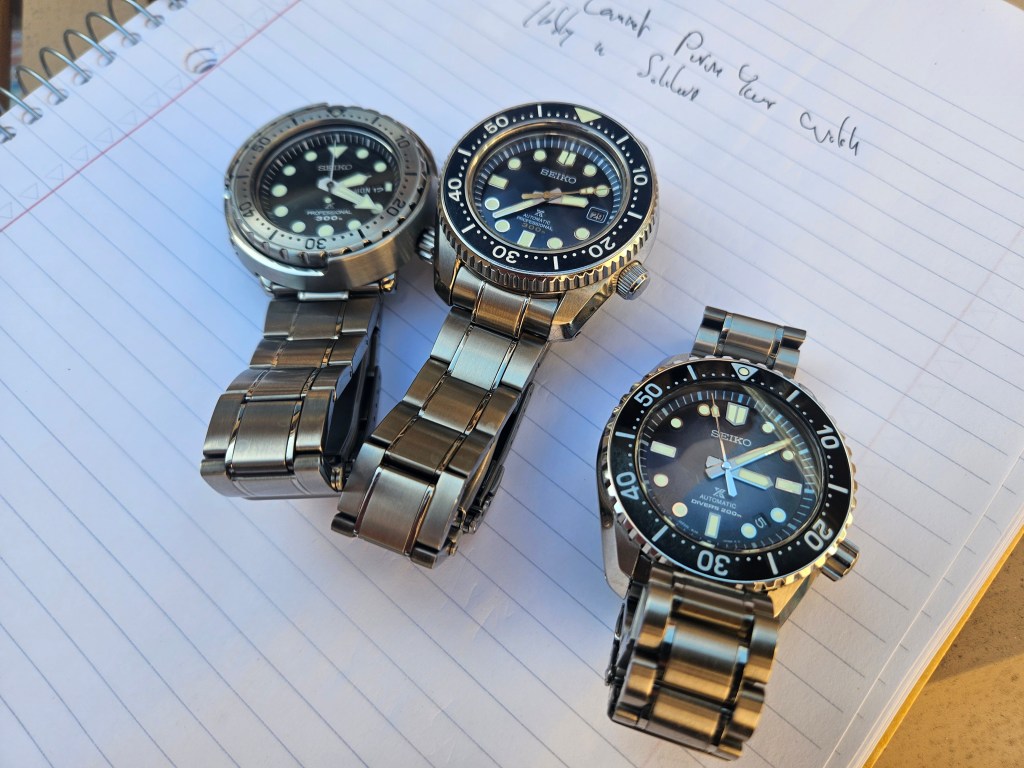
  • The Morning Crisis No One Talks About: Choosing the Wrong Watch

    The Morning Crisis No One Talks About: Choosing the Wrong Watch

    You wake up, shuffle to the coffee maker, and open the watch box.

    Inside, a dozen small mechanical personalities stare back at you, each silently asking the same question: Why not me?

    You freeze.

    The seconds tick. Your coffee overflows. Your toast burns. Your heart rate climbs. This is not a simple accessory choice. This is a moral decision. Identity is at stake. Judgment will be rendered.

    Welcome to Watch-Rotation Anxiety, a condition built from four reliable pressures.

    First, the cognitive load: the sheer mental friction of choosing one watch from many. What should be a two-second decision becomes a committee meeting.

    Second, the creeping suspicion that whatever you choose is wrong. The diver feels too casual. The dress watch feels pretentious. The field watch feels underdressed for a meeting that probably won’t matter but might.

    Third, the guilt. The untouched watches sit in the box like neglected pets. You imagine them fading, unloved, wondering what they did to deserve exile.

    Fourth, the compensation ritual: multiple swaps. Morning diver. Midday GMT. Afternoon chronograph. Evening dress piece. By dinner you’ve worn four watches and bonded with none. The day becomes horological speed-dating—lots of introductions, no relationships.

    Some collectors attempt to outsmart the anxiety with systems. They create rotation schedules—actual calendars mapping two- or three-week cycles. Monday: black dial. Tuesday: titanium. Wednesday: vintage. The calendar decides so the mind doesn’t have to.

    Others rely on a more mystical framework. If Tuesday feels blue, a blue dial must be worn. If Sunday carries a gray mood, only gray will do. The week becomes a chromatic destiny, and the watch simply obeys.

    And then there are the cautionary tales.

    A friend of mine in Laguna Beach—successful, disciplined, financially immune to consequences—once owned a dozen Swiss luxury pieces. Each morning he would lay them out, tilt them toward the light, evaluate them against his suit, his meetings, his mood. What began as appreciation became ritual. What began as ritual became burden. What began as burden became madness.

    One day he solved the problem decisively.

    He gave them all away.

    He still wears watches now—but only those given to him by clients. Which has created a new, more specialized condition. Before every business lunch he must ask himself: Which watch did this person give me?

    In his case, Watch-Rotation Anxiety has not disappeared.

    It has simply evolved into something more professional.

    Client-Recognition Anxiety: the quiet fear that the wrong wrist might cost you the account.

  • An Argument for Healthy Denial: A Self-Help Sermon for the Self-Indulgent

    An Argument for Healthy Denial: A Self-Help Sermon for the Self-Indulgent

    Let’s be honest. You’ve tried the soft-glow Instagram mantras and the overpriced journaling apps. You’ve danced with dopamine like a lab rat in a Vegas casino, chasing every ping, snack, scroll, and retail hit like it was divine revelation. And where has it gotten you? Nowhere worth photographing.

    So here’s your wake-up call, preacher-style, minus the tambourine: take care of your damn self. Not in that syrupy “self-care” way that means binge-watching prestige TV while mainlining DoorDash and calling it therapy. No, I mean the kind of care that involves discipline, boundaries, and strategic discomfort—also known as healthy denial.

    Phil Stutz is right: your relationship with your body, your soul, and the people around you depends on your ability to say “no” like your life depends on it—because it does. Not “no” out of self-loathing or ascetic performance art, but “no” because you actually give a damn about the human being you’re becoming.

    You don’t skip the donut because you hate yourself. You skip it because you respect yourself enough not to let your biology, your boredom, or your bastardized idea of “treat culture” run your life. You are not a French bulldog in a baby stroller. You are a fully grown adult with responsibilities and, presumably, a spine.

    And no, this isn’t some narcissistic glow-up project. You’re not chiseling your abs to become a thirst trap or launching your “healing journey” vlog. This is not a TED Talk in the making. This is about getting better because the people who count on you deserve more than your bloated, distracted, half-baked self. Society doesn’t need another dopamine junkie sucking on algorithmic pacifiers while pretending to be “living their truth.”

    Yes, some will tell you denial is toxic, puritanical, even abusive. These are the same people who believe “treating yourself” five times a day is a human right. But let’s get something straight: healthy denial is not self-hatred—it’s self-respect with a steel backbone. You deny yourself garbage because you’re aiming for gold. You crave meaning, not just muffins. You want to die with fewer regrets, not a legacy of half-eaten potato chips and unread terms of service.

    So here’s what you’re going to do.
    You will stop snacking. Period.
    You will stop scrolling like a brainless peasant begging for dopamine crumbs from tech oligarchs.
    You will stop curating materialistic trinkets—yes, even the “limited edition” timepieces—and broadcasting your conspicuous consumption like a status-starved magpie.

    Instead, you will create.

    You will write.
    You will make music.
    You will work out with the devotion of a monk in a burning temple.
    You will show up for your family like it matters—because it does.
    And you will treat your time on this spinning sphere not as an entitlement but as the limited-edition miracle it is.

    This is not about being better than others. This is about being better for others. And if that sounds corny to you, maybe you’ve been swimming in irony so long you’ve forgotten what sincerity feels like.

    Here’s your new gospel: eat clean, think clearly, serve humbly, and waste nothing—not even time.

    Now get to it. The clock is ticking, and you’re not getting any younger.