Tag: self-improvement

  • The Multi-Headed Dopamine Monster

    The Multi-Headed Dopamine Monster

    Any halfway attentive observer eventually stumbles upon a depressing but unmistakable truth: modern life is a carnival of pleasures engineered to be irresistible and endlessly repeatable. Physical indulgence, consumer toys, and the shimmering applause of social media metrics arrive every day like trays of free samples at a supermarket. The problem is not their existence. The problem is their limitless availability. When gratification can be summoned instantly—one click, one swipe, one purchase—the temptation to pursue it with manic dedication becomes nearly impossible to resist.

    The results are rarely noble. Self-discipline dissolves. Organization frays. Focus collapses like a folding chair under a heavy guest. In their place arrives a nervous state of agitation accompanied by a dull, persistent suspicion: You are wasting your life on trinkets. The realization is humiliating because it is so obvious. Hedonism, convenience, consumerism, and the intoxicating glow of digital approval are not spiritual achievements. They are simply the brain chasing dopamine like a lab rat pounding a reward lever.

    At first the dopamine feels marvelous. A new gadget, a flattering comment, a few hundred views, the pleasing geometry of a purchase confirmation page. But like all stimulants, the effect fades. The rewards grow thinner. The hits arrive faster but satisfy less. Eventually a quiet despair creeps in. You feel oddly disconnected—from other people, from yourself, from the adult you imagined becoming. You begin asking dangerous questions. Is there anything meaningful enough to lift you out of this quicksand of micro-pleasures? Is there any pursuit capable of competing with the relentless ease of cheap gratification?

    You remember that you possess other faculties—creativity, curiosity, philosophical struggle, the ability to tell a story that might illuminate something about the human condition. These pursuits possess real dignity. Yet they struggle to survive in the same ecosystem as frictionless entertainment and effortless affirmation. The brain, like a spoiled monarch, prefers velvet pillows to hard chairs.

    Eventually the interrogation becomes more specific. The real engine of this predicament is not merely pleasure but technology. Your phone and computer function as a many-headed dopamine creature sitting permanently on your desk. Slaying the monster would be satisfying—but impossible. Unlike alcohol, which the addict can abandon entirely, the digital world is inseparable from modern survival. You need the machine to work, communicate, pay bills, manage life, create things, and occasionally attempt to think.

    So you continue to live beside the creature.

    You read the tidy aphorisms offered by productivity gurus: Be mindful. Stay disciplined. Follow your North Star. But these slogans feel faintly ridiculous when the dopamine cauldron sits inches away—one browser tab from ignition. The advice begins to sound less like wisdom and more like a variety of motivational wallpaper.

    And so you arrive at a strange emotional position.

    You do not yet possess a solution. But you possess something useful: anger. Anger at the machinery of distraction. Anger at the cheapness of digital applause. Anger at your own willingness to accept the bargain.

    It is not a cure, but it is a beginning.

    You can see the problem clearly now.

    The only remaining question is what you intend to do about it.
  • Give Me Watch Sobriety—Only Not Yet

    Give Me Watch Sobriety—Only Not Yet

    If you think of yourself as a watch addict—someone whose hobby has drifted from interest into pathology—then you are probably also someone who longs for balance, for improvement, for a steadier inner life. You turn, as serious people do, to philosophy. Cicero’s Tusculan Disputations offers the promise: a tranquil soul, calmed by restraint and consistency. No distress. No fear. No desperate longing. No childish emotional swings. The happy man, Cicero suggests, is not the one who feels good, but the one who lives well.

    Then you look at your watch history and feel personally indicted.

    Restraint? You chased the perfect collection like a man hunting a mirage. Consistency? Your tastes pivoted with the emotional weather. Instead of tranquility, you endured the familiar cycle: anticipation, anxiety, justification, regret, and renewed desire. Twenty years of it. Even writing a book about the madness begins to look suspicious—less reflection than performance, a long-form version of hobby melodrama.

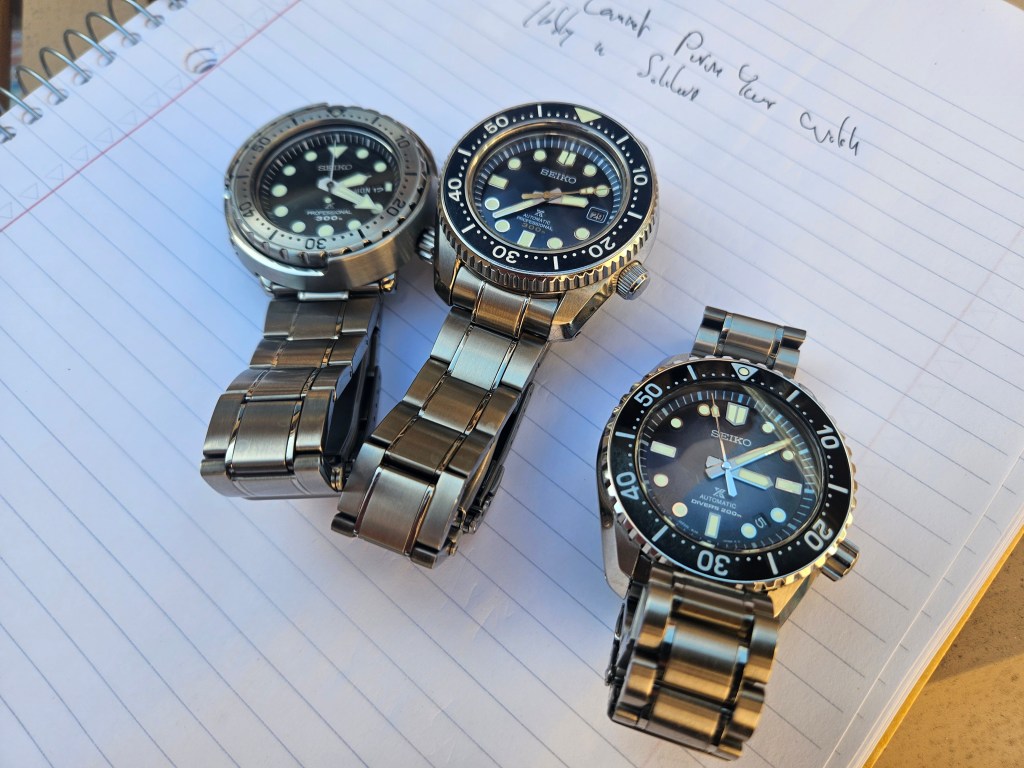
    You thought you had achieved peace. Seven mechanical divers. Stability. Closure.

    Then a G-Shock arrived.

    Then another.

    Like Augustine praying for chastity, the watch collector makes the classic promise:
    “Give me watch sobriety—only not yet.”

    The private bargain follows: One more watch, and the madness will be over.

    The promise is never kept.

    At this point, you have two options. You can keep prosecuting yourself for moral failure, or you can acknowledge a simpler truth: every hobby runs on enthusiasm, and enthusiasm always carries a trace of obsession. If you’re honest, part of this has been fun. But honesty requires the other admission as well: balance matters. An hour spent comparing G-Shock legibility is recreation. Losing an entire day to forums while your family heads to the beach without you is not enthusiasm. That’s displacement.

    So stop diagnosing yourself as diseased. You are not broken. You are wired this way. Some people chase golf swings. Some chase wine vintages. You chase watches.

    The real task is not suppression. It’s containment.

    This is where Guardrail Collecting begins.

    Guardrail Collecting allows your enthusiasm to run at full emotional voltage while installing firm limits that keep it from reorganizing your life around itself. It accepts a non-negotiable fact: the impulse isn’t going away. You will want to research, compare, optimize, and improve. The system doesn’t silence that impulse. It puts it inside a lane where curiosity remains pleasure instead of sliding into compulsion. The goal is not austerity. The goal is stability—so the hobby adds energy to your life instead of quietly draining it.

    The guardrails must be built before the surge hits, because no one makes rational decisions during Acquisition Afterglow. Establish three hard limits: a spending ceiling, a time boundary, and a capacity rule—maximum collection size or strict one-in/one-out. Then add a reality check: if watch activity begins to replace family time, sleep, health, or focused work, the rail has been hit. Activity stops. No bargaining. No heroic narratives.

    Maintenance requires periodic audits. Every few months, ask three questions: What am I wearing? What am I spending? How much time disappeared into comparison and speculation? If the hobby feels heavy, tighten the rails. If it feels light and contained, leave them alone.

    Because willpower is unreliable. Mood fluctuates. Enthusiasm surges and crashes.

    Structure does not.

    Guardrail Collecting works for one reason: it replaces self-control with architecture—and architecture holds steady long after motivation fades.

  • The Fix-It Myth: Why Self-Help is Just a Car Manual for Broken Humans

    The Fix-It Myth: Why Self-Help is Just a Car Manual for Broken Humans

    In her essay “Improving Ourselves to Death,” Alexandra Schwartz skewers our obsession with “setting goals” and the self-help prophets who profit by defining them. These gurus peddle life hacks as if they were cheat codes for existence, promising that with the right app, cue, or wearable gadget, you too can become a shiny human upgrade—an iPhone with abs.

    Their gospel is simple: optimization. A body that runs like a Swiss watch. A brain that hums like a Tesla battery. The result is a consumer barrage of homilies, buzzwords, and dopamine-chasing gadgets—all in service of transforming you into the ultimate product: yourself.

    But Schwartz argues that self-help is nothing more than a mirror, reflecting our dreams, neuroses, and insecurities. And one illusion persists like an American birthright: the Fix-It Myth. The fantasy that we are just machines—cars in need of a tune-up. Find the right manual, grab the right tools, and presto: you’re repaired, maybe even upgraded, ready to roar back onto the freeway of productivity.

    This myth has metastasized in the gig economy, where survival depends on perpetual hustle. We’ve convinced ourselves we must be perfectly fine-tuned—capable of juggling three jobs, dabbling in day trading, and hoarding enough cash to claw our way into a coveted zip code.

    At the core of this delusion is what therapist Phil Stutz calls the “Moment Frozen in Time”: a fantasy snapshot where everything is perfect—you look flawless, your soulmate is flawless, your calendar is conflict-free, and every day is a spa day in Shangri-La. The billion-dollar self-help industry feasts on this fantasy, offering secret codes that promise to deliver the life of a minor deity.

    Gwyneth Paltrow plays High Priestess of the Perfection Myth, hawking jade eggs and kale smoothies as though they were Eucharist wafers. On the Manosphere side, we’ve endured the spectacle of the Liver King—reduced from ancestral beef oracle to fallen fraud—and the smirking jiu-jitsu bodybuilder Mike Israetel, who at least delivers his advice with more honesty than theatrics.

    Stutz, however, refuses to sell the dream. His blunt counter-sermon: life is pain, uncertainty, and work. The faster you accept this, the happier you’ll be—because reality, not fantasy, is the only terrain where resilience and joy can actually grow. Otherwise, you’re just another maladapted child clinging to the hope of effortless bliss.

    And all the while, we’ve marinated in two decades of social media’s dopamine fever swamp: the endless scroll of FOMO, flexing, and fraudulence. Maybe the truest life hack isn’t another app or guru, but closing the laptop, lacing up your shoes, pounding out a five-mile run, and letting endorphins—not Instagram—clear your head.

  • Building a Bulwark Against Dopamine

    Building a Bulwark Against Dopamine

    Charles Duhigg, in The Power of Habit, insists that the real magic of self-improvement isn’t magic at all—it’s repetition, consistency, and time. Muscle memory married to good habits rewires the brain so that willpower stops being a daily knife fight. Instead, habits act as a bulwark, a fortification that keeps temptation outside the walls.

    Take my relationship with German Chocolate Cake. I adore it. But I eat it once a year because I never buy it. The thought of driving downtown, circling for parking, and elbowing through bakery lines kills the craving faster than broccoli. If people on TV are flaunting cake, I’ve trained myself to default to popcorn and an apple, which is like swapping bourbon for chamomile tea. Still, despite this culinary Maginot Line, I live fifteen pounds heavier than I want to be—proof that the fortress has weak spots.

    The Internet, however, is a stronger adversary than cake. Social media rewires the brain more ruthlessly than sugar. Twitter/X trained me to think in quips, Facebook taught me to beg for likes like a starving dog scratching at the door. I finally quit both. I post on Facebook once a month and promptly forget about it. I’m saner for it.

    But YouTube? That’s my heroin. I’ve been making watch-obsession videos for over a decade and built a modest following of 10,000. When a video pops, YouTube showers me with fireworks like a slot machine jackpot. When it flops, I get a scolding message: “This video isn’t bringing in as many of your subscribers as usual.” It’s the algorithm wagging its finger like a principal telling me I’ve failed society.

    YouTube has rewired my brain in both noble and grotesque ways. On the one hand, I’m sharper at public speaking, better at spinning essays into expositions, and more skilled at civil engagement with various personalities. On the other hand, I care too much about metrics, let them colonize my self-worth, and live half my life inside the algorithm’s funhouse mirror. I now inhabit parallel universes—the physical world and the YouTube world—fleeing one when the other displeases me.

    The problem is that the Internet’s temptations can’t be quarantined. My work machine is also my dopamine slot machine. One new tab, one click, and I’m plunging into a carnival of junk content, drenched in FOMO syrup and neon distraction. Cal Newport is right: when you toggle between focused work and dopamine junk food, the brain leaves behind a sticky residue that smothers concentration. I’ve felt that sludge firsthand, and I despise myself for swimming in it.

    As Duhigg notes, the brain is “constantly looking for ways to save effort” by making routines automatic. That’s useful for the monk who wakes at dawn to meditate, but disastrous for someone whose screen offers the New Tab to Nowhere. If only I could build a stronger bulwark against the carnival in my browser, I might actually live lighter, work deeper, and—dare I say it—be happier.

  • Autopilot or Choice: The Battle Beneath Our Habits

    Autopilot or Choice: The Battle Beneath Our Habits

    In The Power of Habit, Charles Duhigg challenges the comforting illusion that we live as fully self-possessed beings. Our existence, he argues, is far more random than we’d like to admit. Take the man who staggers home from work and pours himself a gin and tonic. The drink delivers its fleeting pleasure, but the deeper harm lies not only in the alcohol—it lies in the complacency of unexamined rituals, the sleepwalking habits that shape a life. Duhigg leans on William James to make the point: “All our life, so far as it has definite form, is but a mass of habits.”

    By contrast, when I come home, I reach for sparkling water or diet 7-Up over ice. I probably get the same sensory refreshment as the martini drinker—minus the alcohol. What matters most is that I asserted a choice instead of slipping into autopilot.

    I apply this principle elsewhere. Because I know I tend to drive more aggressively than I’d like, I deliberately leave ten minutes earlier than most people would. That way, I don’t have to be a jackass on the road. Every time I make a conscious choice like this, I chip away at the pull of mindless behavior.

    Duhigg presses us to do the same: make deliberate decisions, rewire our routines, and stop letting unseen patterns run our lives. He cites a Duke study revealing that more than 40 percent of people’s daily actions aren’t conscious choices at all, but habits. From Aristotle onward, philosophers puzzled over why habits exist; now, neuroscience explains not only how they form but how they can be reshaped.

    The book’s central claim is hopeful: we aren’t doomed by our bad habits. We can change them, reprogram our brains, and redirect our lives—if we understand how the mechanics of habit work. I’d assume that anyone picking up Duhigg’s book already has the self-awareness and motivation to attempt change. In the short run, thoughtful people can transform themselves. The greater challenge comes later, when complacency sneaks back after the initial enthusiasm fades. That’s when I wonder if Duhigg’s manifesto offers not just inspiration, but a lasting answer.

  • The Keystone Habit: How One Change Rewires the Rest of Us

    The Keystone Habit: How One Change Rewires the Rest of Us

    Charles Duhigg’s The Power of Habit: Why We Do What We Do in Life and Business argues that vice, self-indulgence, and addiction operate on a neurological level. If we can deliberately rewire those pathways, we can free ourselves from much of our self-destructive behavior. Written more than a decade ago, the book anticipates the same themes that now surface in places like Reddit’s “Nofap” movement, where porn addicts admit their compulsions damage relationships and stunt growth, so they commit to abstinence—except with their partner. Anna Lembke’s Dopamine Nation makes a similar case, charting how dopamine overload leads to the inevitable crash of pleasure into misery.

    Duhigg opens with Lisa, an addict whose husband left her, likely exhausted by her behavior. When she finally saw how deranged her habits had become, she had the spark to change. She replaced her old compulsions with exercise and healthy eating. It’s the familiar “rock bottom” story: you face yourself stripped of illusions. Or as Marc Maron puts it, “Life hands you your ass on a stick.” Only when pride dissolves are you ready for answers.

    As someone who has wrestled with addictions and grown up with alcoholic parents, I read this story with recognition. The researchers studying Lisa’s brain found something striking: her old neural patterns were still visible, but they had been overridden by new ones. The impulses hadn’t vanished—they’d simply been crowded out. And while she overhauled many habits, it was quitting smoking that made the real difference. Duhigg calls this a “keystone habit.” In his words: “By focusing on one pattern…Lisa had taught herself how to reprogram the other routines in her life, as well.”

    The same principle applies to organizations: find the keystone habit, nurture it, and the ripple spreads across the whole system.

    I learned another useful term from the book: “behavioral inhibition.” It resonates painfully, because from 7 to 10 p.m. I suffer relentless food cravings. By then I’ve usually reached 2,300 calories, and eating more destroys my calorie deficit. But television sabotages my self-control—everywhere I look, people are drinking rosé, eating pizza, ice cream, carrot cake. Triggers, triggers everywhere. If I hid in an igloo, maybe I’d get ripped abs, though the view would be grim.

    Still, I’ve seen the power of a keystone habit. My mornings begin with coffee and buckwheat groats mixed with protein powder. Then I study a book and take notes, as I’m doing now. If I skip this, I get swallowed by the Internet, a dopamine carnival of watches, consumer temptations, and FOMO. I unfollow Instagram “safari” channels that inevitably mutate into half-naked influencers shaking their butts in gym close-ups. Once seen, such images can’t be unseen. Now I choose carefully.

    Replacing bad habits with good—writing, piano, exercise—changes not only my productivity but my temperament. I become friendlier, more patient with my family. But when I binge on Internet dopamine, I snap at people. I become “that guy.”

    The contrast reminds me of something Dallas Cowboys wide receiver Michael Irvin confessed in America’s Team: “We are all imperfect people. And each of us has at least two people in all of us; the person you show everybody and that person you never show to anybody.”

    We curate public personas and believe our own polished lies, all while a darker self hides in the shadows. But once life hands you your ass on a stick, integrity becomes your only way forward. Rewiring the brain isn’t just a neurological project. It’s a moral one.

  • College Essay Prompt for Cal Newport’s So Good They Can’t Ignore You

    College Essay Prompt for Cal Newport’s So Good They Can’t Ignore You

    In So Good They Can’t Ignore You, Cal Newport argues that the “craftsman mindset”—a focus on deliberate skill-building and becoming excellent at what you do—is a better path to career fulfillment than following one’s passion. He contends that “passion is rare, passion is dangerous, and passion is overrated.” In his view, obsessing over finding your “true calling” can lead to dissatisfaction, impulsivity, and a lack of resilience when things get hard. Instead, he believes that meaningful, satisfying work emerges from developing rare and valuable skills over time, which in turn gives people autonomy, impact, and a sense of mastery.

    However, some of the sharpest critiques of Newport’s thesis have come from students who see flaws in his binary framing of passion and craftsmanship. They argue:

    1. Not all passion is immature or fleeting. Passion, when grounded in lived experience and self-knowledge, can serve as a powerful motivator—especially when it is shaped by identity, values, and purpose.
    2. Without passion, work risks becoming soulless. A purely utilitarian focus on skill and market value can produce high-functioning but emotionally empty careers, where people feel like cogs in a machine rather than fulfilled human beings.
    3. The craftsman mindset doesn’t guarantee fulfillment. There’s no promise that honing a skill will magically lead to loving the work. Some people get really good at something and still hate doing it.
    4. Newport may be promoting a productivity ideology. His message can be interpreted as a form of secular Protestant work ethic: just grind hard, monetize your skill, and stop complaining. Some students have noted that this implicitly prioritizes economic value over personal meaning.

    With these critiques in mind, write a 1,700-word argumentative essay in which you respond to the following question:


    To what extent is Cal Newport’s “craftsman mindset” a better path to meaningful work than pursuing passion?

    In your essay, be sure to:

    • Summarize Newport’s central argument about the craftsman mindset and how it contrasts with the passion mindset.
    • Critically engage with the counterpoints listed above, especially those concerning the role of passion, emotional fulfillment, and the potential risks of overcommitting to skill development without joy.
    • Use examples from personal experience, observation, or research to illustrate your claims. You might consider real-world figures, your own aspirations, or trends in education and work culture.
    • Address the underlying values and assumptions behind both perspectives. What does Newport value most in his vision of meaningful work? What do his critics value? Where do these value systems clash?
    • Argue your position: Do you agree more with Newport or his critics? Or do you see a third way that reconciles the craftsman and passion mindsets?

    Your essay should aim to do more than take a side. It should dig into the philosophical and practical tensions between passion, discipline, skill, fulfillment, and economic survival. It should explore what we mean by “meaningful work” and who gets to define that meaning.

    Remember: this is not just a debate about careers. It’s a debate about how we live.