Tag: short-stories

  • The Man Who Always Waved

    The Man Who Always Waved

    When my twins were born in 2010, I spent years pacing the sidewalks of my Torrance neighborhood with them—first in a stroller, then a wagon, and eventually on their own unsteady feet. Along those same sidewalks shuffled old couples with dogs, walkers, and time to spare. Sometimes one half of a pair would vanish, leaving the other to walk alone, and soon enough that figure too disappeared from the neighborhood stage. I never knew most of their names, yet I felt tethered to them; they would smile at my daughters, wave with fragile hands, and in that exchange I saw the cycle of life laid bare: the beginning in my stroller, the ending in their absence.

    One man I did know by name—Frank. I don’t recall how we met, but I remember the details: his beige Volvo station wagon, the clever mirror nailed to the tree behind his house so he could back out with precision. Frank looked to be in his late sixties in 2010. He walked the neighborhood with brisk efficiency, always in uniform—olive shorts, white T-shirt, glasses perched on his nose, a beige bucket hat shading his face, and a small wristwatch on a leather band, which he consulted like a man keeping an appointment with life itself.

    He reminded me of a restrained Ned Ryerson from Groundhog Day: perhaps square at first glance, but steady, decent, reliable. No matter how intent he was on his route, he never failed to lift a hand in greeting. The wave was never exuberant, never perfunctory—it was graceful, automatic, the gesture of a man who seemed stitched together with quiet goodness. His wife matched him in cheer, and though I never learned her name, she radiated authenticity. They were a pair who seemed to exist outside of fashion, untouched by fads or pretensions.

    Over time, I realized they had become more than neighbors to me. They were a balm against my cynicism, proof that stability, kindness, and simple decency still existed in a world that seemed allergic to all three. Which is why, six months ago, while lifting weights in my garage, I felt a chill: What happened to Frank? I hadn’t seen him in ages. He would be in his eighties now. Surely he hadn’t slipped away unnoticed?

    Then, this morning, as I turned into my neighborhood after dropping my daughters at high school, I saw him. Frank, unchanged, same outfit, same bucket hat, same little watch. I raised my hand. He raised his. And before I knew it, a tear streaked my cheek.

  • The Monastery of Minimalism and the Data Plan from Hell

    The Monastery of Minimalism and the Data Plan from Hell

    My daughters had waged a two-year campaign for smartphones with the moral fervor of suffragettes, only with less patience and more TikTok references. To hear them tell it, arriving at school without one was social suicide—like showing up to prom in chainmail while everyone else paraded in Teslas. Their tragic narrative crescendoed with the kind of melodrama usually reserved for war memoirs. I half-expected them to stand outside Target holding cardboard signs that read, “Will Work for Wi-Fi.”

    Eventually, I cracked. Call it love. Call it weakness. Call it what it was: a momentary lapse in parental sanity. I marched them into a gadget boutique in Torrance, the kind of place that takes itself so seriously it might as well charge admission.

    This wasn’t a store. This was a temple—a monastery of white walls and Scandinavian despair, where clutter was a sin and every shelf whispered, “You could be better than this.” I felt like I was entering the afterlife Steve Jobs had always dreamed of: sterile, minimalist, and ready to drain your bank account with the gentle efficiency of a Scandinavian hitman.

    I approached the altar—sorry, counter—armed with a $700-per-phone budget and the conviction of a man about to lose an argument he thought he’d already won. Behind it stood Rick, the store’s resident tech evangelist, draped in branded black, exuding the smug aura of someone who meditates with their Apple Watch.

    “Seven hundred dollars per phone,” I declared, like a man presenting tribute to a minor god.

    Rick didn’t laugh—he dismissed me with a flick of the wrist, like I’d just offered to pay in bottle caps. “Forget that,” he said, with the oily charm of a used Tesla dealer. “We’ve got a promo—latest iPhone. Free.”

    Ah, yes. “Free.” That four-letter word that always means the opposite. Like “organic” or “democracy.”

    By the time Rick was done appending essentials—cases, insurance, screen protectors, and a couple of AirTags so my daughters could be properly surveilled—I was looking at a grand total of $480 per phone. A bargain, apparently, in the same way a $19 cocktail is a bargain if it comes with a rosemary twig and existential despair.

    “And the data plan?” I asked, naively hoping for mercy.

    “Only forty bucks more a month,” Rick lied with the conviction of a man who lies for sport. The screen behind him flashed our real bill—$300 a month—like the scoreboard at a casino for idiots.

    Just as I was ready to abort the mission, the store’s front door blew open like a saloon in a spaghetti western. In walked Rocky, the head manager, a windswept titan who looked like he’d wrestled a leaf blower to style his hair. Rick went pale, as if he’d just seen the Grim Reaper—and the Reaper was asking for receipts.

    Rocky summoned Rick to the back with a silent finger wag, like Tony Soprano calling for a private word. The two vanished into the shadows while we stood around, wondering if we were in a deleted scene from Breaking Bad: Genius Bar Edition.

    They returned ten minutes later—Rocky smiling like a man who’d just fixed a parking ticket with a crowbar, and Rick looking like he’d aged five years and lost a bet with God.

    “You can have the phones,” Rick whispered, his soul visibly limping.

    “How much?”

    “Nothing.”

    “What?”

    “It’s… a special promotion,” Rick said, like he was trying to sell me a timeshare in the afterlife.

    “And the data?”

    “Free for a year. Then it’s $200 a month.”

    “Sold!” I said, because I am a man of impulse and poor foresight.

    Rick shook my hand with all the warmth of a damp paper towel. His eyes were vacant, as if he had just witnessed the death of capitalism—or his commission.

    We turned to thank Rocky, the patron saint of unexpected discounts, but he was gone. No trace. No goodbye. Just the lingering scent of burnt ozone and a whisper in the wind that sounded suspiciously like “Gotcha.”

    As we walked out into the sun, shiny new phones in hand, I couldn’t help but feel we hadn’t purchased anything. No—we’d participated in a ritual sacrifice. And somewhere in the back office, Rocky was lighting a candle and laughing.

  • When the Horsefault Sisters Tried to Lock Me in the Rabbit Cage

    When the Horsefault Sisters Tried to Lock Me in the Rabbit Cage

    One warm California afternoon in the spring of 1973, after sixth-grade classes had spit us out and the school bus rumbled off, leaving us at the corner of Crow Canyon Road, my friends and I followed our sacred ritual: a pilgrimage across the street to 7-Eleven to score a Slurpee before facing the long, punishing climb up Greenridge Road. Inside that air-conditioned oasis of fluorescent lights and sugar, “Brandy (You’re a Fine Girl)” crackled from the tinny store radio, its chorus bouncing off the racks of bubble gum and beef jerky.

    That’s when the Horsefault sisters walked in like a blonde tornado.

    They were tall, freckled, and wild—sunburned Valkyries with tangled golden hair, mischievous blue eyes, and the kind of high cheekbones that made me momentarily forget I was twelve. One was an eighth grader; the other, a high school sophomore, already possessing the dangerous confidence of someone who knew she could upend your world with a glance. They lived on a rundown farmhouse just behind the store, surrounded by fields and mystery.

    “Wanna see a rabbit in a cage?” the younger one asked, her grin too wide to be trusted.

    I didn’t give two figs about rabbits, but the sisters had figures that awakened my dim childhood memories of Barbara Eden in I Dream of Jeannie—my first crush and the gold standard of unattainable beauty. So naturally, I replied, “Absolutely.”

    We left 7-Eleven, the door jingling behind us, and crossed into a sun-bleached field dotted with dry horse dung, the air sharp with the tang of manure and wild grass. A dirt trail wound past scrubby bushes and led to the edge of their sagging farmhouse. Behind a thicket of weeds sat a large iron cage with a rusted chain hanging off the latch. The door yawned slightly open like the maw of a trap.

    I peered inside. No rabbit. Just hay, a few feathers, and a faint smell of old alfalfa and chicken droppings. Before I could even register the absence of the promised bunny, the sisters attacked—howling with glee like feral imps. One grabbed my arms, the other lunged for my legs, and together they tried to wrestle me into the cage.

    It was clear: I had been duped by a pair of rural sirens, not into love, but into captivity.

    But they had underestimated me. I was stocky, wiry, and recently obsessed with Charles Atlas. I fought back with the desperation of a wrongfully accused man resisting a wrongful life sentence. We rolled in the tall grass, kicking up dust, hay, and chicken feathers as if auditioning for a Benny Hill episode shot on a farm. A nearby chicken coop exploded with chaos—panicked clucks and frantic wing flaps erupted like a poultry apocalypse.

    The sisters, now sweaty and streaked with dirt, were panting from their failed coup. Realizing they didn’t have the brute strength to imprison me, they collapsed in giggles and defeat. I seized my chance and bolted—running like a fugitive through the meadow, Slurpee long forgotten, heart pounding like a kettle drum.

    I got home, still breathless, still incensed by the attempted kidnapping, and turned on the TV to calm my frayed nerves. There she was: Barbara Eden, in her satin harem pants and cropped top, looking radiant and unbothered, stuck in her gilded bottle and waiting to be summoned. For the rest of the afternoon, I lay on the carpet in front of the television, sipping water from a mason jar and watching Jeannie coo and blink and call her master “darling.”

    Unlike me, she never had to wrestle two hormonal farm girls behind a convenience store to escape a rabbit-less cage.

  • The Pitt: A Baptism by Fire in Plato’s Cave

    The Pitt: A Baptism by Fire in Plato’s Cave

    The Pitt is less a hospital drama and more a relentless, fluorescent-lit purgatory where bodies materialize and vanish like restless spirits. It is Plato’s Cave with a heart monitor, a place where suffering is both immediate and endless, and where every decision carries the weight of life and death. At the center of this beautiful chaos stands Robby, played with raw, bruising complexity by Noah Wyle. Robby doesn’t just run the ER—he absorbs it. His darting, anxious eyes scan the ward like a battlefield general, cataloging the wounded, the dying, and the barely surviving.

    Robby is an enigma—both maternal and paternal, a protector and a disciplinarian. His underlings fear and revere him in equal measure. His bedside manner shifts unpredictably: one moment a wellspring of compassion, the next a storm of exasperation. He can soothe, scold, or shatter, but his presence is undeniable. At times, he seems on the verge of simultaneously breaking down, lashing out, and achieving enlightenment. He is less of a boss and more of a priest, a confessor of secrets, a reluctant oracle whose wisdom carries the weight of his own flaws. In a world where suffering is currency, his counsel is invaluable precisely because he is not perfect—he is simply the one who endures.

    At the heart of The Pitt is fatigue—not just the bone-deep exhaustion of long shifts and too many bodies, but the existential fatigue of staring into a bottomless abyss of suffering and death. How does Robby keep going? How does he drag himself out of the wreckage of his own depletion and continue to fight for those who can’t fight for themselves? He is not just the hospital’s flawed hero—he is its high priest, a force of nature holding together new doctors, overwhelmed nurses, and the terrified patients who see him as their last hope.

    But The Pitt doesn’t just immerse us in Robby’s world—it traps us inside it. Like the flickering shadows in Plato’s Cave, the hospital’s chaos and claustrophobia force us to confront the very nature of entertainment. Watching the ER through Robby’s weary, battle-worn eyes becomes more than just storytelling—it is a disorienting reminder of how fragile, how fleeting, and how utterly real the world outside the screen truly is.

  • When I Met the SpaghettiOs Overlord

    When I Met the SpaghettiOs Overlord

    In June of 1999, I did what a college professor cannot do: I lost the classroom key. Yes, the sacred, university-issued key that was supposedly worth more than its weight in gold and was meant to be guarded as if it were the last surviving relic of Atlantis. After a frantic week of turning my Redondo Beach condo upside down—searching under couch cushions, rifling through laundry baskets, and even interrogating the houseplants—I had to admit defeat. I was summoned to face the wrath of the university’s ice queen of administration, who greeted me with a glare that could freeze lava. “The one thing a college instructor does not do,” she said, as if reciting an ancient curse, “is lose his key.” She inspected me as if I were a criminal in a bad noir film, and then informed me that I had to make a pilgrimage to the edge of campus, to the mythical and dreaded realm known as Plant Ops, to pay for a key replacement with cash only. I felt like I was being sent to Mordor to drop off a pizza. 

    So, I embarked on this perilous quest, driving east from campus. At first, the road was a decent pavement. But soon, it disintegrated into a wasteland of dirt, rubble, and potholes the size of small craters. My car bucked and jolted over the rocky path, like an old west wagon on a treasure hunt, as I passed ghostly rows of cow skulls and tumbleweeds rolling by in the wind like some grim, dusty parade. Above me, buzzards circled, perhaps in anticipation of a fresh meal or merely to witness my impending doom.

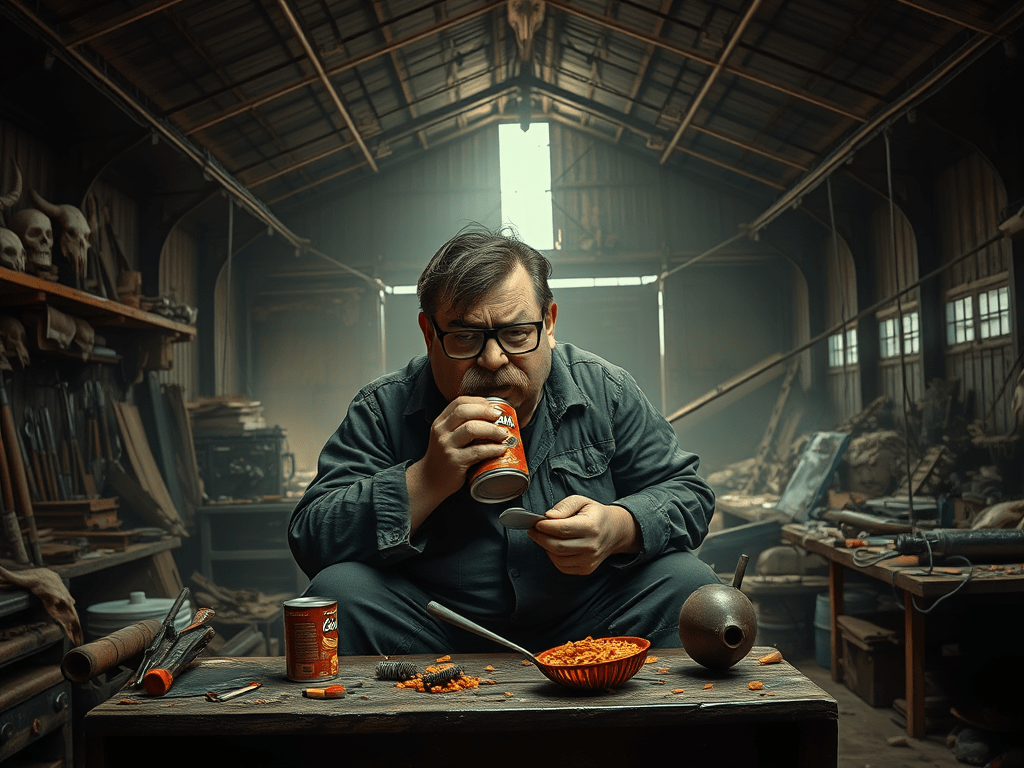
    Just as despair was about to pull me under, a nauseating aroma of glue, pickles, and formaldehyde wafted through the air, signaling the arrival of my destination. I squinted through the gloom to see a structure emerge from the fog—a dilapidated hangar that looked like it had been plucked from a post-apocalyptic movie set. Inside was the world’s most disgruntled handyman, a short, rotund man with glasses thick enough to start a small library, a bushy mustache that looked like it was trying to escape his face, and a head bald enough to use as a landing strip for insects. He was hunched over a workbench, devouring SpaghettiOs straight from the can with the kind of focus usually reserved for nuclear codes. His irritation at being interrupted was palpable, like I’d crashed his private spaghetti party.

    “Twenty dollars cash,” he grunted, extending his hand with the authority of a toll collector in the underworld. I handed him the bill with the reverence of a pilgrim offering gold to a god. He stuffed it into his grease-splattered apron, took another spoonful of his cold, canned meal, and scowled at me like I’d personally betrayed him. With the wind howling through the thin steel walls of the hangar, I half expected the place to take off and join Dorothy’s house in the sky. The handyman delivered his parting words with the gravitas of a crypt keeper: I must never lose a key again, lest I face the incompetence of his replacement, who was, according to him, a veritable nincompoop with the locksmithing skills of a potato. I thanked him, exited the hangar, and raced straight to the nearest hardware store. I bought a keychain made of Kevlar, equipped with a tether reel and a high-density nylon belt loop—basically, a key-keeping apparatus that could survive a nuclear blast. It was clear I’d never let my keys out of my sight again, lest I face another odyssey to the land of a disgruntled Plant-Ops overlord.