The other night, I released a video arguing that variety in a watch collection is overrated. Instead of chasing endless categories—divers, pilots, field watches, dress pieces, and the like—we should focus on our personal style and keep our collections small, tight, and true. That was the premise.
But if I’m honest, I’m not sure I fully believe it. The video was part thought experiment, part self-intervention—an attempt to persuade myself to stop buying watches I don’t have the time (or wrist real estate) to wear. The argument had internal logic. It also had a faint scent of self-justifying desperation.
And that’s okay. I enjoyed making it. Wrestling with the ideas sharpened my thoughts, and the feedback I received from many of you helped me realize something essential: passion without dialogue is narcissism. Ideas need to be tested by others—challenged, probed, broken open. That’s how belief is forged. Not in solitude, but in the noisy, messy public square.
It was gratifying to hear from so many who, like me, have felt tormented by a sprawling watch collection—agonizing over wrist time, managing rotations like a circus act, and wondering if maybe the hobby was no longer bringing joy but anxiety in disguise.
Then came a comment from one of you—Captain Nolan—who posed a question that cut through all my watch-reducing rhetoric:
“How can you discover what your identity is without trying out watches in the various categories (divers, pilots, field, dress, digital, quartz, mechanical, etc., etc.)?”
It’s a fair question. One I initially wanted to swat away with a tight two-sentence reply and move on. But I couldn’t. The question lingered—because it isn’t really about watches. It’s about identity. And once you start poking at identity, you’re no longer in YouTube comment territory. You’ve stepped into the philosophical deep end—an arena better suited for Aristotle than for a guy with a camera and a strap obsession.
The second reason I hesitated is more personal: I only make videos when there’s a spark of fun, curiosity, or joy. The idea of producing a moody think-piece on self-discovery sounded like a slog. Dull. Pretentious. The video equivalent of being cornered by someone at a party who wants to discuss their enneagram type.
Still, Captain Nolan’s question lodged itself in my mind. How do we figure out what we actually like in watches? And how—after two decades of collecting—did I land where I am now?
The answer is both simple and brutal:
There’s the true answer, and there’s the false answer.
And most people—including YouTubers, influencers, and algorithm-chasing content creators—prefer the false one.
The False Answer
The false answer is a story. A myth. A satisfying narrative that wraps things up in a bow. We’ve been telling these stories for millennia. They bring moral clarity, personal triumph, and a happy ending. They sell. They go viral. They’re designed for applause.
In the watch hobby, this tidy fable is called The Purification Myth.
It goes something like this:
You start off as a giddy newbie, blown away by the sheer number of watches out there. You binge. You buy everything from entry-level divers to Swiss Grails. You accumulate far too many watches to wear, and you convince yourself that this is happiness.
But then comes the crash—maybe financial, maybe emotional, maybe romantic. The fever breaks. You wake up, ashamed of your bloated collection and the dopamine-fueled mania that built it. You sell off everything except a small, tasteful core collection. Peace is restored. Cue soft jazz. Fade to black.
It’s a good story. It even has some truth in it. But like most recovery narratives, it’s cleaner than reality.
Because in real life, the fever doesn’t always break for good. You relapse. You sell everything and then buy it all back. You swear off watches on bracelets, only to fall for a titanium chrono six months later. You go minimalist—and then buy a G-Shock with solar charging, atomic syncing, and more features than a fighter jet. Your tastes mutate.
This is the part the Purification Myth leaves out: people are irrational, compulsive, and deeply inconsistent. And the stories they tell—about clarity, simplicity, “knowing what they want”—are often PR campaigns for whatever identity they’ve temporarily settled into.
Let me give you some real-life examples.
The Myth of Pete Rose
I grew up on the myth of Charlie Hustle–Pete Rose, the man who played baseball like his hair was on fire. The story was simple: if you hustle like Pete, greatness will follow. The world will respect you. You’ll win.
Turns out Pete Rose hustled only on the field. Off the field when it came to examining his moral flaws, he was a lazy, selfish, self-mythologizing gambler who bet recklessly and burned bridges like he lit cigars with them.
The moral? The story was inspiring. It just wasn’t true.
The Sedona Illusion
My family recently went to Sedona, Arizona—a place that sells its own myth: come sip matcha, get a mud massage, and experience spiritual rebirth in the vortexes.
What you get is overpriced kitsch, fake mysticism, and conspicuous consumerism wearing a tie-dyed robe. Crystals, smoothies, celebrities in Lamborghinis. It’s Disneyland for people who think they’re too enlightened for Disneyland.
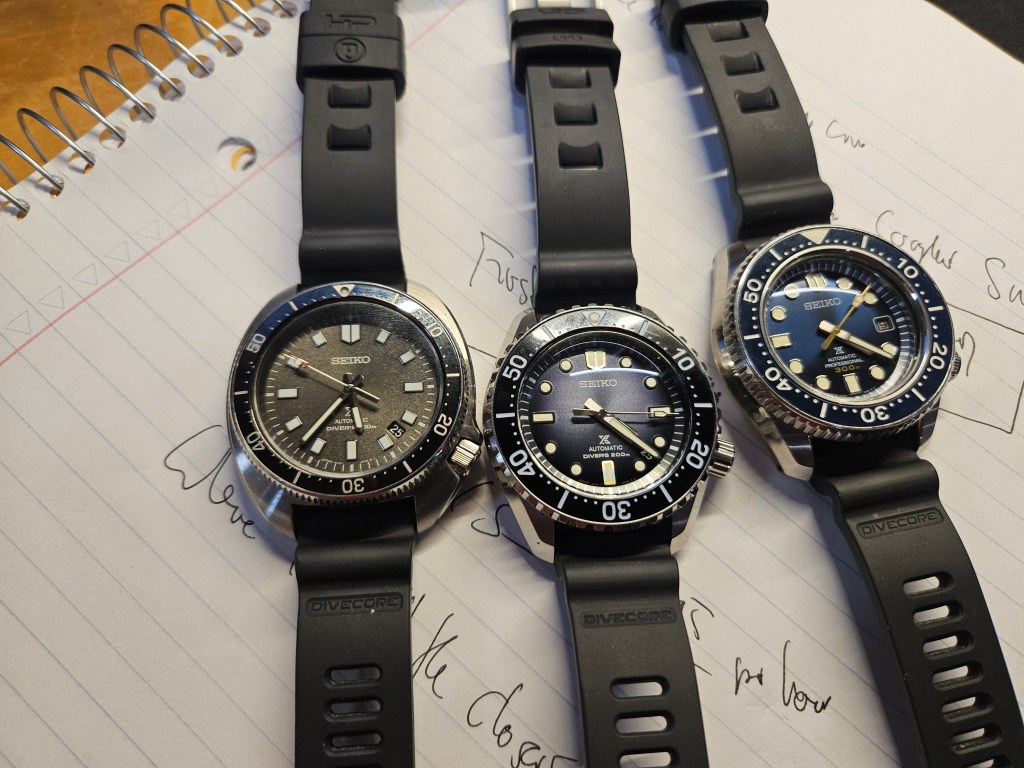
So yes, I could tell you a satisfying story about how I finally landed on a curated set of Seiko divers, all on straps, and how I found inner peace. But I won’t. Because that’s not the whole truth.
The real story is messier, and ongoing. It contradicts itself. It evolves. Sometimes it forgets what it believes and remembers something else entirely.
If you want to find your identity—watch or otherwise—know this: you won’t find it in a story. And you certainly won’t find it in someone else’s.
You find it in the space between obsessions. In the quiet after the hype fades. In the awkwardness of realizing the thing you thought would make you whole… just doesn’t.
That’s where identity lives. Not in clarity, but in contradiction.