Tag: spirituality

  • The Man Who Refused to Retire and Learned to Fly at Costco

    The Man Who Refused to Retire and Learned to Fly at Costco

    You will be sixty-five in less than a year—fifteen months from your last day of work—and you would be wise to bury the word “retirement” before it buries you. It is a feeble, anemic term, a linguistic sedative that disguises the collapse of identity as leisure. Nothing about what lies ahead deserves that kind of small thinking.

    What you are approaching requires a name with altitude, velocity, and a touch of myth.

    You are entering the Sovereign Phase.

    In the Sovereign Phase, you do not keep a schedule—you issue one. You do not await approval—you render decisions. This is not an ending ceremonially dressed in khakis and early dinners; it is a coronation. You are not stepping away. You are stepping above.

    Your final act has begun, and it demands a certain boldness. The first order of business is symbolic but essential: you will upgrade your Costco membership to Executive. No committees. No approvals. No memos. You will simply decide—and it will be done.

    And then, one morning, before the doors officially open to the masses, you will enter.

    The aisles are empty. The pallets stand fresh and untouched. The air itself feels newly issued. You move through this cathedral of abundance with first access, first choice, first claim. Something happens to you here—something disproportionate to the act itself. A quiet but unmistakable inflation of the self. A sense that you have not merely arrived early, but ascended.

    You feel it in your chest first, then in your stride. The strange conviction that you are no longer bound by ordinary constraints. That you have, somehow, earned this.

    You have entered Executive Aisle Rapture.

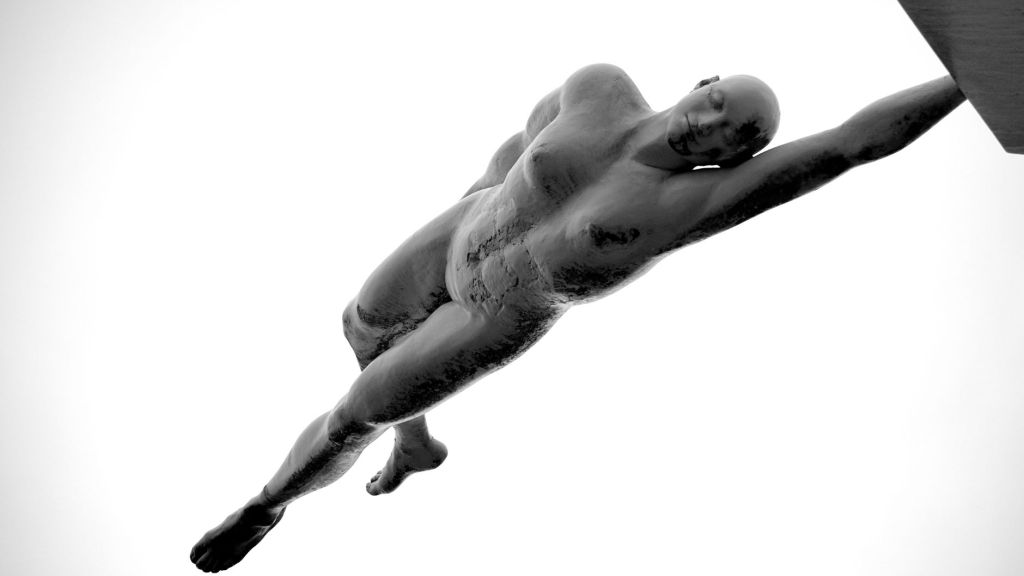
    It is a near-mystical condition in which logistical privilege is mistaken for existential elevation, where empty aisles and shrink-wrapped towers of goods produce a sensation that borders on the divine. You begin to suspect that wings—actual wings—may be forming beneath your shirt, preparing you for a short, ill-advised flight toward the sun.

    This is not a side effect of the Sovereign Phase. It is a requirement.

    So when your last day of work arrives, do not mark it with melancholy or relief. Mark it with a transaction. Upgrade the membership. Secure your access. Step into the early light of the warehouse.

    And when the doors part and the aisles open before you, walk forward without hesitation.

    You are no longer a worker.

    You are sovereign.

  • The Psychological Mess of Wanting Things We Neither Need Nor Intend to Use

    The Psychological Mess of Wanting Things We Neither Need Nor Intend to Use

    One of the strangest features of materialism is the spectacular mismatch between what we imagine an object will do for us and what it actually does. In the mind, the object arrives polished, transcendent—an emblem of taste, discipline, even identity. In reality, it often sits there, unnecessary and faintly ridiculous, like a prop waiting for a performance that never begins. 

    I own an eight-year-old Accord with fewer than 30,000 miles on it—a statistic that quietly announces I neither drive much nor particularly enjoy driving. And yet I can picture, with embarrassing clarity, a brand-new Accord or Camry resting in my garage, gleaming like a sacred artifact I would prefer not to disturb by actually using it.

    Watches operate under the same spell. I can easily imagine owning a Tudor Black Bay or a Tudor Pelagos, each one promising a kind of quiet authority on the wrist. But my habits betray me. I’m not roaming public spaces, not projecting presence, not leveraging this object as a social signal. The watch would sit, admired in theory, unused in practice. I know dozens—no, hundreds—of watch enthusiasts who live in this same contradiction, accumulating pieces they rarely wear because the idea of ownership is more intoxicating than the act of use.

    This gap between having and being is hardly new. I was reminded of it while thinking about Erich Fromm and his book To Have or To Be?, which argues that materialism quietly erodes the possibility of a meaningful life grounded in connection and experience. The argument is persuasive—almost obvious once stated. And yet, knowing this changes very little.

    That’s the part that unsettles me. You can understand the critique, agree with it, even teach it, and still find yourself browsing for the next unnecessary object with the focus of a predator. Clarity does not neutralize desire. It merely observes it, like a detached narrator watching the same old plot unfold. There’s something almost comical about it—this split between the thinking self and the acquisitive impulse. If you wanted to document the absurdity of human behavior, you could dedicate an entire season of Dirty Jobs to it: not the grime of physical labor, but the psychological mess of wanting things we neither need nor intend to use.

  • When Writing Stops You From Lying to Yourself

    When Writing Stops You From Lying to Yourself

    Kafka called writing a form of prayer. Not as piety, but as precision. Prayer, properly understood, is the act of stepping out of ordinary time—the noisy, transactional churn—and entering a space where attention is no longer scattered but gathered. Writing does the same. It refuses the chaos of profane time and insists, however briefly, on the discipline of the sacred.

    The sacred is not mystical fog. It is clarity stripped of dopamine. It is the quiet room where you examine the state of your own soul without distraction or performance. It is where you test whether your words can survive contact with your actions. It demands humility because it exposes how often they don’t. And it offers a kind of nourishment the chronophage—the great time-eating machine—cannot provide, because it cannot be consumed passively. It must be earned.

    To live thoughtfully is to move between two worlds: the sacred and the profane. You cannot remain in either one. You must descend into the ordinary—work, errands, obligations—but carry with you the standards forged in that quieter space. Otherwise, the sacred becomes theater, and the profane becomes drift.

    So the question arrives, unwelcome but necessary: Do my actions align with my ideals? No. Not yet.

    If they did, my life would contract, not expand. I would eat with intention—three meals, no grazing—and call the absence of snacks what it is: a fast, not a deprivation. I would step away from the digital carnival that thrives on FOMO, because I know its rewards are counterfeit—brief spikes followed by longer, duller lows.

    I would stop buying watches. I already own more than I can meaningfully wear. Two G-Shocks tell perfect time. The rest sit like artifacts of former appetites. Rotation is not variety; it is indecision dressed as sophistication.

    And I would reconsider what I make. If my videos exist to chase attention, to measure my worth in clicks and spikes of approval, then they are extensions of the same problem. The medium is different; the mechanism is identical. But if a video can carry an idea forward—if it can clarify rather than agitate—then it earns its place.

    Writing, then, is not an escape. It is a reckoning. It is the act of bringing the sacred into contact with the profane and asking, without flinching, whether they agree. Most days, they don’t. The work is to narrow that distance.

  • The Collection You Don’t Wear but Can’t Survive Without

    The Collection You Don’t Wear but Can’t Survive Without

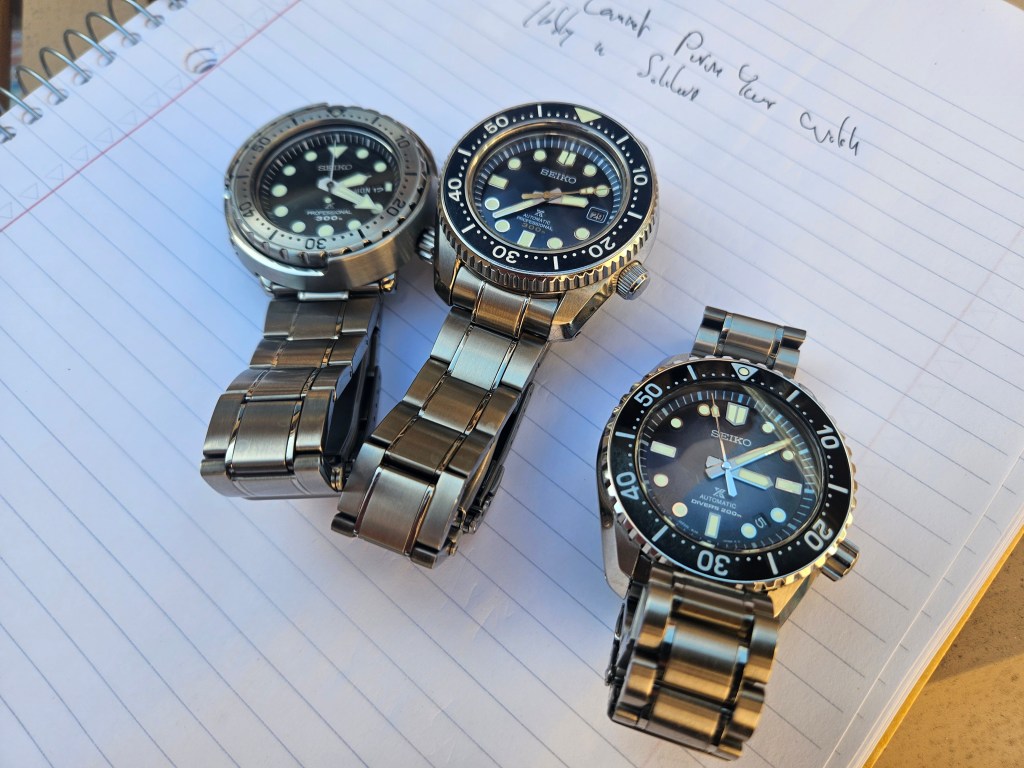
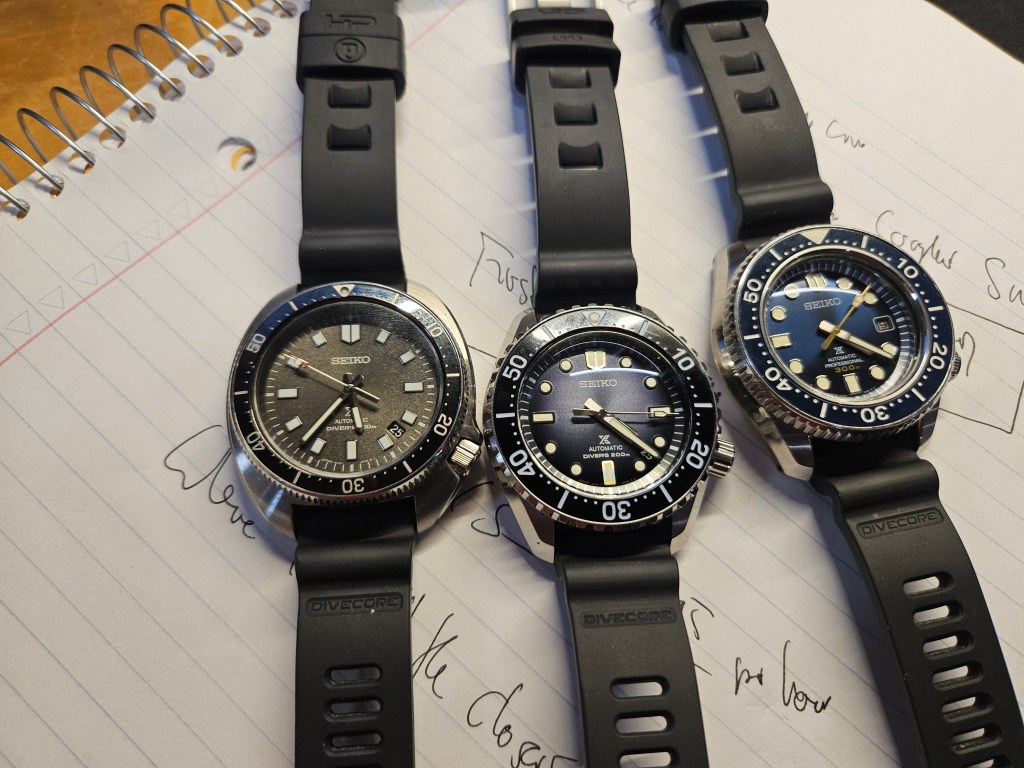
    After decades of horological torment, you finally reached a fragile state of mental stability: seven Seiko mechanical divers on straps, each a gleaming monument to discipline, restraint, and the lie that this was the last one.

    Then, one afternoon, on a whim, you bought a G-Shock Frogman.

    It never left your wrist.

    The atomic time spoke in a language your mechanical watches never could. No drift. No romance. No negotiation. Just cold, sovereign accuracy. Precision not as craft, but as authority.

    Later, you noticed the numerals were slightly small at night. Not a real problem—just enough of a problem to justify research. The Frogman’s cousin joined your G-Shock team: the Rangeman. Bigger digits. Cleaner read. Perfect.

    And since you were already there, you finished the trilogy with the GW5000U—the square, the legend, the watch that doesn’t try to impress because it already knows it has won.

    Now you rotated three G-Shocks in quiet contentment.

    Meanwhile, the Seiko divers sat untouched.

    After a year, you asked the logical question.

    Should you sell those lonely mechanical divers?

    No.

    You told yourself the mechanical itch might return—like a dormant fever waiting for the right conditions.

    Five more years passed.

    The mechanical divers remained untouched. Still sealed in boxes like museum artifacts from a former civilization.

    You asked again.

    Now am I ready to sell them?

    Again: no.

    Because you remembered something.

    Friends with old cars that ran perfectly—until a well-meaning mechanic convinced them to do an oil change. The service was supposed to extend the car’s life. Instead, something shifted. A leak here. A vibration there. One repair triggered another. Soon the car that ran fine was on a tow truck, headed for the graveyard.

    You observe the reason for the car’s demise: Old machines develop a private ecosystem, a delicate equilibrium of wear, grime, and negotiated compromise. Sludge plugs the gaps that worn seals can no longer manage. Thickened oil cushions parts that have learned to move together like an aging married couple—no surprises, no sudden demands. Then comes the well-meaning oil change. Fresh, detergent-rich oil floods the system like a power washer through a century house. It dissolves the gunk that was quietly holding things together, exposes seals that forgot how to seal, and restores pressures that aging gaskets experience as a personal attack. The engine, once stable in its gentle decline, now leaks, ticks, hesitates, and protests as if a dam has been opened upstream and released a torrent of mechanical demons long kept asleep by dirt, viscosity, and mutual resignation. Nothing was “broken” before. The oil change didn’t create the problems—it simply removed the sediment that was hiding the truce.

    That’s what selling the Seikos feels like.

    An oil change on your soul.

    A rational act of simplification that might disturb the delicate machinery holding your psyche together. One decision leading to second thoughts. Second thoughts leading to regret. Regret leading to obsessive re-buying, late-night searches, financial damage, emotional collapse.

    You’re not afraid of losing the watches.

    You’re afraid of the cascade.

    So you leave the mechanical divers where they are.

    The three G-Shocks run your daily life. The mechanical divers sit in darkness, untouched and unnecessary—yet absolutely essential.

    They are the cork in the dam.

    Pull them out, and who knows what pressure comes rushing through.

    This is Stability Hoarding: keeping possessions not because you use them, need them, or even want them, but because their continued existence reassures you that nothing irreversible has happened. They are emotional ballast. Identity reserves. Evidence that former versions of you remain on standby.

    You’re not preserving watches.

    You’re preserving options.

    Selling them feels less like decluttering and more like closing a door you may someday need to sprint through in a panic.

    Stability hoarding isn’t about objects.

    It’s about keeping your past selves employed as an emergency backup system—just in case the life you’re living now ever crashes.

  • Precision Displacement: When the Bezel Replaces the Mirror

    Precision Displacement: When the Bezel Replaces the Mirror

    You know, at least in theory, that the soul deserves more attention than the watch box. But theory is one thing; the comfort of brushed titanium is another. The soul is abstract, unruly, and resistant to instruction. There is no manual, no torque specification, no authorized service interval. A watch, by contrast, behaves. It offers dimensions, tolerances, finishes, and measurable improvements. You can change a strap and feel progress. You can regulate a movement and feel control. The inner life asks unsettling questions; the outer object gives reassuring answers. And so, without ever making a formal decision, you begin treating the collection while postponing the treatment of yourself. The watches become a buffer—a polished, luminous perimeter against the vague anxiety of being a finite creature with unfinished business.

    This drift has a name: Precision Displacement Syndrome—the habit of redirecting emotional or spiritual uncertainty into domains that reward technical exactness. Instead of confronting meaning, identity, or mortality, you refine alignment, accuracy, and material quality. The language shifts accordingly. You stop asking whether your life is coherent and start asking whether the bezel action is crisp. The psyche seeks certainty wherever it can find it, and mechanics provide something the soul does not: compliance.

    Over time, this pattern produces a strange and impressive asymmetry. The collection improves. It becomes curated, rationalized, and narrated with the solemnity of a museum catalog. Meanwhile, the interior landscape narrows. Complexity is replaced by control; vulnerability by optimization. This is Gollumification—the quiet contraction of the inner life alongside the expansion of horological expertise. Faced with the untidy work of self-examination, the enthusiast retreats into the clean world of case thickness, lume performance, crown feel, and strap chemistry, where every unease can be translated into a specification and every mood can be managed with a purchase.

    The final transformation is subtle but unmistakable. Precision Displacement Syndrome does the thinking for you. Instead of asking, Who am I becoming? you ask, Is this the correct lug width? The watches grow more refined, more intentional, more spiritually justified. The wearer grows more guarded, more dependent, more quietly organized around objects that stabilize his emotional climate. Like Tolkien’s cave-dweller, he becomes pale but authoritative, whispering “my precious” over a perfectly regulated timepiece—externally upgraded, internally undernourished, and increasingly persuaded that mastery of the mechanism is a close enough substitute for mastery of his life.

  • Monowatch Asceticism Meets the Skinny Yoga Guy

    Monowatch Asceticism Meets the Skinny Yoga Guy

    As the clock keeps punching holes in the calendar and I drift into the middle distance of my sixties, I’m stalked by the uneasy sense that I am not the man I’m supposed to be. I carry thirty extra pounds like unpaid emotional invoices. I cave to food temptations with embarrassing regularity. I indulge in narcissistic spirals of self-pity. My body bears the archaeological record of a lifetime of weightlifting injuries. Something has to give. The question isn’t whether I’m a complex human being—of course I am—but which single image can give me dignity, courage, and self-possession as I face my obligations, stay engaged with this lunatic world, and fend off entropy. The image that keeps returning, uninvited but insistent, is this: I am the Skinny Yoga Guy.

    The Skinny Yoga Guy eats vegan, clean, and whole, not as a performance but as a quiet discipline. He hits his protein macros with buckwheat, pumpkin seeds, peas, soy, garbanzos, and nutritional yeast, without sulking or negotiating. He cooks plant-based meals anchored in Thai, Mexican, and Indian traditions, not sad beige bowls marketed as “fuel.” He doesn’t snack like a raccoon in a pantry; he sips cucumber water and green tea and moves on with his day.

    He practices yoga six days a week, a full hour each time, sweating without complaint. The body lengthens. The spine straightens. He appears taller, calmer, less compressed by life. There’s a faint health glow—less “Instagram guru,” more “someone whose joints don’t hate him.” The discipline reshapes his temperament. The short fuse and indulgent sulks fade. In their place emerges a man who notices other people, attends to their needs without sermonizing, and discovers—almost accidentally—that service makes him sturdier, not smaller.

    In this revised operating system, the watch obsession quietly dies. No more chunky diver watches as heroic cosplay. No rotation. No drama. Just one watch: the G-Shock GW-5000. The purest G-Shock because it refuses theater. Shockproof, accurate, solar-powered, atomically synced. No Bluetooth, no notifications, no begging for attention. It does one thing relentlessly well: it tells the truth about time. It is reliability without narcissism.

    If the GW-5000 is indestructibility stripped of spectacle, then my assignment is clear: I must become its carbon-based counterpart. Less bloat. Fewer features. More uptime. Yoga becomes joint maintenance. Vegan food becomes corrosion control. No supplements that blink. No gadgets that chirp. No dietary Bluetooth pairing with guilt. Just a lean system designed to absorb impact, recover quickly, and remain accurate. GW-5000 firmware, now awkwardly attempting to run on two legs. Stripped down to one G-Shock, I can enjoy Monowatch Asceticism: the deliberate reduction of a watch collection to a single, purely functional timepiece as an act of identity purification. Ownership shifts from expression to discipline; the watch becomes less an accessory than a vow—proof that the wearer has stepped off the cycle of acquisition and into a life governed by restraint, durability, and quiet competence

    The longing is real. I want to be the Skinny Yoga Guy—disciplined, light, healthy—wearing a single $300 G-Shock as a quiet marker of having stepped off the status treadmill. I no longer want validation from a $7,000 luxury watch. Wanting this man is easy. Becoming him is not. That requires character, not aspiration.

    My hunch is that I need to write my way into him. A novel titled The Skinny Yoga Guy. Not a parody, not a self-help tract, but a chronicle of real-time change rendered with mordant humor and unsparing honesty. The book isn’t the point. Transformation is. The novel would simply be the witness.

    So here I am, a larval creature trapped in my cocoon. I must emerge as a new creature. The challenge is issued. Whether the world is waiting for my metamorphosis is irrelevant. I am. And that, for once, feels like enough.

  • Pleasure Island Goes Digital: The Rise of the Hedonist-Sapien

    Pleasure Island Goes Digital: The Rise of the Hedonist-Sapien

    Eric Weiner’s The Geography of Bliss introduces one of the great cautionary silhouettes of modern travel writing: the Farang. In Thailand, the word names a particular species of Western pleasure-seeker—less tourist than residue. He is instantly legible. White. Middle-aged. Soft around the middle and hard around the eyes. His skin has that sickly, overcooked hue of someone who hasn’t slept, eaten, or hoped correctly in years. He lurches down the beach in baggy, sweat-darkened clothes, face glazed, spirit half-evacuated, as if his soul stepped out for air and never came back. What keeps him upright is not health or purpose but a wallet swollen with cash. When the money runs out, so does the illusion. He staggers home to recover, refill, and then returns to the same tropical oubliette to repeat the cycle—debauch, deplete, disappear, reload. Pleasure, in this form, isn’t joy. It’s maintenance.

    Pinocchio offers its own version of the Farang, with less sunscreen and more clarity. Linger too long on Pleasure Island and you don’t just lose your moral compass—you sprout hooves. The boy becomes a jackass. The metaphor is unsubtle and mercifully so. Pleasure without restraint doesn’t make you free; it makes you stupid, loud, and increasingly unrecognizable to yourself. World culture is thick with such warnings. Myths, fables, scriptures, novels—whole libraries exist to explain why worshiping pleasure ends badly. And yet hedonism has never been more ascendant, because unlike virtue, it scales beautifully. It drives commerce. It sells. Entire industries are built on the catechism that pleasure is the highest good and discomfort the only sin. Billions now live as functional hedonists without ever using the word, while a more self-aware elite practices a refined variant—“mindful hedonism”—spending staggering sums to curate lives of seamless comfort, aesthetic indulgence, and moral exemption. In a culture that treats pleasure as proof of success, the hedonist-sapien is not a cautionary tale; he is a lifestyle influencer.

    If you are a hedonist-sapien, your gaze turns inward, away from society’s disputes and toward the sovereign self. The highest goods are pleasure, freedom, and the smooth, uninterrupted unfolding of personal desire. Politics is static. Transcendence is optional. What matters is feeling good, living well, and sanding down every rough edge along the way. Into this worldview step the AI machines, not as ethical dilemmas but as gift baskets. They curate taste, anticipate desire, eliminate friction, and turn effort into an avoidable inconvenience. They promise a life where comfort feels earned simply by existing, and choice replaces discipline. Of the four orientations, the hedonist-sapien greets AI with the least suspicion and the widest grin, welcoming it as the perfect accomplice in the lifelong project of maximizing pleasure and minimizing resistance—Pleasure Island, now fully automated.

  • Carl Jung’s Bollingen Tower Represents Our Sanctuary for Deep Work

    Carl Jung’s Bollingen Tower Represents Our Sanctuary for Deep Work

    Bollingen Principle

    noun
    The principle that original, meaningful work requires a deliberately constructed refuge from distraction. Named after Carl Jung’s Bollingen Tower, the Bollingen Principle holds that depth does not emerge from convenience or connectivity, but from environments intentionally designed to protect sustained thought, solitude, and intellectual risk. Such spaces—whether physical, temporal, or psychological—function as sanctuaries where the mind can operate at full depth, free from the pressures of immediacy and performance. The principle rejects the idea that creativity can flourish amid constant interruption, insisting instead that those who seek to do work that matters must first build the conditions that allow thinking itself to breathe.

    ***

    In an age saturated with technological distraction and constant talk of “disruption” and AI-driven upheaval, it is easy to lose sight of one’s personal mission. That mission is a North Star—a purpose that orients work, effort, and flourishing. It cannot be assigned by an employer, an algorithm, or a cultural trend. It must be discovered. As Viktor Frankl argues in Man’s Search for Meaning, you do not choose meaning at will; life chooses it for you, or rather, life discloses meaning to you. The task, then, is attentiveness: to look and listen carefully to one’s particular circumstances, abilities, and obligations in order to discern what life is asking of you.

    Discerning that mission requires depth, not shallowness. Cal Newport’s central claim in Deep Work is that depth is impossible in a state of constant distraction. A meaningful life therefore demands the active rejection of shallow habits and the deliberate cultivation of sustained focus. This often requires solitude—or at minimum, long stretches of the day protected from interruption. Newport points to Carl Jung as a model. When Jung sought to transform psychiatry, he built Bollingen Tower, a retreat designed to preserve his capacity for deep thought. That environment enabled work of such originality and power that it reshaped an entire field.

    Jung’s example reveals two essential conditions for depth: a guiding ideal larger than comfort or instant gratification, and an environment structured to defend attention. To avoid a shallow life and pursue a meaningful one, we must practice the same discipline. We must listen for our own North Star as it emerges from our lives, and then build our own version of Bollingen Tower—physical, temporal, or psychological—so that we can do the work that gives our lives coherence and meaning.

  • The Camera, the Angel, and the Mantra

    The Camera, the Angel, and the Mantra

    Last night I dreamed I was drifting up the coast with my twin daughters, sermonizing like a broken record: There is a physical world and there is a spiritual world. I said it so often I sounded like a street preacher who’d lost his pamphlets but kept his conviction.

    We stopped at a retreat, the entrance nothing more than a ladder plunging into a meadow. Down we went, rung by rung, my mantra trailing after us like incense: physical and spiritual, spiritual and physical.

    In the meadow stood an angelic blonde, late teens, all halo and camera gear, fiddling with a tripod as if she were about to capture the resurrection. Beside her was her younger brother, a sweet kid who instantly bonded with my daughters—proof that love doesn’t check the itinerary before showing up.

    I told the angelic sister this was an inconvenient day for romance, since we were traveling north to find the rest of our family. Still, watching affection bloom like an invasive weed, I conceded we might linger a little longer. My daughters, I suggested, could teach her brother the finer points of philosophy, relationships, and all the grand illusions we adults mistake for wisdom. She nodded, grateful, and asked where we were headed. I repeated: north, always north.

    Her camera squatted in the grass, looking familiar—something from an earlier chapter of the dream, mediocre at best. I bit my tongue rather than insult her equipment, repeating inwardly my refrain: The world is both physical and spiritual.

    Meanwhile, my daughters and the boy turned the ladder into a playground, climbing and descending until their thighs grew visibly muscular—an anatomical exclamation point underscoring my point. The body is flesh, the soul is fire, and the dream was happy to remind me of both.

  • The Tabloid Mind Vs. The Thoughtful Mind

    The Tabloid Mind Vs. The Thoughtful Mind

    The verdict is in: after fifteen years of running their experiment on us, social media has mangled the human psyche. It has sandblasted away nuance, turned civility into snarling, and left us performing as shrill tribal mascots. The trouble begins with its essence: an Attention Machine. Every scroll is a sugar hit for the brain—quick spike, hard crash. We learn the trick ourselves, spitting out content like human Pez dispensers, packaging our thoughts as candy for the feed.

    Belonging is rationed out in likes and retweets, and the cost is subtlety. To win attention, you don’t weigh both sides—you crank the volume, you caricature, you inflame. What begins as a hook metastasizes into belief. We develop the Tabloid Mind: the reflex to turn every notion into a screaming headline. And once we inhabit the Tabloid Mind, we degrade, becoming not better humans but better performers for the algorithm.

    The Thoughtful Mind never stood a chance. A Tabloid platform attracts tens of millions; the Thoughtful Mind, if lucky, limps along with scraps. Yet the difference is stark. The Thoughtful Mind asks, listens, considers contradictions, and cools the room so clarity can thrive. The Tabloid Mind, by contrast, thrives on panic and rage, reducing discourse to a lizard-brain cage match where opponents are demons and the fire must never go out.

    A culture enthroned by the Tabloid Mind breeds paranoia, extremism, conspiracy, and violence. And violence doesn’t need to be shouted—it can be winked into existence by the constant drip of toxic adrenaline.

    I know the alternative exists because I live it daily in the classroom. When my students wrestle with bro culture, influencer fakery, or the cultural fallout of GLP-1 drugs, they do so with humor, nuance, and critical thought. The Thoughtful Mind lives there, in the room, face to face. No one is frothing at the dopamine mouth. No one is shitposting for clout. We disagree, we wrestle, we laugh—but we think.

    The Tabloid Mind is not sustainable. It’s a toxin, and unchecked, it will kill us. Our survival depends on choosing the Thoughtful Mind instead. The fight between them—clickbait versus clarity, heat versus light—is not just cultural noise. It’s the defining battle of our age.