Tag: tech

  • The First 24 Hours of Using My Mac Mini M4 Have Not Been Promising

    The First 24 Hours of Using My Mac Mini M4 Have Not Been Promising

    I had been wanting to work at my desk with two 27-inch monitors and a quiet small, form factor desktop to replace my old Acer gaming laptop connected to a monitor at my desk for a long time. I did a lot of research and finally settled on a Mac Mini M4 with 32GB RAM and 1TB SSD. Yesterday I began the process of leaving Windows, after 7 years, and working in the Mac OS system. 

    So far I regret my decision. The hardware on the Mac Mini is impressive. It is a beautiful, fast, responsive machine. However, it is too fussy for me and it doesn’t work well with hubs and peripherals, which you need if you want to be fully functional at your desk. 

    It doesn’t respond to my Asus mechanical keyboard after it falls asleep, so I have to turn off and restart the computer just to get it to respond to my keyboard. 

    I have to buy a USB converter so the A on my wired keyboard can go into the Mini’s C portal. That arrives later today.

    I’ve already bought an Anker hub that proved insufficient for the amount of ports I need. To be honest, I asked ChatGPT to recommend a hub, I gave it my requirements, and ChatGPT gave me inaccurate information. Not only did ChatGPT tell me to get a hub with insufficient ports, it told me to get a powered one, so I bought a power brick and power cable as well. My engineering friend came over and said a passive hub would have actually worked better, so ChatGPT was wrong on two fronts. I feel stupid for having trusted it. 

    I had my engineering friend help me connect my Edifier speakers and told me what hub to buy for my USB-A ports that I need for my camera, mic, and printer. 

    The Mac Mini fails in providing portals. If I were Apple, I would sell, for $200, a hub that turns the Mini into a true desktop. You need a portal for the following:

    • Keyboard
    • Mouse
    • Camera
    • Mic
    • Speakers
    • Two monitors
    • Printer
    • SD Card Reader

    Because my mechanical keyboard is not currently connected to the actual Mini but going through my Anker hub, the Mac is not reading it after the Mac wakes up, so I have to turn off the Mac. 

    The Mac Mini and Mac in general fails to provide a seamless experience when it comes to connecting peripherals. You have to follow too many protocols before it accepts “strangers” into its home and sometimes it seems to randomly kick out the strangers this way. 

    I’m also having problems with the mouse. When I want to scroll over three pages of content I wrote on Google Docs, the mouse stops when I get to a bottom of a page, so I have to copy and paste in pieces. This is terrible workflow. Perhaps I’ll find a solution to this, but it’s yet another reason I’m not liking my new Mac Mini.

    Another failure of Mac in general is workflow. My wife and I are both teachers and my students have mostly Macs, and we all use Google Chrome for our workflow. Why hasn’t Apple come up with something like Google Docs and Google Chrome so workflow can be as appealing as Google Chrome? So far, it hasn’t. 

    I’m using Google Chrome on my Mac, which isn’t optimal because Google Chrome eats a lot of RAM and memory on Macs. That’s why I got 32GB RAM and 1TB SSD. 

    I have an Acer 516GE Chromebook in my room and it is seamless, fast, and works well with Google Chrome. 

    So far I’m not impressed with this Mac. My engineering friend, who loves his MacBook Pro, says to wait a week before I give up and give the Mac to my daughter or return it. 

    I’m not going to give up yet. If you’re like me and you want this amazing machine called the Mac Mini, I have some important advice based on what I’ve gone through the last 24 hours:

    1. Be sure you have a hub that meets your portal needs.
    2. If you like a mechanical keyboard wired with USB-A, get a C converter so you can plug it directly into the Mini so that the Mini reads your keyboard after it sleeps.
    3. Import all your Google Chrome bookmarks to Safari because your mouse won’t scroll on Google Docs in Chrome properly. It will, however, in Safari.

  • The Great Port Panic: Notes from a Man Who Bought Two Mac Minis

    The Great Port Panic: Notes from a Man Who Bought Two Mac Minis

    My wife’s seven-year-old iMac has slowed to a crawl, spinning that cursed “wheel of death” like a medieval torture device. My own seven-year-old laptop, lashed to a monitor like a patient in an ICU, hasn’t exactly delivered the clarity and comfort I need at my desk. For years I procrastinated on upgrades for the usual reasons—data migration, password authentication, DPI settings, monitor heights, the question of whether the mouse goes left or right. Every new computer setup promises productivity but arrives with a Costco-sized migraine.

    At Thanksgiving, my brother-in-law delivered the slap: “Get off your butt and replace them. RAM prices are exploding. AI is eating the supply.” He said it with the urgency of a man who has watched a tech apocalypse montage on fast-forward.

    I went back and forth between a Lenovo business mini PC and a Mac Mini, like a man choosing between two religions, neither of which he fully trusts. In the end I rolled the dice on Cupertino. I bought two identical Mac Minis—M4, 32GB RAM, 1TB SSD. I’m either a pragmatic genius or the biggest sucker Apple has netted since the butterfly keyboard years.

    Last night I couldn’t sleep. I lay in the dark obsessing over the only question that matters to men of a certain age: Does it have enough ports? I have a mechanical keyboard, a mouse, Edifier speakers, two 27-inch monitors, a printer, an SD reader for my Nikon Z30, and ethernet. Eight connections. The Mac Mini has two USB-A ports and some USB-C wizardry that feels like a riddle designed by a monk from the USB Consortium. So I bought an Anker multi-port hub. But of course the hub isn’t self-sufficient—you must also buy the 100W charger, and the 100W cable, like tech accessories sold separately from your dignity.

    Then there’s the setup. I’ll have to dive into Apple System Settings and tell the machine who I am: configure the mechanical keyboard, calibrate the Dell and Asus monitors, coax the printer to speak in the dialect of Cupertino. I haven’t used macOS in years. My engineering friend—who worships his MacBook Pro like it’s Thor’s hammer—assures me, “The extra you pay for Apple is stupid tax.” I’m not sure whether I’m buying ease of use or a velvet rope to my own humiliation.

    But the final boss isn’t the ports, or the migration, or the learning curve. It’s the aesthetics. I will have a quiet four-inch metal cube powering two gleaming monitors. I want the desk to look like a minimalist command station, not the back room of a RadioShack circa 1997. Every cable threatens the illusion. Every adapter is a serpent in Eden. The rat’s nest must not be allowed to encroach.

    This is why I waited so long to replace the old machines. Not because I feared expense or inconvenience—but because I feared myself. The arrival of a new computer flips my OCD switch like a Vegas neon sign. For the next week, I’ll be pacing my office like an engineer at Cape Canaveral—sleepless, wiring my life together one USB-C at a time.

  • The Cult of the Desktop Shrine

    The Cult of the Desktop Shrine

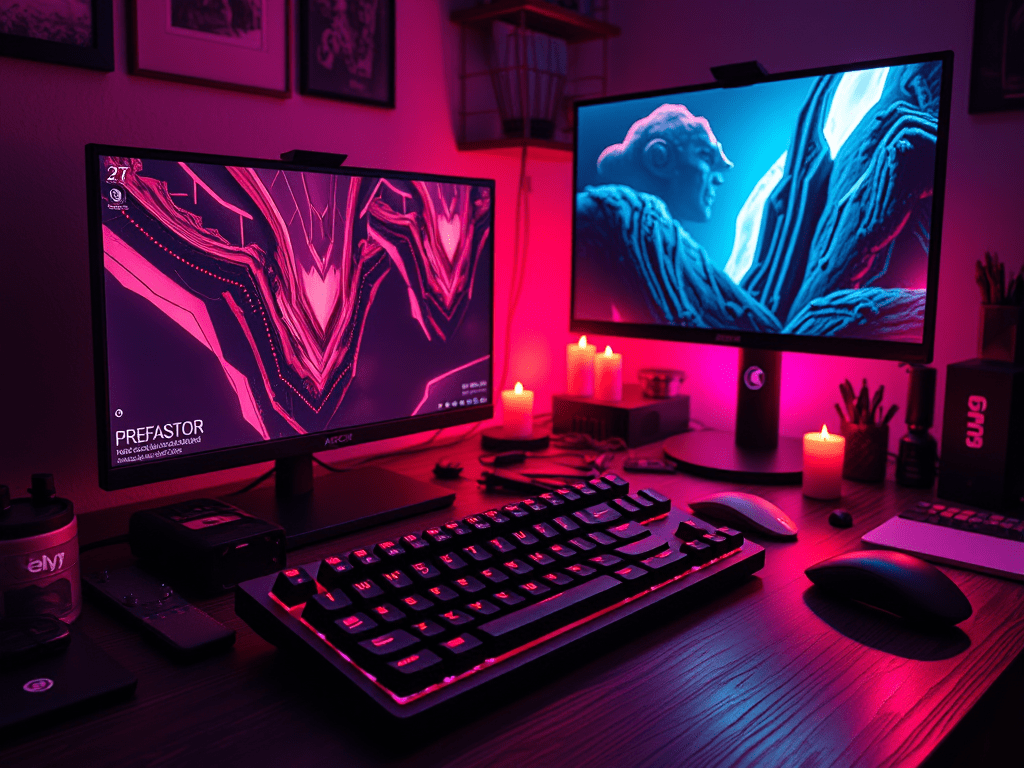
    There is a particular species of human for whom a new computer is not a tool — it’s a religious conversion. The desktop isn’t a workspace; it’s a cockpit for a future self, the glamorous avatar of the writer, artist, or content sorcerer they imagine they will become. People like this do not simply buy machines. They curate private shrines. A desk becomes an escape pod: LED lights humming like temple candles, two monitors glowing like stained-glass windows, and the mechanical keyboard serving as a holy relic. Once seated, the outside world ceases to exist — or so the fantasy goes — until an eBay tab opens and suddenly a $2,500 dive watch begs for attention, or a pair of ergonomic walking shoes on sale becomes a spiritual priority. Sacredness is delicate; it collapses at the first whiff of retail dopamine.

    I speak as one of these zealots. I live in a small home with a wife and two teenage daughters, so I protect the illusion of solitude with the devotion of a medieval monk. My desktop setup has become my monastery. For seven years, I have sat beside the same computer: a 15.6-inch Acer Predator Triton 500 with an RTX 2080, perched like a retired fighter pilot on a wooden pedestal. Beside it stands a 27-inch Asus Designo 4K monitor. My keyboard is an Asus Rog Strix Scope II fitted with “quiet snow” switches — though I still regret not choosing switches that click like a typewriter possessed by Bukowski.

    Here’s the problem: the machine refuses to die. It doesn’t slow down, wheeze, or show symptoms of electronic mortality. It handles everything I throw at it. This stubborn longevity has become an accusation. If I truly mattered — if I were a world-crushing content creator — surely I would need M4 silicon or a Windows Ultra 9. But here I am, a humble i7 and RTX 2080 carrying my entire life on its back like a mule. The message is humiliating: you produce so little that even an elderly predator laptop barely notices your existence. I am not a digital gladiator. I am an NPC.

    One half of me wants to honor the Acer’s absurd durability. I want to see how long it lasts: eight years? Ten? Will it run until I am eighty and my daughters sell it on Facebook Marketplace to a grad student writing her dissertation? The other half of me yearns for a new identity — a fresh cockpit. I fantasize about a Lenovo ThinkPad P16, a machine with the aesthetic of a NATO command center. In my imagination I would sit before it, efficient and unstoppable, a productivity samurai. Then I read about thermals, swollen batteries, and the corporate decay of ThinkPad build quality, and the fantasy curdles.

    Mini PCs tempt me, too — elegant little cubes promising freedom from laptop fan noise. But then I scroll deeper and learn about overheating, BIOS drama, firmware rituals, and mysterious Windows gremlins that exist only for people who try to “optimize.” This is when I confront the truth: Windows PCs are for people fluent in Linux, the jiu-jitsu masters of tech. These individuals have tattoos of penguins on their forearms and spend weekends customizing drivers the way normal people mow their lawns. They don’t “use computers.” They tame them.

    I am not that creature. I am a man who gets nervous updating his router. This leaves me with one path: the Mac Mini. Not because I am enlightened, but because the walls of Apple’s walled garden keep me from accidentally burning the place down. Windows is a vast golf course stretching to the horizon. MacOS is miniature golf: enclosed, guarded, brightly colored obstacles that keep your ball out of the swamp. I must accept who I am — a timid, high-functioning idiot — and pick the putter.

    And yet, when people complain about laptops dying after three years, I can raise a hand and say: “Seven years. RTX 2080. Still alive.” It is not greatness, but it is a kind of glory.

  • The Laptop That Refuses to Die

    The Laptop That Refuses to Die

    I never imagined my $3,000 Acer gaming laptop—armed with an RTX 2080 and given to me as a review model back in 2019—would still be chugging along like a caffeinated mule nearly seven years later. It was supposed to be a flashy fling, not a long-term relationship. Yet here we are, the old beast still running my digital life as a home desktop replacement, while newer machines preen on YouTube reviews like showroom models whispering, “You deserve better.”

    Recently, I started the ritual again—tech research as performance art. I even discovered a comment I’d left a year ago under a Mac Mini review, declaring with absolute conviction that it would be my next computer. A year later, I’m still typing this on the Acer. Why? Because the damn thing refuses to die. Sure, I’m not exactly rendering Pixar films here; the most demanding task I throw at it is uploading Nikon footage. But still—seven years? That’s geriatric in tech years.

    Then came the unnerving thought: what if this laptop outlives my enthusiasm? What if it just… keeps working? The fantasy of upgrading evaporates under the weight of practicalities—transferring files, wrestling with two-step verification, updating passwords, the tedium of digital reincarnation. Let’s be honest: the desire for a “new system” might be less about performance and more about the dopamine of novelty.

    A darker impulse lurks beneath: part of me wants the Acer to fail, to give me permission to move on. But it won’t. It boots up every morning like a loyal mutt, eager to serve. And really—what are the odds that a new Mac Mini or Asus A18 Ryzen 7 would deliver another seven trouble-free years? Slim to none. So, I’m waiting. Not quite ready to buy, not quite ready to let go. Maybe the pursuit of new tech is its own kind of seduction—the chase more intoxicating than the catch.

  • The Last Laptop I’ll Ever Buy (Until Next Year)

    The Last Laptop I’ll Ever Buy (Until Next Year)

    For nearly seven years, my Acer Predator Triton 500 has been the iron lung of my digital life—an aging warhorse with an RTX 2080 GPU that’s seen me through countless essays, projects, and caffeinated obsessions. It’s been docked to an Asus 27-inch monitor and paired with an Asus mechanical keyboard fitted with “snow linear” keys that clack like polite thunder. Compact Edifier speakers provide the soundtrack, and with minor upgrades here and there, this has been my workstation since early 2019.

    But lately, the setup feels a little haunted. My Acer sits on a riser, its keyboard unused, like a retired prizefighter still showing up to the gym out of habit. I justify its existence by using its display as a secondary reading screen—my Kindle or some grim online essay glowing faintly while I type notes on the big monitor. Still, I feel like I’m keeping a loyal but obsolete machine on life support.

    So, I’ve been hunting for a replacement—something new, powerful, and, most importantly, emotionally satisfying. My first thought was to go full desktop. But each option carries its own curse:

    Apple Mac Studio: A minimalist marvel with angelic cooling and infernal control. For $2,500 I could get the specs I want, but I’d be exiled back into Apple’s walled garden—a sleek gulag where the motto is “Our way or the highway.” I haven’t touched macOS in seven years and don’t miss it. Besides, reconfiguring my mechanical keyboard to play nice with Cupertino’s control freaks feels like negotiating peace in the Middle East. I’m too old for that kind of diplomacy.

    Windows mini PCs: They’re cute, powerful, and cheap. Unfortunately, I can’t shake the suspicion that they run hotter than a Vegas blackjack dealer. Every buyer review reads like a cautionary tale about throttling and regret.

    Tower PCs: Cooling problem solved, aesthetics annihilated. They look like 1990s fossils—hulking boxes humming with regret, some lit up like a Dave & Buster’s rave. I want my office to feel serene, not like I’m rebooting Tron.

    Small Form Factor PCs: The corporate cousins of mini-PCs—clean, respectable, and utterly soulless. A Lenovo ThinkCentre or HP Elite Mini would be safe, but seven years of loyalty deserves a little passion. Safe feels like tofu: virtuous, flavorless, and instantly forgettable.

    Laptops (Again): I swore I wouldn’t go this route, but comfort is seductive. I know the terrain. I nearly bought a Lenovo Pro 7i—until I saw the price tag. Three grand for specs I’ll never fully use? I want power, not penance.

    This indecision loop has become my mental treadmill, the same cycle I went through choosing between a Honda Accord and a Toyota Camry—until I realized I’d pick the Accord, someday, probably, maybe. The problem isn’t the purchase—it’s the unresolved narrative. My brain demands closure before it can move on.

    Then, last night, salvation—or something close. The 2025 Asus TUF A18: RTX 5070, Ryzen 7, QHD screen, and the sweet, stabilizing heft of an 18-inch chassis. The specs scream overkill—64GB RAM, 2TB SSD—but the price, at $2,300, hums just right. It’s powerful, cool, substantial, and mercifully within budget. It feels like destiny—or at least the closest thing a middle-aged man can get to it while comparison-shopping on Newegg at midnight.

    If you asked me right now what I’d buy, I wouldn’t hesitate. The TUF A18 isn’t perfect—but it’s enough. It’s rational, emotional, and, most of all, final. The debate ends here.

    Or does it? Perhaps tomorrow I’ll wake up and prostrate myself to the Mac Studio with the words, “I’ll obediently reconfigure my mechanical keyboard to your System Settings, Master.”

  • How Headphones Made Me Emotionally Unavailable in High-Resolution Audio

    How Headphones Made Me Emotionally Unavailable in High-Resolution Audio

    After flying to Miami recently, I finally understood the full appeal of noise-canceling headphones—not just for travel, but for the everyday, ambient escape act they offer my college students. Several claim, straight-faced, that they “hear the lecture better” while playing ASMR in their headphones because it soothes their anxiety and makes them better listeners. Is this neurological wizardry? Or performance art? I’m not sure. But apocryphal or not, the explanation has stuck with me.

    It made me see the modern, high-grade headphone as something far more than a listening device. It’s a sanctuary, or to use the modern euphemism, an aural safe space in a chaotic world. You may not have millions to seal yourself in a hyperbaric oxygen pod inside a luxury doomsday bunker carved into the Montana granite during World War Z, but if you’ve got $500 and a credit score above sea level, you can disappear in style—into a pair of Sony MX6s or Audio-Technica ATH-R70s.

    The headphone, in this context, is not just gear—it’s armor. Whether cocobolo wood or carbon fiber, it communicates something quietly radical: “I have opted out.”

    You’re not rejecting the world with malice—you’re simply letting it know that you’ve found something better. Something more reliable. Something calibrated to your nervous system. In fact, you’ve severed communication so politely that all they hear is the faint thump of curated escapism pulsing through your earpads.

    For my students, these headphones are not fashion statements—they’re boundary-drawing devices. The outside world is a cacophony of canvas announcements, attention fatigue, and algorithmically optimized despair. Inside the headphones? Rain sounds. Lo-fi beats from a YouTube loop titled “study with me until the world ends.” Maybe even a softly muttering AI voice telling them they are enough.

    It doesn’t matter whether it’s true. It matters that it works.

    And here’s the deeper point: the headphone isn’t just a sanctuary. It’s a non-accountability device. You can’t be blamed for ghosting a group chat or zoning out during a team huddle when you’re visibly plugged into something more profound. You’re no longer rude—you’re occupied. Your silence is now technically sound.

    In a hyper-networked world that expects your every moment to be a node of productivity or empathy, the headphone is the last affordable luxury that buys you solitude without apology. You don’t need a manifesto. You just need active noise-canceling and a decent DAC.

    You’re not ignoring anyone. You’ve just entered your own monastery of midrange clarity, bass-forward detachment, and spatially engineered peace.

    And if someone wants your attention?

    Tell them to knock louder. You’re in sanctuary.

  • Confessions of a Neurotic Audiophile: Bargain Hunting My Way to $89 Sony Headphone Bliss

    Confessions of a Neurotic Audiophile: Bargain Hunting My Way to $89 Sony Headphone Bliss

    Three weeks ago, crammed into a flying aluminum sausage between Los Angeles and Miami, I found myself envying the travelers swanning around with $500 AirPods Max clamped over their smug skulls.
    Meanwhile, I was roughing it with a $10 pair of gas station earbuds, gamely trying to absorb Ty Cobb: A Terrible Beauty on Audible — Charles Leerhsen’s excellent biography about the famously complicated, mercurial baseball legend.

    It wasn’t just the status parade that triggered me. It was the simple, physical longing for some real insulation from the shrieking toddler in 34B and the endless snack cart rattle. Add to that my growing irritation with my usual setup: cheap wireless earpods for napping, which jam into my ears like corks in a wine bottle, utterly ruining my quest for a gentle, dignified snooze while listening to my favorite podcasters.

    When I got back to Los Angeles, I plunged headfirst into the shimmering, self-defeating abyss of headphone reviews.
    After hours of caffeinated obsession, I settled on the Soundcore Q85s — on sale for $99, and allegedly a bargain.
    They arrived dead on arrival. Not just sleepy-dead. Full weekend-at-Bernie’s dead.
    After 24 hours of desperate charging attempts, I admitted defeat, boxed the corpse, and sent it back.

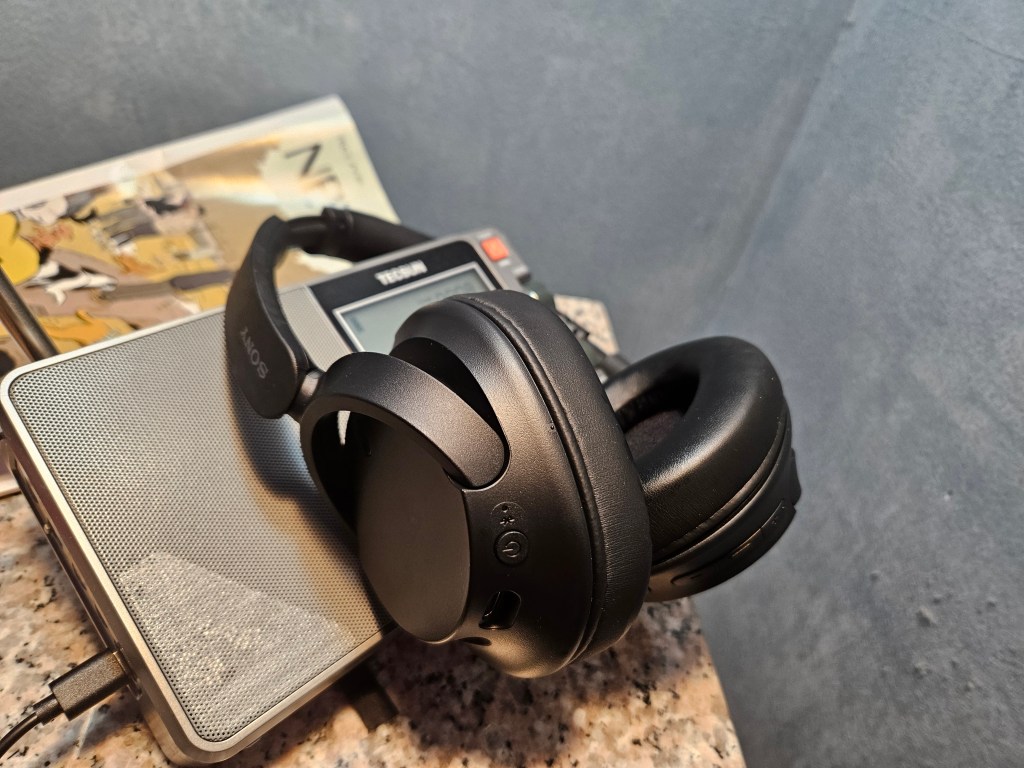
    Then I struck gold — a sale on the Sony WH-CH720N noise-canceling headphones for a criminally low $89.
    I ordered them, and then — naturally — descended into the familiar buyer’s spiral:
    Had I gone too cheap? Should I have splurged on Sony’s crown jewel, the WH-1000XM4s, on sale for $248?
    Was I an idiot forever exiling myself from sonic paradise for a lousy $159 savings?

    Before I could drown in regret, the WH-CH720Ns arrived. I checked the fit–very comfortable for my big head. Then I downloaded the Sony app, dialed in noise-canceling, jacked the equalizer to “Bright,” and hit play.

    First test: Josh Szeps interviewing Facebook whistleblower Frances Haugen on Uncomfortable Conversations.
    I was so blissfully submerged in the sound that 72 minutes evaporated — I barely surfaced in time to stagger into my office hour Zoom call, looking freshly abducted.

    Later, drunk on my own tech triumph, I sampled music on Spotify:
    SZA’s “Good Days,” MorMor’s “Whatever Comes to Mind,” LoMoon’s “Loveless,” Nao’s “Orbit,” and Stephen Sanchez’s “Evangeline.”
    The music sparkled. The instruments had space to breathe.
    The sound was bright, crisp, separate — not the muddy sonic stew I’d suffered through before.

    Which left me wondering: What black magic could the Sony XM4s possibly possess to be worth more than double the price?
    Because right now, $89 felt like grand larceny — I didn’t buy these headphones, I stole them.
    And considering how easy it is to lose or destroy a pair of headphones in an airport stampede, maybe it’s time to quit while I’m ahead and leave the luxury models to the Instagram aristocracy.