Tag: timepieces

  • Why I’m Not Fully G-Shockified (Yet)

    Why I’m Not Fully G-Shockified (Yet)

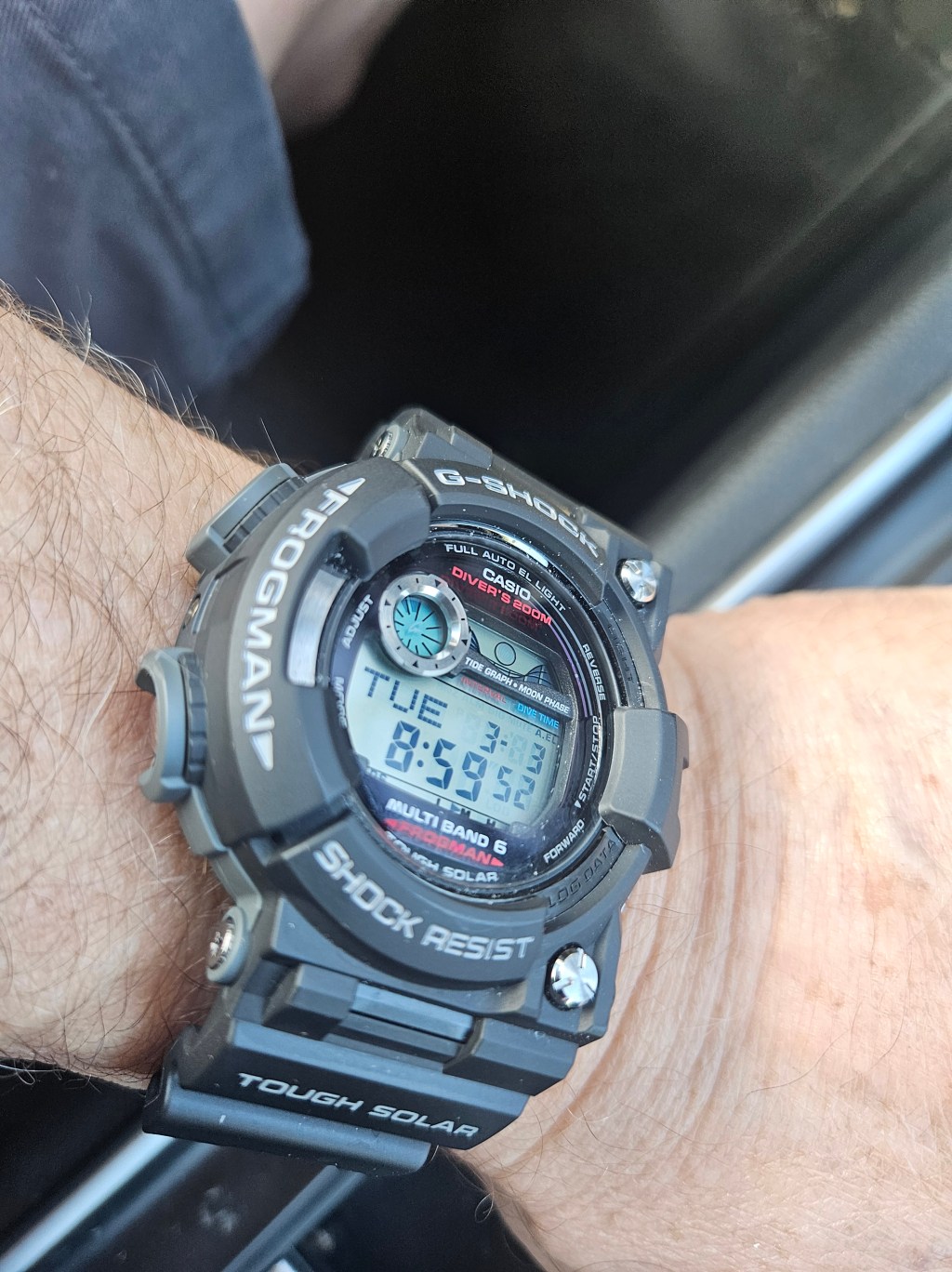
    A month ago, I fell—hard—for the G-Shock Frogman GWF-1000. Not a mild infatuation. Not a passing curiosity. A full conversion experience. Within days, I recruited two accomplices—the GW-7900 Rescue and the GW-6900 Three-Eyed Monster—and suddenly my mechanical divers, once the crown jewels of my collection, were sitting in the watch box like retired prizefighters telling stories no one asked to hear.

    Let me be clear: I have not renounced them. I still admire the Seiko SLA055. I still regard the quartz Tuna SBBN049 with something close to reverence. But admiration is not the same as use. Once you’ve tasted atomic time—precise, indifferent, quietly superior—it’s difficult to return to the charming imprecision of mechanical watches. You don’t switch back from filtered water to a garden hose unless nostalgia is doing the driving.

    And I’m not alone. Since confessing my condition, I’ve received a steady stream of testimonials. Men who bought a GW-M5610 or a GW-5000U and quietly stopped wearing everything else. Not because they planned to. Not because they declared war on their collections. But because the G-Shock—comfortable, accurate, frictionless—refused to leave their wrist. Their curiosity still wandered, their addiction still whispered, but the watch stayed put. Anchored. Unmoved.

    This phenomenon deserves a name: G-Shockification.

    It is the moment when a watch enthusiast, steeped in the romance of mechanical horology, is overtaken by the brute efficiency of atomic precision. At first, there is resistance. Then rationalization. Finally, surrender. Variety collapses. The rotation dies. The watch box becomes a museum, and the G-Shock becomes the only living artifact. What began as a hobby turns into a single, dominant habit—quiet, practical, and oddly liberating.

    Some resist the change. Some embrace it. Some preach it like a new religion. But they all share one outcome: the mechanical watch, once a daily companion, becomes an occasional guest.

    Which brings me to the uncomfortable question: Have I been G-Shockified?

    The honest answer is: not quite.

    I have my objections. With a G-Shock, I cannot simply glance at the time. I must present the watch to my face like an offering, or press a button and summon light—an act that triggers a faint but persistent anxiety about draining the solar charge. In a dark movie theater, the problem becomes almost philosophical. Do I illuminate my wrist and disrupt the room? Or do I behave like a civilized adult and wear something else?

    This is where the quartz Tuna reenters the story.

    Since my G-Shock conversion began, the Tuna has enjoyed a quiet renaissance. It is as if atomic time granted me permission to appreciate quartz accuracy without guilt. At night, it is flawless—constant lume, instant readability, no negotiation required. It does not ask for a button press. It does not demand a ritual. It simply tells the time, like a professional.

    And so I arrive at a compromise.

    I am not fully G-Shockified because I am not willing to tolerate certain frictions: the angle-sensitive readability, the dependence on backlight, the small social calculations about when it is appropriate to illuminate my wrist. These are minor issues, but they are enough to prevent total surrender.

    What I have instead is something more complicated: Hybridification.

    My collection is now split down the middle—four analog watches, four G-Shocks. This is not harmony. It is a negotiated settlement. The G-Shocks govern precision, durability, and daily utility. The analog watches—especially the Tuna—reclaim territory where immediate readability and luminous clarity matter.

    The result is a managed tension between two philosophies:

    • the digital world of accuracy, convenience, and indifference
    • the analog world of presence, legibility, and quiet satisfaction

    It is not a perfect system. But it is stable.

    For now.

  • Why a G-Shock Frogman Makes More Sense Than a Mechanical Collection

    Why a G-Shock Frogman Makes More Sense Than a Mechanical Collection

    If you come to me and confess that you’re curious about my watch hobby—intrigued, even—and ask for guidance so you can pursue the passion with the same enthusiasm, I won’t welcome you into the brotherhood.

    I’ll stop you at the door.

    If you are currently free from thoughts of watches, I will advise you to remain free. Walk away. Continue your life as a relatively sane and solvent human being. Because the mechanical watch hobby, viewed without romance or nostalgia, makes less and less sense in the modern world.

    You are paying premium money for obsolete technology in an age that worships useful technology. Why spend six thousand dollars on a Swiss machine that tells you the time when a five-hundred-dollar fitness watch can monitor your heart, track your sleep, detect arrhythmias, and quietly send your vital signs to your doctor before you collapse in a parking lot?

    Mechanical watches don’t make you healthier. They make you sentimental.

    The future is not kind to sentiment. As the world moves away from mechanical timekeeping, competent service will become slower, rarer, and more expensive. Your treasured watch will eventually be packed into a padded box and shipped across the country—or the ocean—where it will sit for months awaiting lubrication, regulation, or a gasket replacement. When it returns scratched, delayed, or mysteriously altered, you’ll enter a corporate complaint system so backlogged it feels less like customer service and more like geological time.

    Meanwhile, the social currency that once justified the expense is quietly evaporating.

    There was a time when a fine mechanical watch signaled professional success. Doctors noticed. Lawyers noticed. Bankers noticed. Today, most people don’t know a Rolex from a Fossil, and many don’t notice watches at all. The design language of luxury horology is becoming a private dialect spoken by a shrinking tribe.

    This is where the collector encounters Analog Futility Syndrome: the slow, uncomfortable realization that enormous resources are being poured into a technology that no longer solves a modern problem. The pleasure remains—but it is shadowed by a faint, persistent question: Why am I doing this?

    Meanwhile, the cultural signaling has inverted.

    Show up wearing a $500 solar-powered G-Shock that works everywhere, never needs service, survives abuse, and keeps atomic time, and people read something entirely different. Efficiency. Practical intelligence. Optimization. The G-Shock wearer looks like a person who solves problems, not one who collects them. The same watch works at the office, on a trail, or on a flight across time zones. It whispers competence. It suggests you might belong to MENSA. Or at least that you don’t spend your evenings arguing about bezel fonts.

    So if you ask me how to become a watch enthusiast, I will not guide you toward Swiss luxury and its Ferrari-like maintenance costs. I will point you toward the solar, radio-controlled, GPS-enabled tools that actually serve a modern life.

    A GPS Master of G Rangeman.
    A radio-controlled square.
    The digital Frogman.

    Real time anywhere. Light weight. Near-zero maintenance. Functional serenity.

    Writing this advice to you has caused something strange to happen to me while composing it. The argument has pointed an accusatory finger toward me. What began as guidance for you has become a prosecution of my imbecilic watch hobby.

    The longer I write, the more irritated I become at my own years of horological excess—years spent chasing mechanical romance while quietly accumulating cost, inconvenience, and low-grade anxiety.

    I may have to sell everything.

    I may have to replace the entire collection with a single indestructible digital watch and walk away.

    You think I’m exaggerating. I am not.

    Writing this has triggered a full-blown Horological Renunciation Fantasy: the emotionally charged vision of liquidating every mechanical piece and replacing them with one maintenance-free instrument—liberation not from watches, but from the psychological gravity of owning too many of them.

    The fantasy is seductive. I can’t imagine being happy right now unless I sell all my mechanicals and replace them with a digital Frogman.

    And that should tell you everything you need to know about the hobby.

  • From Watch Nirvana to Strap Hell and Back Again (a Short Story)

    From Watch Nirvana to Strap Hell and Back Again (a Short Story)

    I’m nearing sixty-four, and you’d think the resume of my life would say it all: married man, father of twin teenage daughters, lifelong weightlifter, and full-time college writing instructor pushing four decades in the trenches. Yet none of those titles define me quite like the pathology that has consumed my last twenty years: an obsession with diver watches.

    The disease began in 2005, when I bought my first “Hero Watch,” a Citizen Ecozilla. I was a suburbanite with all the aquatic daring of a backyard kiddie pool, but strapping that hulk of steel on my wrist turned me into a fantasy adventurer. The Ecozilla was my passport into adventurist cosplay, proof that even if my only dive was into Costco’s frozen food aisle, I could still play Jacques Cousteau in my imagination.

    For nearly two decades, I clung to bracelets and dismissed rubber. Rubber straps were sticky, sweaty, and cheap—the footwear of wristwear. But then, in 2024, a fellow enthusiast on Instagram whispered the gospel of Minotaur, a boutique strap company out of Houston. Their FKM rubber was no ordinary rubber—it was luxury-grade, accordion-style, fat spring bar holes, the kind of strap that doesn’t just hold a watch but weds it. Think craft brewery meets haute horology.

    When I slipped a Minotaur onto my Seiko diver, it was a conversion experience. Think Paul in Damascus. The strap was supple yet firm, sleek yet rugged. It was the hand-in-glove perfection every watch collector secretly craves.

    Suddenly, my seven Seiko divers weren’t just watches—they were sacraments. I no longer needed to fuss with bracelet links or endure the daily annoyance of micro-adjustments. The Minotaur straps brought equilibrium to my collection, and by extension, to my life.

    I became the town crier of Minotaur. Instagram posts, YouTube videos, flowery effusions of praise—my strap evangelism knew no bounds.

    I even struck up a friendship with Ron Minitrie, the Minotaur founder himself, who sent me models to showcase. For a while, I was living the influencer’s dream: watch bliss, strap perfection, hobby fulfillment so complete I worried it might be dangerous.

    But what happens when you reach nirvana? Do you close the YouTube channel, ride off into the sunset, and live happily ever after? Of course not. That’s when the gods get bored and send you a curse.

    The curse arrived in the form of a comment from a viewer named Infiniti-88. He linked to a Notre Dame study that accused FKM rubber straps of being Trojan horses of doom. According to the study, FKM bled PFAS “forever chemicals” into the bloodstream, potentially wrecking organs, scrambling hormones, and sowing cancer. Because watch straps are worn all day—sweat, heat, friction, even while sleeping—the risk was presented as constant exposure.

    Infiniti-88’s question was simple: “What are you going to do?”

    Cue the descent into madness. I read the study, panicked, and stripped all my Minotaur straps, replacing them with silicone and vulcanized rubber. Immediately, my watches felt diminished, like Ferraris stuck on snow tires. They lost their soul.

    I made a YouTube confessional and discussed the finer points of the Notre Dame Study. Half the viewers thanked me for raising the alarm; the other half mocked me for peddling paranoia. They insisted FKM risk was bottom-tier, a blip in the PFAS risk hierarchy. My response? Oscillation. I switched from Minotaur to silicone and back again—sometimes eight times in a single day. I was a man possessed, toggling straps like a lab rat on amphetamines.

    Desperate for clarity, I appealed to the digital oracles: Gemini, Claude, ChatGPT. Their verdict was unanimous: the study was flawed. The researchers had tortured the straps—soaked them in solvents, scorched them with heat, abraded them into pulp. In short, conditions no wristwatch strap would ever endure on a human arm. The Minotaur straps, they said, were stable, inert, safe.

    I breathed relief. For about three minutes. Then paranoia struck again. Were the AI platforms telling me the truth, or, as the dutiful sycophants they are, just feeding me the reassurance I craved? Was I clinging to wishful thinking dressed up as “analysis”?

    Meanwhile, fellow watch obsessives chimed in from YouTube and Instagram, their chorus split evenly between “Don’t worry” and “Panic with me.” Their voices joined the cacophony in my head. Certainty dissolved. Once you’ve pictured poison seeping into your wrist, you can’t unsee it.

    I began to hate the hobby itself. Hate the straps, hate the watches, hate the endless cycle of worry. It wasn’t about horology anymore—it was about risk management as a form of neurosis. I even considered selling everything and defecting to Tudor, whose bracelets come with the T-fit clasp–a miracle of quick adjustment that eliminates the fuss of links and tools. No chemicals, no rubber, no paranoia. Just a slide-and-click mechanism that promises freedom from my madness.

    When I think of my complicated relationship with Minotaur straps, the potentially-flawed Notre Dame Study, the fear of forever chemicals, and thoughts of a T-fit clasp, an image comes to mind that defines the insanity of my current situation:

    I’m thinking of the Balrog in The Lord of the Rings: The Fellowship of the Ring.

    In Moria, Gandalf confronts the Balrog on the Bridge of Khazad-dûm. They fall together into the abyss, and after an epic battle that spans mountains and caverns, Gandalf is mortally spent. It’s not a literal tail piercing—Tolkien describes Gandalf being dragged down by the Balrog’s whip after he breaks the bridge. The trauma of the battle kills him in his “Gandalf the Grey” form, but he is later sent back, transfigured, as Gandalf the White.

    Gandalf is never the same again, not because of the wound, but because his role changes: he comes back more powerful, more detached from the mortal world, and closer to a messenger of the divine.

    If I’m to survive my Minotaur strap crisis, I must follow the trajectory of Gandalf : I have to let the old self fall into the abyss. Like Gandalf, I must die to the madness and come back reborn, detached, stronger, armed with perspective. Because at this point, it’s not just about straps. It’s about what kind of man I am when the watch box stares back at me.