Tag: video-games

  • Gunmetal, DLC, and the Case Against Babying a Watch

    Gunmetal, DLC, and the Case Against Babying a Watch

    If you’re a watch collector, you’ve probably flirted with the idea of a black watch. At some point, the monochrome seduction gets you. A black case on a matching bracelet has a severity to it—stealthy, self-contained, faintly militant. I’ve fallen for it more than once. I’ve owned some genuinely beautiful black watches.

    I no longer own any of them.

    Such is life in the fever swamp of watch addiction, where flipping is not a behavior but a temperament. Watches arrive. Watches depart. Attachments form briefly and dissolve without ceremony.

    Take me back to around 2012. I owned two PVD-coated Seiko kinetic divers: the SUN007 and the SKA427P1. They were handsome, purposeful, and—contrary to every online hand-wringing session about coatings—remarkably resilient. I never scratched them. Not once. And yet they’re gone, casualties of some forgotten bout of restless dissatisfaction.

    Here’s the dangerous part: you can still find them brand new on eBay. I know this because I went looking. The prices are tempting. I felt the familiar tightening in the chest as I typed the model numbers. Relapse always begins with “just checking.”

    Another repeat offender from my past was the Citizen Promaster Sky BY0084-56E. I owned that watch no fewer than seven times over a decade. That’s not ownership—that’s a custody arrangement. Unlike PVD, the Citizen used Super Titanium treated with Duratect—often described as DLC. Marketing aside, the material difference is real. Stainless steel sits around 200 on the Vickers hardness scale. DLC-coated Super Titanium pushes north of 1,000. That’s not invincible, but it’s not cosplay either.

    In real life, that translates to this: the clasp will show desk-diver scuffs, because clasps always do. The rest of the watch? It shrugs off normal wear with indifference.

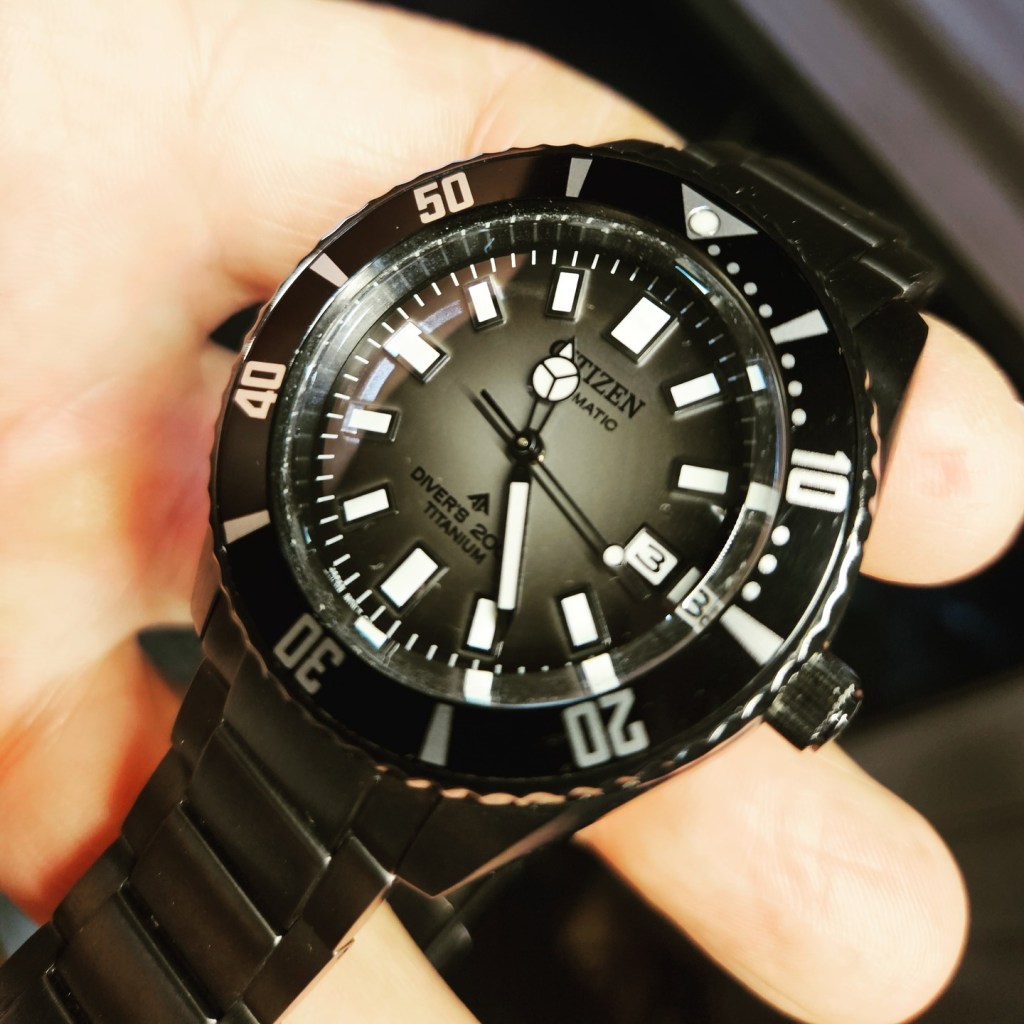
    Which brings me to the present. In a couple of days, the Citizen Super Titanium Gunmetal Diver NB6025-59H will return to my collection. Its DLC coating reads more dark gray than true black—an advantage, frankly. I plan to take it traveling. Miami. Hawaii. Heat. Salt water. Airport bins. Sunscreen. Sweat. This watch is not entering witness protection. It’s not being boxed, babied, or preserved for a future auction. It’s being worn.

    I’m glad to have one black—or gunmetal—watch in the rotation. It’s a welcome disruption from stainless steel, a visual reset. But there’s a caveat worth stating. Black watches are all about proximity. Up close, the details are rich and seductive. From a distance, they collapse into silhouette—lume floating in darkness. If you need your watch to announce itself across a room, black may frustrate you.

    For me, that quiet severity is the point.

  • The Phantom in the Mirror: On Becoming an NPC

    The Phantom in the Mirror: On Becoming an NPC

    The Non-Player Character—or NPC—was born in the pixelated void of video games. It is a placeholder. A background hum. A digital ghost whose job is to stand in a market, repeat a scripted line, or walk in endless circles without complaint. The NPC has no hunger for freedom, no dreams of becoming more. It exists in the half-life of interactivity—a cardboard cutout propped up by code. It’s “there,” but not there. You see it. Then you forget it. And that, in essence, is the horror.

    Somewhere along the way, the term slipped out of the screen and into real life. “NPC” became shorthand for a human who seems hollowed out—emotionally neutralized, culturally sedated, and spiritually declawed. Not stupid. Not evil. Just disengaged. The light behind the eyes? Gone dim. What was once an ironic jab at background characters is now a chilling metaphor for people who’ve surrendered to the most generic, algorithm-approved version of themselves.

    What’s grimly poetic is that NPCs in video games are often controlled by artificial intelligence. And so, too, are many modern humans—nudged by dopamine, entranced by endless scrolls, soothed by the hypnotic rhythms of consumption. The Roman formula of bread and circuses has merely been rebranded. Netflix. DoorDash. TikTok. It’s all the same anesthetic. As therapist Phil Stutz would say, we’re stuck in the “lower channel”—an emotional basement filled with numbing comforts and artificial highs.

    And yet, here’s the twist: even the brilliant can become NPCs. The anxious. The depressed. The overworked. The soul-sick. Sometimes the smartest people are the most vulnerable to emotional collapse and digital retreat. They don’t become NPCs because they’re shallow. They become NPCs because they’re hurting.

    There are, perhaps, two species of NPCs. One is blissfully unaware—sleepwalking through life without a second thought. The other is terrifying: self-aware, but immobilized. The mind remains active, but the body slouches in the chair, feeding on stale memories and reruns of past selves. Think of Lot’s Wife, gazing back at a past she couldn’t let go. She wasn’t punished arbitrarily; she was frozen in time—literally—a statue of salt and sorrow. The original NPC.

    Middle age is particularly fertile ground for NPC-ism. Nostalgia becomes narcotic. We mythologize our former selves—thinner, bolder, brighter—and shrink in the shadow of our own legend. Why live in the present, when the past is easier to romanticize and the future is too much work? Just ask Neddy Merrill from John Cheever’s “The Swimmer,” paddling from pool to pool in a daze, believing in a youth long gone, burning every real connection he had on the altar of delusion. An NPC in swim trunks.

    Today, we’re incentivized to become NPCs. Social media trains us like lab rats, handing out dopamine pellets in the form of likes, follows, and artificial intimacy. The real world—messy, unfiltered, full of awkward silences and genuine risk—is rejected for the smoother contours of algorithmic approval. Our souls are curated, our emotions trimmed to fit the timeline.

    The NPC, then, is not a throwaway gag. It’s a portrait of the modern condition. A spirit trapped in a basement, scrolling for meaning, addicted to memory, afraid of action. A being slowly turning into vapor, still breathing but no longer alive.

    And the true terror? Sometimes I feel it in myself. That quiet moment when I trade meaning for ease, purpose for distraction, vitality for sedation. That’s when I hear the whisper: You’re becoming one of them. That’s when I feel the NPC, not on my screen, but inside my skin.