
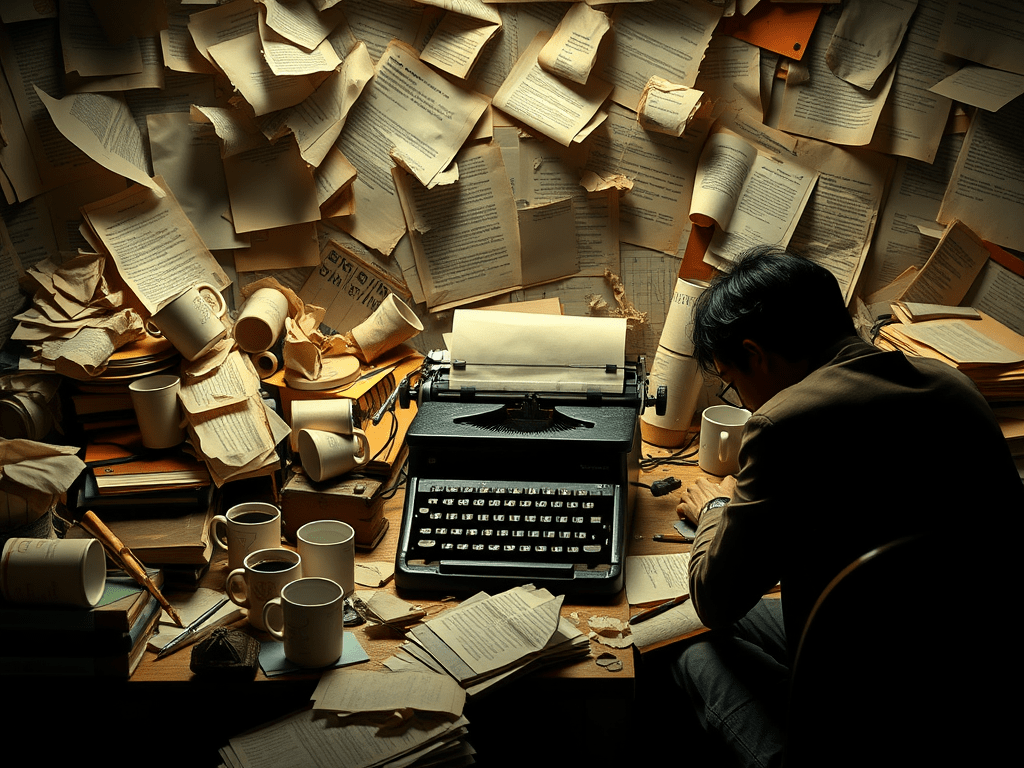
You write the book the way a man fights a war—sleepless, exhilarated, slightly deranged. The watch obsession pours out of you in a manic fever dream. Paragraphs multiply. Arguments sharpen. The dragons of doubt are hunted down and slain one by one. The process is violent, cathartic, intoxicating. Then one day the battlefield goes silent.
The book is finished.
You resist the temptation to congratulate yourself. You are not a novelist emerging from a mahogany-paneled publishing house. You are a self-publishing writer who lives in the strange modern territory between the written page and the spoken performance. Your books feed your videos. Your videos feed your books. You are part author, part storyteller, part one-man theater troupe trying to keep reading culture alive in an age that prefers the human voice and the glowing screen.
So the manuscript about your horological madness is uploaded, and the waiting begins.
Amazon’s machinery now takes possession of your work. Your manuscript passes through a quiet bureaucratic gauntlet. The system inspects your file the way a customs officer inspects luggage. It checks whether the text converts properly into Kindle’s internal formats—the KPF and MOBI skeletons that power the ecosystem. It scans for broken hyperlinks, missing images, corrupted fonts, copyright problems, suspicious passages that resemble plagiarism, and metadata that smells like deception.
Once the manuscript survives inspection, Amazon manufactures the retail version of your book. A downloadable Kindle file appears. The “Look Inside” preview is generated. Internal indexing is built so readers can search the text. Page locations are mapped so the book behaves properly across Kindle devices. Then the storefront is assembled: title, subtitle, description, keywords, categories, price, royalties. When all of this is complete, the book is pushed into the distribution queue.
For roughly seventy-two hours, you exist in a peculiar form of creative purgatory.
You are finished with the book, yet the book does not exist.
Meanwhile your mind refuses to stop working. New sentences appear uninvited. Fresh paragraphs demand insertion. You sketch revisions for the next edition even though the current one has not yet been born. These are the creative aftershocks—the involuntary spasms that follow the completion of a major piece of work. The engine keeps firing even though the race is over. The sensation resembles a phantom limb: the writer’s brain continues to move muscles that are no longer attached to the task.
Eventually the tremors subside.
And then the crash arrives.
When you were writing, your mind functioned like a soldier in combat—focused, purposeful, rewarded with small chemical bursts every time a paragraph landed cleanly on the page. Once the book is done, the mission vanishes overnight. The brain suddenly finds itself unemployed.
What follows is the Post-Manuscript Collapse.
Energy drains. Conversation feels exhausting. The meaning of life becomes suspiciously vague. You stare at walls, wondering whether a medically induced coma might be the most efficient way to pass the time. This stage is unpleasant, but it is not pathological. It is the nervous system resetting after prolonged creative exertion.
Think of the narrators in Tony Banks’ finest Genesis compositions. In “Mad Man Moon” and “Afterglow,” a man constructs a world around himself only to watch that world age, crumble, and lose its meaning. The collapse is not merely tragic—it is necessary. Something must die so that something else can emerge.
The writer experiences the same cycle.
You must shed the identity you inhabited while writing the book. That identity served its purpose, but it cannot follow you into the next chapter. This transitional stage is what might be called the Snakeskin Interval—the quiet, uncomfortable period when the old creative skin peels away.
Do not mistake this shedding for failure. It is renewal in disguise.
The only appropriate response is humility. Resist the theatrical temptation to despair. Instead, recognize that this strange melancholy is part of the creative metabolism. Listen again to those Genesis songs. Let their melancholy wisdom remind you that endings are rarely endings at all.
They are merely the silence that makes the next beginning possible.





 Cinemorphosis