Tag: writing

  • How I Lost the Watch Plot

    How I Lost the Watch Plot

    Six months ago, I was living in a rare state of horological peace. My collection was small, disciplined, and complete: seven Seiko divers, each mounted on a Divecore FKM strap. Some straps were black, some orange. After twenty years of swapping straps, chasing combinations, and second-guessing myself, I had finally found alignment. The watches felt right. The system felt right. I was, for once, connected.

    Then came the study.

    Someone alerted me to a Notre Dame report suggesting that PFAS—“forever chemicals”—could leach into the skin from FKM rubber. The strap world stiffened. The finding itself was questionable; the testing conditions resembled industrial abuse, not normal wear. Still, the principle of unnecessary risk began whispering: Why expose yourself to something you don’t have to?

    So I did what anxious rational people do. I removed the FKM straps and told myself I was being prudent.

    The problem was immediate.

    The connection vanished.

    Bracelets went on. Bracelets came off. Vulcanized rubber, silicone, back to bracelets, back to rubber. The watches still told time, but the emotional voltage was gone. And when I returned to the Divecore straps, the old satisfaction flickered—until the worry returned a few days later and drove me back to something “safer.”

    I had entered a Risk Contamination Cascade—the psychological chain reaction that begins when a low-probability hazard lodges in the mind and spreads beyond its original scope. The issue was no longer PFAS. The issue was doubt. The study didn’t just question a material; it destabilized a system that had been working.

    Meanwhile, Divecore responded to the same study. Their upcoming Waffle strap, originally planned in FKM, was delayed and reformulated in hydrogenated rubber. I ordered one. It arrives in a month. If it works, I’ll retrofit the collection.

    But something else happened while I waited.

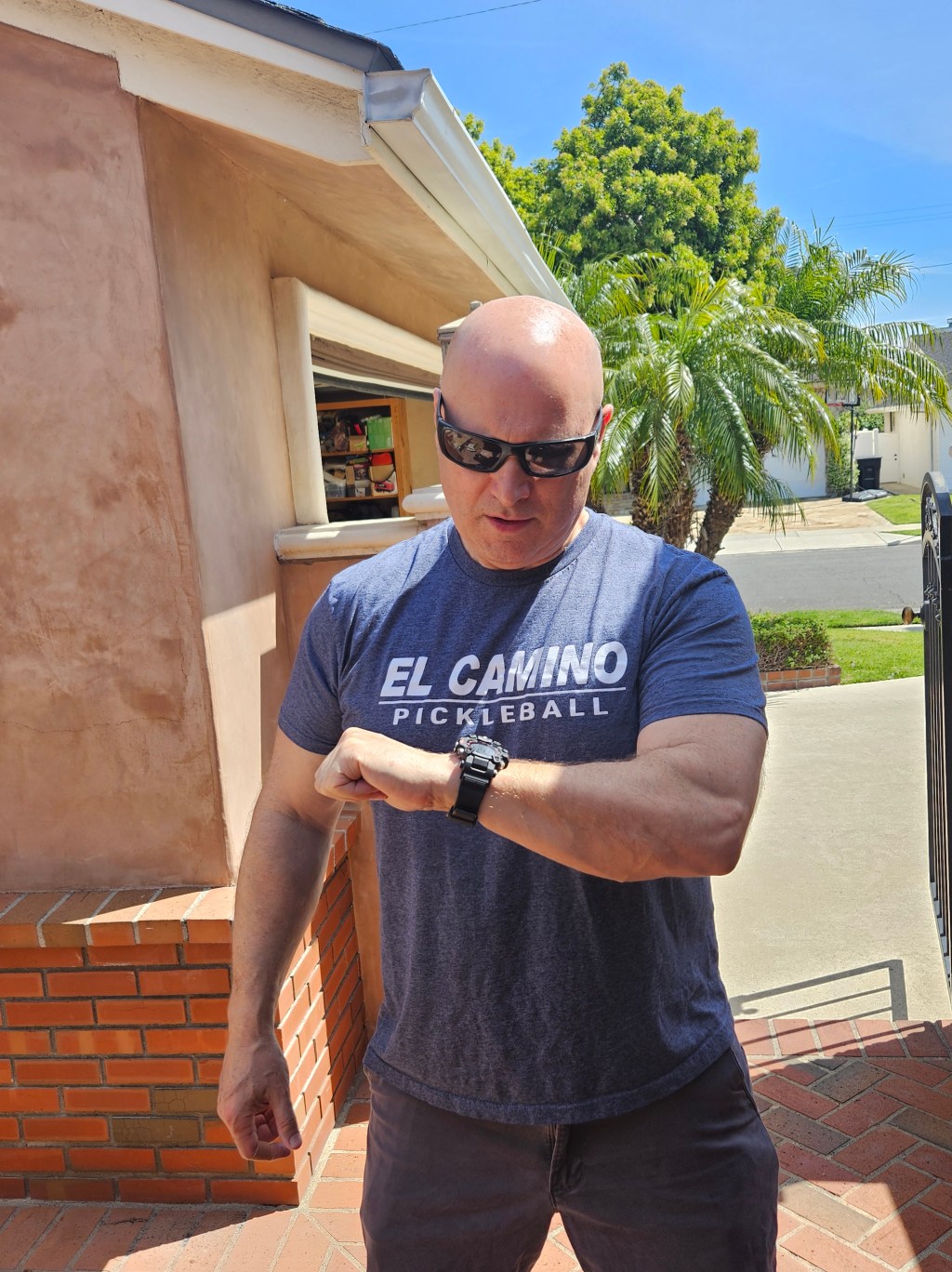
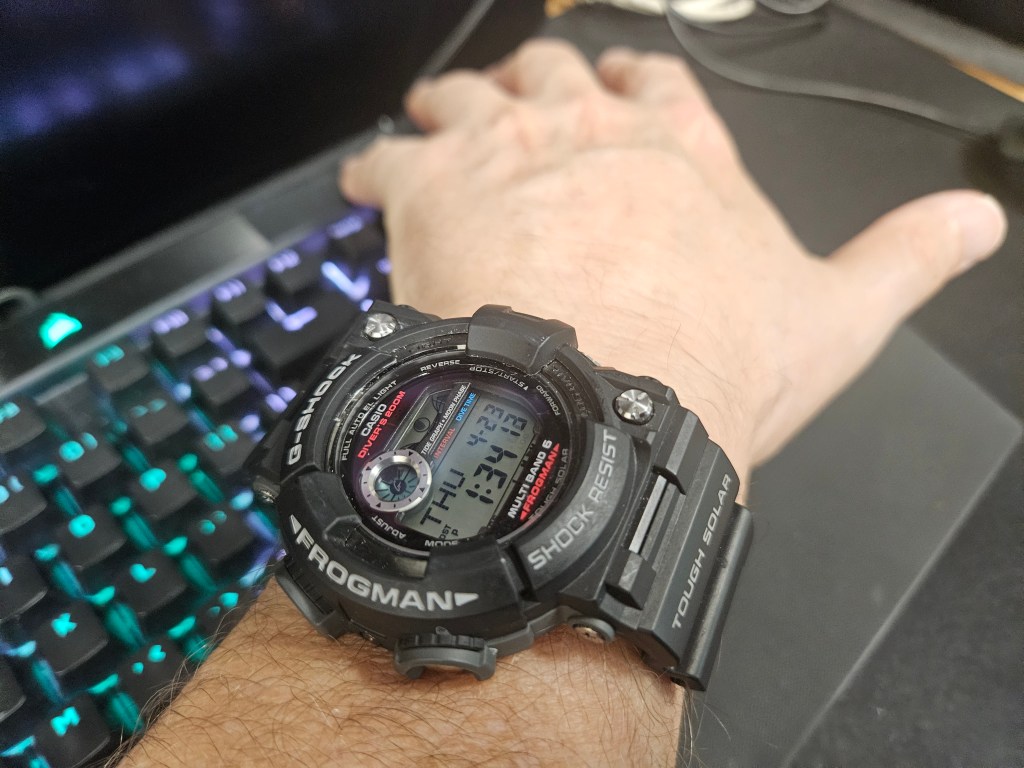
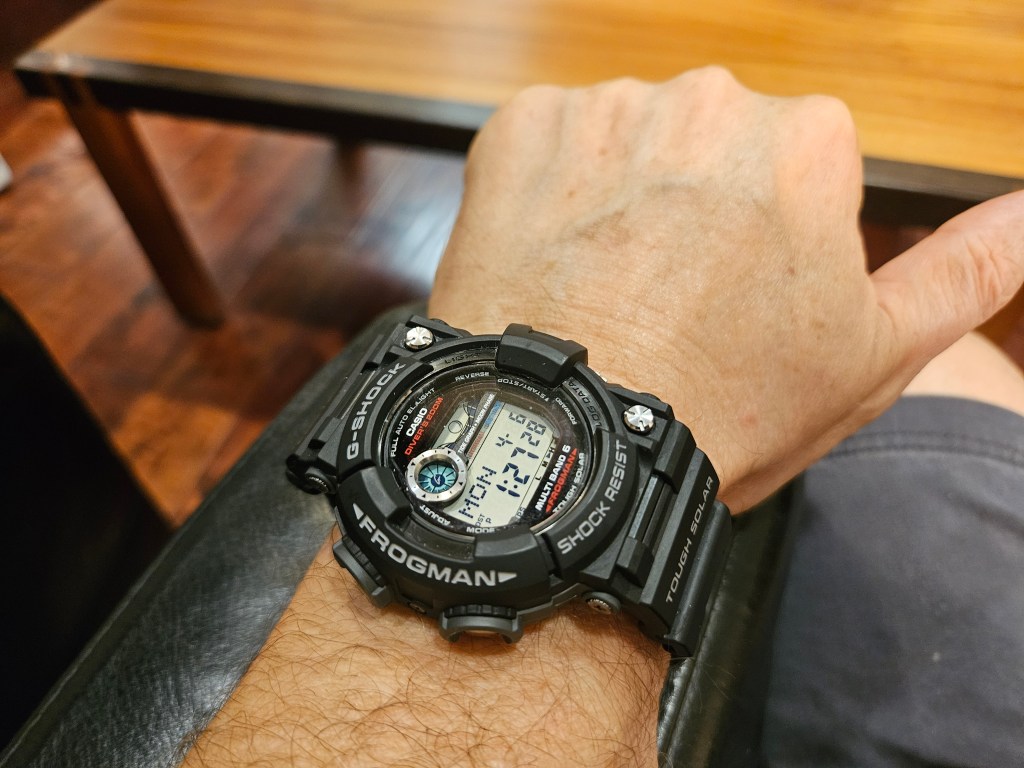
    Restless. Slightly displaced. Perhaps bored. Perhaps still addicted to motion. I added two watches: a gunmetal Citizen Super Titanium diver and a G-Shock Frogman.

    Would I have bought them if the Notre Dame study had never appeared and my Seikos had remained happily married to their Divecore straps?

    I honestly don’t know.

    The question came to me directly from a viewer on my YouTube channel:

    “McMahon, I thought you were content with your seven Seikos. What happened?”

    I could have given the collector’s answer—diversification, appreciation, aesthetic curiosity. Instead, I told the truth:

    “I lost the plot.”

    It was the only honest explanation. I had experienced a Plot Loss Event—the moment when decisions are no longer guided by enjoyment or intention but by anxiety, restlessness, and narrative drift. External triggers—a study, a forum discussion, a rumor—become convenient villains. But the deeper shift is internal: contentment gives way to motion without direction.

    To be fair, the Notre Dame study didn’t create the anxiety. It simply opened the door.

    Before the study, I lived in a Watch Happy Zone. After it, I felt expelled from a stable ecosystem. The mind shifted into precaution mode. And precaution, once activated, rarely stops at one adjustment.

    FKM to silicone.
    Silicone to bracelets.
    Bracelets back to rubber.

    Each move reduced theoretical risk while increasing psychological instability. I was caught in a Precautionary Spiral—a loop of substitutions that never restored satisfaction.

    The experience felt like wrestling a giant. The giant didn’t defeat me, but I walked away with a limp.

    Now the hydrogenated Divecore Waffle is on its way. The Frogman is somewhere between customs forms and identity disclosures. And life, which once felt clean and contained, now feels slightly overgrown.

    I know the honest accounting: my anxiety did the real damage. My tendency toward optimization, toward vigilance, toward self-interference.

    Still, I’d be lying if I said I didn’t resent that study.

    Before it, I had an oasis.

    After it, the sand started shifting again.

  • The G-Shock Frogman Sits in a Dark Warehouse

    The G-Shock Frogman Sits in a Dark Warehouse

    My G-Shock Frogman from Japan is currently in the custody of DHL Customs, where it has been detained for reasons that appear to fall somewhere between administrative caution and bureaucratic sport.

    After a chain of communications—email links that didn’t open, automated messages that solved nothing, and the familiar sense of shouting into a digital canyon—I finally reached a living human being. The verdict: my package had been randomly flagged. To prove I was a legitimate citizen worthy of receiving a rubber-strapped dive watch, I was instructed to photograph my 1040 tax form, Social Security number included, and submit it for verification.

    I complied.

    The representative then added the final procedural flourish: the clearance team is backlogged, they don’t work weekends, and my Friday submission will not be reviewed until Monday at the earliest.

    And so the Frogman waits.

    Somewhere in a warehouse, my solar-powered watch sits sealed in darkness, a creature built to drink sunlight now confined to a bureaucratic aquarium. It calls to mind Melville’s Dead Letter Office—objects sent with intention, now suspended in institutional stillness. The watch waits. I wait.

    We are both experiencing what might be called Solar Purgatory Syndrome: a condition in which a solar watch is deprived of light while its owner is deprived of momentum. Energy, both mechanical and emotional, drains slowly while the system remains perfectly unmoved.

    What has changed is the feeling.

    Once, waiting for an overseas parcel carried the electricity of childhood—anticipation, possibility, the quiet thrill of something special moving across the world toward you. That feeling has been replaced by fatigue. Bitterness. The dull resentment that comes from being processed rather than served.

    Getting bitten by customs bureaucracy was not part of the romance.

    And something unexpected has happened. The friction hasn’t just slowed the purchase—it has cracked open a larger question. The stress, the forms, the delays, the mild institutional suspicion directed at a man buying a watch from Japan—it all begins to feel disproportionate.

    A voice, calm and unsentimental, has begun to speak:

    You’ve been bitten by the system.
    Consider this instruction.
    Consider this an exit opportunity.
    Enjoy the watches you have.
    Move on.

    This is the onset of a Bureaucratic Burnout Event—the moment when administrative friction overwhelms the emotional reward of the hobby that triggered it. What began as excitement—tracking updates, imagined wrist time, the pleasure of acquisition—collapses under documentation, verification, delay, and institutional indifference. The object itself begins to feel smaller than the effort required to obtain it.

    But the episode may carry a deeper meaning.

    It may be an Exit Omen Moment—the psychological shift in which inconvenience stops feeling like bad luck and starts feeling like instruction. The delay becomes a message. Simplify. Reduce. Stop expanding. Perhaps even stop buying altogether.

    Whether this reaction proves temporary or permanent remains to be seen.

    But for now, somewhere in a dark warehouse, a solar watch waits for light.

    And somewhere outside it, its owner is reconsidering the whole enterprise.

  • Reunion Loop Syndrome: The Watch You Can’t Quit

    Reunion Loop Syndrome: The Watch You Can’t Quit

    Seasoned watch collectors know a particular form of heartbreak: selling a watch they love—then hunting it down again like a lost soulmate. The cycle repeats. Buy. Sell. Regret. Rebuy. Promise never to let it go again. Then, a few months later, the relationship cools, restlessness sets in, and the breakup happens all over again.

    At some point it becomes clear: the fixation isn’t the watch.

    It’s the drama.

    This pattern has a name: Reunion Loop Syndrome—a behavioral cycle in which the collector repeatedly parts with and repurchases the same watch, not because their taste has changed, but because they crave the emotional arc. The pleasure isn’t ownership; it’s the story. Separation sharpens longing. Regret fuels the search. The chase restores meaning. And the reunion delivers a brief, intoxicating high.

    The watch becomes less an object than a romantic partner in a serialized relationship. Each transaction reenacts the emotional turbulence of a teenage breakup—except now the reconciliation includes PayPal fees, overnight shipping, and the quiet humiliation of buying back your own mistake.

    Eventually, some collectors recognize the madness and attempt an intervention.

    Instead of selling, they stage a controlled disappearance.

    The watch is locked in a safe. Or exiled to a friend’s house. Sometimes both. Access is restricted for months—three at a minimum, sometimes a full year. The strategy is simple: simulate loss without the financial damage. Absence rebuilds longing. Time restores novelty. When the watch finally returns to the wrist, the reunion feels earned rather than repurchased.

    It’s emotional theater without the market penalty.

    The good news is the method works. Thousands of dollars remain safely in the bank. The flipping stops. The collection stabilizes. Financial maturity has arrived.

    The bad news is harder to admit. Emotional security is still stuck in senior year.

  • From Bicep Envy to Rolex Envy

    From Bicep Envy to Rolex Envy

    As a teenage bodybuilder, you suffered from classic body dysmorphia—the iron game’s most reliable side effect. Your arms measured a thick, hard-earned 19 inches. Impressive by any sane standard. But Arnold’s were 23. He owned the Rolex of physiques: cathedral pecs, mountain biceps, mythological proportion. You, by comparison, felt like you were wearing a plastic Timex.

    You could bench 400 pounds. Across the gym, a human forklift was casually repping 500 to warm up his joints. He was the champion. You were the fraud. The mirror didn’t show muscle; it showed deficiency. Reality had no vote. Comparison ran the court.

    Years later, the iron left your life, but the disease simply changed wardrobes.

    Now you collect watches. You watch Bosch. Titus Welliver stalks through Los Angeles wearing a Rolex Submariner like a badge of existential authority. Lance Reddick appears in the same universe, his TAG Heuer sitting on his wrist with the quiet confidence of a man who signs warrants and ends conversations.

    It isn’t the watches that get to you. It’s the gravity. The presence. The sense that the watch is merely the visible edge of a life lived at full command.

    Then you look down.

    Your Citizen Eco-Drive stares back—accurate, reliable, environmentally responsible. The watch of a reasonable man. The watch of an overweight suburbanite who owns a good coffee maker and worries about cholesterol. For a brief moment, you consider curling into the fetal position and asking the universe for a refund.

    The condition has a name: Watch Dysmorphia.

    Watch Dysmorphia is a status-perception disorder in which satisfaction with one’s watch—and by extension, one’s life—collapses under the pressure of upward comparison. The object on the wrist may be handsome, capable, even excellent. None of that matters. Against the symbolic weight of a Rolex on a television detective or the effortless confidence of a higher-status wearer, adequacy feels like failure.

    Like its muscular ancestor, the disorder ignores objective reality. A solid Citizen becomes a narrative of smallness. A respectable collection becomes evidence of mediocrity. The luxury watch is no longer a tool for telling time; it becomes a portable mythology of power, competence, and gravitas. When you look at your own wrist, you aren’t checking the hour—you’re reading a verdict.

    The result is predictable: dissatisfaction, restless upgrading, momentary relief, then renewed deficiency. Not because the watch is lacking, but because comparison has quietly rewritten the terms of enough.

    To live with Watch Dysmorphia is to learn a hard law of modern life:

    Comparison is the mother of misery.

  • The Wrist That Ate the Workday

    The Wrist That Ate the Workday

    Working from home is supposed to be a privilege. Deliver the numbers, meet the deadlines, and you’re spared the slow death of freeway traffic and fluorescent lighting. Your company trusts you. Your productivity is tracked by a sleek little monitoring app that converts your workday into a tidy efficiency score.

    Unfortunately, your desk shares airspace with the enemy.

    The lacquered watch box sits there like a silent casino. You glance at the watch on your wrist. Nice. Solid choice. But what about the others? You lift the lid. A row of polished faces looks back at you—steel, lume, sapphire, promise. You’re supposed to be refining actuarial tables, tightening the language in your report, making sure the graphs don’t embarrass you in front of management.

    Instead, you swap.

    The new watch feels right. For three minutes.

    Then doubt creeps in. Maybe the diver was too heavy. Maybe the field watch better matches your “work-from-home professional” persona. Swap again. Back to the box. Another selection. Another micro-adjustment to your identity. Meanwhile, the cursor blinks on an unfinished paragraph, and your productivity score quietly bleeds out.

    You know the behavior is neurotic. You also know you’re waiting for a moment of revelation—for one watch to settle onto your wrist and announce, in a calm and authoritative voice, This is the one. The watches remain silent. So you keep rotating, chasing a verdict that never comes.

    What you have is Chrono-Proximity Compulsion.

    The disorder is simple: when your collection lives within eyesight, your brain enters a loop—check, compare, swap, repeat. Each decision feels minor, harmless, even rational. In aggregate, they shred your attention into chrome-plated confetti. The watches stop telling time and start interrupting it. Work hours dissolve into wrist experiments, each swap chasing a mythical state of alignment between object, mood, and self.

    The cure is drastic but effective.

    You remove the collection from the battlefield. Down to the basement it goes—sealed in a treasure trunk, out of sight, out of negotiation. No lineup. No options. No silent chorus asking to be chosen.

    On your wrist remains the G-Shock GW5000.

    It does not flatter you. It does not whisper about heritage, craftsmanship, or lifestyle. It does not ask to be admired or reconsidered. It delivers one message, blunt and unromantic: Get back to work.

    For the first time all day, the cursor moves.

    And the efficiency app finally has something to measure.

  • When Too Much Self-Awareness Kills the Hobby

    When Too Much Self-Awareness Kills the Hobby

    Your watch doomsday routine was entertaining at first. The addiction jokes, the madness metaphors, the psychological autopsies—it all had bite. But over time, the act hardened into a script. Same diagnosis, same grim prognosis, same weary punchline: the hobby is a pathology and you are its patient. What began as sharp self-awareness slowly turned into background noise. When every watch conversation ends in a cautionary tale, the insight stops sounding wise and starts sounding tired.

    Yes, the hobby has its absurdities. Grown men tracking bezel action like lab technicians. Endless forum debates about lume longevity and strap chemistry. The theater of acquisition, the drama of regret. It’s funny because it’s true. But truth has a shadow side: if you keep rehearsing the dysfunction, you begin to believe dysfunction is the whole story. And it isn’t. Watches are also craft, design, history, engineering, ritual, friendship, and—most dangerously of all—simple pleasure.

    Push the pessimism too far and you commit a quiet act of vandalism against your own life. Years of learning, refining your taste, and assembling a disciplined collection suddenly feel like evidence in a case against yourself. Instead of appreciation, you feel suspicion. Instead of satisfaction, you feel embarrassment. The hobby becomes a courtroom where enjoyment is treated as a character flaw.

    So ease off the throttle. Keep your critical edge—persnickety is part of the fun—but let some sunlight into the room. You don’t need to romanticize the hobby, but you don’t need to prosecute it either. Otherwise, you’ll fall into the Self-Sabotage Loop: the habit of undermining your own enjoyment by endlessly rehearsing the hobby’s worst traits—addiction, immaturity, manipulation—until pleasure itself feels irresponsible. That’s the trap. Too invested to quit. Too cynical to enjoy.

    The goal isn’t innocence. It’s balance. Own the flaws. Then wear the watch anyway.

  • Leaving Action Park: The Day Your Watch Obsession Loses Its Voltage

    Leaving Action Park: The Day Your Watch Obsession Loses Its Voltage

    In the 1980s, some of my New Jersey friends spent their summers at a place that now sounds less like a water park and more like a liability experiment: Action Park. After watching the documentary Class Action Park, I was reminded that this was no ordinary recreational facility. It was a carnival of abrasions, concussions, electrocutions, and broken bones—a gauntlet designed by people who apparently believed safety was a form of weakness. And yet, for the locals, surviving Action Park wasn’t a warning; it was a credential. If you came out scraped, bruised, and still standing, you belonged. You were tough. You were one of them. When a former employee explained the park’s eventual collapse, his answer was simple and almost philosophical: like everything else, it just took its course.

    Watch obsession operates the same way. When you’re deep inside it, the madness feels permanent. The research, the tracking, the buying, the selling, the late-night forum autopsies—it grips you with the conviction that this is who you are now. But no obsession sustains peak intensity forever. Eventually the voltage drops. The chase slows. The emotional temperature falls. And when it does, you enter what might be called a Tribal Burnout Exit—the quiet unwinding of an identity built around a shared fixation. The relief is immediate: less pressure, less noise, less compulsion. But the sadness follows close behind. You don’t just lose the obsession; you lose the tribe, the language, the rituals, the daily structure that gave shape to your time.

    This is the strange aftertaste of recovery. You escape the psychological Action Park—but you also miss the ride. The hobby that once exhausted you also organized your days and connected you to people who spoke your dialect of madness. Without it, the calendar can feel oddly spacious, even exposed.

    That’s why the end of watch madness shouldn’t be treated as a victory lap but as a transition plan. Obsessions always have a shelf life, whether you admit it or not. When this one burns out—and it will—you’ll need something sturdier, quieter, and healthier to take its place. Otherwise, the mind, uncomfortable with empty space, will simply go looking for the next amusement park.

  • Stop Writing About Your Obsession Before It Gets Worse

    Stop Writing About Your Obsession Before It Gets Worse

    You may be tempted to turn your watch obsession into literature. The idea has a certain romance. You picture yourself channeling Dostoevsky, producing a modern Diary of a Madman, transforming your horological unraveling into art—brave, raw, cathartic. You imagine clarity emerging from confession, insight distilled from chaos.

    But this is a dangerous illusion.

    Writing about your obsession does not drain it. It feeds it. The writer inside you is not a therapist; he is a scavenger. He needs material. And if the material isn’t dramatic enough, he will improve it. Soon you are not merely observing your compulsions—you are staging them, heightening them, curating your own instability for narrative effect. What began as self-examination becomes performance. You are now caught in a Pathology Amplification Loop: the act of writing about the fixation rehearses it, enlarges it, and gives it emotional weight. Reflection becomes rehearsal. Analysis becomes reinforcement.

    There is a second problem. Writing about watches keeps your attention locked on watches. For someone trying to loosen the grip of a fixation, this is the cognitive equivalent of hosting a wine tasting during sobriety. You are not stepping away from the stimulus. You are polishing it, describing it, lighting it for dramatic effect. Attention is fuel, and you are pouring it directly onto the fire.

    There is a third cost, and it is social. Confessional obsession reads less like literature and more like a slow-motion car crash. Your friends may be sympathetic, but sympathy has limits. Once people see the full machinery of your fixation—the spreadsheets, the rationalizations, the psychic weather reports—they quietly step back. You are still invited to gatherings. You are still greeted warmly. But you are no longer the person they choose for long conversations over coffee. Everyone has their own burdens. Few volunteer to carry someone else’s.

    The wiser move is not literary but physical. Shift the energy out of the head and into the body. Walk long distances. Lift something heavy. Eat food that grew in soil rather than in a laboratory. Maintain a modest calorie deficit. Build routines that produce fatigue instead of rumination. When watch thoughts rise, do not interrogate them, narrate them, or mine them for prose. Dismiss them the way you clear your throat when a cold threatens—briefly, calmly, without ceremony.

    The goal is not a better story.

    The goal is less story.

  • The Watch That Quietly Took Over Your Life

    The Watch That Quietly Took Over Your Life

    Every so often, a strange coup takes place inside a watch collection. One piece—sometimes a $50 Casio, sometimes a $5,000 Tudor—quietly stages a takeover. It doesn’t announce its intentions. It simply shows up on your wrist one morning… and then the next… and then every day after that. Before long, the rest of the collection sits in the watch box like retired generals, decorated but inactive. Without ceremony, without debate, you’ve acquired a Watch Buddy—the one piece that absorbs nearly all your wrist time and rewrites the rules of your ownership.

    What makes the phenomenon unsettling is that you didn’t go looking for it. This was not your grail, your research obsession, your late-night forum fixation. It just happened. Somewhere between errands, workouts, and ordinary Tuesdays, the watch proved itself comfortable, legible, reliable, emotionally neutral in the best way. You wake up one day and realize you’re living inside the Accidental Grail Effect: a lifelong favorite that earned its status the old-fashioned way—by being easy to live with. No mythology. No prestige theater. Just quiet competence and the absence of friction.

    Curiously, most enthusiasts don’t liquidate the rest of the collection once the hierarchy becomes obvious. The other watches remain in their slots, like supporting actors who make the lead look better simply by standing nearby. Their presence sharpens the contrast. The Watch Buddy doesn’t just win—it wins by comparison, day after day, until its dominance feels less like a choice and more like gravity.

    This is not a honeymoon. Honeymoons are loud, hormonal, and short-lived—social-media enthusiasm followed by the inevitable cooling. The Watch Buddy is something else entirely: a long marriage. The dopamine fades, the novelty disappears, and what remains is habit, trust, and emotional silence. From that point forward, the collector’s behavior changes. The chase slows. The fantasy of the next perfect watch loses voltage. Because once you’ve found the one you actually live in, the rest of the hobby begins to look like what it always was—auditions.

  • Monowatch Asceticism Meets the Skinny Yoga Guy

    Monowatch Asceticism Meets the Skinny Yoga Guy

    As the clock keeps punching holes in the calendar and I drift into the middle distance of my sixties, I’m stalked by the uneasy sense that I am not the man I’m supposed to be. I carry thirty extra pounds like unpaid emotional invoices. I cave to food temptations with embarrassing regularity. I indulge in narcissistic spirals of self-pity. My body bears the archaeological record of a lifetime of weightlifting injuries. Something has to give. The question isn’t whether I’m a complex human being—of course I am—but which single image can give me dignity, courage, and self-possession as I face my obligations, stay engaged with this lunatic world, and fend off entropy. The image that keeps returning, uninvited but insistent, is this: I am the Skinny Yoga Guy.

    The Skinny Yoga Guy eats vegan, clean, and whole, not as a performance but as a quiet discipline. He hits his protein macros with buckwheat, pumpkin seeds, peas, soy, garbanzos, and nutritional yeast, without sulking or negotiating. He cooks plant-based meals anchored in Thai, Mexican, and Indian traditions, not sad beige bowls marketed as “fuel.” He doesn’t snack like a raccoon in a pantry; he sips cucumber water and green tea and moves on with his day.

    He practices yoga six days a week, a full hour each time, sweating without complaint. The body lengthens. The spine straightens. He appears taller, calmer, less compressed by life. There’s a faint health glow—less “Instagram guru,” more “someone whose joints don’t hate him.” The discipline reshapes his temperament. The short fuse and indulgent sulks fade. In their place emerges a man who notices other people, attends to their needs without sermonizing, and discovers—almost accidentally—that service makes him sturdier, not smaller.

    In this revised operating system, the watch obsession quietly dies. No more chunky diver watches as heroic cosplay. No rotation. No drama. Just one watch: the G-Shock GW-5000. The purest G-Shock because it refuses theater. Shockproof, accurate, solar-powered, atomically synced. No Bluetooth, no notifications, no begging for attention. It does one thing relentlessly well: it tells the truth about time. It is reliability without narcissism.

    If the GW-5000 is indestructibility stripped of spectacle, then my assignment is clear: I must become its carbon-based counterpart. Less bloat. Fewer features. More uptime. Yoga becomes joint maintenance. Vegan food becomes corrosion control. No supplements that blink. No gadgets that chirp. No dietary Bluetooth pairing with guilt. Just a lean system designed to absorb impact, recover quickly, and remain accurate. GW-5000 firmware, now awkwardly attempting to run on two legs. Stripped down to one G-Shock, I can enjoy Monowatch Asceticism: the deliberate reduction of a watch collection to a single, purely functional timepiece as an act of identity purification. Ownership shifts from expression to discipline; the watch becomes less an accessory than a vow—proof that the wearer has stepped off the cycle of acquisition and into a life governed by restraint, durability, and quiet competence

    The longing is real. I want to be the Skinny Yoga Guy—disciplined, light, healthy—wearing a single $300 G-Shock as a quiet marker of having stepped off the status treadmill. I no longer want validation from a $7,000 luxury watch. Wanting this man is easy. Becoming him is not. That requires character, not aspiration.

    My hunch is that I need to write my way into him. A novel titled The Skinny Yoga Guy. Not a parody, not a self-help tract, but a chronicle of real-time change rendered with mordant humor and unsparing honesty. The book isn’t the point. Transformation is. The novel would simply be the witness.

    So here I am, a larval creature trapped in my cocoon. I must emerge as a new creature. The challenge is issued. Whether the world is waiting for my metamorphosis is irrelevant. I am. And that, for once, feels like enough.