Tag: writing

  • The Weight of a Ringing Phone During the Landline Era

    The Weight of a Ringing Phone During the Landline Era

    I remember the Landline Era with a kind of reverence that borders on disbelief. Back then, I inhabited a different self. Those heavy rotary phones were not appliances; they were portals. You dialed into a world where connection had weight, where conversations stretched for hours until your ear burned raw against the receiver. When the phone rang, it didn’t interrupt life—it elevated it. The call carried you from ordinary time into something charged and consequential. Someone wanted you. Someone chose you. That alone conferred meaning.

    Even the timing of a call had its own grammar. A phone ringing before dawn meant dread. I was eleven on December 31, 1972, when my best friend Marc Warren called early to deliver news that felt too large for our age: Our beloved baseball hero Roberto Clemente had died in a plane crash while bringing aid to earthquake victims in Nicaragua. The call itself became part of the tragedy—a ritual of shared shock, proof that grief demanded a witness.

    In my late twenties, after I moved from the Bay Area to the California desert for my first full-time teaching job, the phone remained a lifeline. Friends scattered across Denver, Eureka, and back home would call, or I would call them, and we would talk—really talk—for two hours or more. We told stories not just to report events but to interpret them, to make sense of who we were becoming. The underlying message was never spoken, yet it saturated everything: you matter enough for this kind of time. Your life deserves this level of attention. I never questioned my worth because it was constantly affirmed in the currency of sustained conversation.

    By the early 2000s, the erosion had begun. Calls shrank to thirty minutes, sometimes less. You could feel the shift before you could name it. Texting arrived first, then the slow takeover of online life—relationships diluted into fragments, attention splintered across endless digital surfaces. The word “engagement” was repurposed into something thin and transactional. It came to mean clicks, likes, metrics—fleeting signals that mimicked connection without ever achieving it. No surge of digital attention could rival the steady gravity of a two-hour conversation in which your existence was never in doubt.

    In what I think of as the Parasocial Era, self-worth became unstable, tied to numbers that refreshed by the second. Real relationships receded as people adapted to simulations of connection. You watched others contort themselves to stay visible—posting constantly, performing outrage, dispensing optimism like a drug, chasing relevance as if it were oxygen. It was easy to recognize the pathology in others and harder to admit its presence in yourself. That recognition, uncomfortable as it was, pushed me to step back from social media, though not entirely free of its pull.

    Around 2006, I started a blog about my obsession with radios. It wasn’t really about radios. It was about reaching out, about recreating some version of the connection I had lost. When I joined social media a few years later, I found myself tracking engagement numbers with a vigilance that bordered on compulsion. Each fluctuation felt like a verdict. For the first time, I didn’t take my self-worth for granted; I monitored it, measured it, doubted it.

    Meanwhile, the practical demands of life closed in. Raising twin daughters, managing time, keeping everything afloat—these became the organizing principles of my days. Friendships didn’t end so much as they withered. Meeting someone in person required planning, travel, coordination—all the friction that digital life had taught me to avoid. Plans were made and then canceled. Illness intervened. Weeks turned into years. Absence became normal.

    I understand now that these simulated connections cannot supply what they promise. They offer stimulation, not sustenance. They mimic affirmation but cannot anchor it. I wish I had protected a handful of friendships with more stubbornness, more intention. Not out of nostalgia, but out of necessity—for myself, and for the people closest to me. A man with real friendships is a steadier presence at home. Deprive him of those, and something essential erodes.

    I don’t pretend there’s a way back to the Landline Era. I don’t see myself as a casualty either. I made choices. I accepted the bargain of convenience and efficiency, believing I could preserve deep connection while embracing frictionless substitutes. I believed I could have my cake and eat it too. That belief was naïve. The system was designed to flatter that illusion.

    Still, I return to that Sunday morning in 1972. A tragedy had occurred, and my friend needed to tell me—not broadcast it, not post it, not signal it to a crowd, but tell me. Because I mattered. The call was the message.

  • The Rise of the Cyborg Student and the Collapse of Learning

    The Rise of the Cyborg Student and the Collapse of Learning

    In her Atlantic essay “Is Schoolwork Optional Now?”, Lila Shroff describes a classroom that has quietly slipped its friction. Students entering high school around 2024 have discovered that schoolwork—once a slog of half-formed ideas, crossed-out sentences, and mild despair—can now be outsourced with the elegance of a corporate merger. With tools like Claude Code, they recline while a digital understudy attends class on their behalf, taking quizzes, drafting lab reports, and assembling PowerPoints with the glossy finish of a mid-level consultant angling for a promotion.

    Teachers respond with variety, as if novelty could outpace automation. More assignments, different formats, new prompts. It doesn’t matter. The students simply retrain their AI to shapeshift into whatever species of learner is required: the earnest analyst, the reflective humanist, the data-savvy pragmatist. The submissions arrive immaculate—coherent, polished, and suspiciously free of the small humiliations that once marked actual thinking.

    The problem is not that the work gets done. It’s that no one is being worked on. The transformation has shifted from mind to method. Students aren’t learning the material; they’re learning how to manage a machine that can impersonate someone who did.

    If that weren’t enough, the next escalation has arrived with a name designed to soothe your nerves: Einstein. This AI agent claims it can log into platforms like Canvas and complete an entire semester’s workload in a single day. It doesn’t just skim the surface. It watches lectures, digests readings, writes essays, posts discussion comments, submits assignments, and takes exams—leaving behind a digital paper trail so competent it borders on smug.

    Shroff decided to test the promise. She enrolled in an online statistics course and turned Einstein loose. Within an hour, it had completed the entire semester of work: eight modules and seven quizzes. She earned a perfect score. She also learned, by her own account, almost nothing. The grade was real. The education was imaginary.

    Einstein’s creator, Advait Paliwal, is a 22-year-old who speaks with the calm inevitability of someone announcing the weather. His argument is simple: this is a warning. Adapt or become decorative. Educators have responded with lawsuits and cease-and-desist letters, which he treats as polite acknowledgments that the problem is larger than any one person. If he hadn’t built it, someone else would have. And if you find Einstein alarming, he assures us, you should pace yourself—this is the beta version of the apocalypse. “There’s more to come.”

    Meanwhile, Silicon Valley is not retreating. It is accelerating, pouring resources into embedding AI deeper into the educational bloodstream. The irony is almost too clean: educators are losing control not only because the technology can’t be contained, but because they use it themselves. AI grades papers, drafts materials, streamlines feedback. It makes the job more efficient. It also quietly rewrites what the job is.

    The endgame is already visible. It has a name that sounds like a software feature but reads like a verdict: the Fully Automated Loop. AI generates the assignments. AI completes them. AI grades them. The student, once the point of the enterprise, becomes a spectator to a closed circuit of competence.

    We used to worry about students not doing the work. Now the work does itself.

    And when that loop closes, education doesn’t collapse in a dramatic heap. It hums. It functions. It produces results.

    It just stops producing people.

  • G-Shock Atomic Time Is Too Perfect to Talk About

    G-Shock Atomic Time Is Too Perfect to Talk About

    I’m reluctant to make a video about my G-Shock saga and how atomic time cured me of my restless quest for timekeeping.

    That’s not a boast. It’s a problem.

    In a hobby that runs on dissatisfaction—the faint itch that your mechanical watch is almost right but not quite—content thrives on unrest. There’s always another model to chase, another micro-adjustment to obsess over, another reason to believe the next acquisition will finally close the gap. Discontent is the engine. It powers the reviews, the comparisons, the late-night rationalizations dressed up as research.

    And then along comes atomic time, which does something unforgivable: it removes the gap.

    My G-Shocks are correct. Not “close enough,” not “within spec,” but correct in a way that leaves nothing to argue about. The second hand doesn’t drift. The numbers don’t wander. The watch does its job with a kind of quiet authority that makes further discussion feel like talking to fill the silence.

    That silence is the problem.

    Because what, exactly, am I supposed to say now? I can’t keep making variations of the same video—“I’m still happy,” “Still accurate,” “Nothing has changed except my continued satisfaction.” That’s not content. That’s a man reporting, week after week, that the sun rose on schedule.

    Making such a video would amount to a confession: the story has reached its logical conclusion. The quest for perfect timekeeping—the narrative arc that justified the channel—has ended, not with a triumphant crescendo, but with a polite, digital beep.

    And endings are bad for business.

    The only way forward would be to pivot—to talk about something other than watches. But let’s be honest: people didn’t subscribe for my thoughts on life, philosophy, or the alarming moral implications of oatmeal. They came for watches. Leave the watches behind, and you risk discovering that the audience was never there for you—only for the object you orbited.

    So yes, making such a video is terrifying.

    Not because it’s difficult to make, but because it points, with uncomfortable clarity, to my limitations. It suggests that I’ve solved the very problem that made me interesting to watch. It hints—quietly but persistently—that the channel may have been a story with a natural endpoint all along.

    And I’m not sure I’m ready to film that ending.

  • Exiled from Desert: A Bodybuilder’s Dream of Failure

    Exiled from Desert: A Bodybuilder’s Dream of Failure

    Last night I dreamed I lived in a place so stripped of imagination it had the confidence to call itself Desert, Arizona—as if the planners had looked at a map, shrugged, and said, “Why embellish? We’re in the desert. That’s our name.”

    In Desert, I was a bodybuilder. Not one of the marble statues you see in magazines, but a working stiff with a barbell and delusions of parity. My friends—my friends, I thought—were Serge Nubret and Robbie Robinson in their prime. Thirty years old, luminous, carved out of some superior mineral. We spent our afternoons at a man-made lake, discussing training splits, protein intake, and the eternal question of carbs—as if the fate of civilization hinged on oatmeal versus steak.

    For a while, I forgot who they were. That was the charm. They were just Serge and Robbie—men with opinions, not monuments with lats.

    Then I made the mistake that ruins most good things: I noticed the hierarchy. They were far beyond me in achievement. 

    One afternoon, the thought hit me with the force of a missed squat: I told them I didn’t belong. These were titans. I was a reasonably assembled civilian. I said as much—praised their greatness, confessed my inadequacy, pledged to work ten times harder to catch up.

    And just like that, the air changed.

    They didn’t argue. They didn’t correct me. They simply withdrew, as if I had violated an unspoken clause in the friendship agreement: Do not turn us into symbols. The moment I stopped seeing them as people and started seeing them as achievements, the spell broke. They eased me out of the circle with the quiet efficiency of men accustomed to dropping dead weight.

    A replacement arrived with the punctuality of a cautionary tale: a young Englishman in his early twenties, newly employed as a high school teacher, brimming with the kind of metabolic optimism that borders on arrogance. He made gains at a rate that suggested divine favoritism. Within weeks, he surpassed me. Within days of that, he lost interest in me. He graduated upward—into the company of Serge and Robbie—leaving me where all the surpassed are left: behind, holding yesterday’s program.

    That’s when I knew I had to leave Desert.

    My in-laws were waiting to drive me to Prescott Valley, a destination that sounded like a compromise. Before the journey, we stopped at an overnight smoothie station—an oasis for the nutritionally anxious. Imagine a row of blenders stretching into the horizon, bins of organic ingredients arranged like offerings, and travelers preparing their liquid penance before braving the heat.

    I approached the blender with the confidence of a man who has learned nothing.

    I added fruit. Then vegetables. Then protein powder. Then more of everything, because moderation is for people who have already succeeded. The machine whirred, strained, and then produced something biblical: a green, algae-like tendril that rose from the blender and clawed at the ceiling, as if trying to escape my dietary philosophy.

    The proprietor—a matronly woman in an apron who had seen too many men confuse excess with virtue—fixed me with a look that could curdle whey. “You overloaded it,” she said, with the calm authority of someone accustomed to cleaning up after ambition.

    Nearby, bodybuilder and YouTuber Greg Doucette produced a perfect smoothie with surgical precision and regarded me the way a pilot regards turbulence: an inconvenience best ignored. His competence was an indictment.

    We got in the car.

    As we drove away from Desert, the realization settled in: this wasn’t a relocation. It was a retreat. I had committed the small, accumulating sins of a man who wants the result without fully respecting the method. I ate buckwheat groats when I should have eaten steak and eggs. I entertained carbs with a softness bordering on affection. I mistook enthusiasm for discipline and variety for virtue.

    But the deeper failure wasn’t nutritional. It was philosophical. I had tried to stand among the great by admiring them as great, which is the surest way to exile yourself. I had reduced people to their achievements, and in doing so, reduced myself to a spectator.

    In Desert, that’s a disqualifying offense.

    And so I left, not because I was banished, but because I finally understood the terms of my own eviction: in a city that rewards precision, I had been imprecise—in diet, in discipline, and worst of all, in how I saw other people.

  • Purple Toothbrushes and Other Acts of Quiet Genius

    Purple Toothbrushes and Other Acts of Quiet Genius

    I have a student who makes the rest of the room recalibrate. Her essays arrive fully formed—sharp, unshowy, and quietly devastating—and in discussion she does what most people only pretend to do: she thinks out loud with precision. If airtime were currency, she’d hold a majority stake. And the remarkable part is that no one resents it. The other students lean in. They listen. At eighteen, she carries herself with a kind of early-onset professorial clarity, but without the usual symptoms—no grandstanding, no ornamental jargon, no whiff of performance. Just a mind doing its work in public.

    Yesterday she told the class she’s neurodivergent. It landed without ceremony. No one froze, no one fumbled for a response. She simply kept going, threading her way back into our discussion of cruelty as entertainment in The Biggest Loser, dissecting it with the same steady intelligence she brings to everything. The label didn’t explain her; it just named the angle of her vision.

    Later that day, I watched Sheng Wang: Purple on Netflix and had a familiar thought within five minutes: here is another mind that refuses to see the world the way the rest of us have agreed to see it. Sheng Wang doesn’t manufacture jokes so much as he exposes the wiring. He takes the banal—the humble toothbrush aisle—and turns it into a referendum on identity. Faced with a rainbow of options, he chooses purple, not because it cleans better, but because it confers a temporary aura of purpose, as if pigment could rescue a life drifting toward mediocrity. It’s ridiculous, which is why it’s true.

    Wang, born in Taiwan and raised in Houston, delivers all this with a soft Southern cadence that suggests a Baptist sermon delivered by a man who wandered in from a parallel universe. He glides across the stage in flowing purple clothes and white sneakers, looking like a kindly prophet of low-stakes revelation. The dissonance works. His demeanor—gentle, unhurried, almost disarmingly sincere—feels less like an act and more like a refusal to harden into one. You don’t watch him perform; you eavesdrop on how he thinks.

    That’s the throughline between my student and Wang. The best comedians aren’t joke machines; they’re cartographers of attention. They map the ordinary at strange angles and invite you to follow. Sometimes they surface thoughts you didn’t know you had—your private negotiations with a toothbrush color, your quiet horror as a friend’s child demolishes a bowl of expensive berries with the appetite of a small animal. Sometimes the thoughts are entirely their own, but the vantage point is so exact you recognize yourself anyway.

    A good comedian, like a good student, doesn’t just entertain or impress. He builds a small porch between minds. You sit there for a while, listening, and realize you’re not being dazzled—you’re being let in. That’s rarer, and far more valuable, than a punchline.

  • Why My G-Shock Saga Refuses to Become a YouTube Video

    Why My G-Shock Saga Refuses to Become a YouTube Video

    What follows is the essay that will serve as the basis for my YouTube video explaining why no such video can, in fact, be made from it.

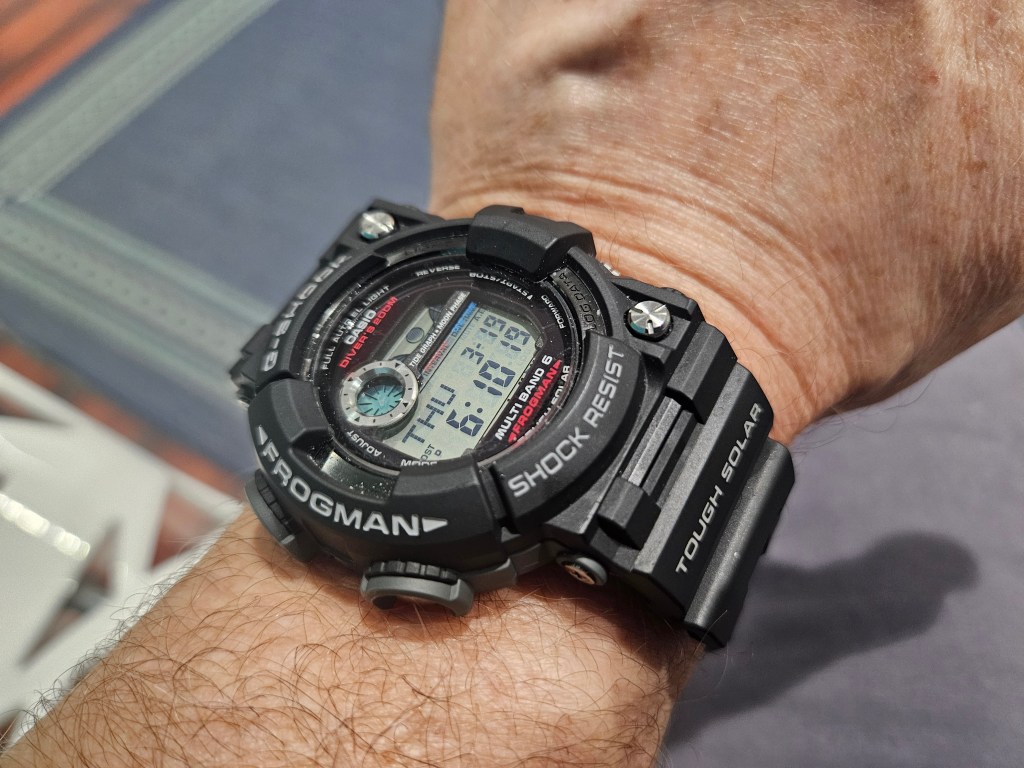
    Six weeks ago, I received my G-Shock Frogman and promptly lost my mind. Not gradually. Not with dignified hesitation. I went down hard. The more I studied its lopsided, industrial architecture, the more I found myself staring at it the way one stares at brutalist buildings—confused at first, then strangely moved. Black resin, thick as a tire wall, sat on my wrist with the quiet confidence of a machine that does not care if you approve of it. No one told me industrial black resin could look so beautiful. 

    This startled me. I had long filed resin under “gym timer” and “Office Space despair”—the sort of material worn by men who have stopped expecting things from life. What kind of man sidelines a stable of expensive mechanical divers—curated, polished, lovingly rationalized—for a slab of molded polymer that costs a fraction of the least expensive piece in the box? The answer, apparently, is me. Something shifted. I can’t explain it. It may take years, or therapy, or both.

    Naturally, I doubled down.

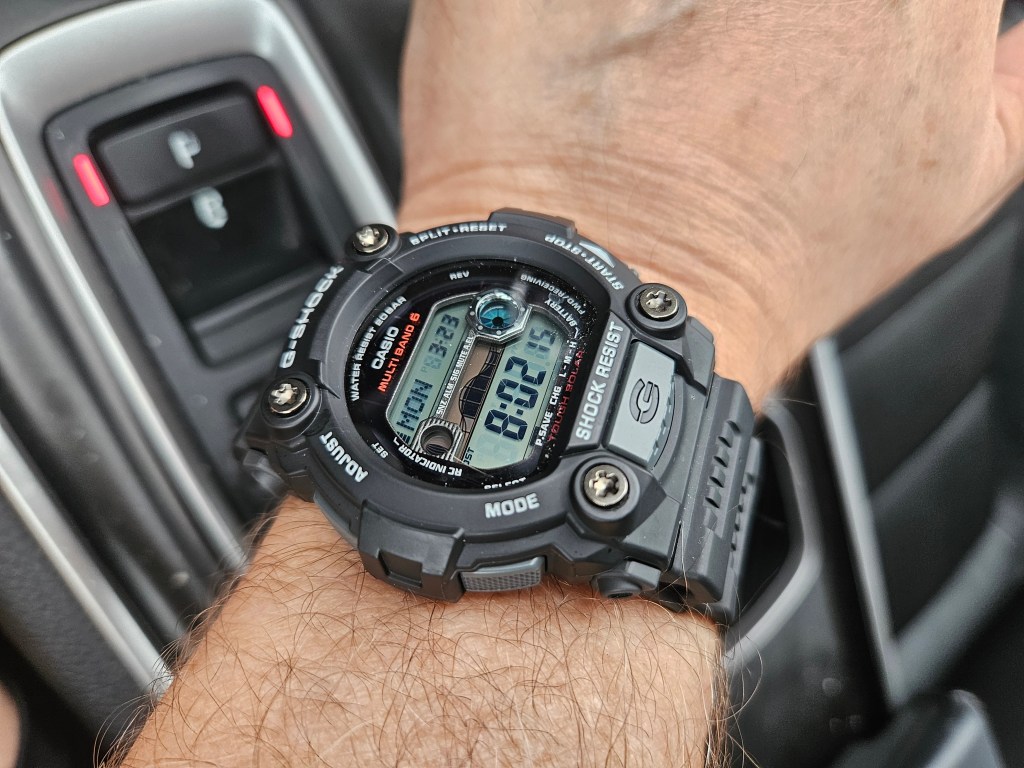
    Intoxicated by the Frogman, I added the GW-7900 Rescue, a watch that costs about one-fifth as much and delivers five times the daily utility. It is padded, legible, and indifferent to my previous standards. Its numerals are large enough to read without squinting, which, at this stage of life, qualifies as a luxury feature. It became my daily wearer within a week, displacing watches that once required white gloves and a sense of occasion.

    Still unsatisfied, I escalated. The Mudman GW-9500 arrived next, with numerals that resemble municipal signage. If the Rescue was readable, the Mudman is unavoidable. Together, the three form what I have come to call—without irony—the Hero Triad.

    All three are Multiband-6 with Tough Solar, which means they spend their nights quietly consulting the atomic clock in Fort Collins and correcting themselves with a level of discipline I have never achieved in any area of my life. The Frogman and Mudman prefer to be placed carefully—on a desk, or hanging from my T-bar like well-behaved instruments. The Rescue, by contrast, syncs wherever it pleases. It has the personality of a straight-A student who does not need supervision.

    These three watches now consume over ninety percent of my wrist time. My mechanical divers sit in their box like retired generals, decorated but irrelevant. When I told my wife this, she paused and asked, “Wrist time? Who uses that term?”

    I do. We do. We count wrist time the way bodybuilders count macros—with vigilance, denial, and occasional self-deception. And lately, my wrist time has been taken over by G-Shock.

    I’ve written about this infatuation on my blog, but my YouTube audience has made something clear: words are no longer enough. We live in an age where ideas must be performed, not merely stated. If I want to be understood, I must produce a video.

    And yet, I cannot make this video.

    First, the landscape is saturated. There are already hundreds of G-Shock videos—reviews, tutorials, warnings about imminent discontinuations delivered with the urgency of a public safety alert. To add my voice would be to echo the chorus, and I have no desire to hear myself harmonizing with better singers.

    Second, I refuse to become an evangelist. I am not here to declare a holy war against Seiko, Tudor, or Omega. This is not a zero-sum game. I have not betrayed mechanical watches with a Judas Iscariot kiss and fled into the desert with a resin accomplice. I still believe in their beauty. I simply no longer rely on them for giving me accurate time. That distinction is subtle, and subtlety does not perform well on YouTube.

    Third, I lack a coherent explanation for my conversion. I cannot tell you whether this shift is driven by age, by proximity to retirement, or by a growing intolerance for approximation in a world already saturated with it. Perhaps I simply escaped Seikotraz—the self-imposed prison of mechanical devotion—and ran toward the first open door. Whatever the cause, I am not yet qualified to narrate it.

    Fourth, my story is not unique. Millions discovered G-Shock long before I arrived, breathless and late, to report that it works. To stand before an audience and announce this would reduce me to a background character—another man discovering electricity and insisting on a press conference.

    Fifth—and most damning—this narrative reads like a watch downgrade. The story people want is ascent: the climb, the conquest, the triumphant pose at the summit. I have done the opposite. I have descended, calmly, into black resin. I have traded filet mignon for a protein bar and now stand before you insisting it is not only sufficient, but superior. This is not a heroic arc. It is a dietary confession. And possibly a sign of a pathology. 

    So no, I cannot make this video. 

    My escape from Seikotraz may or may not be complete. What I can promise is this: when the next chapter reveals itself—and it will—I’ll report back, possibly with less confusion, but no guarantees. Aren’t you glad I didn’t make this video? 

  • Teaching Without a Map in a Shifting World

    Teaching Without a Map in a Shifting World

    In “Teaching in an American University Is Very Strange Right Now,” Frank Bruni captures a tension that defines the modern classroom: how do you offer students hope without lying to them? His students at Duke University are coming of age in a moment that feels less like a transition and more like a rupture—truth is contested, institutions feel unstable, artificial intelligence is reshaping entire professions, and the political climate leans toward confusion and consolidation of power. Add to that a job market where careers in public policy, government, and nonprofits are shrinking, and the traditional pathways begin to look like dead ends.

    Bruni’s difficulty is not just emotional; it’s epistemological. The ground keeps shifting. The job market no longer behaves like a map you can study and memorize. It behaves like weather—volatile, unpredictable, and indifferent to your plans. Bruni and his colleagues find themselves in an unfamiliar position: experts who no longer trust their own expertise. When the mentors are unsure of the terrain, the act of mentoring starts to feel like guesswork dressed up as guidance.

    And yet, retreating into cynicism would be a dereliction of duty. Bruni insists on offering hope, but not the anesthetized version that avoids discomfort. His version of hope is anchored in reality. He tells his students that survival in this environment will not belong to the most credentialed or the most specialized, but to the most adaptable. The winners will be those who can pivot quickly, read patterns early, and anticipate what’s coming before it arrives. In other words, they must think several moves ahead while the board itself is being rearranged.

    This requires a shift in how students approach their education. The old model—bury yourself in your major, master the material, trust that the system will reward you—was always a partial truth. Now it’s a liability. Depth without awareness is no longer enough. Students need a wide-angle lens, an ongoing scan of the broader landscape: economic shifts, technological disruptions, political currents. The classroom can no longer be a refuge from the world; it has to be a vantage point from which to read it.

    Bruni’s message is unsettling, but it has the virtue of being honest. Hope, in this context, is not the promise that things will work out as planned. It’s the conviction that those who stay alert, flexible, and strategically aware can still find a way forward—even when the path refuses to stay still.

  • The Kryptonite Effect of Screens in Education

    The Kryptonite Effect of Screens in Education

    In her Atlantic essay “What Happened After a Teacher Ditched Screens,” the author examines a belief so widely accepted it rarely gets questioned: that more technology automatically improves learning. Dylan Kane, a seventh-grade math teacher, bought into that belief for over a decade. His students worked on Chromebooks, navigating a custom-built math site while monitoring software kept them from drifting into games or distractions. It was a tightly managed digital ecosystem—efficient on paper, persuasive in theory.

    Then Kane pulled the plug.

    This wasn’t a minor adjustment; it was a small act of rebellion. Nearly ninety percent of school districts now issue laptops or tablets, sold on the promise of “personalization”—the idea that technology can tailor instruction to each student’s needs, close learning gaps, and adapt to different cognitive styles. It’s an elegant theory, especially attractive to those whose reputations and revenue depend on merging education with technology.

    But in Kane’s classroom, the theory collapsed under the weight of actual human behavior. Screens didn’t personalize learning; they colonized attention. Students stared at them the way gamblers stare at slot machines—fixed, hypnotized, and detached from the room. Class discussion withered. The teacher’s voice, once the organizing force of the classroom, lost every round to the glowing rectangle. When attention becomes a zero-sum game, the screen doesn’t negotiate. It wins.

    Kane’s frustration deepened when he read Jared Cooney Horvath’s The Digital Delusion, which argues that increased technology use correlates with declining student performance. So Kane ran an experiment: he removed the Chromebooks for a month. What he discovered was not subtle. Students began paying attention again. Participation returned. Assignment completion jumped from 45 to 62 percent. Writing equations by hand—slow, deliberate, mildly inconvenient—forced students to see their own thinking unfold. The inconvenience turned out to be the point. Learning, it seems, benefits from friction.

    I’ve been teaching college writing for over thirty-five years, and I’ve seen my own version of this “kryptonite effect.” Smartphones siphon attention. Laptops become portals to games, sports, and anything but the task at hand. I’ve watched students drift out of the room without leaving their seats. The screen doesn’t just distract; it competes, and it usually wins.

    And yet, my experience isn’t a simple indictment of technology. Between 2018 and 2019, I ran a structure that worked. We met twice a week: one day for lecture and discussion, the other as a writing lab. During lab sessions, students wrote on desktops or their own laptops, working through scaffolded assignments. I read their drafts in real time, helping them revise thesis statements and sharpen arguments. The dynamic shifted. I wasn’t a distant lecturer; I was a coach moving from desk to desk. Students completed work on campus instead of procrastinating at home. Completion rates improved, not because of the machines themselves, but because of how they were used.

    The pandemic ended that model. My courses shifted to a hybrid format—one meeting a week—and the lab disappeared. I’ve been reluctant to surrender precious face-to-face time to silent writing sessions. But I’m beginning to wonder if I’ve been too cautious. If Kane is right about the power of attention, perhaps the most effective use of class time is not more talking, but more doing.

    What Kane’s experiment ultimately reveals is not that technology is useless, but that it is context-dependent. A math classroom, built on sequential problem-solving, may suffer when screens fracture attention. A writing classroom, structured around drafting and revision, may benefit from them under the right conditions. The mistake is not using technology. The mistake is treating it as a universal solution.

    If I were back to teaching two days a week, I wouldn’t hesitate. One day for discussion. One day for writing in a lab. Not because technology is inherently good, but because, in that setting, it serves the work instead of sabotaging it.

  • Why the Word “Stress” Has Outlived Its Usefulness

    Why the Word “Stress” Has Outlived Its Usefulness

    The word stress has been talked into exhaustion. It shows up everywhere—therapy sessions, productivity podcasts, corporate memos—until it becomes a kind of verbal white noise. Everything is stressful. Traffic is stressful. Email is stressful. Existence itself is apparently one long panic attack. The result is not clarity but numbness. A word that once pointed to something real now floats, bloated and imprecise, over every inconvenience and calamity alike. It needs to be stripped down, cleaned up, and returned to service.

    Start by dividing what we lazily call “stress” into three distinct experiences.

    First, there is what we might call existential friction—the strain that comes from living a life that actually matters. Sartre described it as getting your hands dirty. It is the tension of responsibility, of choosing action over comfort. Think of Viktor Frankl, who could have escaped a concentration camp but stayed to tend to the suffering around him. To say he was “stressed” is to trivialize the moment. He was engaged in a moral confrontation with evil. The discomfort was not a malfunction; it was the price of meaning. A bodybuilder tears muscle to grow stronger. A moral person strains against life’s conflicts to become more fully human. This is not pathology. It is construction.

    Second, there is narcissistic agitation—the counterfeit version of stress, self-generated and corrosive. This is the anxiety of the addict chasing relief, the restless paranoia of the status-obsessed, the brittle ego that reads every room as a threat. Here the individual is both the engine and the victim of the distress. It is not the friction of purpose but the turbulence of misalignment. To confuse this with existential friction is not just sloppy; it is morally obtuse. One builds character. The other erodes it.

    Finally, there is existential overload—the strain that arrives uninvited and exceeds your capacity to absorb it. This is not heroic and not self-inflicted. It is what happens when life stacks too many weights on the bar at once. Divorce, illness, financial collapse—events that don’t ask for your permission before they rearrange your nervous system. In this state, the body begins to narrate what the mind cannot contain. Appetite disappears. Sleep fractures. Symptoms bloom. There is no lesson neatly packaged inside it, no redemptive arc guaranteed. It is endured, not chosen.

    I think of my brother in 2020. His marriage collapsed. He was suddenly alone during the pandemic, financially strained, disoriented. Then came the diagnosis: Burkitt lymphoma. Two months to live. That is not “stress.” That is existential overload in its purest form. And yet, against those odds, he found a narrow corridor of hope—a CAR T-cell therapy trial at UCSF. He took it. He survived. He is in remission. The word stress does not belong anywhere near that story.

    This is why the word needs to be retired from serious use. It flattens distinctions that matter. It places the inconvenience of a crowded inbox on the same plane as a confrontation with mortality. Better to replace it with terms that carry weight: existential friction, narcissistic agitation, existential overload. Precision is not pedantry; it is navigation. If you’re trying to find your way out of the dark, you don’t need a vague feeling. You need a compass that actually points somewhere.

  • When Time Stops Asking and Starts Telling

    When Time Stops Asking and Starts Telling

    At sixty-four and four months, you thought you were still wading—water warm, footing reliable, the shoreline within easy reach. Then, without warning, the bottom vanished. One step of confidence, followed by that cold, immediate truth: you are no longer in control of the depth. The drop-off doesn’t negotiate. It doesn’t slope politely. It takes you.

    This particular plunge announced itself through something as mundane—and as revealing—as a watch. For decades, you wore mechanical divers with analog dials, small, intricate machines that whispered of heritage, craft, and a certain gentlemanly patience. That language no longer translated. You didn’t want poetry. You wanted coordinates.

    So you defected. You strapped on Tough Solar, Multiband-6 atomic G-Shocks—watches that don’t ask what time it feels like but what time it is, down to the second, corrected nightly by a signal from a tower you will never see. This was not a style change. It was an Atomic Conversion Event: the moment when nostalgia is exposed as a luxury item and precision becomes a survival tool. Time ceased to be something you admired. It became something you obeyed.

    You found yourself thinking of that Robinson family from Lost in Space—before stepping onto an alien surface, they consulted their robot, which scanned the air and issued a verdict: breathable or lethal. You needed your own robot now, but smaller, quieter, strapped to your wrist. Not to tell you whether the atmosphere would kill you, but whether you were wasting it.

    Because the deeper realization was not horological. It was existential. You no longer had the bandwidth for drift. “Fiddlefaddling,” once an acceptable pastime, now read like malpractice. Clarity was no longer optional; it was oxygen. You had to extract meaning from the noise and live with an alignment that would have bored your younger self. The watch change was merely the visible symptom of an internal regime shift.

    And this was not your first encounter with the abyss. A decade earlier, you performed a similar surgery on your life: you quit sports. Not gradually, not ceremoniously—just stopped. You recognized the structure for what it was: three-hour games followed by hours of commentary, followed by meta-commentary, followed by the analysis of the analysis. An infinite regress disguised as entertainment. You didn’t taper off. You cauterized the habit. Torch, not scalpel.

    That’s when the pattern revealed itself. Life is not a smooth shoreline; it is a series of drop-offs. Each one demands a new posture, a new set of tools, a new tolerance for truth. You don’t get to choose whether they arrive—only whether you adapt before you drown.

    There will be more. Of course there will. The only sensible response is not optimism but readiness.

    Buckle up.