Tag: writing

  • Camry vs. Accord: A Meditation on Spec Sheets, Obsession, and the Art of Manspreading

    Camry vs. Accord: A Meditation on Spec Sheets, Obsession, and the Art of Manspreading

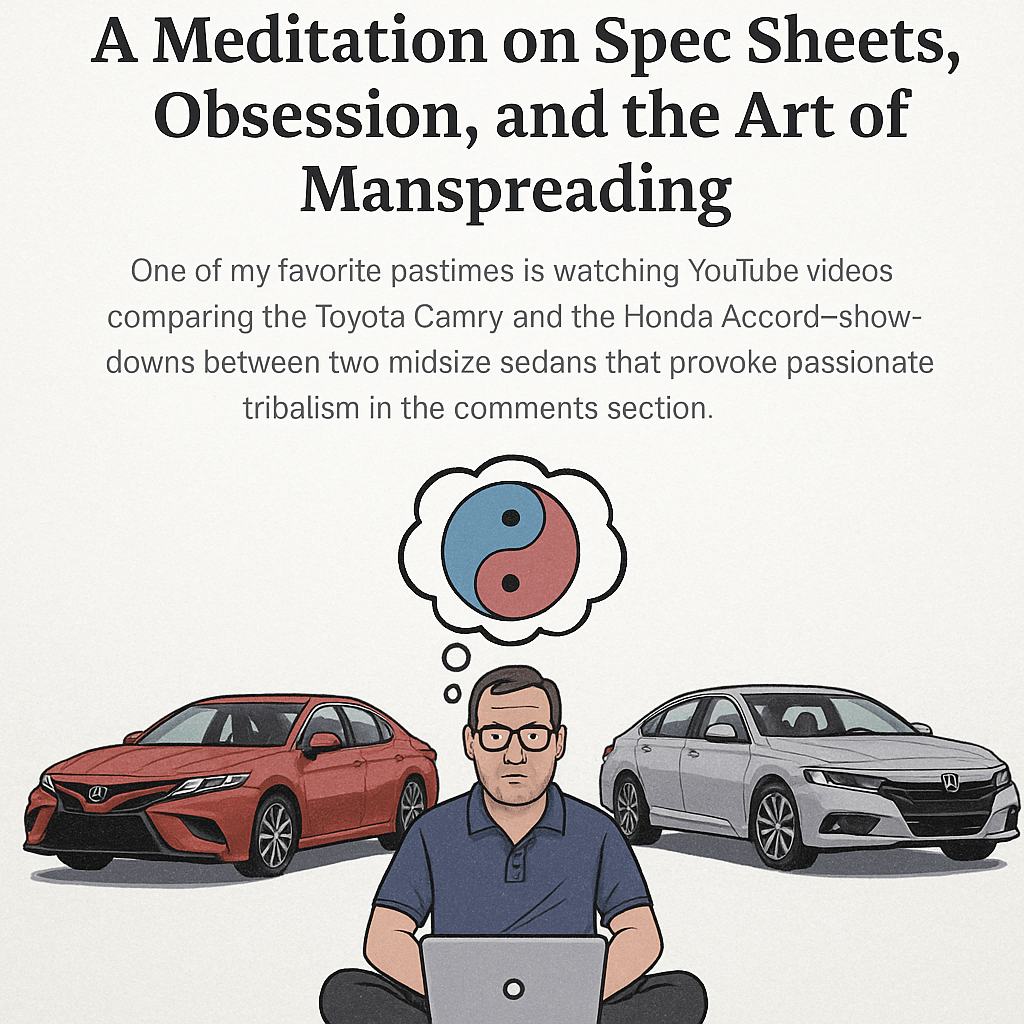
    One of my favorite pastimes—oddly specific and strangely soothing—is watching YouTube comparison videos of the Toyota Camry vs. the Honda Accord. I’m not car shopping. I don’t need a car. I may never buy another car. But these videos are my digital comfort food. They’re as satisfying to me as fine wine is to a sommelier or apple pie tastings are to a pastry chef—only instead of tasting notes, I savor engine specs and torque curves.

    There’s something singular about the Camry-Accord rivalry. In the sedan world, these two are the Goliaths. It’s not just another car comparison. It’s the comparison. Watching these two go head-to-head year after year is like seeing the best Steelers team take on the peak Patriots in a Super Bowl that never ends. Everything else—BMW vs. Mercedes, Rolex vs. Omega—feels less pure. BMW and Mercedes aren’t in the same pricing tier. Rolex exists in a brand vacuum. And while coffee maker comparisons have their niche charm, they lack the existential gravity of Camry vs. Accord.

    No rivalry inspires more content—or more heated debate. YouTube is flooded with these matchups, and if you scan the view counts, it’s clear: Camry vs. Accord is the king of consumer showdowns. Reviewers comb over the details with forensic intensity—fuel economy, powertrain specs, road noise, trunk space, rear-seat legroom, infotainment ergonomics, ride comfort, styling. They break it down like seminary students parsing Greek New Testament syntax.

    But what really fascinates me is the comments section, where strangers proclaim their loyalty with righteous conviction. Owners justify their purchase with religious fervor, deploying cherry-picked data to reinforce their superiority. It’s a textbook case of post-purchase rationalization: that psychological reflex where we inflate the virtues of what we bought to feel smarter, savvier, and self-assured.

    One commenter might praise the Accord’s refined cabin and roomier interior—but add that its exterior is so bland, driving one is akin to living as an NPC. Another insists Camry’s superior sales figures are proof of its aesthetic and mechanical dominance. Some dismiss the Accord entirely, predicting its extinction in five years. Others proudly declare they’re on their fifth generation of the same car, with brand loyalty woven into the fabric of their identity. For these drivers, the car isn’t a tool—it’s family.

    Ultimately, this rivalry isn’t really about cars. It’s about identity, tribalism, and the human need to choose a side and be right. It’s a Dr. Seussian fable in metallic paint: one team wears Honda badges, the other wears Toyota, and both believe their side represents reason, taste, and truth.

    For those of us with no appetite for political tribalism, this is our outlet. Camry vs. Accord is safer ground—less polarizing than politics, but don’t tell that to a diehard on either side. Watch how they argue: calmly, firmly, methodically—as if their livelihood depends on selecting the superior midsize sedan. They approach the debate with the solemnity of theologians discussing substitutionary atonement or post-mortem salvation.

    And me? I’m both relaxed and riveted. The debate calms my nerves and sharpens my focus. For a glorious hour, as I parse suspension tuning and rear-seat headroom, my worries dissolve. My thoughts narrow into something blissful. I study the specs like they’re verses from Leviticus. And in that deep focus, my anxiety lifts.

    Then it hits me: I don’t actually want the car—I want the focus. The Camry and Accord are just proxies for obsession. They’re placeholders in the temple of hyper-attention. Some people do yoga. I watch two middle-aged men compare infotainment systems like Cold War arms inspectors.

    And I do this with full self-awareness. I said earlier I might never buy another car. That wasn’t entirely true. My wife owns a 2014 silver Honda Accord Sport. I drive a 2018 gunmetal gray Accord Sport. We’re a two-Accord household. When it comes to car-buying, I’m conservative by nature—and what’s more conservative than buying a Camry or an Accord?

    I’m nearly certain our next car—whether hers or mine—will be one of the two. Likely an Accord, given that I’m six feet tall, 230 pounds, claustrophobic, and deeply committed to driver’s seat manspreading. The Accord gives me room to sprawl. The Camry? Not so much. I know this because, during a San Francisco vacation, an Uber driver picked us up in a brand-new Camry. It looked sleek from the curb, but once inside I felt like I was strapped into a fetal position. The experience ruined the car for me.

    And yet, I want to love the Camry. I really do. In my ideal life, my driveway would have both: the Camry and the Accord parked side by side like yin and yang. One the smooth operator, the other the sensible sibling. Their competition makes each better. Their rivalry sustains them both—and keeps me obsessively circling the rabbit hole.

    Because in the end, the Camry vs. Accord battle isn’t just about choosing a car. It’s about longing for clarity in a world of noise. It’s about choosing sides, rationalizing decisions, and pretending—for a few hours on YouTube—that the world makes sense if you can just pick the right sedan.

  • Watch Ownership Is a Letdown; Research Is the High

    Watch Ownership Is a Letdown; Research Is the High

    One of my favorite pastimes is watching YouTube comparison videos of the Toyota Camry vs. the Honda Accord. I’m not shopping for a car. I don’t need a car. I may never buy another car. 

    But these videos? They soothe the savage beast inside of me. They go down like a smooth bourbon, with notes of ABS braking and a smoky finish of fuel economy.

    While others go to YouTube to meditate or do yoga, I fall into the hypnotic cadence of two grown men comparing rear-seat legroom and infotainment systems with the solemnity of Cold War negotiators. 

    I’m riveted. Parsing the pros and cons of these two sedans gives me a focus so intense it borders on religious ecstasy. I study engine specs like they’re verses from Leviticus. My concentration sharpens, my anxiety fades. I am, for a brief and blissful moment, free.

    And then it hits me: I don’t want the car. I want the focus. The Camry and Accord are just placeholders in the temple of obsession.

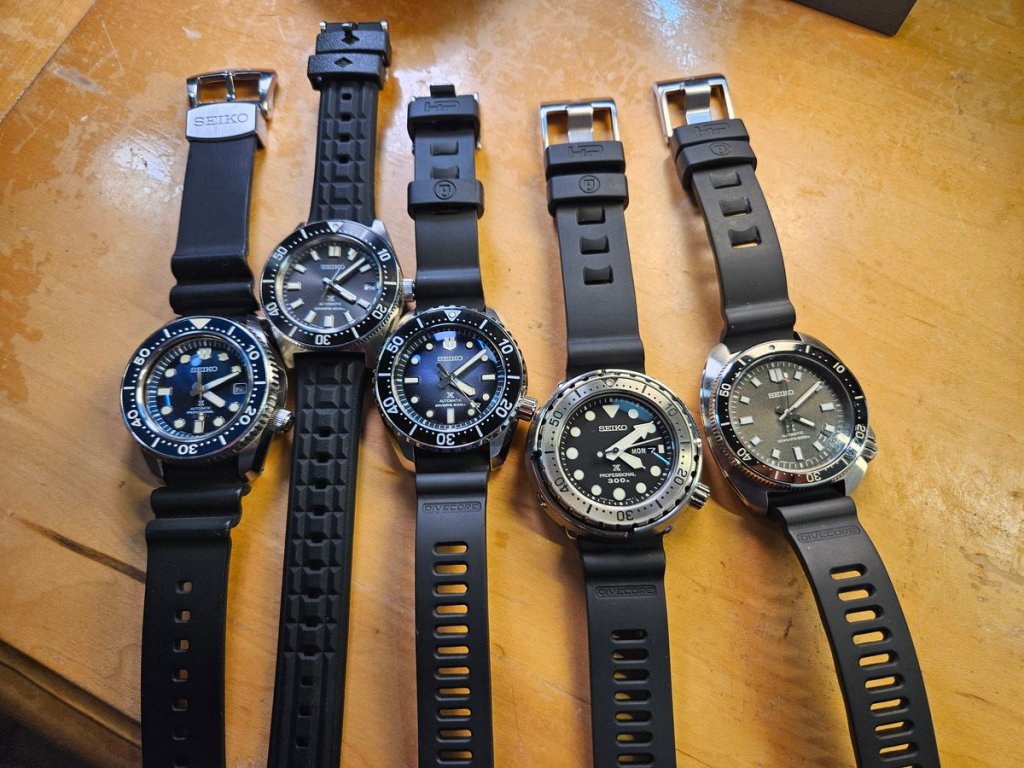
    This revelation sheds light on my watch obsession. It helps me realize that acquiring a watch in most cases is a bitter letdown. A $3,000 watch on the wrist is like a Tinder date at Denny’s: out of place and super embarrassing. 

    I’ve worn $5,000 watches while taking my daughters to YogurtLand and I’ve said to myself, “Dude, you’ve lost the plot.”

    How did I get here with expensive watches that I wear when I’m buying pretzels and diet soda at Target?

    And then I realize. The same drive to focus on Camry-Accord comparisons is the same drive that makes me do “timepiece research.”  Watching my fellow timepiece obsessives drool over bezels and lume shots is the real high. That’s what lights me up. That’s what gets the adrenaline surging through my veins. 

    I’ve spent years confusing consumer acquisition with personal transformation. Getting this thing or that thing will change me inside. I want to be courageous, dignified, courteous, disciplined, fit, and healthy. A watch can’t redeem me. It can’t make me whole. It can’t make me the person I wish I were. Not once have I ever put a new watch on my wrist, gave my wife a wrist shot, and said, “Look, honey, I’ve achieved a metamorphosis.”

    She’ll just look at me and say, “Dude, clean the leaves out of the rain gutters.”

    The material thing in my hands is a letdown because what I really want is the chase and the intense focus. The glorious plunge down a rabbit hole lined with brushed stainless steel and leather-wrapped dashboards. My consumerism isn’t about consumption—it’s about cultivating a state of intense obsession that drowns out the shrieking absurdity of modern life.

    So no more mistaking adrenaline for fulfillment. No more clicking “Buy Now” hoping for transcendence in a shipping box. 

    I’ll keep researching. That’s my Prozac. That’s my monastery. 

    But buying something has proven to be a fool’s errand. And if doing so-called research inflames my consumer appetites, then I should probably put my foot on the brakes when it comes to the research because it can be a prelude to making a purchase I don’t want to make.

    Let me give you an analogy. Let’s say you’re back in high school and you’re at the high school dance, but your girlfriend isn’t there because she’s on a ski trip. While bored at the dance, your ex shows up. She looks more beautiful than you remember her. She approaches you and asks you to dance. “Nothing will happen,” she says. “It will be completely innocent.” You dance with her and something happens. 

    That’s what watch research is like. You tell yourself the research is innocent. You’re just reading forums. Watching a video or two. Maybe checking inventory. 

    But then you wake up and you’re shopping at Target with a $5,000 watch on your wrist and you feel both embarrassed and ashamed.

    Doing research on watches is like having that dance with your ex-girlfriend: Something is going to happen. And it’s not going to be pretty. 

    Have a wonderful day, everyone. Don’t forget to smash that Like button of your soul.

  • If Cormac McCarthy Wrote a Movie Treatment for The Beatles’ “The Long and Winding Road.” 

    If Cormac McCarthy Wrote a Movie Treatment for The Beatles’ “The Long and Winding Road.” 

    FADE IN:

    A road. It winds through the wastes like a serpent that forgot its own name. Cracked earth on either side. Fence posts like grave markers. Vultures in the sky, circling nothing in particular, just keeping warm. A man walks it. His boots are flayed open. His eyes are sunburned. His soul is a blister dragging itself behind him.

    His name is Lyle. Or maybe Thomas. The script never says. Doesn’t matter. He’s every man who ever wrote a love letter in blood and mailed it into the void.

    He is looking for her. She has no name, just a shape in the distance, a memory braided from perfume and last words. She left him. Maybe twice. Maybe more. He kept the door open. She never knocked.

    The road has been long. Winding. Bleak. It led him through dead towns and ghost motels. Once he stayed in a place where the concierge was a buzzard and the minibar held only regret.

    He speaks not. The road speaks for him. It says:

    Every fool must follow something. You picked hope. Bad draw.

    Flashbacks flicker: A woman, face soft as moonlight, eyes like unpaid debt. She tells him she’s leaving. He says he’ll wait. She laughs. That’s the last thing she gives him. Her laughter. Acid-bright and final.

    Along the road he meets others—pilgrims of delusion.

    One man rides a shopping cart filled with old love songs on cassette.

    One woman sews wedding dresses for brides that never were.

    One child sells maps to places that no longer exist.

    They all walk. They all believe the road leads somewhere. It don’t.

    Eventually, Lyle comes upon a house at the end of the road. It is the house. Her house. Or what’s left of it. The windows are boarded. The door is gone. Inside, just dust, a broken phonograph, and a bird trapped in the chimney, fluttering against the soot.

    He kneels.

    Not to pray. To listen.

    There’s no music. No answer. Only wind. And the bird’s soft thump, thump, thump.

    He lies down. The road curls around him like a noose.

    FADE TO BLACK.

    The final line scrolls in silence:

    Love didn’t leave. It just stopped answering the door.

  • If Cormac McCarthy Wrote a Movie Treatment for Maria Muldaur’s “Midnight at the Oasis”

    If Cormac McCarthy Wrote a Movie Treatment for Maria Muldaur’s “Midnight at the Oasis”

    FADE IN:

    A bone-white desert stretches out beneath a black vault of stars. The dunes are still as sacrificial altars. Somewhere out there, beneath the coyote moon and the ruined tower of Orion, rides a woman of indeterminate age and infinite mischief. She wears a sun hat like a halo. Her sandals leave no prints.

    The camel she rides is named Jeremiah. He does not speak but regards the world with the mournful gaze of a beast who has seen empires fall and lovers lie. His saddle is adorned with silver conches, turquoise fringe, and a little brass bell that tolls only for the damned.

    She comes upon a man.

    He is shirtless, jawline like a blade. Smokes roll-your-owns and speaks in aphorisms. Former bluesman turned snake-oil preacher turned fugitive for a crime he may or may not have committed in Santa Fe, where the sheriff’s daughter still dreams of him and leaves milk out for the scorpions.

    She says

    Midnight at the oasis

    He says

    There’s no such thing as time in this country. Only heat and forgetting.

    They drink wine from a dented canteen and roast cactus blossoms on a fire made of mesquite and ancient regret. The camel chews cud. The stars wheel. A frog laughs somewhere.

    The woman suggests they slip off to a sand dune real soon. Her voice, soft as velvet, carries across the salt-swept wind like prophecy or seduction or both. The man, being a fool or a poet (but never both at once), accepts.

    The desert is watching. It has watched worse.

    They make love like two fugitives hiding from God, beneath constellations older than grammar. Their bodies steam in the moonlight. A lizard judges them and scuttles away.

    At dawn, they are pursued. By whom? Perhaps the woman’s husband. Perhaps bounty hunters. Perhaps just Time, wearing spurs and humming a Carter Family tune. The chase is unspoken but certain.

    The camel refuses to run.

    The woman kisses the man once more and vanishes into a dust devil. Gone. Or maybe never there to begin with.

    The man will ride Jeremiah to the nearest roadhouse and order three fingers of mezcal. He will never again look at the moon without suspicion.

    FADE TO BLACK.

  • The Phantom in the Mirror: On Becoming an NPC

    The Phantom in the Mirror: On Becoming an NPC

    The Non-Player Character—or NPC—was born in the pixelated void of video games. It is a placeholder. A background hum. A digital ghost whose job is to stand in a market, repeat a scripted line, or walk in endless circles without complaint. The NPC has no hunger for freedom, no dreams of becoming more. It exists in the half-life of interactivity—a cardboard cutout propped up by code. It’s “there,” but not there. You see it. Then you forget it. And that, in essence, is the horror.

    Somewhere along the way, the term slipped out of the screen and into real life. “NPC” became shorthand for a human who seems hollowed out—emotionally neutralized, culturally sedated, and spiritually declawed. Not stupid. Not evil. Just disengaged. The light behind the eyes? Gone dim. What was once an ironic jab at background characters is now a chilling metaphor for people who’ve surrendered to the most generic, algorithm-approved version of themselves.

    What’s grimly poetic is that NPCs in video games are often controlled by artificial intelligence. And so, too, are many modern humans—nudged by dopamine, entranced by endless scrolls, soothed by the hypnotic rhythms of consumption. The Roman formula of bread and circuses has merely been rebranded. Netflix. DoorDash. TikTok. It’s all the same anesthetic. As therapist Phil Stutz would say, we’re stuck in the “lower channel”—an emotional basement filled with numbing comforts and artificial highs.

    And yet, here’s the twist: even the brilliant can become NPCs. The anxious. The depressed. The overworked. The soul-sick. Sometimes the smartest people are the most vulnerable to emotional collapse and digital retreat. They don’t become NPCs because they’re shallow. They become NPCs because they’re hurting.

    There are, perhaps, two species of NPCs. One is blissfully unaware—sleepwalking through life without a second thought. The other is terrifying: self-aware, but immobilized. The mind remains active, but the body slouches in the chair, feeding on stale memories and reruns of past selves. Think of Lot’s Wife, gazing back at a past she couldn’t let go. She wasn’t punished arbitrarily; she was frozen in time—literally—a statue of salt and sorrow. The original NPC.

    Middle age is particularly fertile ground for NPC-ism. Nostalgia becomes narcotic. We mythologize our former selves—thinner, bolder, brighter—and shrink in the shadow of our own legend. Why live in the present, when the past is easier to romanticize and the future is too much work? Just ask Neddy Merrill from John Cheever’s “The Swimmer,” paddling from pool to pool in a daze, believing in a youth long gone, burning every real connection he had on the altar of delusion. An NPC in swim trunks.

    Today, we’re incentivized to become NPCs. Social media trains us like lab rats, handing out dopamine pellets in the form of likes, follows, and artificial intimacy. The real world—messy, unfiltered, full of awkward silences and genuine risk—is rejected for the smoother contours of algorithmic approval. Our souls are curated, our emotions trimmed to fit the timeline.

    The NPC, then, is not a throwaway gag. It’s a portrait of the modern condition. A spirit trapped in a basement, scrolling for meaning, addicted to memory, afraid of action. A being slowly turning into vapor, still breathing but no longer alive.

    And the true terror? Sometimes I feel it in myself. That quiet moment when I trade meaning for ease, purpose for distraction, vitality for sedation. That’s when I hear the whisper: You’re becoming one of them. That’s when I feel the NPC, not on my screen, but inside my skin.

  • The Comedians of Cell Block B

    The Comedians of Cell Block B

    Last night I dreamed I was in a bustling, overlit restaurant packed with the usual suspects—people chewing too loudly, waitstaff dodging elbows, silverware clinking like wind chimes in a windstorm. I was halfway through what I assumed was risotto when I realized two of my teeth had come loose, flapping in my gums like faulty hinges.

    Panicked, I waved down a waiter. He listened gravely, nodded with theatrical sympathy, then pointed toward a man in a white coat weaving through the crowd like a prophet leaving a revival. “That’s Dr. Beltrán,” he said. “Fixes teeth. Fixes lives. If you move now, you might catch him before he ascends to the exit sign.”

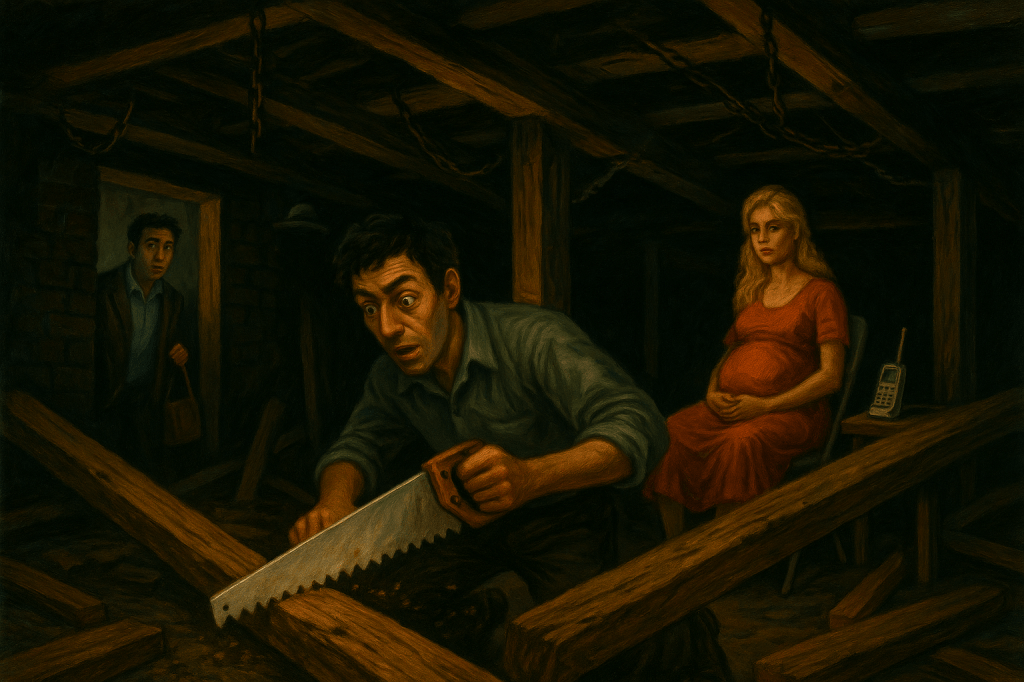
    So I followed. Fast forward to the next day: I’m in a waiting room that looked more like a casting call for eccentric sitcom roles. Among the crowd sat a married couple, both comedians. Raffi, a Canadian import with the weary charisma of someone who’s done too many festivals, and Tina, his statuesque, golden-haired wife, radiantly pregnant and visibly amused by the absurdity of her own life.

    Turns out Raffi and I had gone to college together, which gave our small talk the sheen of nostalgia. Tina, meanwhile, was the sort of woman you describe as a “former beauty queen” only because it sounds more manageable than “mythical being with a driver’s license.”

    Then the tone shifted. They told me they were serving life sentences. Yes—life sentences—for misreading pesticide instructions. About five years ago, they’d tried to fumigate their house for fleas and spiders but sprayed an industrial outdoor poison all over their bedroom carpet. Their organs liquefied. They almost died. When they recovered, they were arrested. The terms of their punishment? Eternal residence in a dungeon—an actual pitch-black basement beneath a towering apartment block. They were allowed out only for comedy gigs. Art, apparently, still mattered to the state.

    Dental work complete, Raffi left for Canada to perform at a club. Tina, contractions ticking in her belly like a countdown timer, insisted on showing me the dungeon. The space was a horror. Not just black-as-night oppressive, but physically punishing—an absurdly low ceiling crisscrossed by thick beams of lumbar that made it feel like you were crawling through a collapsed IKEA warehouse.

    So I did what any good houseguest-slash-dream hero would do: I went to the nearest hardware store, returned with a comically oversized saw, and spent the afternoon hacking through beams like a man possessed. Tina cheered me on from a folding chair, one hand on her belly, the other clutching her flip phone, waiting for Raffi’s call.

    When I finished, the dungeon felt ever so slightly less apocalyptic. She looked at me and said, “I think the baby’s coming.” I nodded like I’d just finished installing a light fixture. My work here was done.

  • My Philosophy of Grading in the Age of ChatGPT and Other Open-AI Writing Platforms (a mini manifesto for my syllabus)

    My Philosophy of Grading in the Age of ChatGPT and Other Open-AI Writing Platforms (a mini manifesto for my syllabus)

    Let’s start with this uncomfortable truth: you’re living through a civilization-level rebrand.

    Your world is being reshaped—not gradually, but violently, by algorithms and digital prosthetics designed to make your life easier, faster, smoother… and emptier. The disruption didn’t knock politely. It kicked the damn door in. And now, whether you realize it or not, you’re standing in the debris, trying to figure out what part of your life still belongs to you.

    Take your education. Once upon a time, college was where minds were forged—through long nights, terrible drafts, humiliating feedback, and the occasional breakthrough that made it all worth it. Today? Let’s be honest. Higher ed is starting to look like an AI-driven Mad Libs exercise.

    Some of you are already doing it: you plug in a prompt, paste the results, and hit submit. What you turn in is technically fine—spelled correctly, structurally intact, coherent enough to pass. And your professors? We’re grading these Franken-essays on caffeine and resignation, knowing full well that originality has been replaced by passable mimicry.

    And it’s not just school. Out in the so-called “real world,” companies are churning out bloated, tone-deaf AI memos—soulless prose that reads like it was written by a robot with performance anxiety. Streaming services are pumping out shows written by predictive text. Whole industries are feeding you content that’s technically correct but spiritually dead.

    You are surrounded by polished mediocrity.

    But wait, we’re not just outsourcing our minds—we’re outsourcing our bodies, too. GLP-1 drugs like Ozempic are reshaping what it means to be “disciplined.” No more calorie counting. No more gym humiliation. You don’t change your habits. You inject your progress.

    So what does that make you? You’re becoming someone new: someone we might call Ozempified. A user, not a builder. A reactor, not a responder. A person who runs on borrowed intelligence and pharmaceutical willpower. And it works. You’ll be thinner. You’ll be productive. You’ll even succeed—on paper.

    But not as a human being.

    If you over rely on AI, you risk becoming what the gaming world calls a Non-Player Character (NPC)—a background figure, a functionary, a placeholder in your own life. You’ll do your job. You’ll attend your Zoom meetings. You’ll fill out your forms and tap your apps and check your likes. But you won’t have agency. You won’t have fingerprints on anything real.

    You’ll be living on autopilot, inside someone else’s system.

    So here’s the choice—and yes, it is a choice: You can be an NPC. Or you can be an Architect.

    The Architect doesn’t react. The Architect designs. They choose discomfort over sedation. They delay gratification. They don’t look for applause—they build systems that outlast feelings, trends, and cheap dopamine tricks.

    Where others scroll, the Architect shapes.
    Where others echo, they invent.
    Where others obey prompts, they write the code.

    Their values aren’t crowdsourced. Their discipline isn’t random. It’s engineered. They are not ruled by algorithm or panic. Their satisfaction comes not from feedback loops, but from the knowledge that they are building something only they could build.

    So yes, this class will ask more of you than typing a prompt and letting the machine do the rest. It will demand thought, effort, revision, frustration, clarity, and eventually—agency.

    If your writing smacks of AI–the kind of polished mediocrity that will lead you down a road of being a functionary or a Non-Player Character, the grade you receive will reflect that sad fact. On the other hand, if your writing is animated by a strong authorial presence, evidence of an Architect, a person who strives for a life of excellence, self-agency, and pride, your grade will reflect that fact as well. 

  • Toothpaste, Technology, and the Death of the Luddite Dream

    Toothpaste, Technology, and the Death of the Luddite Dream

    A Luddite, in modern dress, is a self-declared purist who swats at technology like it’s a mosquito threatening their sense of self-agency, quality, and craft. They fear contamination—that somehow the glow of a screen dulls the soul, or that a machine’s hand on the process strips the art from the outcome. It’s a noble impulse, maybe even romantic. But let’s be honest: it’s also doomed.

    Technology isn’t an intruder anymore—it’s the furniture. It’s the toothpaste out of the tube, the guest who showed up uninvited and then installed a smart thermostat. You can’t un-invent it. You can’t unplug the century.

    And I, for one, am a fatalist about it. Not the trembling, dystopian kind. Just… resigned. Technology comes in waves—fire, the wheel, the iPhone, and now OpenAI. Each time, we claim it’s the end of humanity, and each time we wake up, still human, just a bit more confused. You can’t fight the tide with a paper umbrella.

    But here’s where things get tricky: we’re not adapting well. Right now, with AI, we’re in the maladaptive toddler stage—poking it, misusing it, letting it do our thinking while we lie to ourselves about “optimization.” We are staring down a communications tool so powerful it could either elevate our cognitive evolution… or turn us all into well-spoken mannequins.

    We are not guaranteed to adapt well. But we have no choice but to try.

    That struggle—to engage with technology without becoming technology, to harness its speed without losing our depth—is now one of the defining human questions. And the truth is: we haven’t even mapped the battlefield yet.

    There will be factions. Teams. Dogmas. Some will preach integration, others withdrawal. Some will demand toolkits and protocols; others will romanticize silence and slowness. We are on the brink of ideological trench warfare—without even knowing what colors the flags are yet.

    What matters now is not just what we use, but how we use it—and who we become in the process.

    Because whether you’re a fatalist, a Luddite, or a dopamine-chasing cyborg, one thing is clear: this isn’t going away.

    So sharpen your tools—or at least your attitude. You’re already in the arena.

  • Why Reading Is the Last Romantic Act

    Why Reading Is the Last Romantic Act


    If you take my Critical Thinking class, let me set expectations up front: I will not stand at the front of the room and lecture you into becoming an intellectual. That’s not how it works. I can’t command you to read. I can’t install curiosity like a software update.

    What I can tell you is this: the default setting is mediocrity. It’s smooth, seductive, and socially acceptable. The world—especially its algorithmic avatars—is built to exploit that setting. Platforms like OpenAI don’t just offer tools; they offer excuses. They whisper: You don’t have to think. Just prompt.

    You’ll get by on it. You’ll write tolerable essays. You might even land a job—something stable and fluorescent-lit with a breakroom fridge. But if you keep outsourcing your critical thinking to machines and your inner life to streaming platforms, you may slowly congeal into a Non-Player Character: a functionally adequate adult with no self-agency, just dopamine hits from cheap tech and cheaper opinions.

    The world needs thinkers, not task-completers.

    And that’s why I push reading—not as an obligation, but as a doorway to a higher mode of existence. Reading changes the texture of your thoughts. It exposes you to complexity you didn’t ask for and patterns of mind you didn’t inherit. But here’s the inconvenient truth: no one can make you read.

    Reading isn’t a commandment. It’s a love affair—and like any love worth having, it’s irrational, wild, and self-chosen. You don’t read because it’s good for you. You read because at some point a book wrecked you—in the best way possible. It made your brain itch, or your chest tighten, or your worldview crack open like an old floorboard.

    And that’s what I want for you. Not because it makes me feel like a good professor, but because if you don’t fall in love with ideas—on the page, in the margins, in someone else’s wild, flawed sentences—you’ll live a life someone else designed for you.

    And you’ll call it freedom.

  • Ozempification and the Death of the Inner Architect

    Ozempification and the Death of the Inner Architect

    Let’s start with this uncomfortable truth: you’re living through a civilization-level rebrand.

    Your world is being reshaped—not gradually, but violently, by algorithms and digital prosthetics designed to make your life easier, faster, smoother… and emptier. The disruption didn’t knock politely. It kicked the damn door in. And now, whether you realize it or not, you’re standing in the debris, trying to figure out what part of your life still belongs to you.

    Take your education. Once upon a time, college was where minds were forged—through long nights, terrible drafts, humiliating feedback, and the occasional breakthrough that made it all worth it. Today? Let’s be honest. Higher ed is starting to look like an AI-driven Mad Libs exercise.

    Some of you are already doing it: you plug in a prompt, paste the results, and hit submit. What you turn in is technically fine—spelled correctly, structurally intact, coherent enough to pass. And your professors? We’re grading these Franken-essays on caffeine and resignation, knowing full well that originality has been replaced by passable mimicry.

    And it’s not just school. Out in the so-called “real world,” companies are churning out bloated, tone-deaf AI memos—soulless prose that reads like it was written by a robot with performance anxiety. Streaming services are pumping out shows written by predictive text. Whole industries are feeding you content that’s technically correct but spiritually dead.

    You are surrounded by polished mediocrity.

    But wait, we’re not just outsourcing our minds—we’re outsourcing our bodies, too. GLP-1 drugs like Ozempic are reshaping what it means to be “disciplined.” No more calorie counting. No more gym humiliation. You don’t change your habits. You inject your progress.

    So what does that make you? You’re becoming someone new: someone we might call Ozempified. A user, not a builder. A reactor, not a responder. A person who runs on borrowed intelligence and pharmaceutical willpower. And it works. You’ll be thinner. You’ll be productive. You’ll even succeed—on paper.

    But not as a human being.

    You risk becoming what the gaming world calls a Non-Player Character (NPC)—a background figure, a functionary, a placeholder in your own life. You’ll do your job. You’ll attend your Zoom meetings. You’ll fill out your forms and tap your apps and check your likes. But you won’t have agency. You won’t have fingerprints on anything real.

    You’ll be living on autopilot, inside someone else’s system.

    So here’s the choice—and yes, it is a choice: You can be an NPC. Or you can be an Architect.

    The Architect doesn’t react. The Architect designs. They choose discomfort over sedation. They delay gratification. They don’t look for applause—they build systems that outlast feelings, trends, and cheap dopamine tricks.

    Where others scroll, the Architect shapes.
    Where others echo, they invent.
    Where others obey prompts, they write the code.

    Their values aren’t crowdsourced. Their discipline isn’t random. It’s engineered. They are not ruled by algorithm or panic. Their satisfaction comes not from feedback loops, but from the knowledge that they are building something only they could build.

    So yes, this class will ask more of you than typing a prompt and letting the machine do the rest. It will demand thought, effort, revision, frustration, clarity, and eventually—agency.

    Because in the age of Ozempification, becoming an Architect isn’t a flex—it’s a survival strategy.

    There is no salvation in a life run on autopilot.

    You’re here. So start building.