Tag: writing

  • The Composition Apocalypse: How AI Ate the Syllabus

    The Composition Apocalypse: How AI Ate the Syllabus

    We’ve arrived at the third and final essay in this course, and the gloves are off.

    Just as GLP-1 drugs are transforming eating—from pleasure to optimization—AI is transforming writing. That’s not speculation; it’s the new syllabus. We’re witnessing the great extinction event of the traditional writing process. Drafting, revising, struggling with a paragraph like it’s a Rubik’s Cube in the dark? That’s quaint now. The machines are here, and they’re fast, fluent, and disarmingly coherent.

    Meanwhile, college writing programs are playing catch-up while the bots are already teaching themselves AP Composition. If we want writing instructors to remain relevant (i.e., not replaced by a glowing terminal that says “Rewrite?”), we’ll need to reimagine our role. The new instructor is less grammar cop, more rhetorical strategist. Part voice coach, part creative director, part ethicist.

    Your task:
    Write a 1,700-word argumentative essay responding to this claim:
    To remain essential in the Age of AI, college writing instruction must evolve from teaching students how to write to teaching students how to think—critically, ethically, and strategically—alongside machines.

    Consider how AI is reprogramming the writing process and what we must do in response:

    • Should writing classes teach AI prompt-crafting instead of thesis statements?
    • Will rhetorical literacy and moral clarity become more important than knowing where to put a semicolon?
    • Should students learn to turn Blender into a rhetorical tool—visualizing arguments as 3D structures or spatial infographics?
    • Will gamification and multimodal projects replace the five-paragraph zombie essay?
    • Are writing studios the future—dynamic, collaborative AI-human spaces where “How well can you prompt?” becomes the new “How well can you argue?”

    In short, what must the writing classroom become when the act of writing itself is no longer uniquely human?

    This prompt doesn’t ask you to mourn the old ways. It demands that you architect the new ones. Push past nostalgia and imagine what a post-ChatGPT curriculum might look like—not just to survive the AI onslaught, but to lead it.

  • The Rebranding of College Writing Instructors as Prompt Engineers

    The Rebranding of College Writing Instructors as Prompt Engineers

    There’s a cliché I’ve sidestepped for decades, the kind of phrase I’ve red-penned into oblivion in freshman essays. But now, God help me, I must say it: I see the handwriting on the wall. And it’s written in 72-point sans serif, blinking in algorithmic neon.

    I’ve taught college writing for forty years. My wife, a fellow lifer in the trenches, has clocked twenty-five teaching sixth and seventh graders. Between us, we’ve marked enough essays to wallpaper the Taj Mahal. And yet here we are, staring down the barrel of obsolescence while AI platforms politely tap us on the shoulder and whisper, “We’ve got this now.”

    Try crafting an “AI-resistant” assignment. Go ahead. Ask students to conduct interviews, keep journals, write about memories. They’ll feed your prompt into ChatGPT with the finesse of a hedge fund trader moving capital offshore. The result? A flawlessly ghostwritten confession by a bot with a stunning grasp of emotional trauma and a suspicious lack of typos.

    Middle school teachers, my wife says, are on their way to becoming glorified camp counselors with grading software. As for us college instructors, we’ll be lucky to avoid re-education camps dressed up as “professional development.” The new job? Teaching students how to prompt AI like Vegas magicians—how to trick it into coherence, how to interrogate its biases, how to extract signal from synthetic noise. Critical thinking rebranded as Prompt Engineering.

    Gone are the days of unpacking the psychic inertia of J. Alfred Prufrock or peeling back the grim cultural criticism of Coetzee’s Disgrace. Now it’s Kahoot quizzes and real-time prompt battles. Welcome to Gamified Rhetoric 101. Your syllabus: Minecraft meets Brave New World.

    At sixty-three, I’m no fool. I know what happens to tired draft horses when the carriage goes electric. I’ve seen the pasture. I can smell the industrial glue. And I’m not alone. My colleagues—bright, literate, and increasingly demoralized—mutter the same bitter mantra: “We are the AI police. And the criminals are always one jailbreak ahead.”

    We keep saying we need to “stop the bleeding,” another cliché I’d normally bin. But here I am, bleeding clichés like a wounded soldier of the Enlightenment, fighting off the Age of Ozempification—a term I’ve coined to describe the creeping automation of everything from weight loss to wit. We’re not writing anymore; we’re curating prompts. We’re not thinking; we’re optimizing.

    This isn’t pessimism. It’s clarity. And if clarity means leaning on a cliché, so be it.

  • Toxins, Teas, and the Tyranny of Self-Care

    Toxins, Teas, and the Tyranny of Self-Care

    In How to Be Well: Navigating Our Self-Care Epidemic, One Dubious Cure at a Time, Amy Larocca introduces us to the “Well Woman”—an aspirational specter of affluent spirituality who floats through Erewhon aisles like a priestess of turmeric. She is non-religious but deeply “spiritual,” an educated, upper-middle-class avatar of intentional living. Her diet? Whole, organic, plant-based. Her skincare? Sourced from the tears of ethically massaged avocados. Her wardrobe? Soft, breathable cottons dyed with herbs. Her soul? Allegedly pure.

    She’s the type who throws around words like “boundaries” and “holding space” while sipping adaptogenic mushroom tea. Fluent in therapy-speak and swaddled in the cozy lexicon of mindfulness, she’s not just living—she’s curating her life, building an identity out of emollients, detoxes, and artisanal spices. And all of it—every mindful, ethically sourced drop—feeds the $5.6 trillion wellness-industrial complex.

    Larocca sees through the yoga-scented fog. The Well Woman, she argues, is just the latest installment in America’s ongoing franchise of unattainable feminine ideals: a new model to aspire to, envy, and—most importantly—buy into. Today’s purity isn’t moral; it’s material.

    Reading Larocca’s opening, I couldn’t help but think of Todd Haynes’s 1995 masterpiece Safe, in which Carol White—a vapid housewife in the chemical-glazed sprawl of the San Fernando Valley—slowly dissolves into the cult of purity. After one too many trips to the dry cleaner, Carol spirals into an obsession with environmental toxins, abandons her friends and family, and ends up exiled to a pastel-drenched wellness commune. There she lives alone in a sterile dome, staring at herself in the mirror, parroting affirmations until there’s nothing left behind her eyes but empty devotion.

    Carol White is the ghost of the Well Woman’s future—a cautionary tale in Lululemon. She doesn’t find peace; she finds a purgatory curated by Goop. And as Larocca peels back the lavender-scented rhetoric of self-care, it’s clear she sees this modern cult of wellness not as healing but as hollowing—a $5.6 trillion seduction that promises salvation and delivers scented self-delusion.

  • Trapped in the AI Age’s Metaphysical Tug-of-War

    Trapped in the AI Age’s Metaphysical Tug-of-War

    I’m typing this to the sound of Beethoven—1,868 MP3s of compressed genius streamed through the algorithmic convenience of a playlist. It’s a 41-hour-and-8-minute monument to compromise: a simulacrum of sonic excellence that can’t hold a candle to the warmth of an LP. But convenience wins. Always.

    I make Faustian bargains like this daily. Thirty-minute meals instead of slow-cooked transcendence. Athleisure instead of tailoring. A Honda instead of high horsepower. The good-enough over the sublime. Not because I’m lazy—because I’m functional. Efficient. Optimized.

    And now, writing.

    For a year, my students and I have been feeding prompts into ChatGPT like a pagan tribe tossing goats into the volcano—hoping for inspiration, maybe salvation. Sometimes it works. The AI outlines, brainstorms, even polishes. But the more we rely on it, the more I feel the need to write without it—just to remember what my own voice sounds like. Just as the vinyl snob craves the imperfections of real analog music or the home cook insists on peeling garlic by hand, I need to suffer through the process.

    We’re caught in a metaphysical tug-of-war. We crave convenience but revere authenticity. We binge AI-generated sludge by day, then go weep over a hand-made pie crust YouTube video at night. We want our lives frictionless, but our souls textured. It’s the new sacred vs. profane: What do we reserve for real, and what do we surrender to the machine?

    I can’t say where this goes. Maybe real food will be phased out, like Blockbuster or bookstores. Maybe we’ll subsist on GLP-1 drugs, AI-tailored nutrient paste, and the joyless certainty of perfect lab metrics.

    As for entertainment, I’m marginally more hopeful. Chris Rock, Sarah Silverman—these are voices, not products. AI can churn out sitcoms, but it can’t bleed. It can’t bomb. It can’t riff on childhood trauma with perfect timing. Humans know the difference between a story and a story-shaped thing.

    Still, writing is in trouble. Reading, too. AI erodes attention spans like waves on sandstone. Books? Optional. Original thought? Delegated. The more AI floods the language, the more we’ll acclimate to its sterile rhythm. And the more we acclimate, the less we’ll even remember what a real voice sounds like.

    Yes, there will always be the artisan holdouts—those who cook, write, read, and listen with intention. But they’ll be outliers. A boutique species. The rest of us will be lean, medicated, managed. Data-optimized units of productivity.

    And yet, there will be stories. There will always be stories. Because stories aren’t just culture—they’re our survival instinct dressed up as entertainment. When everything else is outsourced, commodified, and flattened, we’ll still need someone to stand up and tell us who we are.

  • Dreams of Debt, Pastries, and Postponed Purpose

    Dreams of Debt, Pastries, and Postponed Purpose

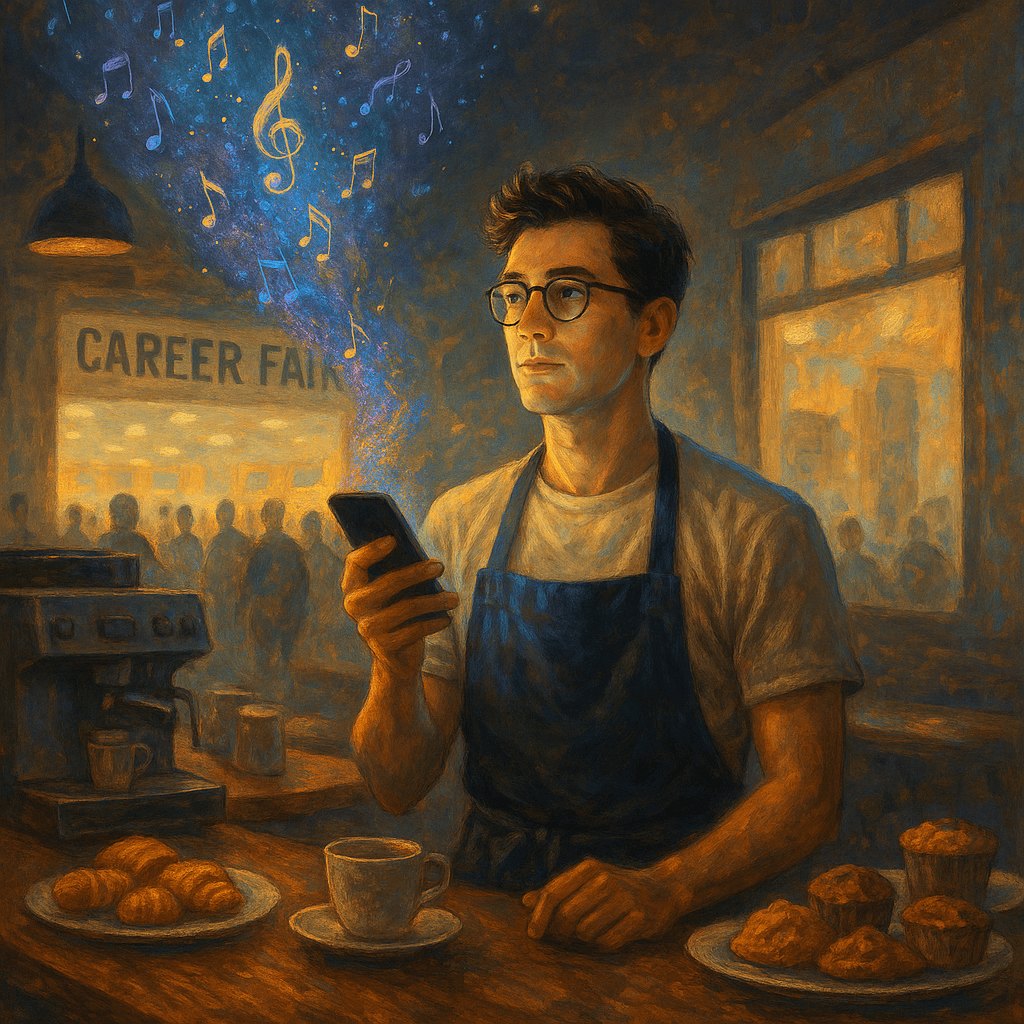
    I dreamed I was working in a café—one of those indie joints that sells artisanal pastries dusted with powdered irony—while slogging through my Master’s in English. Picture a barista apron slung over a grad student’s existential dread.

    I carried a phone that wasn’t just smart—it was sorcerous. With one tap, it summoned a stream of music from a satellite orbiting somewhere above Earth’s pettiness. This music wasn’t Spotify-tier. It was celestial—otherworldly symphonies that made Bach sound like background noise at a carwash. The entire café basked in it, as if rapture had been accidentally triggered over the scones.

    Then he appeared. A mysterious man—part career counselor, part trickster god—told me that if I attended a career convention, I could buy a van for my family. Not just any van. A magical, dream-fulfilling van priced at $400, which in dream economics is about the cost of a single textbook in grad school.

    The convention was a riot of lanyards and desperation. Voices swirled about the final class I needed to finish my degree: the dreaded seminar with Professor Boyd, a real professor from my waking life, whose lectures felt like intellectual CrossFit and whose office smelled faintly of despair and dry-erase markers.

    I never found the van man.

    The dream logic began to wobble. Doubt crept in like a late fee. I wandered through the convention’s gray carpeted purgatory and began rehearsing how I’d tell my family we would remain vanless, bound to our modest, immobile fate.

    And then—like a plot twist penned by a sentimental sportswriter—I ran into two Hawaiian brothers I hadn’t seen since Little League. We were kids once. They were legends. One of them, Wesley, struck me out four times in a single game, and I still remembered the way the ball moved like it had free will. Decades later, we were all adrift—middle-aged, mildly broke, and marvelously unsure of ourselves.

    We stood there, in that convention center of failed ambitions and discounted dreams, and talked about what we could’ve been. I told them they had enough charisma to turn their names into brands. I hugged Wesley and said, “You struck me out four times, and it’s a privilege to see you again.”

    None of us had a career. But we had memories. And love. And the unspeakable beauty of a satellite song that once played over cinnamon rolls.

  • Kafka Called—He Wants His Nightmare Back

    Kafka Called—He Wants His Nightmare Back

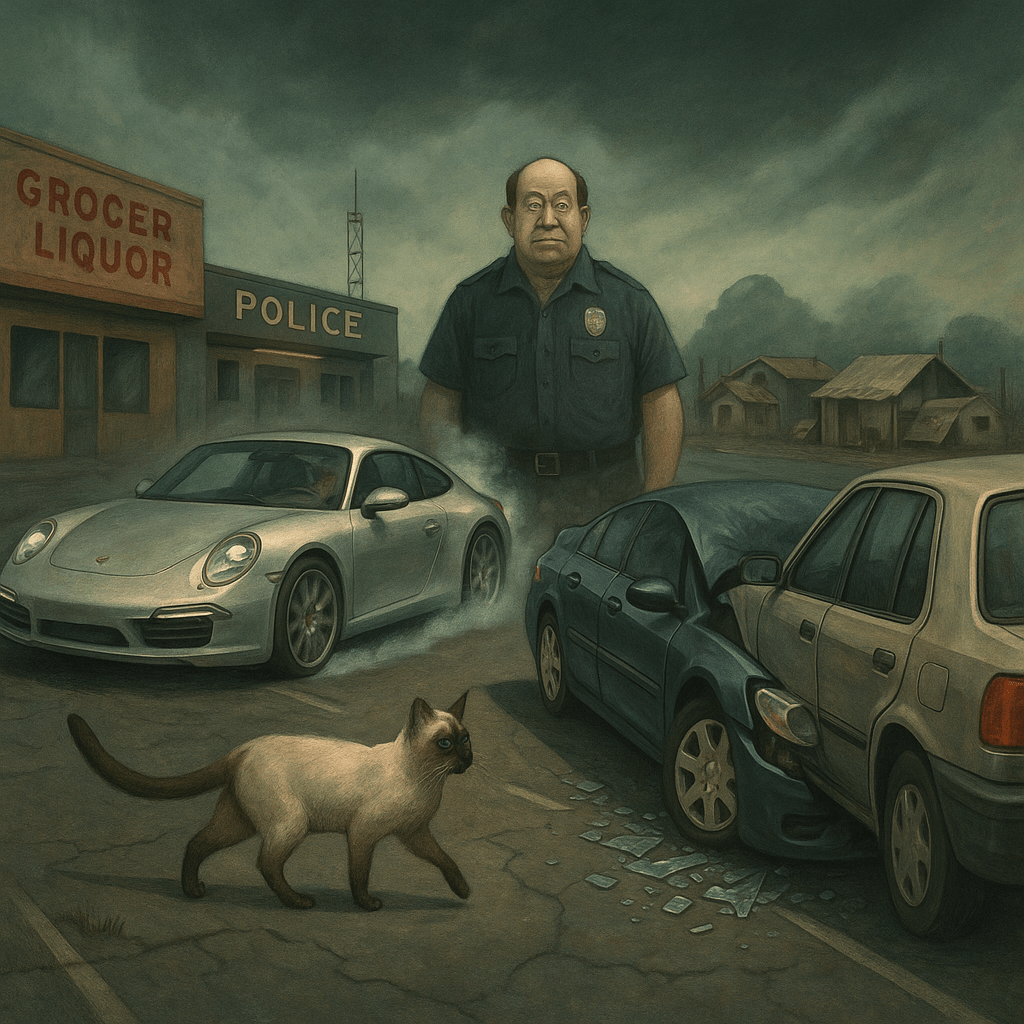
    Last night’s dream was less REM sleep and more bureaucratic farce with automotive stunt work. It started with me sprinting into a liquor store—not for booze, but for groceries, because apparently, in dream logic, milk and bananas are shelved next to Jack Daniels and scratchers. The plaza was wedged next to a police station, and as I pulled into the lot, I grazed another car. Minor fender-bender. Did I report it? Of course not. I had perishables. Yogurt waits for no man.

    Soon after, the cops called. Apparently, they frown upon drive-away accidents, even ones that involve $3.99 rotisserie chickens. Dutifully, I set off for the station, where fate promptly mocked me.

    As I crossed the street, a silver Porsche came screaming down the road like it was late for a yacht meeting. Behind the wheel was a rich guy with the glossy detachment of a man who names his houseplants after Nietzsche quotes. He swerved to avoid hitting a stray Siamese cat—an act of mercy that nearly murdered me. I dodged, lost control, and promptly rear-ended a parked car. Yes: I got in a car crash on my way to report a previous car crash.

    Inside the station, things went from absurd to surreal. The desk captain was none other than Todd, a former San Quentin prison guard I used to train with back in the ‘70s. Todd had the physique of a worn punching bag and the unmistakable face of Larry from The Three Stooges—if Larry had done time in corrections and smoked Kools for thirty years.

    Todd was unimpressed with my double-crash disclosure. He squinted at me like I was a damaged clipboard and muttered something like, “You ever thought of Canada?”

    Canada, in this dreamscape, was not a country but a penal colony for the mildly broken. A rehab center for the emotionally overdrawn. It wasn’t maple leaves and healthcare—it was despair with a windchill. The entire nation had collapsed into an encampment of defunct influencers and men who thought podcasts were a substitute for therapy. No plumbing, no cash, just bartering and tents. People traded AA batteries and protein bars like it was the yard at Pelican Bay.

    A man named Damon—he was 34, depressed, and once had a viral TikTok about the deep state—gave me the grand tour of my future. He pointed to the shell of a trailer I’d be assigned, complete with a tarp roof and a milk crate toilet. “It’s provisional,” he said, as if permanence were even an option.

    I immediately regretted migrating to Dream-Canada. I wanted to go back to the police station, fix the record, beg forgiveness, and reclaim my life of yogurt-based negligence. But that’s where the dream froze.

    I woke up to the smell of coffee. My wife was getting ready for work. Civilization, still intact—for now.

  • College Essay Prompt That Addresses Food and Economic Class: Ozempification, AI, and the Class Divide in the End of Food Culture

    College Essay Prompt That Addresses Food and Economic Class: Ozempification, AI, and the Class Divide in the End of Food Culture

    Prompt Overview:
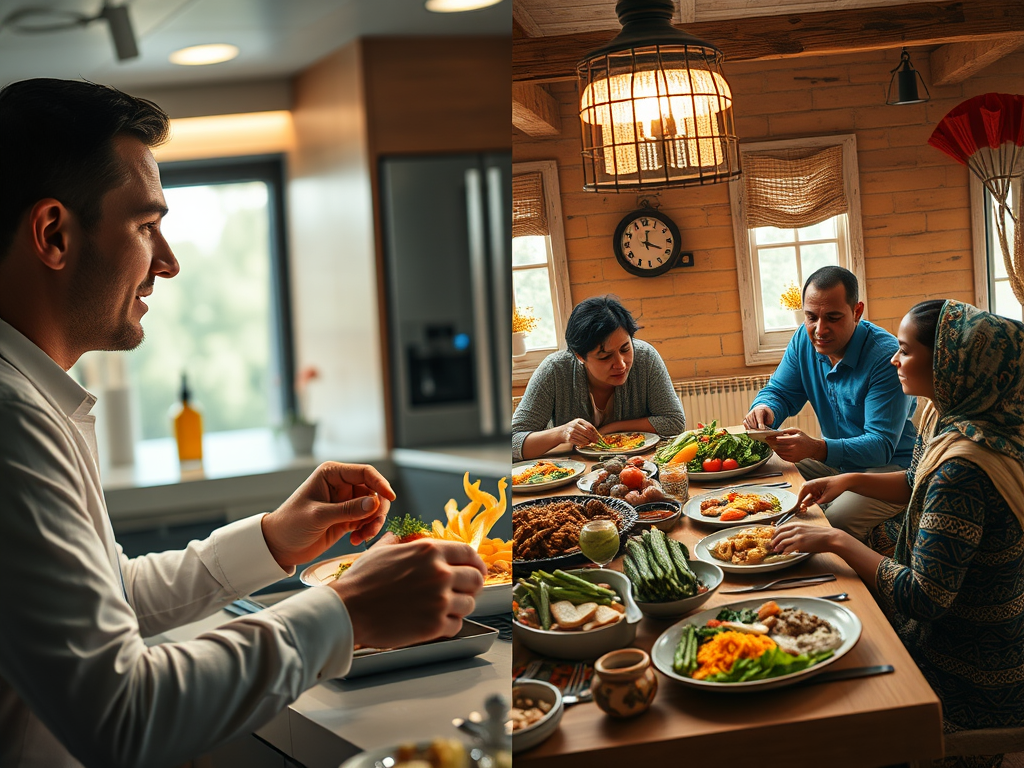
    As GLP-1 drugs like Ozempic suppress hunger and artificial intelligence tailors hyper-personalized, nutrient-optimized meals, our relationship with food is undergoing a radical transformation. But not all communities are experiencing this shift equally. While affluent professionals embrace biotech and AI to streamline their eating, working-class and immigrant communities often continue to practice food as culture, tradition, and emotional ritual.

    Your Task:
    Write an 8-paragraph argumentative essay that responds to the following claim:

    Claim:
    GLP-1 drugs and artificial intelligence are ending the traditional notion of food and eating as cultural, emotional, and communal experiences—but primarily for the educated upper-middle class, creating a new kind of class-based food divide.

    Instructions:

    1. Introduction (Paragraph 1):
      Open with a compelling hook. Present the claim and your thesis—whether you agree, disagree, or take a nuanced stance.
    2. Background (Paragraph 2):
      Briefly explain what GLP-1 drugs do and how AI is influencing food production and personalization. Introduce the concept of “Ozempification.”
    3. First Argument (Paragraph 3):
      Argue how the professional-managerial class is disproportionately embracing GLP-1 and AI technologies as part of a broader trend toward self-optimization.
    4. Second Argument (Paragraph 4):
      Show how this new model of eating—quantified, detached, and efficient—erodes traditional food practices like communal meals, emotional eating, or ritual cooking.
    5. Third Argument (Paragraph 5):
      Examine the contrasting experience of working-class and immigrant communities who, whether by choice or necessity, retain deeper connections to cultural food practices.
    6. Counterargument and Rebuttal (Paragraph 6):
      Acknowledge the argument that biotech and AI could democratize health and nutrition. Then challenge this by exploring accessibility, affordability, or cultural loss.
    7. Cultural Reflection (Paragraph 7):
      Reflect on the long-term cultural implications of this class-based divide. Will we see a future where the elite biohack their appetites while the working class clings to endangered food rituals?
    8. Conclusion (Paragraph 8):
      Reassert your thesis and end with a provocative insight, question, or forecast about the future of food and class.

    Source Requirement:
    Use at least 4 credible sources, including recent journalism, scholarly articles, or reports (2023 or later). Cite sources in MLA format.

    Suggested Angles to Explore:

    • How does Silicon Valley’s culture of optimization affect food rituals?
    • Is “Ozempification” a privilege or a necessity?
    • What happens when food stops being a shared story and becomes a solo algorithm?

    Here is a curated reading list for your revised prompt on Ozempification, AI, and the Class Divide in the End of Food Culture. These selections balance journalism, research, and cultural commentary, providing accessible and provocative sources for students at various reading levels:


    READING LIST

    1. Ozempic and GLP-1 Drugs

    • “Scientists Find Why Ozempic Changes the Types of Food People Eat”
      Prevention Magazine, 2024
      Explains how GLP-1 drugs alter appetite and food preferences.

    • “Ozempic’s Effect on Food Innovation”
      Institute of Food Technologists (IFT), May 2024
      Discusses how food manufacturers are shifting products in response to Ozempic-driven consumer changes.

    2. AI and the Personalization of Food

    • “AI-Driven Transformation in Food Manufacturing”
      Frontiers in Nutrition, 2025
      An in-depth research article on AI’s impact on food production, sustainability, and consumer targeting.
      PDF Download
    • “AI Is Hacking Your Hunger: How the Food Industry Engineers Addiction”
      Forbes, March 2025, by Jason Snyder
      A bold look at how AI and biotech are reprogramming consumer desire and food experience.

    3. Food, Class, and Culture

    • “The Labor of Lunch: Why We Need Real Food and Real Jobs in American Public Schools”
      By Jennifer E. Gaddis, University of California Press, 2019
      Offers a clear view of how food, labor, and class intersect in institutional settings like schools.
    • “Cultural Appropriation in Food: Is It a Problem?”
      The New York Times, by Ligaya Mishan
      Reflects on food, culture, and who gets to profit from culinary traditions—good for contrast with bioengineered food trends.
    • “You Can’t Eat Optimized Food with Your Grandma”
      The Atlantic, speculative title suggestion (hypothetical essay you might write or assign students to mimic stylistically)
      Encourages reflection on the emotional and generational disconnect caused by hyper-personalized, tech-driven diets.
  • College Essay Prompt: Ozempification, AI, and the End of Food Culture?

    College Essay Prompt: Ozempification, AI, and the End of Food Culture?

    Prompt Overview:
    In recent years, the rise of GLP-1 drugs like Ozempic and Wegovy has begun to reshape our relationship with hunger, desire, and food itself. Meanwhile, artificial intelligence is transforming how food is produced, marketed, and even chosen—sometimes without human involvement. This convergence may signal the end of eating as a social, cultural, and emotional act.

    Your Task:
    Write an 8-paragraph argumentative essay that responds to the following claim:

    Claim:
    GLP-1 drugs and artificial intelligence are ending the traditional notion of food and eating as cultural, emotional, and communal experiences.

    Instructions:

    1. Introduction (Paragraph 1):
      Hook the reader with a striking observation or anecdote. Clearly present the claim and your thesis—whether you agree, disagree, or hold a nuanced position.
    2. Background (Paragraph 2):
      Briefly explain what GLP-1 drugs (e.g., Ozempic) do and how AI is being used in food production and personalization.
    3. First Argument (Paragraph 3):
      Make your first point in support of or against the claim. Use evidence from a reliable source.
    4. Second Argument (Paragraph 4):
      Develop a second point. This might include shifts in consumer behavior, changing food rituals, or the erosion of cultural traditions.
    5. Third Argument (Paragraph 5):
      Add a third supporting point that deepens your position. Consider long-term consequences or ethical implications.
    6. Counterargument and Rebuttal (Paragraph 6):
      Acknowledge a reasonable opposing view—perhaps that AI and GLP-1 drugs offer needed solutions to health crises—and then refute it using logic and evidence.
    7. Cultural Reflection (Paragraph 7):
      Reflect on what is at stake culturally. What do we lose if food is reduced to a biometric algorithm?
    8. Conclusion (Paragraph 8):
      Return to your thesis and end with a memorable insight or call to action.

    Source Requirement:
    Use at least 4 credible sources. At least two should come from recent journalism or peer-reviewed studies (2023 or later). Sources must be cited in MLA format.

    Optional Angles to Explore:

    • How do GLP-1 drugs rewire human appetite?
    • Will AI-generated food disconnect us from culinary heritage?
    • Can technological efficiency coexist with food as a ritual or joy?
  • The Driveway Diaries: A Confession from the Curb

    The Driveway Diaries: A Confession from the Curb

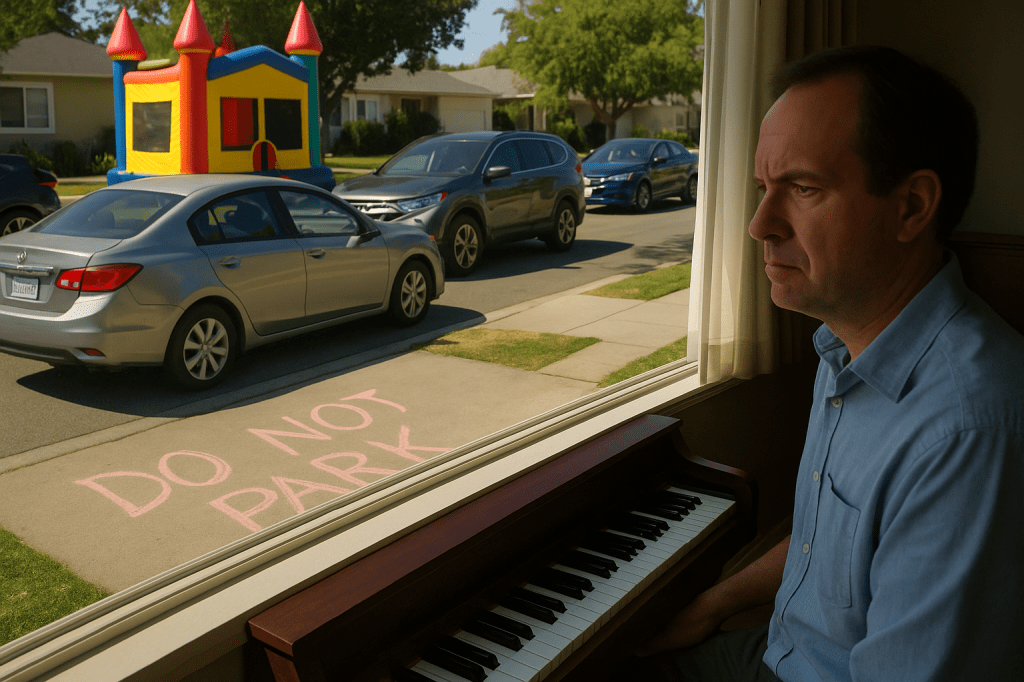
    I live in Southern California’s golden triangle of suburban prestige: safe streets, sky-high property values, and public schools so highly rated they practically demand tuition. But on weekends and holidays, my block transforms into a theme park of inflatable bounce castles, fold-out chairs, and off-brand DJ booths—all courtesy of neighboring homeowners hosting backyard fiestas for their tiny heirs.

    With festivity comes the scourge: street congestion. Cars squeeze themselves into curbside crevices like sardines in a midlife crisis. They stack and cram and sidle up so tight to my house you’d think we were giving away parking validation and carne asada.

    Every so often, a guest parks with their bumper edging an inch—an inch—into the edge of my newly repaved driveway. A driveway I paid for myself because city bureaucracy shrugged and pointed to tree roots like they were an Act of God. That innocent slab of concrete cost me $5,500. Every time a Honda Pilot sniffs it without permission, I feel like I’m watching someone use my toothbrush.

    Still, I try to be Zen. I tell myself: “People want to be here. This isn’t intrusion. It’s affirmation. I am so blessed to live in a place so desirable, others will risk a petty homeowner’s wrath just to brush against my apron.”

    Then there’s the nightly ritual across the street. My neighbors, bless them, have adopted my driveway as part of their sacred reverse-entry protocol. They swing into my drive like a fighter pilot locking onto a carrier, headlights blazing through my living room window while I’m watching a true crime doc with my wife. Then they shift into reverse and back into their own driveway like they’re starring in a Ford commercial for backing-in bravado.

    Again, I resist the pettiness. I whisper: “What an honor to share my $5,500 slab of artisanal pavement. The city may have abandoned me, but I haven’t abandoned my commitment to grace.”

    But some nights, I spiral. I see my empty driveway (because my Honda is parked dutifully inside the garage like a respectable introvert) and I grow suspicious. “They’re circling,” I think. “Someone’s going to claim this space. They’re going to park smack in the middle of my private driveway, right under the basketball hoop I haven’t used since 2008.”

    In my darkest moments, I fantasize about war. “Let them try it,” I growl internally. “I’ll tow them. I’ll call the police. I’ll lawyer up. I’ll blog about it to my three dozen loyal followers and publicly shame their license plate into eternity.”

    And just when I think I’ve shaken off my paranoia, the sirens come. Always the sirens. I live wedged between two hospitals, so I’m serenaded hourly by ambulance howls and the Doppler wail of emergency response. It’s like being reminded every ten minutes that death is always trending.

    The crowded streets don’t help. It’s not just congestion—it’s existential compression. The world is full. There’s no more room. Civilization is a Jenga tower one move away from collapse.

    And still, I try to be kind. I try to be sane. “I’m not petty,” I tell myself. “I’m not paranoid. I’m just emotionally literate.”

    So I do what I’ve always done: I go to the piano. I sit and play one of the hundreds of songs I’ve written since I was sixteen. The music softens the beast. It wraps my dread in a velvet ribbon of minor chords. Unfortunately, all my songs sound vaguely identical—like clones from the same melancholy womb. But I take what I can get.

    If twenty minutes of recycled piano sadness gives me peace in the suburbs, then I’ll sit at that bench and bleed quietly into the keys. No apologies.

  • College Essay Prompt: Beyond Authentic: How Evolving Cuisines Tell Stories of Survival, Adaptation, and Identity

    College Essay Prompt: Beyond Authentic: How Evolving Cuisines Tell Stories of Survival, Adaptation, and Identity

    Overview:

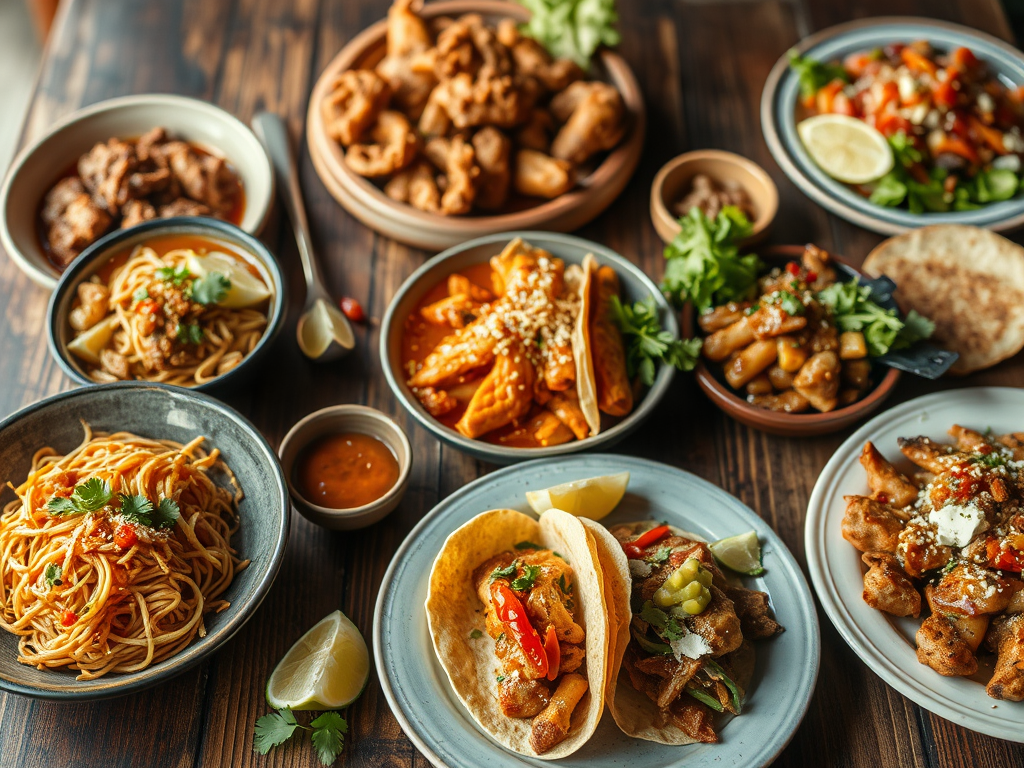
    Write a 1,700-word argumentative essay examining whether dishes like birria ramen, orange chicken, Korean tacos, or Tex-Mex fajitas should be dismissed as inauthentic or embraced as culturally rich, adaptive expressions of immigrant creativity. Using the evolution of Mexican and Chinese food in the U.S. as your focus, evaluate how culinary “impurity” may reflect resilience more than betrayal.

    This assignment challenges the simplistic binary of cultural appropriation vs. cultural preservation by exploring how food evolves through migration, racism, class, capitalism, and the human need to survive—and thrive.


    Central Claim to Defend, Refute, or Complicate:

    Criticizing American Chinese and modern Mexican cuisine as “inauthentic” oversimplifies the historical, cultural, and economic forces that drive culinary evolution.


    Required Sources (Use at least 4, MLA format):

    • Gustavo Arellano – “Let White People Appropriate Mexican Food”
    • The Search for General Tso (dir. Ian Cheney, 2014)
    • Charles W. Hayford – “Who’s Afraid of Chop Suey?”
    • Cathy Erway – “More Than ‘Just Takeout’”
    • Kelley Kwok – “‘Not Real Chinese’: Why American Chinese Food Deserves Our Respect”
    • Jiayang Fan – “Searching for America with General Tso”

    Focus Questions to Consider:

    • What is gained or lost when immigrant cuisines adapt to mainstream tastes?
    • How have Mexican and Chinese-American dishes reflected creative survival strategies in the face of xenophobia or marginalization?
    • Is culinary “authenticity” a meaningful cultural value or an exclusionary myth?
    • How do evolving cuisines challenge stereotypes and redefine American identity?
    • Should food be judged by origin or by impact?

    Essay Requirements:

    • Length: 1,700 words
    • Format: MLA (12 pt font, double-spaced, Times New Roman)
    • Sources: At least 4 from the required list
    • Tone: Academic and analytical, but open to personal insight or cultural experience
    • Structure: Use the suggested outline below or build your own coherent structure

    Suggested Structure:

    Intro (200–300 words):

    • Open with the “authenticity” debate in food culture
    • Present the evolution of Mexican and Chinese cuisine as a case study
    • Clearly state your thesis: whether you defend, challenge, or complicate the rejection of “inauthentic” foods

    Section 1: Culinary Evolution as Cultural Power (400–500 words)

    • Use Arellano’s “adaptability” argument and The Search for General Tso
    • Explore how adaptation expands—not erases—culinary traditions

    Section 2: Food as a Tool of Survival (400–500 words)

    • Use Jiayang Fan and Cathy Erway to show how these cuisines offered paths to economic mobility and belonging
    • Address how racism shaped what was “acceptable” for the mainstream palate

    Section 3: Rethinking Authenticity (400–500 words)

    • Use Kelley Kwok and Hayford to interrogate what we even mean by “authentic”
    • Acknowledge that tradition matters—but argue that hybridity is the tradition of diaspora

    Section 4: Counterargument & Rebuttal (300–400 words)

    • Address critics who claim fusion or Americanized food dilutes culture
    • Rebut: show how adaptation often preserves a culture’s essence in new form

    Conclusion (200–300 words)

    • Reaffirm your thesis: evolving cuisine reflects the ingenuity, creativity, and endurance of immigrant communities
    • Reflect on how accepting culinary adaptation challenges us to redefine American identity itself

    Final Notes to Students:

    This essay isn’t just about food—it’s about the stories food tells. Let your argument reflect that complexity. Engage deeply with your sources, and don’t be afraid to explore tensions: pride vs. commodification, tradition vs. survival, innovation vs. erasure.