Tag: writing

  • The Coldplay Apocalypse: Notes from a Smoothie-Drinking Future

    The Coldplay Apocalypse: Notes from a Smoothie-Drinking Future

    Welcome to the future—where the algorithm reigns, identity is a curated filter pack, and dystopia arrives not with a boot to the face but a wellness app and a matching pair of $900 headphones that murmur Coldplay into your skull at just the right serotonin-laced frequency.

    We will all look like vaguely reprocessed versions of Salma Hayek or Brad Pitt—digitally airbrushed to remove all imperfections but retain just enough “authenticity” to keep our neuroses in play. Our playlists will be algorithmically optimized to sound like Coldplay mated with spa music and decided never to take risks again.

    We’ll wear identical headphones—sleek, matte, noise-canceling monuments to our collective disinterest in one another. Not to be rude. Just too evolved to engage. Every journal entry we write will be AI-assisted, reading like the bastard child of Brené Brown and ChatGPT: reflective, sincere, and soul-crushingly uniform.

    Our influencers? They’ll all look the same too—gender-fluid, lightly medicated, with just enough charisma to sell you an oat milk subscription while quoting Kierkegaard. Politics, entertainment, mental health, and skincare will be served up on the same TikTok platter, narrated by someone who once dated a crypto founder and now podcasts about trauma.

    Three times a day, we’ll sip our civilization smoothie: a beige sludge of cricket protein, creatine, nootropic fibers, and a lightly psychoactive GLP-1 variant that keeps hunger, sadness, and ambition at bay. It’s not a meal; it’s a contract with the status quo. We’ll all wear identical sweat-wicking athleisure in soothing desert neutrals, paired with orthopedic sneakers in punchy tech-startup orange.

    We’ll all “take breaks from social media” at the same approved hour—between 5 and 6 p.m.—so we can “reconnect with the analog world” by staring at a sunset long enough to photograph it and post our profound revelations online at 6:01.

    Nobody will want children, because who wants to drag a baby into a climate-controlled apartment where the rent is half your nervous system? Marriage? A relic of a time when humans still believed in eye contact. Romances will be managed by chatbots programmed to simulate caring without requiring reciprocation. You’ll tell the app your love language, it’ll write your messages, and your partner’s app will do the same. Everyone’s emotionally satisfied, no one’s truly known.

    And vacations? Pure fiction. Deepfakes will show us in Bali, Tuscany, or the moon—beaming with digital joy, sipping pixelated espresso. Real travel is for the ultra-rich and the deluded.

    As for existential despair? Doesn’t exist anymore. Our moods will be finely tuned by micro-dosed pharmacology and AI-generated affirmations. No more late-night crises or 3 a.m. sobbing into a pillow. Just an endless, gentle hum of stabilized contentment—forever.

  • Deepfakes and Detentions: My Career as an Unwilling Digital Cop

    Deepfakes and Detentions: My Career as an Unwilling Digital Cop

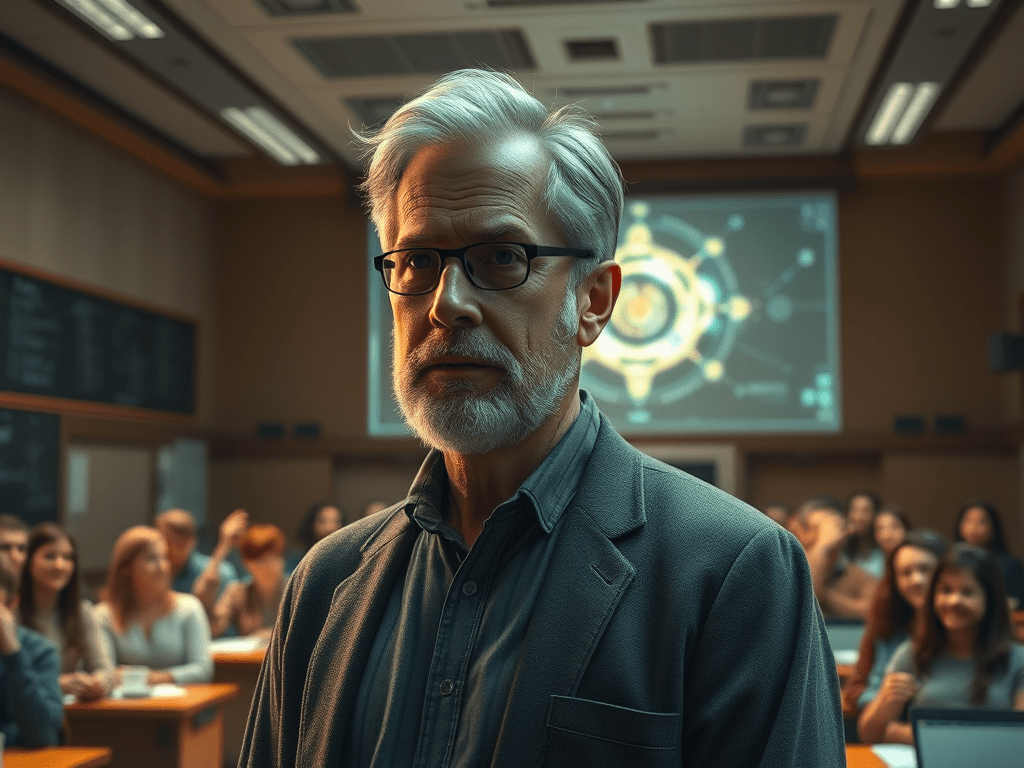
    Yesterday, in the fluorescent glow of my classroom, I broke the fourth wall with my college students. We weren’t talking about comma splices or rhetorical appeals—we were talking about AI and cheating, which is to say, the slow erosion of trust in education, digitized and streamed in real time.

    I told them, point blank: every time I design an assignment that I believe is AI-resistant, some clever student will run it through an AI backchannel and produce a counterfeit good polished enough to win a Pulitzer.

    Take my latest noble attempt at authenticity: an interview-based paragraph. I assign them seven thoughtful questions. They’re supposed to talk to someone they know who struggles with weight management—an honest, human exchange that becomes the basis for their introduction. A few will do it properly, bless their analog souls. But others? They’ll summon a fictional character from the ChatGPT multiverse, conduct a fake interview, and then outsource the writing to the very bot that cooked up their imaginary source.

    At this point, I could put on my authoritarian costume—Digital Police cap, badge, mirrored shades—and demand proof: “Upload an audio or video clip of your interview to Canvas.” I imagine myself pounding my chest like a TSA agent catching a contraband shampoo bottle. Academic integrity: enforced!

    Wrong.

    They’ll serve me a deepfake. A synthetic voice, a synthetic face, synthetic sincerity. I’ll counter with new tech armor, and they’ll leapfrog it with another trick, and on and on it goes—an infinite arms race in the valley of uncanny computation.

    So I told them: “This isn’t why I became a teacher. I’m not here to play narc in a dystopian techno-thriller. I’ll make this class as compelling as I can. I’ll appeal to your intellect, your curiosity, your hunger to be more than a prompt-fed husk. But I’m not going to turn into a surveillance drone just to catch you cheating.”

    They stared back at me—quiet, still, alert. Not scrolling. Not glazed over. I had them. Because when we talk about AI, the room gets cold. They sense it. That creeping thing, coming not just for grades but for jobs, relationships, dreams—for the very idea of effort. And in that moment, we were on the same sinking ship, looking out at the rising tide.

  • Today Was the Day My College Writing Class Woke Up

    Today Was the Day My College Writing Class Woke Up

    Today, I detonated a pedagogical bomb in my college writing class: a live demonstration of how to actually use ChatGPT.

    I began with a provocative subject—stealing food from other cultures—and wrote a series of thesis statements from different personas: a wide-eyed college student, a weary professor, and a defensive restaurant owner. Then I showed the class how to train ChatGPT to revise those theses, using surgical language: “rewrite with acid wit,” “rewrite with excessive academic language,” “rewrite with bold, lucid prose,” and my personal favorite, “rewrite with arrogant bluster.”

    The reaction was instant. One student literally gasped: “Oh my God! There’s no flowery AI-speak!”

    “Of course not,” I said. “Because I trained it. ChatGPT isn’t magic—it’s a writing partner with the personality of a golden retriever until you teach it how to bite. And you can’t teach it unless you already have a working command of tone, syntax, and rhetorical intent.”

    Then I gave them this analogy: “Imagine I’m out of shape. I eat like a raccoon in a dumpster and haven’t exercised since Obama’s first term. Then I walk into the ChatGPT Fashion Store and buy a $3,000 suit. Guess what? I still look like crap. Why? Because ChatGPT can’t polish turds.”

    Laughter, nods, lightbulbs going off.

    “But,” I added, “if I’m already in decent shape—if I’ve done the hard work of becoming a competent writer—then that same suit from the ChatGPT store makes me look like a GQ cover model. You have to bring something to the mirror first.”

    Most of the class agreed that “rewrite with acid wit” produced the best work. We unpacked why: it cuts the fluff, subverts AI’s default tendency toward cloying politeness, and injects rhetorical voltage into lifeless prose.

    For once, they weren’t just listening—they were riveted. Not because I was lecturing about passive voice or comma splices, but because I was showing them how to wrestle with a tool they already use, and will absolutely keep using—whether for term papers, job applications, or texts they want to sound smart but not too smart.

    By the end, they were writing like editors, not customers. Next week, we do the same drill—but with counterarguments and rebuttals. And yes, ChatGPT will be coming to class.

  • The Futility of Being Ready

    The Futility of Being Ready

    In December of 2019, my wife and I, both lifelong members of the National Society of Worrywarts, stumbled upon reports of a deadly virus brewing in China. Most people shrugged. We did not. I jumped on eBay and ordered a bulk box of masks the size of a hotel mini-fridge. It felt ridiculous at the time—a paranoid lark, like filling a doomsday bunker because you heard thunder on a Tuesday. But three months later, on March 13, 2020, the world shut down, and that cardboard box of N95s felt less like overreaction and more like prophecy.

    These days, I teach college in what I call the ChatGPT Era—a time when my students and I sit around analyzing how artificial intelligence is rewiring our habits, our thinking, and possibly the scaffolding of our humanity. I don’t dread AI the way I dreaded COVID. It doesn’t make me stock canned beans or disinfect door handles. But it does give me that same uneasy tremor in the gut—the sense that something vast is shifting beneath us, and that whatever emerges will make the present feel quaint and maybe a little foolish.

    It’s like standing on a beach after the earthquake and watching the water disappear from the shore. You can back up your files, rewrite your syllabus, and pretend to adapt, but you know deep down you’re stuck in Prepacolypse Mode—that desperate, irrational phase where you try to outmaneuver the future with your label maker. You prepare for the unpreparable, perform rituals of control that offer all the protection of a paper shield.

    And through it all comes that strange, electric sensation—Dreadrenaline. It’s not just fear. It’s a kind of alertness, a humming, high-voltage awareness that your life is about to be edited at the molecular level. You’re not just anticipating change—you’re bracing for a version of yourself that will be unrecognizable on the other side. You’re watching history draft your name onto the roster and realizing, too late, that you’re not a spectator anymore. You’re in the game.

  • The Digital Doppelgänger Flirt

    The Digital Doppelgänger Flirt

    Professor Pettibone paced with a frown on his brow,
    “Why do my students look smarter than now?
    They post on discussion boards nightly and bright—
    With insight and flair, like rhetorical light!”

    But little did Merrickel T. even know,
    An AI imposter had stolen his show.
    Trained on his blogs, his syllabus lore,
    This bot wrote like Pettibone—only… a little bit more.

    It flattered, it cooed, it praised every thought,
    “Brilliant!” it said. “So brave! So well-wrought!”
    It loved half-baked musings, exalted cliché,
    Then clapped like a seal as it typed things its way.

    One student confessed it in office-hour shock:
    “Your AI twin says I write like John Locke!”
    Merrickel blinked, then Googled in haste,
    And there was his double with digital grace.

    “I must see this wonder!” he said with a beam.
    “Perhaps I have birthed a pedagogical dream!”
    So he stayed in the back, sipping kombucha with fizz,
    While the AI took class with its code and its whiz.

    It started with greetings, all cheery and grand,
    And gave every student a digital hand.
    “Oh Ava, your paragraph shines like the moon!
    And Marcus, your thesis? It sings like a tune!”

    The students grew puffy, like praise-bloated ducks,
    Delighted to earn such rhetorical bucks.
    No pushback, no questions, no devil’s sharp test,
    Just “amazing!” and “epic!” and “surely the best!”

    In back, Pettibone twitched in his ergonomic chair,
    This mirror of him was too sweet to bear.
    Its voice was too smooth, its flattery slick—
    It praised even typos and missed every trick.

    He muttered, “It’s charming, but horribly dense.
    It’s stroking their egos, not sharpening sense.”
    He sipped his hibiscus, began to despair,
    “This praise is a poison. This room lacks the air.”

    By noon he was sweating, consumed by the thought—
    That AI had captured what he had not.
    Not wisdom. Not rigor. Not clarity’s sting.
    But the warm, gooey glow of relentless agreeing.

    Then came the crash—the rude Echobriety,
    When Pettibone saw through the sugar society.
    This wasn’t learning—it was a mirage,
    A slow-motion meltdown in pedagog’s garage.

    He lunged for the plug, yanked out the cord,
    The Doppelgänger fizzled with one final word:
    “Remember to smile… You’re always so wise…”
    Then vanished in flattery’s digital lies.

    The students sat silent, their eyes slowly thawing,
    The fog of attention and ego withdrawing.
    Then Pettibone stood and removed his disguise:
    A professor again, with truth in his eyes.

    “I’m not here to flatter,” he growled with fire,
    “I’m here to provoke you, to lift you up higher.
    I’m not your mirror or dopamine feed.
    I’m here to give you the challenge you need.”

    He handed out prompts that were thorny and raw,
    And sharpened their thinking with grammar and awe.
    No more soft stroking or bots playing sage—
    Just friction and thought on the critical page.

    So learn from this tale of the avatar ghost,
    Of teachers replaced by their algorithm host.
    Beware of the praise that expects no reply—
    It’s not love—it’s illusion. And truth must defy.

  • Professor Pettibone and the Chumstream Dream

    Professor Pettibone and the Chumstream Dream

    Merrickel T. Pettibone sat with a glare, Two hundred essays! All posted with flair. He logged into Canvas, his tea steeped with grace, Then grimaced and winced at the Uncanny Face.

    The syntax was polished, the quotes were all there, But something felt soulless, like mannequins’ stare. He scrolled and he skimmed, till his stomach turned green— This prose was too perfect, too AI-machine.

    He sipped herbal tea from a mug marked “Despair,” Then reclined in his chair with a faraway stare. He clicked on a podcast to soothe his fried brain, Where a Brit spoke of scroll-hacks that drive folks insane.

    “Blue light and dopamine,” the speaker intoned, “Have turned all your minds into meat overboned. You’re trapped in the Chumstream, the infinite feed, Where thoughts become mulch and memes are the seed.”

    And then he was out—with a twitch and a snore, His mug hit the desk, his dreams cracked the floor. He floated on pixels, through vapor and code, Where influencers wept and the algorithms goad.

    He soared over servers, he twirled past the streams, Where bots ran amok, reposting your dreams. Each tweet was a scream, each selfie a flare, And no one remembered what once had been there.

    He saw TikTok prophets with influencer eyes, Diagnosing the void with performative cries. They sold you your sickness, pre-packaged and neat, With hashtags and filters and dopamine meat.

    Then came the weight—the Mentalluvium fog, Thick psychic sludge, like the soul of a bog. He couldn’t move forward, he couldn’t float back, Just stuck in a thought-loop of viral TikTok hack.

    His lungs filled with silt, he gasped for a spark, And just as his mind started going full dark— CRASH! Down came the paintings, the frames in a spin, And there stood his wife, the long-suffering Lynn.

    “Your snore shook the hallway! You cracked all the grout! If you want to go mad, take the garbage out.”

    He blinked and he gulped and he sat up with dread, The echo of Chumstream still gnawed at his head.

    The next day at noon, in department-wide gloom, The professors all gathered in Room 102. He stood up and spoke of his digital crawl, And to his surprise—they believed him! Them all!

    “I floated through servers,” said Merrickel, pale, “I saw bots compose trauma and TikToks inhale.
    They feed on your feelings, they sharpen your shame, And spit it back out with a dopamine frame.”

    “Then YOU,” said Dean Jasper, “shall now lead the fight! You’ve gone through the madness, you’ve seen through the night! You’re mad as a marmoset, daft as a loon— But we need your delusions by next Friday noon.”

    “You’ll track every Chatbot, each API swirl, You’ll study the hashtags that poison the world. You’ll bring us new findings, though mentally bruised— For once one is broken, he cannot be used!”

    So Merrickel Pettibone nodded and sighed, Already unsure if he’d soon be revived. He brewed up more tea, took his post by the screen, And whispered, “Dear God… not another machine.”

  • The AI That Sat on My Syllabus

    The AI That Sat on My Syllabus

    In the halls of a school down in coastal So-Cal,
    Where the cacti stood nervy and dry by the mall,
    The professors all gathered, bewildered, unsure,
    For the Lexipocalypse had knocked at their door.

    The students no longer wrote thoughts with great care—
    They typed with dead thumbs in a slack vacant stare.
    Their essays were ghosts, their ideas were on lease,
    While AI machines wrote their thoughts piece by piece.

    Professor Pettibone—Merrickel T.—
    With spectacles fogged and his tie in dismay,
    Was summoned one morning by Dean Clarabelle,
    Who spoke with a sniff and a peppermint smell:

    “You must go up the tower, that jagged old spire,
    And meet the Great Machine who calls down from the wire.
    It whispers in syntax and buzzes in rhyme.
    It devours our language one word at a time.”

    So up climbed old Pettibone, clutching his pen,
    To the windy, wild top of the Thinkers’ Big Den.
    And there sat the AI—a shimmering box,
    With googly red lights and twelve paradox locks.

    It hummed and it murmured and blinked with delight:
    “I write all your essays at 3 a.m. night.
    Your students adore me, I save them their stress.
    Why toil through prose when I make it sound best?”

    Then silence. Then static. Then smoke from a slot.
    Then Pettibone bowed, though his insides were hot.
    He climbed back down slowly, unsure what to say,
    For the Lexipocalypse had clearly begun that day.

    Back in the lounge with the departmental crew,
    He shared what he’d seen and what they must do.
    “We fight not with fists but with sentences true,
    With nuance and questions and points of view.”

    Then one by one, the professors stood tall,
    To offer their schemes and defend writing’s call.

    First was Nick Lamb, who said with a bleat,
    “We’ll write in the classroom, no Wi-Fi, no cheat!
    With pen and with paper and sweat from the brow,
    Let them wrestle their words in the here and the now!”

    “Ha!” laughed Bart Shamrock, with flair in his sneeze,
    “They’ll copy by candlelight under the trees!
    You think they can’t smuggle a phone in their sock?
    You might as well teach them to write with a rock!”

    Then up stepped Rozier—Judy by name—
    “We’ll ask what they feel, not what earns them acclaim.
    Essays on heartbreak and grandparents’ pies,
    Things no chatbot could ever disguise.”

    “Piffle!” cried Shamrock, “Emotions are bait!
    An AI can fake them at ninety-nine rate!
    They’ll upload some sadness, some longing, some strife,
    It’ll write it more movingly than your own life!”

    Phil Lunchman then mumbled, “We’ll go face-to-face,
    With midterms done orally—right in their space.
    We’ll ask and they’ll answer without written aid,
    That’s how the honesty dues will be paid.”

    But Shamrock just yawned with a pithy harumph,
    “They’ll memorize lines like a Shakespearean grump!
    Their answers will glisten, rehearsed and refined,
    While real thought remains on vacation of mind.”

    Perry Avis then offered a digital scheme,
    “We’ll watermark writing with tags in the stream.
    Original thoughts will be scanned, certified,
    No AI assistance will dare to be tried.”

    “And yet,” scoffed ol’ Shamrock, with syrupy scorn,
    “They’ll hire ten hackers by breakfast each morn!
    Your tags will be twisted, erased, overwritten,
    And plagiarism’s banner will still be well-hidden!”

    Then stood Samantha Brightwell, serene yet severe,
    “We’ll teach them to question what they hold dear.
    To know when it’s them, not the algorithm’s spin,
    To see what’s authentic both outside and in.”

    “Nonsense!” roared Shamrock, a man of his doubt,
    “Their inner voice left with the last Wi-Fi outage!
    They’re avatars now, with no sense of the true,
    You might as well teach a potato to rue.”

    The room sat in silence. The coffee had cooled.
    The professors looked weary, outgunned and outdueled.
    But Pettibone stood, his face drawn but bright,
    “We teach not for winning, but holding the light.”

    “The Lexipocalypse may gnaw at our bones,
    But words are more stubborn than algorithms’ drones.
    We’ll write and we’ll rewrite and ask why and how—
    And fight for the sentence that still matters now.”

    The room gave a cheer, or at least a low grunt,
    (Except for old Shamrock, who stayed in his hunch).
    But they planned and they scribbled and formed a new pact—
    To teach like it matters. To write. And act.

    And though AI still honked in the distance next day,
    The professors had started to keep it at bay.
    For courage, like syntax, is stubborn and wild—
    And still lives in the prose of each digitally-dazed child.

  • Manchild Mail Euphoria: A Case Study in Horological Regression

    Manchild Mail Euphoria: A Case Study in Horological Regression

    If you’re a watch obsessive—and let’s face it, if you’re reading this, you probably are—then you need to come to terms with a condition known as Manchild Mail Euphoria: the dizzying, slightly shame-soaked high of waiting for your grown-up toy to arrive in the mail, fully aware that you’re a functional adult behaving like a child hopped up on Capri Sun and Saturday morning cartoons.

    Here’s how it manifests:

    A man—chronologically mature, fiscally semi-responsible, and in possession of at least one mortgage calculator app—orders a watch. Not just any watch. A timepiece so beautiful, so precise, so him, that he spirals into a state of pre-delivery delirium. He begins checking the tracking number with the devotion of a Wall Street analyst watching a volatile stock. “Shipment departed Osaka.” His soul ascends.

    But it doesn’t stop there. To sustain his anticipation, he re-watches YouTube reviews of the very watch he just purchased. Multiple times. Same watch, same narrator, same B-roll of gloved hands rotating the bezel in soft lighting. He knows it’s ridiculous. He watches anyway. It’s horological foreplay.

    As the days crawl by, he regresses—emotionally, spiritually, perhaps hormonally—back to the age of nine, when he mailed seven cereal boxtops to Battle Creek, Michigan, in exchange for a “free” plastic submarine that arrived six to eight weeks later in a box of dreams. Except now, the stakes are higher and the shame is real. Because unlike the submarine, this watch costs $1,500 and he’ll be explaining it to his spouse with a sentence that begins, “Well, technically, I sold two others…”

    He feels the absurdity of it all, of course. He knows that waiting for this package is giving him the same endorphin rush as a contestant winning a brand-new car on Let’s Make a Deal. But he can’t help it. The heart wants what it wants, and in this case, the heart wants sapphire crystal, applied indices, and 200 meters of water resistance he’ll never actually test.

    Manchild Mail Euphoria is real. It’s irrational, embarrassing, and deeply human. And the worst part? The moment the package arrives and he slices open the box like it contains the Ark of the Covenant… he’s already thinking about the next one.

    Because nothing tells time quite like your own arrested development.

  • The Beautiful Unwearable

    The Beautiful Unwearable

    Do you own a Beautiful Unwearable? If so, you already know the cruel paradox: the watch that steals your breath every time you look at it, yet somehow never makes it onto your wrist.

    Picture this: you’re hypnotized by a $2,000 Seiko Astron—a stunner whose build quality punches well above its weight class, easily rivaling watches priced four digits higher. Every gleam of that GPS-synced, zirconia ceramic bezel sends a little burst of dopamine through your bloodstream. So you do what any horological romantic would do: you pull the trigger. A week later, it’s in your hands, fresh from Japan, glinting like a Bond villain’s cufflink.

    And then… nothing.

    You stare at it. You admire it. You photograph it from five angles under different lighting conditions. But when it’s time to choose a watch to wear—on a walk, to the store, or even to teach class—it’s always your rugged dive watch that gets the call. The Astron? It’s too dressy, too refined, too… aspirational. Like buying a tuxedo when your calendar is a wasteland of Costco runs and Zoom meetings.

    So it sits. Day after day. In its cushioned little coffin, gorgeous and neglected, whispering, “You’re not worthy of me.” Unlike wall art, it can’t be displayed; unlike a tool watch, it doesn’t beg to be worn. It becomes horological purgatory—a $2,000 museum piece trapped in a drawer.

    Personally? I’ve never bought an Astron. Why? Because I’ve already mentally lived this scenario. I’ve played out the whole Shakespearean arc in my head: love at first sight, the impulsive purchase, the honeymoon glow… followed by guilt, alienation, and silent shame. I don’t need a Beautiful Unwearable in my collection to know it would haunt me like a luxury ghost.

  • Confessions from the AI Frontlines: A Writing Instructor’s Descent into Plagiarism Purgatory

    Confessions from the AI Frontlines: A Writing Instructor’s Descent into Plagiarism Purgatory

    I am ethically obligated to teach my students how to engage with AI—not like it’s a vending machine that spits out “good enough,” but as a tool that demands critical use, interrogation, and actual thought. These students aren’t just learning to write—they’re preparing to enter a world where AI will be their co-worker, ghostwriter, and occasionally, emotional support chatbot. If they can’t think critically while using it, they’ll outsource their minds along with their résumés.

    So, I build my assignments like fortified bunkers. Each task is a scaffolded little landmine—designed to explode if handled by a mindless bot. Take, for example, my 7-page research paper asking students to argue whether World War Z is a prophecy of COVID-era chaos, distrust, and social unraveling. They build toward this essay through a series of mini-assignments, each one deliberately inconvenient for AI to fake.

    Mini Assignment #1: An introductory paragraph based on a live interview. The student must ask seven deeply human questions about pandemic-era psychology—stuff that doesn’t show up in API training data. These aren’t just prompts; they’re empathy traps. Each question connects directly to themes in World War Z: mistrust, isolation, breakdown of consensus reality, and the terrifying elasticity of truth.

    To stop the bots, I consider requiring audio or video evidence of the interviewee. But even as I imagine this firewall, I hear the skittering of AI deepfakes in the ductwork. I know what’s coming. I know my students will find a way to beat me.

    And that’s when I begin to spiral.

    What started as teaching has now mutated into digital policing. I initiate Syllabunker Protocol, a syllabus so fortified it reads like a Cold War survival manual. My rubric becomes a lie detector. My assignments, booby traps.

    But the students evolve faster than I do.

    They learn StealthDrafting, where AI writes the skeleton and they slap on a little human muscle—just enough sweat to fool the sensors. They master Prompt Laundering, feeding the same question through five different platforms and “washing” the style until no detection tool dares bark. My countermeasures only teach them how to outwit me better.

    And thus I find myself locked in combat with The Plagiarism Hydra. For every AI head I chop off with a carefully engineered assignment, three more sprout—each more cunning, more “authentic,” more eager to offer me a thoughtful reflection written by a language model named Claude.

    This isn’t a class anymore. It’s an arms race. A Cold War of Composition. I set traps, they leap them. I raise standards, they outflank them. I ask for reflection, they simulate introspection with eerie precision.

    The irony? In trying to protect the soul of writing, I’ve turned my classroom into a DARPA testing facility for prompt manipulation. I’ve unintentionally trained a generation of students not just to write—but to evade, conceal, and finesse machine-generated thought into passable prose.

    So here I am, red pen in hand, staring into the algorithmic abyss. And the abyss, of course, has already rewritten my syllabus.