Tag: writing

  • Confessions of a Muscled Impostor: How Not Knowing How to Teach Made Me a Better Teacher

    Confessions of a Muscled Impostor: How Not Knowing How to Teach Made Me a Better Teacher

    I was twenty-four, had zero pedagogical training, and was entirely unqualified to teach college writing. That, of course, made me the perfect hire for Merritt College’s emergency “bridge” program at Skyline High School, a gig none of the seasoned professors wanted. My only credential? A shiny new Master’s in English and a well-placed friend whose father was a desperate administrator. If nepotism were an Olympic sport, I’d have taken gold.

    Truthfully, I had no intention of ever teaching. I wanted to be a novelist, famous and feared, spinning tales about neurotics and grotesques while charming the world with my lexical brilliance. But the novels weren’t going anywhere except maybe the recycling bin, and I was making peanuts at a snooty Berkeley wine store, where all of us over-educated slackers pretended we were too brilliant for regular jobs.

    So, guilt-tripped by childhood memories of swimming in my friend’s pool, I took the job.

    Lacking any actual teaching chops, I improvised. I gave long, baroque vocabulary lectures, using Nabokovian polysyllables illustrated by grotesque anecdotes. “Sycophant” became the story of a vomit-covered airline lackey too deferential to wipe himself off. “Serendipitous” was illustrated by a teenager fishing a silver dollar out of a toilet during a disco brawl. “Lugubrious”? Richard Lewis, alone on Thanksgiving, eating turkey in a black armband. The kids loved it. And it ate up class time like a champ.

    When vocab stories weren’t enough, I filled the silence with tales from my bodybuilding days and recycled material from my failed novels. My biceps did the rest. I intimidated my way through teaching—jacking iron before class to maintain a physique that made other instructors mistake me for the wrestling coach. They kept their distance. Good. I didn’t want anyone close enough to realize I had no idea what I was doing.

    I became friends with my students, especially the ones who played basketball with me after school. We’d hoop at Merritt College with my boombox blaring The Cocteau Twins. So much for maintaining professional boundaries.

    We were all poor. I saw them at Laundry Land. We shared shameful nods while “Seasons Change” played on loop from the jukebox. I was no role model. Just a dude schlepping a mesh laundry bag and trying not to spill detergent on his Cocteau Twins T-shirt.

    Collaborative learning was a disaster. No one read the handouts. Group projects devolved into gossip-fests. Points meant nothing. I might as well have been offering them coupons for discounted paper towels.

    Yet, somehow, I kept getting hired. I was the adjunct version of a touring rock band, dragging my briefcases from one campus to another, mixing up lectures, and still receiving praise from students for being “brilliant.” I couldn’t believe it either.

    Eventually, I got a full-time lectureship in California’s Central Valley, where rent was cheap and I could finally trade in my Toyota Tercel for an Acura Integra, as any insecure man-child would. I thought I’d made it. I bought pirate shirts from mail-order catalogs and confused this consumer charade for fulfillment. I was, in short, a highly literate buffoon.

    And then—somewhere in that desert—I learned to shut up and listen.

    I met Kong, a pre-med student who told me how his father, a professor in Cambodia, had saved his life by pushing him on a raft into the river, seconds before being executed by the Khmer Rouge. Kong had survived, emigrated, and was now calmly acing my class while radiating a sense of gratitude and grit I couldn’t fake on my best day.

    I met Evelyn, whose South Korean parents had given up wealth and comfort so she and her sister could study in America. They worked a dry-cleaning job in obscurity so Evelyn could ace her papers in my class, all with grace and humility that made my “me me me” inner monologue shrink in shame.

    Then there was Kim, abandoned by her addict parents and raised in chaos, now a young mother herself. She told me something I’ll never forget: by loving her daughter, she became the mother she never had. I left my office that day, fell to my knees, and asked God to forgive me for being a colossal dumbass.

    These students—these warriors of resilience—taught me what no pedagogy seminar ever could. Teaching wasn’t about syllabi or academic jargon. It was about listening. Really listening.

    So yes, I was an impostor. But I was an impostor who learned. And that, I think, made all the difference.

  • Dumbbells and Demagogues: The Bizarre Battle for the Bros

    Dumbbells and Demagogues: The Bizarre Battle for the Bros

    In “The Battle for the Bros,” Andrew Marantz dons his flak vest and ventures into the testosterone-slicked minefield of online masculinity, where disenfranchised young men are drifting rightward faster than a Joe Rogan cold plunge. Bro culture, Marantz argues, isn’t just real—it’s a booming cottage industry of rage, raw meat, and red pills. It thrives on podcasts, YouTube channels, and Instagram feeds soaked in motivational bile, where carnivore diets, deadlifts, and conspiracy theories all count as self-improvement.

    At the center of this digital flex-off is the Rogan Industrial Complex, which has evolved from left-leaning curiosities like The Young Turks to its current stance of muttering about immigrants while gnawing on elk jerky and praising Vladimir Putin’s virility. Rogan isn’t just an influencer—he’s a cultural battering ram who can probably swing a presidential election with a few bro-ish shrugs and an anecdote about DMT. Meanwhile, the left is left blinking in the dust, coming off to many young men as smug, brittle, and somehow both humorless and condescending—like a human resources memo with a sociology degree.

    Marantz interviews Hasan Piker, a foul-mouthed socialist Twitch-streamer with cheekbones sharp enough to cut through the culture war. Piker wants to offer a leftist alternative to the Bro pipeline, but despite his 1.5 million subscribers, he’s still playing catch-up to Rogan’s podcast empire. Piker gets it: if you tell a broke 23-year-old living in his parents’ basement that he’s “privileged,” don’t be shocked when he rage-clicks his way into the arms of Andrew Tate.

    The tragedy—and farce—of this ecosystem is that much of it runs on ersatz authenticity. Grifters wear the costume of “real talk” while peddling warmed-over xenophobia and junk-science self-help. Marantz muses on whether the left can produce its own no-nonsense avatar of male angst—someone with enough swagger, wit, and working-class rage to compete. Though not mentioned in the essay, Bill Burr came to mind as I pondered a possible counterforce to the bro culture from the right. Burr is pissed off, principled, and perpetually exasperated—a man who could roast Elon Musk and filet toxic masculinity in the same breath. But Burr is sui generis, not a manufactured product. As Marantz rightly notes, you don’t summon authenticity with a PR team and a protein shake.

    The real kicker? In a post-truth world, what matters isn’t truth—it’s vibes. And right now, the right’s vibes are winning the war for the bros.

  • The Effort Mandate: Why Your Milkshake Scene Matters More Than Your Netflix Queue

    The Effort Mandate: Why Your Milkshake Scene Matters More Than Your Netflix Queue

    My students read Cal Newport, who argues—rightly—that happiness has less to do with basking in self-care rituals and more to do with rolling up your sleeves and pursuing a life of relentless, purpose-driven work. Newport, like a modern-day monk with a MacBook, insists that true contentment doesn’t come from “finding your passion” or retiring to some fantasy Airbnb with pizza in one hand and a remote in the other. Instead, happiness is built the old-fashioned way: through grit, sweat, and enough existential gumption to brave the storms of effort.

    Alex Hutchinson, in “The Paradox of Hard Work,” asks why we pursue brutal, bone-crunching tasks when our evolutionary wiring is supposedly set to “energy-saving mode.” He calls it puzzling. I don’t. The so-called “Effort Paradox” isn’t a mystery; it’s a truth so obvious we dress it up in academic hand-wringing to avoid confronting it: people crave hard things because without them, we rot.

    Whether it’s Peter Gabriel locking himself in a farmhouse to claw So into existence, or Isabel Wilkerson spending fifteen years writing The Warmth of Other Suns, meaningful work demands blood. Even weekend warriors know this. Ask a suburbanite about their yearlong bathroom renovation—listen to them swell with the pride of a soldier recounting a siege.

    And then there’s art. Cheap, glossy, instant-gratification art that evaporates from your mind before you reach the parking lot. You didn’t watch a movie—you consumed a content burrito and forgot the taste. Contrast that with There Will Be Blood: a cinematic ordeal so dense and punishing that it leaves claw marks on your psyche. I think of that milkshake scene more than I think of most people I went to college with. That’s not paradox. That’s payoff.

    So let’s stop calling it a paradox and start calling it what it is: The Effort Mandate. Meaning isn’t a gift; it’s a byproduct of voluntary suffering. You want happiness? Go earn it.

  • Fear, Fat, and the Fickle Gods of Appetite: A Diet Writer’s Tale

    Fear, Fat, and the Fickle Gods of Appetite: A Diet Writer’s Tale

    Rebecca Johns spent decades whispering sweet, slimming nothings into the ears of women’s magazine readers—low-fat gospel by day, seductive chocolate cake recipes by night. In her Atlantic essay, “A Diet Writer’s Regrets,” she confesses the irony that while readers gobbled up her diet advice like SnackWell’s cookies, she was losing the battle against her own body. At twenty-three, fresh out of college and desperate to shrink her waistline, Johns eagerly volunteered for the magazine’s diet beat. She got the gig—and with it, a front-row seat to her own unraveling.

    As her writing career expanded, so did she. The more she advised others on portion control, the more food tightened its psychological grip on her. She became the oracle of thinness while secretly bingeing and self-loathing. And her audience? They were just as eager to read about lemon-water detoxes as they were molten lava cakes for their next dinner party. The entire racket, she realized, was built on contradiction and fantasy.

    By 2017, she weighed 298 pounds, with a BMI in “Call the doctor” territory. She had tried every acronym on the dieting menu—WW, keto, IF, CICO—but none of them stuck. Then, like a miracle in an injector pen, came Mounjaro. Prescribed in 2023, this GLP-1 wonder drug rewired her hunger like a tech support call for the brain. No more food noise. No more gnawing obsession. Eighty pounds evaporated. At last, she became the kind of person she had written about for thirty years but never met—herself, only thinner.

    But here’s the twist: now that she’s tasted liberation, she’s terrified. Insurance may soon ghost her, and Mounjaro, priced like a luxury car lease, will slip from reach. She knows too much to let herself go back, and not enough to know how to stay the course without her miracle molecule. The horror? She might have to white-knuckle her way through celery sticks and willpower.

    Johns doesn’t mince words when she calls body acceptance a euphemism for surrender. “If skinny were truly optional,” she writes, “we’d all choose it.” And she’s not wrong. If college is driven by fear of poverty, maybe dieting is driven by fear of dying too soon—or worse, returning to a body you fought so hard to escape.

    If fear gets the job done, Johns suggests, then let it. After all, if love won’t keep you away from the donuts, maybe dread will.

  • The Great, on Hulu, is your TV Mount Everest

    The Great, on Hulu, is your TV Mount Everest

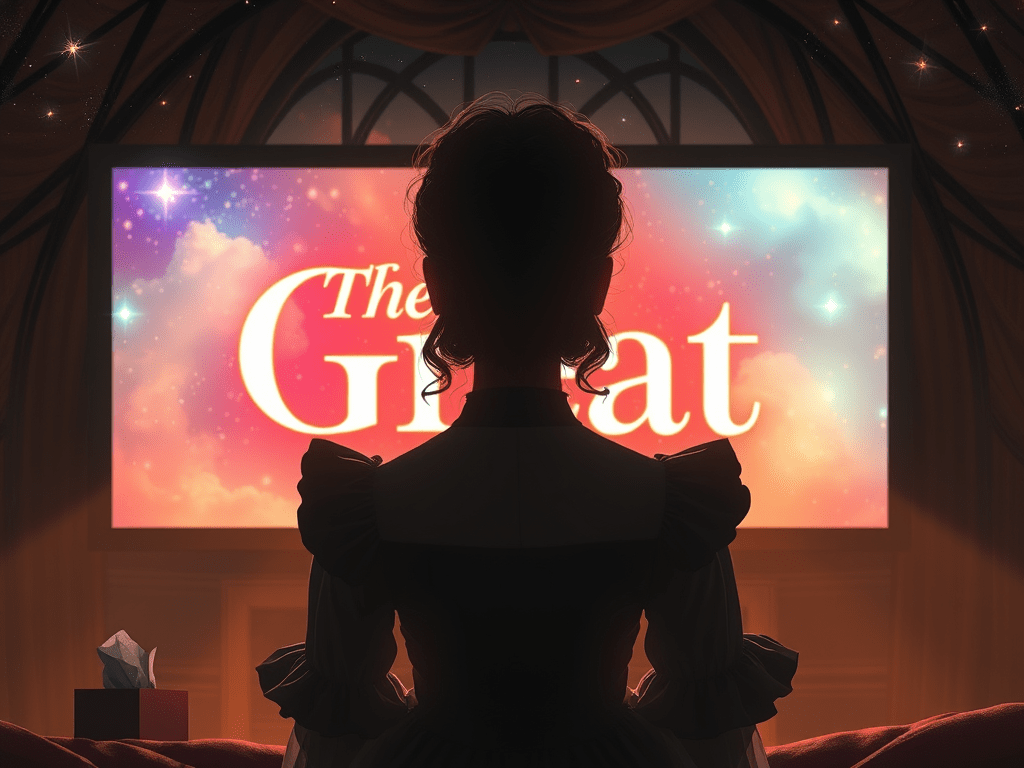
    So, you’ve just finished watching the complete 3 seasons of The Great on Hulu, and now you’re a broken shell of a human being. This “anti-historical” comedy about Empress Catherine the Great, penned by the devilishly talented Tony McNamara, is hands-down the best thing you’ve ever seen on television. And now, you’re plunged into a depression so deep that not even Elle Fanning’s radiant smirk or Nicholas Hoult’s glorious, sociopathic wit can pull you out of it. Why? Because you know, deep in your soul, that you’ll never see a script with such biting humor, impeccable cadence, and penetrating insight again. Ever.

    The Great is your TV Mount Everest, and the air up there is so thin that coming back down to the ground feels like an existential freefall. Desperate for solace, you decide to drown your sorrows in another “costume comedy,” because clearly, nothing soothes the soul like more ruffles and wigs.

    Enter The Decameron on Netflix—a comedy about the bubonic plague in 14th Century Italy. Yes, someone thought it would be a good idea to wring laughs out of a pandemic that killed a third of Europe. And the shocking part? They actually pulled it off. You’re impressed. Sort of. But at the same time, let’s not kid ourselves—the writing is not even in the same universe as The Great. It’s like comparing a Michelin-starred meal to the tastiest TV dinner you’ve ever had. Sure, it’s good, but come on—it’s not The Great. But here’s the kicker: you can’t trust your judgment anymore. You’ve entered a full-blown Post-Masterpiece Meltdown. On one hand, you’re bending over backward to be generous toward The Decameron, because you know deep down it’s unfair to compare anything to the sheer brilliance of The Great. On the other hand, you’re haunted by the suspicion that your generosity might be blinding you to the show’s actual merits—or lack thereof. You’re like someone who’s just lost the love of their life and is now attempting to date again by swiping right on Tinder with tears streaming down their face.

    Can you really trust your post-Great heart to judge anything properly? To make matters worse, The Decameron features the enigma that is Tanya Reynolds, an actress whose face is a bafflingly delightful conundrum—one moment goofy, the next serenely beautiful, as if she’s somehow tapped into a facial time machine that can travel between awkward adolescence and timeless beauty at will. Her intoxicating, elastic pulchritude is the final nail in the coffin of your short-circuited judgment. Your critical faculties, once sharp as a chef’s knife, now resemble a spoon trying to slice through steak. And you used to take pride in your TV criticism! Now you’re floundering in a sea of existential doubt, questioning everything—your taste, your standards, your very identity as a TV aficionado. So here you are, a once-confident critic, now reduced to a quivering mass of uncertainty, all because you stumbled upon Tony McNamara’s masterpiece, The Great. It’s like finding out you’ve been living in Plato’s cave all along, and now you’ve seen the light, you’re doomed to spend the rest of your days in the shadows, longing for the brilliance you can never unsee. Welcome to your new life in the Post-Masterpiece Meltdown. Enjoy the view—such as it is.

  • I found my true life purpose at a McDonald’s in Mojave

    I found my true life purpose at a McDonald’s in Mojave

    Coming home from Mammoth last summer, I had naively believed that my children would be sated from their breakfast at the McDonald’s in Bishop, allowing us to drive straight home without further interruptions.

    But by the time we reached Mojave around noon, my daughters swore they would perish on the spot if they didn’t have lunch immediately. So, we found ourselves pulling into yet another McDonald’s in Mojave. The thought of visiting two McDonald’s in a single day felt like a deep plunge into the abyss of self-debasement, a loss of dignity on par with other legendary acts of self-humiliation. I began to think this might be the modern-day equivalent of wearing a sandwich board that reads, “I have given up.” Yet, amid my indignation, I secretly thanked the universe for my daughters’ insatiable appetites because I desperately needed to use the bathroom.

    However, fate—or rather the cruel architects of this establishment—had installed combination locks on the bathroom doors, and the workers guarding these sacred numbers were about as generous with them as a dragon hoarding gold. I had to persuade them that my family of four would be forking over more than fifty dollars for the world’s most lackluster cuisine, and thus, I was surely deserving of the golden code.

    After securing the coveted combination, I made a beeline for the bathroom, practically kicking the door open like a cowboy in a saloon. The relief was so immense that it felt as if I had just liberated a small nation from tyranny. Afterward, I returned to the counter to wait for our food, feeling light as a feather. As I stood there, I observed dozens of men rattling the bathroom doorknob with the desperation of someone who had just spotted an oasis in the desert, only to find it locked. Their faces were contorted in pain, and their eyes begged for mercy but the cruel workers were unmoved.

    Seeing their plight, I realized I had the power to make a difference. I could be their savior. In an act of defiance against the oppressive bathroom code policy, I began shouting the combination with a gusto that could only be described as revolutionary. “Two-four-six-eight!” I bellowed, as if each digit was a bullet in the war against bladder injustice. The relief that spread across their faces was almost spiritual. I had become a mythical prophet, a modern-day Moses leading the oppressed to the Promised Land of Bladder Relief.

    Meanwhile, as I basked in the glory of my newfound role, my wife and daughters sank deeper into their chairs, their faces a mix of horror and embarrassment. They pretended not to know me, as if I were some wild-eyed lunatic who had wandered in from the Mojave Desert. But I didn’t care. I had found my spiritual calling, even if it was in the unlikeliest of places—shouting bathroom codes at a McDonald’s in Mojave.

  • The Los Angeles Wildfires Reconnected Me to Radio

    The Los Angeles Wildfires Reconnected Me to Radio

    The Los Angeles fires, blazing with apocalyptic fury, prompted me to do something I hadn’t done in years: dust off one of my radios and tune into live local news. The live broadcast brought with it not just updates but an epiphany. Two things, in fact. First, I realized that deep down, I despise my streaming devices—their algorithm-driven content is like an endless conveyor belt of lukewarm leftovers, a numbing backdrop of music and chatter that feels canned, impersonal, and incurably distant. Worst of all, these devices have pushed me into a solipsistic bubble, a navel-gazing universe where I am the sole inhabitant. Streaming has turned my listening into an isolating, insidious form of solitary confinement, and I haven’t even noticed.

    When I flipped on the radio in my kitchen, the warmth of its live immediacy hit me like a long-lost friend. My heart ached as memories of radio’s golden touch from my youth came flooding back. As a nine-year-old, after watching Diahann Carroll in Julia and Sally Field in The Flying Nun, I’d crawl into bed, armed with my trusty transistor radio and earbuds, ready for the night to truly begin. Tuned to KFRC 610 AM, I’d be transported into the shimmering world of Sly and the Family Stone’s “Hot Fun in the Summertime,” Tommy James and the Shondells’ “Crystal Blue Persuasion,” and The Friends of Distinction’s “Grazing in the Grass.” The knowledge that thousands of others in my community were swaying to the same beats made the experience electric, communal, alive—so unlike the deadening isolation of my curated streaming playlists.

    And then there was talk radio. Live conversations on KGO 810 AM with Jim Eason and Ronn Owens held a spellbinding charm. In the 70s, my mother and I would sit in the kitchen, enraptured, as they dissected controversies and gossip with the vigor of philosophers at a cocktail party. It was conversation as an art form, communal and vital, like cavemen telling stories around the fire. Contrast that with my podcasts: cherry-picked for my biases, carefully calibrated to affirm my tastes, locking me in an echo chamber so snug it could double as a straightjacket.

    The fires aren’t just devastating to the city—they’ve exposed the cracks in my own longing for connection. The nostalgic ache sent me down a rabbit hole of online research, hunting for a high-performance radio, convinced that it might resurrect the magic of my youth. But even as I clicked through reviews of antennas and AM clarity, a voice nagged at me: was this really about finding a better radio, or was it just another futile errand from a man in his sixties trying to outrun time? Could a supercharged radio transport me back to those transistor nights and kitchen conversations, or was I just tuning into the static of my own melancholia?

  • FOMO and the Mythical Past Can Ruin You

    FOMO and the Mythical Past Can Ruin You

    I remain haunted by three men who, decades later, are still gnashing their teeth over a squandered romantic encounter so catastrophic in their minds, it may as well be their personal Waterloo.

    It was the summer of their senior year, a time when testosterone and bad decisions flowed freely. Driving from Bakersfield to Los Angeles for a Dodgers game, they were winding through the Grapevine when fate, wearing a tie-dye bikini, waved them down. On the side of the road, an overheated vintage Volkswagen van—a sunbaked shade of decayed orange—coughed its last breath. Standing next to it? Four radiant, sun-kissed Grateful Dead followers, fresh from a concert and still floating on a psychedelic afterglow.

    These weren’t just women. These were ethereal, free-spirited nymphs, perfumed in the intoxicating mix of patchouli, wild musk, and possibility. Their laughter tinkled like wind chimes in an ocean breeze, their sun-bronzed shoulders glistening as they waved their bikinis and spaghetti-strap tops in the air like celestial signals guiding sailors to shore.

    My friends, handy with an engine but fatally clueless in the ways of the universe, leaped to action. With grease-stained heroism, they nursed the van back to health, coaxing it into a purring submission. Their reward? An invitation to abandon their pedestrian baseball game and join the Deadhead goddesses at the Santa Barbara Summer Solstice Festival—an offer so dripping with hedonistic promise that even a monk would’ve paused to consider.

    But my friends? Naïve. Stupid. Shackled to their Dodgers tickets as if they were golden keys to Valhalla. With profuse thanks (and, one imagines, the self-awareness of a plank of wood), they declined. They drove off, leaving behind the road-worn sirens who, even now, are probably still dancing barefoot somewhere, oblivious to the tragedy they unwittingly inflicted.

    Decades later, my friends can’t recall a single play from that Dodgers game, but they can describe—down to the last bead of sweat—the precise moment they drove away from paradise. Bring it up, and they revert into snarling, feral beasts, snapping at each other over whose fault it was that they abandoned the best opportunity of their pathetic young lives. Their girlfriends, beautiful and present, might as well be holograms. After all, these men are still spiritually chained to that sun-scorched highway, watching the tie-dye bikini tops flutter in the wind like banners of a lost kingdom.

    Insomnia haunts them. Their nights are riddled with fever dreams of sun-drenched bacchanals that never happened. They wake in cold sweats, whispering the names of women they never actually kissed. Their relationships suffer, their souls remain malnourished, and all because, on that fateful day, they chose baseball over Dionysian bliss.

  • Dealing with ChatGPT Essays That Are “Good Enough”

    Dealing with ChatGPT Essays That Are “Good Enough”

    Standing in front of thirty bleary-eyed college students, I was deep into a lesson on how to distinguish a ChatGPT-generated essay from one written by an actual human—primarily by the AI’s habit of spitting out the same bland, overused phrases like a malfunctioning inspirational calendar. That’s when a business major casually raised his hand and said, “I can guarantee you everyone on this campus is using ChatGPT. We don’t use it straight-up. We just tweak a few sentences, paraphrase a bit, and boom—no one can tell the difference.”

    Cue the follow-up from a computer science student: “ChatGPT isn’t just for essays. It’s my life coach. I ask it about everything—career moves, investments, even dating advice.” Dating advice. From ChatGPT. Let that sink in. Somewhere out there is a romance blossoming because of AI-generated pillow talk.

    At that moment, I realized I was facing the biggest educational disruption of my thirty-year teaching career. AI platforms like ChatGPT have three superpowers: insane convenience, instant accessibility, and lightning-fast speed. In a world where time is money and business documents don’t need to channel the spirit of James Baldwin, ChatGPT is already “good enough” for 95% of professional writing. And therein lies the rub—good enough.

    “Good enough” is the siren call of convenience. Picture this: You’ve just rolled out of bed, and you’re faced with two breakfast options. Breakfast #1 is a premade smoothie. It’s mediocre at best—mystery berries, more foam than a frat boy’s beer, and nutritional value that’s probably overstated. But hey, it’s there. No work required.

    Breakfast #2? Oh, it’s gourmet bliss—organic fruits and berries, rich Greek yogurt, chia seeds, almond milk, the works. But to get there, you’ll need to fend off orb spiders in your backyard, pick peaches and blackberries, endure the incessant barking of your neighbor’s demonic Rottweiler, and then spend precious time blending and cleaning a Vitamix. Which option do most people choose?

    Exactly. Breakfast #1. The pre-packaged sludge wins, because who has the time for spider-wrangling and kitchen chemistry before braving rush-hour traffic? This is how convenience lures us into complacency. Sure, you sacrificed quality, but look how much time you saved! Eventually, you stop even missing the better option. This process—adjusting to mediocrity until you no longer care—is called attenuation.

    Now apply that to writing. Writing takes effort—a lot more than making a smoothie—and millions of people have begun lowering their standards thanks to AI. Why spend hours refining your prose when the world is perfectly happy to settle for algorithmically generated mediocrity? Polished writing is becoming the artisanal smoothie of communication—too much work for most, when AI can churn out passable content at the click of a button.

    But this is a nightmare for anyone in education. You didn’t sign up for teaching to coach your students into becoming connoisseurs of mediocrity. You had lofty ambitions—cultivating critical thinkers, wordsmiths, and rhetoricians with prose so sharp it could cut glass. But now? You’re stuck in a dystopia where “good enough” is the new gospel, and you’re about as on-brand as a poet peddling protein shakes at a multilevel marketing seminar.

    And there you are, staring into the abyss of AI-generated essays, each more lifeless than the last, wondering if anyone still remembers the taste of good writing—let alone craves it.

    This is your challenge, the struggle life has so graciously dumped in your lap. So, what’s it going to be? You could curl into the fetal position and sob, sure. Or you could square your shoulders, channel your inner battle cry, and start fighting like hell for the craft you once believed in. Either way, the abyss is watching.

  • 95% of books are just bloated short stories and essays with unnecessary padding

    95% of books are just bloated short stories and essays with unnecessary padding

    As part of my rehabilitation from writing novels I have no business writing, I remind myself of an uncomfortable truth: 95% of books—both fiction and nonfiction—are just bloated short stories and essays with unnecessary padding. How many times have I read a novel and thought, This would have been a killer short story, but as a novel, it’s a slog? How often have I powered through a nonfiction screed only to realize that everything I needed was in the first chapter, and the rest was just an echo chamber of diminishing returns?

    Perhaps someday, I’ll learn to write an exceptional short story—the kind that punches above its weight, the kind that leaves you feeling like you’ve just read a 400-page novel even though it barely clears 30. It takes a rare kind of genius to pull off this magic trick. I think of Alice Munro’s layered portraits of regret, Lorrie Moore’s razor-sharp wit, and John Cheever’s meticulous dissections of suburban despair. I flip through my extra-large edition of The Stories of John Cheever, and three stand out like glittering relics: “The Swimmer,” “The Country Husband,” and “The Jewels of the Cabots.” Each is a self-contained universe, a potent literary multivitamin that somehow delivers all the nourishment of a novel in a single, concentrated dose. Let’s call these rare works Stories That Ate a Novel—compact, ferocious, and packed with enough emotional and intellectual weight to render lesser novels redundant.

    As part of my rehabilitation, I must seek out such stories, study them, and attempt to write them. Not just as an artistic exercise, but as a safeguard against relapse—the last thing I need is another 300-page corpse of a novel stinking up my hard drive.

    But maybe this is more than just a recovery plan. Maybe this is a new mission—championing Stories That Eat Novels. The cultural winds are shifting in my favor. Attention spans, gnawed to the bone by social media, no longer tolerate literary excess. Even the New York Times has noted the rise of the short novel, reporting in “To the Point: Short Novels Dominate International Booker Prize Nominees” that books under 200 pages are taking center stage. We may be witnessing a tectonic shift, an age where brevity is not just a virtue but a necessity.

    For a failed novelist and an unapologetic literary wind-sprinter, this could be my moment. I can already see it—my sleek, ruthless 160-page collection, Stories That Eat Novels, four lapidary masterpieces gleaming like finely cut diamonds. Rehabilitation has never felt so good. Who says a man in his sixties can’t find his literary niche and stage an artistic rebirth? Maybe I wasn’t a failed novelist after all—maybe I was just a short-form assassin waiting for the right age to arrive.