Tag: writing

  • Kafka Called—He Wants His Nightmare Back

    Kafka Called—He Wants His Nightmare Back

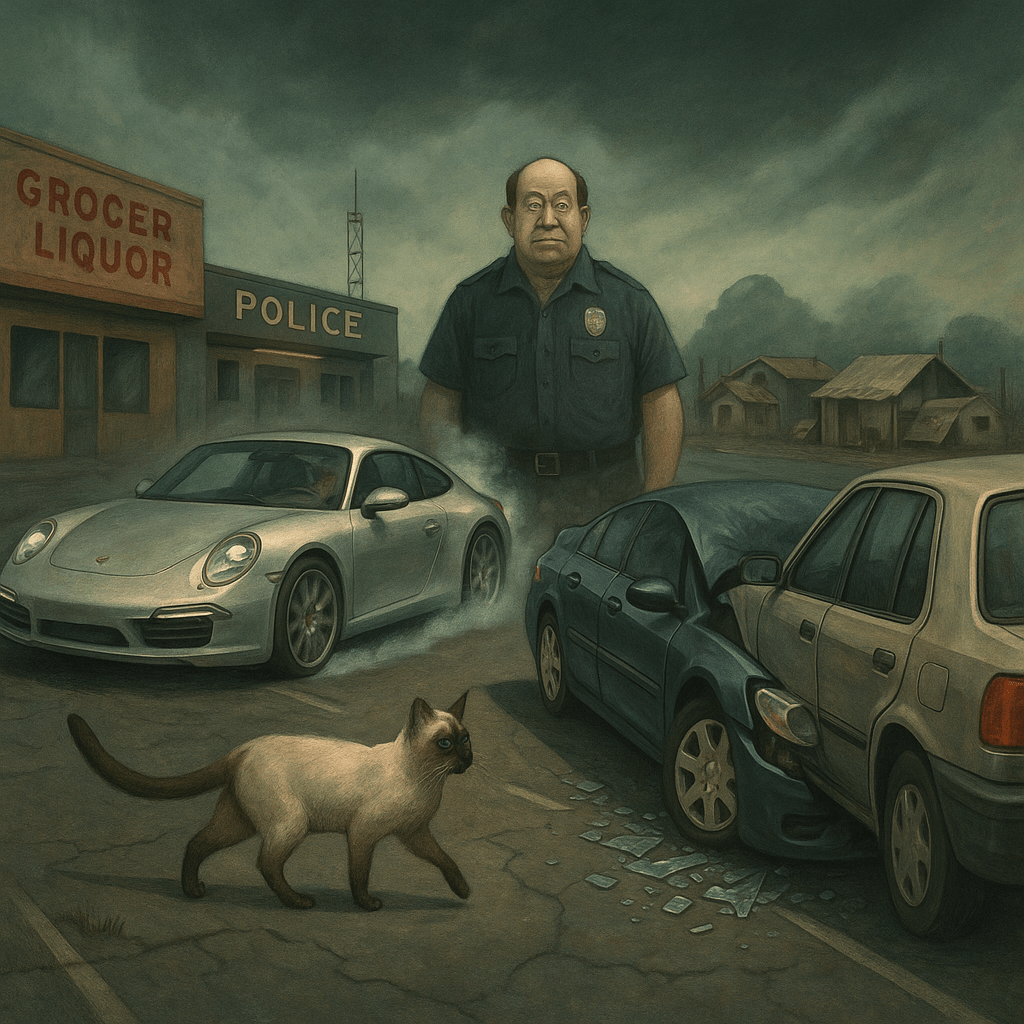
    Last night’s dream was less REM sleep and more bureaucratic farce with automotive stunt work. It started with me sprinting into a liquor store—not for booze, but for groceries, because apparently, in dream logic, milk and bananas are shelved next to Jack Daniels and scratchers. The plaza was wedged next to a police station, and as I pulled into the lot, I grazed another car. Minor fender-bender. Did I report it? Of course not. I had perishables. Yogurt waits for no man.

    Soon after, the cops called. Apparently, they frown upon drive-away accidents, even ones that involve $3.99 rotisserie chickens. Dutifully, I set off for the station, where fate promptly mocked me.

    As I crossed the street, a silver Porsche came screaming down the road like it was late for a yacht meeting. Behind the wheel was a rich guy with the glossy detachment of a man who names his houseplants after Nietzsche quotes. He swerved to avoid hitting a stray Siamese cat—an act of mercy that nearly murdered me. I dodged, lost control, and promptly rear-ended a parked car. Yes: I got in a car crash on my way to report a previous car crash.

    Inside the station, things went from absurd to surreal. The desk captain was none other than Todd, a former San Quentin prison guard I used to train with back in the ‘70s. Todd had the physique of a worn punching bag and the unmistakable face of Larry from The Three Stooges—if Larry had done time in corrections and smoked Kools for thirty years.

    Todd was unimpressed with my double-crash disclosure. He squinted at me like I was a damaged clipboard and muttered something like, “You ever thought of Canada?”

    Canada, in this dreamscape, was not a country but a penal colony for the mildly broken. A rehab center for the emotionally overdrawn. It wasn’t maple leaves and healthcare—it was despair with a windchill. The entire nation had collapsed into an encampment of defunct influencers and men who thought podcasts were a substitute for therapy. No plumbing, no cash, just bartering and tents. People traded AA batteries and protein bars like it was the yard at Pelican Bay.

    A man named Damon—he was 34, depressed, and once had a viral TikTok about the deep state—gave me the grand tour of my future. He pointed to the shell of a trailer I’d be assigned, complete with a tarp roof and a milk crate toilet. “It’s provisional,” he said, as if permanence were even an option.

    I immediately regretted migrating to Dream-Canada. I wanted to go back to the police station, fix the record, beg forgiveness, and reclaim my life of yogurt-based negligence. But that’s where the dream froze.

    I woke up to the smell of coffee. My wife was getting ready for work. Civilization, still intact—for now.


  • College Essay Prompt That Addresses Food and Economic Class: Ozempification, AI, and the Class Divide in the End of Food Culture

    College Essay Prompt That Addresses Food and Economic Class: Ozempification, AI, and the Class Divide in the End of Food Culture

    Prompt Overview:
    As GLP-1 drugs like Ozempic suppress hunger and artificial intelligence tailors hyper-personalized, nutrient-optimized meals, our relationship with food is undergoing a radical transformation. But not all communities are experiencing this shift equally. While affluent professionals embrace biotech and AI to streamline their eating, working-class and immigrant communities often continue to practice food as culture, tradition, and emotional ritual.

    Your Task:
    Write an 8-paragraph argumentative essay that responds to the following claim:

    Claim:
    GLP-1 drugs and artificial intelligence are ending the traditional notion of food and eating as cultural, emotional, and communal experiences—but primarily for the educated upper-middle class, creating a new kind of class-based food divide.

    Instructions:

    1. Introduction (Paragraph 1):
      Open with a compelling hook. Present the claim and your thesis—whether you agree, disagree, or take a nuanced stance.
    2. Background (Paragraph 2):
      Briefly explain what GLP-1 drugs do and how AI is influencing food production and personalization. Introduce the concept of “Ozempification.”
    3. First Argument (Paragraph 3):
      Argue how the professional-managerial class is disproportionately embracing GLP-1 and AI technologies as part of a broader trend toward self-optimization.
    4. Second Argument (Paragraph 4):
      Show how this new model of eating—quantified, detached, and efficient—erodes traditional food practices like communal meals, emotional eating, or ritual cooking.
    5. Third Argument (Paragraph 5):
      Examine the contrasting experience of working-class and immigrant communities who, whether by choice or necessity, retain deeper connections to cultural food practices.
    6. Counterargument and Rebuttal (Paragraph 6):
      Acknowledge the argument that biotech and AI could democratize health and nutrition. Then challenge this by exploring accessibility, affordability, or cultural loss.
    7. Cultural Reflection (Paragraph 7):
      Reflect on the long-term cultural implications of this class-based divide. Will we see a future where the elite biohack their appetites while the working class clings to endangered food rituals?
    8. Conclusion (Paragraph 8):
      Reassert your thesis and end with a provocative insight, question, or forecast about the future of food and class.

    Source Requirement:
    Use at least 4 credible sources, including recent journalism, scholarly articles, or reports (2023 or later). Cite sources in MLA format.

    Suggested Angles to Explore:

    • How does Silicon Valley’s culture of optimization affect food rituals?
    • Is “Ozempification” a privilege or a necessity?
    • What happens when food stops being a shared story and becomes a solo algorithm?

    Here is a curated reading list for your revised prompt on Ozempification, AI, and the Class Divide in the End of Food Culture. These selections balance journalism, research, and cultural commentary, providing accessible and provocative sources for students at various reading levels:


    READING LIST

    1. Ozempic and GLP-1 Drugs

    • “Scientists Find Why Ozempic Changes the Types of Food People Eat”
      Prevention Magazine, 2024
      Explains how GLP-1 drugs alter appetite and food preferences.

    • “Ozempic’s Effect on Food Innovation”
      Institute of Food Technologists (IFT), May 2024
      Discusses how food manufacturers are shifting products in response to Ozempic-driven consumer changes.

    2. AI and the Personalization of Food

    • “AI-Driven Transformation in Food Manufacturing”
      Frontiers in Nutrition, 2025
      An in-depth research article on AI’s impact on food production, sustainability, and consumer targeting.
      PDF Download
    • “AI Is Hacking Your Hunger: How the Food Industry Engineers Addiction”
      Forbes, March 2025, by Jason Snyder
      A bold look at how AI and biotech are reprogramming consumer desire and food experience.

    3. Food, Class, and Culture

    • “The Labor of Lunch: Why We Need Real Food and Real Jobs in American Public Schools”
      By Jennifer E. Gaddis, University of California Press, 2019
      Offers a clear view of how food, labor, and class intersect in institutional settings like schools.
    • “Cultural Appropriation in Food: Is It a Problem?”
      The New York Times, by Ligaya Mishan
      Reflects on food, culture, and who gets to profit from culinary traditions—good for contrast with bioengineered food trends.
    • “You Can’t Eat Optimized Food with Your Grandma”
      The Atlantic, speculative title suggestion (hypothetical essay you might write or assign students to mimic stylistically)
      Encourages reflection on the emotional and generational disconnect caused by hyper-personalized, tech-driven diets.
  • College Essay Prompt: Ozempification, AI, and the End of Food Culture?

    College Essay Prompt: Ozempification, AI, and the End of Food Culture?

    Prompt Overview:
    In recent years, the rise of GLP-1 drugs like Ozempic and Wegovy has begun to reshape our relationship with hunger, desire, and food itself. Meanwhile, artificial intelligence is transforming how food is produced, marketed, and even chosen—sometimes without human involvement. This convergence may signal the end of eating as a social, cultural, and emotional act.

    Your Task:
    Write an 8-paragraph argumentative essay that responds to the following claim:

    Claim:
    GLP-1 drugs and artificial intelligence are ending the traditional notion of food and eating as cultural, emotional, and communal experiences.

    Instructions:

    1. Introduction (Paragraph 1):
      Hook the reader with a striking observation or anecdote. Clearly present the claim and your thesis—whether you agree, disagree, or hold a nuanced position.
    2. Background (Paragraph 2):
      Briefly explain what GLP-1 drugs (e.g., Ozempic) do and how AI is being used in food production and personalization.
    3. First Argument (Paragraph 3):
      Make your first point in support of or against the claim. Use evidence from a reliable source.
    4. Second Argument (Paragraph 4):
      Develop a second point. This might include shifts in consumer behavior, changing food rituals, or the erosion of cultural traditions.
    5. Third Argument (Paragraph 5):
      Add a third supporting point that deepens your position. Consider long-term consequences or ethical implications.
    6. Counterargument and Rebuttal (Paragraph 6):
      Acknowledge a reasonable opposing view—perhaps that AI and GLP-1 drugs offer needed solutions to health crises—and then refute it using logic and evidence.
    7. Cultural Reflection (Paragraph 7):
      Reflect on what is at stake culturally. What do we lose if food is reduced to a biometric algorithm?
    8. Conclusion (Paragraph 8):
      Return to your thesis and end with a memorable insight or call to action.

    Source Requirement:
    Use at least 4 credible sources. At least two should come from recent journalism or peer-reviewed studies (2023 or later). Sources must be cited in MLA format.

    Optional Angles to Explore:

    • How do GLP-1 drugs rewire human appetite?
    • Will AI-generated food disconnect us from culinary heritage?
    • Can technological efficiency coexist with food as a ritual or joy?
  • The Driveway Diaries: A Confession from the Curb

    The Driveway Diaries: A Confession from the Curb

    I live in Southern California’s golden triangle of suburban prestige: safe streets, sky-high property values, and public schools so highly rated they practically demand tuition. But on weekends and holidays, my block transforms into a theme park of inflatable bounce castles, fold-out chairs, and off-brand DJ booths—all courtesy of neighboring homeowners hosting backyard fiestas for their tiny heirs.

    With festivity comes the scourge: street congestion. Cars squeeze themselves into curbside crevices like sardines in a midlife crisis. They stack and cram and sidle up so tight to my house you’d think we were giving away parking validation and carne asada.

    Every so often, a guest parks with their bumper edging an inch—an inch—into the edge of my newly repaved driveway. A driveway I paid for myself because city bureaucracy shrugged and pointed to tree roots like they were an Act of God. That innocent slab of concrete cost me $5,500. Every time a Honda Pilot sniffs it without permission, I feel like I’m watching someone use my toothbrush.

    Still, I try to be Zen. I tell myself: “People want to be here. This isn’t intrusion. It’s affirmation. I am so blessed to live in a place so desirable, others will risk a petty homeowner’s wrath just to brush against my apron.”

    Then there’s the nightly ritual across the street. My neighbors, bless them, have adopted my driveway as part of their sacred reverse-entry protocol. They swing into my drive like a fighter pilot locking onto a carrier, headlights blazing through my living room window while I’m watching a true crime doc with my wife. Then they shift into reverse and back into their own driveway like they’re starring in a Ford commercial for backing-in bravado.

    Again, I resist the pettiness. I whisper: “What an honor to share my $5,500 slab of artisanal pavement. The city may have abandoned me, but I haven’t abandoned my commitment to grace.”

    But some nights, I spiral. I see my empty driveway (because my Honda is parked dutifully inside the garage like a respectable introvert) and I grow suspicious. “They’re circling,” I think. “Someone’s going to claim this space. They’re going to park smack in the middle of my private driveway, right under the basketball hoop I haven’t used since 2008.”

    In my darkest moments, I fantasize about war. “Let them try it,” I growl internally. “I’ll tow them. I’ll call the police. I’ll lawyer up. I’ll blog about it to my three dozen loyal followers and publicly shame their license plate into eternity.”

    And just when I think I’ve shaken off my paranoia, the sirens come. Always the sirens. I live wedged between two hospitals, so I’m serenaded hourly by ambulance howls and the Doppler wail of emergency response. It’s like being reminded every ten minutes that death is always trending.

    The crowded streets don’t help. It’s not just congestion—it’s existential compression. The world is full. There’s no more room. Civilization is a Jenga tower one move away from collapse.

    And still, I try to be kind. I try to be sane. “I’m not petty,” I tell myself. “I’m not paranoid. I’m just emotionally literate.”

    So I do what I’ve always done: I go to the piano. I sit and play one of the hundreds of songs I’ve written since I was sixteen. The music softens the beast. It wraps my dread in a velvet ribbon of minor chords. Unfortunately, all my songs sound vaguely identical—like clones from the same melancholy womb. But I take what I can get.

    If twenty minutes of recycled piano sadness gives me peace in the suburbs, then I’ll sit at that bench and bleed quietly into the keys. No apologies.

  • College Essay Prompt: Beyond Authentic: How Evolving Cuisines Tell Stories of Survival, Adaptation, and Identity

    College Essay Prompt: Beyond Authentic: How Evolving Cuisines Tell Stories of Survival, Adaptation, and Identity

    Overview:

    Write a 1,700-word argumentative essay examining whether dishes like birria ramen, orange chicken, Korean tacos, or Tex-Mex fajitas should be dismissed as inauthentic or embraced as culturally rich, adaptive expressions of immigrant creativity. Using the evolution of Mexican and Chinese food in the U.S. as your focus, evaluate how culinary “impurity” may reflect resilience more than betrayal.

    This assignment challenges the simplistic binary of cultural appropriation vs. cultural preservation by exploring how food evolves through migration, racism, class, capitalism, and the human need to survive—and thrive.


    Central Claim to Defend, Refute, or Complicate:

    Criticizing American Chinese and modern Mexican cuisine as “inauthentic” oversimplifies the historical, cultural, and economic forces that drive culinary evolution.


    Required Sources (Use at least 4, MLA format):

    • Gustavo Arellano – “Let White People Appropriate Mexican Food”
    • The Search for General Tso (dir. Ian Cheney, 2014)
    • Charles W. Hayford – “Who’s Afraid of Chop Suey?”
    • Cathy Erway – “More Than ‘Just Takeout’”
    • Kelley Kwok – “‘Not Real Chinese’: Why American Chinese Food Deserves Our Respect”
    • Jiayang Fan – “Searching for America with General Tso”

    Focus Questions to Consider:

    • What is gained or lost when immigrant cuisines adapt to mainstream tastes?
    • How have Mexican and Chinese-American dishes reflected creative survival strategies in the face of xenophobia or marginalization?
    • Is culinary “authenticity” a meaningful cultural value or an exclusionary myth?
    • How do evolving cuisines challenge stereotypes and redefine American identity?
    • Should food be judged by origin or by impact?

    Essay Requirements:

    • Length: 1,700 words
    • Format: MLA (12 pt font, double-spaced, Times New Roman)
    • Sources: At least 4 from the required list
    • Tone: Academic and analytical, but open to personal insight or cultural experience
    • Structure: Use the suggested outline below or build your own coherent structure

    Suggested Structure:

    Intro (200–300 words):

    • Open with the “authenticity” debate in food culture
    • Present the evolution of Mexican and Chinese cuisine as a case study
    • Clearly state your thesis: whether you defend, challenge, or complicate the rejection of “inauthentic” foods

    Section 1: Culinary Evolution as Cultural Power (400–500 words)

    • Use Arellano’s “adaptability” argument and The Search for General Tso
    • Explore how adaptation expands—not erases—culinary traditions

    Section 2: Food as a Tool of Survival (400–500 words)

    • Use Jiayang Fan and Cathy Erway to show how these cuisines offered paths to economic mobility and belonging
    • Address how racism shaped what was “acceptable” for the mainstream palate

    Section 3: Rethinking Authenticity (400–500 words)

    • Use Kelley Kwok and Hayford to interrogate what we even mean by “authentic”
    • Acknowledge that tradition matters—but argue that hybridity is the tradition of diaspora

    Section 4: Counterargument & Rebuttal (300–400 words)

    • Address critics who claim fusion or Americanized food dilutes culture
    • Rebut: show how adaptation often preserves a culture’s essence in new form

    Conclusion (200–300 words)

    • Reaffirm your thesis: evolving cuisine reflects the ingenuity, creativity, and endurance of immigrant communities
    • Reflect on how accepting culinary adaptation challenges us to redefine American identity itself

    Final Notes to Students:

    This essay isn’t just about food—it’s about the stories food tells. Let your argument reflect that complexity. Engage deeply with your sources, and don’t be afraid to explore tensions: pride vs. commodification, tradition vs. survival, innovation vs. erasure.

  • Late Night Linguine: What The Big Night Taught Us About Conan and Leno

    Late Night Linguine: What The Big Night Taught Us About Conan and Leno

    In Stanley Tucci’s criminally under-watched gem The Big Night (1996), two Italian brothers run a brilliant but nearly empty restaurant on the Jersey shore. Primo, the chef, is an artist of uncompromising culinary vision; he serves risotto that would make a grown man weep. But across the street, the tables are packed—at a red-sauce theme park run by Pascal, a bombastic hack whose food is as bland as it is crowd-pleasing. Pascal serves chicken parmesan to the masses. Primo serves culture, discipline, and slow-cooked soul. One sells out nightly. The other nearly starves. Sound familiar?

    This, friends, is the Conan O’Brien vs. Jay Leno saga, plated beautifully in pasta.

    Jay Leno is Pascal: Safe, Satisfying, and Instantly Forgettable

    Pascal’s restaurant thrives not because the food is good, but because it’s predictable. You know what you’re getting. He panders to his audience, flatters their expectations, and sends them home full but not transformed. He is, in short, Jay Leno with a meat tenderizer.

    Leno’s version of The Tonight Show was the late-night equivalent of chicken alfredo with a side of inoffensive jokes about airport security. He killed in the ratings. He never offended. He never challenged. He played it down the middle, night after night, in denim.

    Conan is Primo: Brilliant, Awkward, and Often Underappreciated

    Primo is the brother who won’t compromise. He won’t dumb down his food, won’t swap risotto for spaghetti and meatballs just to please a palate that doesn’t know what it’s missing. He’s the chef who would rather close the restaurant than sully the integrity of a dish. Conan O’Brien, likewise, built his comedy around absurdity, self-sabotage, and exquisite oddness. He gave us Masturbating Bears, Triumph the Insult Comic Dog, and the fever dream that was Walker, Texas Ranger lever pulls. Ratings? Meh. Relevance? Immeasurable.

    Conan didn’t want to “serve” the audience. He wanted to surprise them, confuse them, maybe even challenge them. He made comedy with the same attitude Primo brought to the kitchen: They may not get it now. But it matters.

    NBC as the Landlord: Just Pay the Rent, Please

    In The Big Night, the brothers face foreclosure. Their landlord doesn’t care about risotto. He cares about checks clearing. NBC was no different. When The Tonight Show with Conan O’Brien struggled in the ratings, the network didn’t see a delicate soufflé in progress. They saw empty tables and a full plate of Jay Leno standing by. So they evicted Primo and reinstalled Pascal, with all the subtlety of a bulldozer.

    The Feast We Deserved, the Chicken We Got

    The emotional climax of The Big Night is a final, silent meal—a simple omelet, cooked and shared after the titular “big night” fails to save the restaurant. There are no words, no triumph, no redemption—just brothers, food, and fatigue. It’s one of the great, quiet scenes in cinema, the kind that stays with you.

    And so it is with Conan. He didn’t get the kingdom. He didn’t win the war. But he got the last word. And his work—the strange, defiant, beautiful risotto of late-night—endures. Meanwhile, Leno’s legacy, like Pascal’s veal scaloppine, is likely to congeal into a nostalgic footnote: “He made people happy. I think?”

    Final Bill

    Pascal may have owned the block. But Primo owned the soul.
    Leno owned the ratings. But Conan owns the legacy.

    Late night, like food, is about more than filling time.
    It’s about what stays with you.

    And forty years from now, nobody’s quoting Jay Leno.

    But someone, somewhere, will be pulling the Walker, Texas Ranger lever. And laughing like hell.

  • Why I Don’t Read Happiness Essays (and Neither Should You)

    Why I Don’t Read Happiness Essays (and Neither Should You)

    Arthur Brooks is a best-selling author, a man of clear intellect, solid decency, and enough charm to disarm even a hardened cynic. I read one of his books, From Strength to Strength, which tackles the subject of happiness with insight, elegance, and more than a few glimmers of genuine wisdom. For a week or so, I even took his ideas seriously—pondering the slow fade of professional relevance, the shift from fluid to crystallized intelligence, and the noble art of growing old with grace.

    And then I moved on with my life.

    What I didn’t move on from, unfortunately, was the onslaught of Brooks’ happiness essays in The Atlantic. They appear like clockwork, regular as a multivitamin—each one another serving of cod liver oil ladled out with the same hopeful insistence: “Here, take this. It’s good for you.” The problem isn’t Arthur Brooks. It’s happiness itself. Or rather, happiness writing—that genre of glossy, over-smoothed, well-meaning counsel that now repels me like a therapy dog that won’t stop licking your face during a panic attack.

    Let me try to explain why.

    1. The Word “Happiness” Is Emotionally Bankrupt

    The term happiness is dead on arrival. It lands with the emotional resonance of a helium balloon tied to a mailbox. It evokes cotton candy, county fairs, and the faded joy of children playing cowboys and Indians—an aesthetic trapped in amber. It feels unserious, childish even. I can’t engage with it as a concept because it doesn’t belong in the adult vocabulary of meaning-making. It’s not that I reject the state of being happy—I’m just allergic to calling it that.

    2. It Feels Like Cod Liver Oil for the Soul

    Brooks’ essays show up with the regularity and charm of a concerned mother armed with a spoonful of something you didn’t ask for. I click through The Atlantic and there it is again: another gentle lecture on how to optimize my inner light. It’s no longer nourishment. It’s over-parenting via prose.

    3. Optimizing Happiness Is a Ridiculous Fantasy

    Some of Brooks’ formulas for increasing happiness start to feel like they were dreamed up by a retired actuary trying to convert existential dread into a spreadsheet. As if flourishing could be reduced to inputs and outputs. As if there’s a number on the dial you can crank up if you just follow the steps. It’s wellness-by-algorithm, joy-by-numbers. I’m not a stock portfolio. I’m a human being. And happiness doesn’t wear a Fitbit.

    4. Satire Has Already Broken the Spell

    Anthony Lane, in his New Yorker essay “Can Happiness Be Taught?,”
    dismantled this whole genre with surgical wit. Once you’ve read a masterful takedown of this kind of earnest life-coaching prose, it’s impossible to take it seriously again. Like seeing the zipper on a mascot costume, the magic disappears. You’re just watching a grown-up in a plush suit tell you to breathe and smile more.

    5. I Like Things That Exist in the World

    I’m interested in things with friction and form—things you can grip, build, question, deconstruct. Music. Technology. Communication tools. Exercise. Love. Psychological self-sabotage. You know, the good stuff. Happiness, as a subject, has all the density of vapor. It’s more slogan than substance, and when I see it trotted out as a destination, I start scanning for exits.

    6. It’s a Hot Tub Full of Bromides

    I have no interest in an adult ed class on happiness led by a relentlessly upbeat instructor talking about “mindfulness” and “centeredness” with the fixed grin of someone who has replaced coffee with optimism. I can already hear the buzzwords echoing off the whiteboard. These classes are group therapy in a coloring book—pastel platitudes spoon-fed to the emotionally dehydrated.

    7. It’s Not Self-Help. It’s Self-Surveillance

    Let’s be honest: a lot of happiness literature feels like a soft form of control. Smile more. Meditate. Adjust your attitude. If you’re not happy, it must be something you’re doing wrong. It’s capitalism’s way of gaslighting your suffering. Don’t look outward—don’t question the system, the politics, the institutions. Just recalibrate your “mindset.” In this sense, the language of happiness is more pacifier than pathfinder.

    So yes, Arthur Brooks writes well. He thinks clearly. He’s probably a better person than I am. But his essays on happiness make me recoil—not because they’re wrong, but because they speak a language I no longer trust. I don’t want to be managed, monitored, or optimized. I want to be awake. I want to be challenged. And if I’m lucky, I’ll get to experience the real stuff of life—anger, beauty, confusion, connection—not just a frictionless simulation of contentment.

    Happiness can keep smiling from the other side of the screen. I’ve got kettlebells to swing.

  • Echo-Chamber Fatigue: When Trusted Media Starts to Sound Like Static

    Echo-Chamber Fatigue: When Trusted Media Starts to Sound Like Static

    For years, I counted The Bulwark and The Atlantic among the few media outlets that seemed to keep their heads above water. Thoughtful, principled, and often sharp in their critique, they offered a sense of clarity during a time when the political center felt like it was collapsing under the weight of tribalism. I read The Atlantic with the same reverence people once reserved for the Sunday paper. I tuned into The Bulwark’s podcasts with eagerness, particularly the sparring matches and tag-team lamentations of Sarah Longwell and JVL.

    But lately, something’s shifted.

    I’ve been struggling to name the feeling exactly—disenchantment, disconnection, even a touch of annoyance. It’s not that they’ve suddenly started publishing bad takes (though no one’s immune to that). It’s more that I’ve come to feel like I’m listening to the same looped monologue. Their arguments are often cogent, yes, but increasingly predictable—a chorus of like-minded voices rehearsing the same concerns, circling the same drain.

    Call it echo-chamber fatigue.

    The Bulwark, once a clarion voice of principled conservatism and a fierce watchdog against authoritarianism, now often feels like a room full of smart people endlessly rehashing the same grim diagnosis: American democracy is circling the drain. The problem isn’t that they’re wrong—it’s that I already see the collapse unfolding in real time. Listening to it dissected again and again isn’t cathartic anymore. It’s just salt in the wound.

    The Atlantic, long celebrated for its intellectual breadth, increasingly feels like it’s scanning for moral alignment before publishing an idea. There’s little friction. Little surprise. Just a gentle stroking of reader confirmation bias.

    Meanwhile, I find myself gravitating to media that feels more alive—podcasts like The Gist with Mike Pesca, Blocked and Reported with Katie Herzog and Jesse Singal, The Fifth Column, Ink-Stained Wretches, and even The Remnant with Jonah Goldberg. These shows don’t always align with my politics—and that’s exactly the point. They’re not trying to usher me into ideological safety. They’re wrestling with absurdities across the spectrum. They’re skeptical. Curious. Sometimes contrarian. Always human.

    And that, I think, is the deeper issue: emotional resonance. The Bulwark and The Atlantic haven’t necessarily changed. I have. Or perhaps the times have. I need more than agreement—I need tension, exploration, contradiction. The intellectual monoculture, no matter how principled, starts to feel like a sedative after a while.

    I’ve even considered canceling my subscriptions. But there’s friction there, too: The Atlantic remains a useful classroom resource, and every now and then, The Bulwark sparks a genuinely engaging dialogue that reminds me why I once admired it so much.

    So I stay, for now. But I’ve moved my ears—and increasingly, my attention—toward media that still surprises me. That still thinks out loud, rather than reading from a polished script.

    I’m not rejecting thoughtful media. I’m just bored of watching it slowly turn into liturgy.

  • The future, we’re told, is full of freedom—unless you’re the one still cleaning the mess.

    The future, we’re told, is full of freedom—unless you’re the one still cleaning the mess.

    Last semester, in my college critical thinking class—a room full of bright minds and burnt-out spirits—we were dissecting what feels like a nationwide breakdown in mental health. Students tossed around possible suspects like a crime scene lineup: the psychological hangover of the pandemic, TikTok influencers glamorizing nervous breakdowns with pastel filters and soft piano music, the psychic toll of watching America split like a wishbone down party lines. All plausible. All depressing.

    Then a re-entry student—a nurse with twenty years in the trenches—raised her hand and calmly dropped a depth charge into the conversation. She said she sees more patients than ever staggering into hospitals not just sick, but shattered. Demoralized. Enraged. When I asked her what she thought was behind the surge in mental illness, she didn’t hesitate. “Money,” she said. “No one has any. They’re working themselves into the ground and still can’t cover rent, groceries, and medical bills. They’re burning out and breaking down.”

    And just like that, all our theories—algorithms, influencers, red-vs-blue blood feuds—melted under the furnace heat of economic despair. She was right. She sees the raw pain daily, the kind of pain tech billionaires will never upload into a TED Talk. While they spin futuristic fables about AI liberating humanity for leisure and creativity, my nurse watches the working class crawl into urgent care with nothing left but rage and debt. The promise of Universal Basic Income sounds charming if you’re already lounging in a beanbag chair at Singularity HQ, but out here in the world of late rent and grocery inflation, it’s a pipe dream sold by people who wouldn’t recognize a shift worker if one collapsed on their marble floors. The future, we’re told, is full of freedom—unless you’re the one still cleaning the mess.

  • Thank You for Your Support (and Your Gullibility): Two Corporate Con Jobs from the ’80s

    Thank You for Your Support (and Your Gullibility): Two Corporate Con Jobs from the ’80s

    I almost called this post “Memories of Manipulative Advertising,” but that’s like calling water wet. Advertising doesn’t sometimes manipulate—it’s a full-time gaslighter with a jingle and a logo. The question isn’t if it’s lying to you, but how cleverly, and with what flavor of Americana.

    Case in point: Bartles & Jaymes, the wine cooler swindle dressed up like a Norman Rockwell painting. Back in the 1980s, I worked at Jackson’s Wine & Spirits in Berkeley—a respectable shop selling overpriced Bordeaux to grad students pretending they weren’t on food stamps. Then came the Bartles & Jaymes blitz, courtesy of Hal Riney & Partners and the corporate overlords at E & J Gallo.

    Suddenly, America was smitten with two crusty front-porch philosophers in denim and flannel, sipping pastel-colored booze and thanking us for “our support,” as if we were funding their modest struggle to afford Hamburger Helper and citronella candles. They weren’t winemakers. They weren’t even real. One was a retired Air Force pilot, the other a contractor. But that didn’t stop millions from believing that these Gallo sock puppets had personally hand-crafted their strawberry kiwi elixirs under a tin roof in Appalachia.

    These weren’t ads. They were full-blown folklore, sold to a Reagan-era audience desperate to believe in something wholesome—preferably something with artificial watermelon flavor and a 5% ABV.

    But the biggest act of psychological warfare I witnessed during my wine shop tenure came not from Gallo, but from that fizzy behemoth: Coca-Cola.

    In 1985, Coke announced it was changing its iconic recipe. Cue the national meltdown. Pickup trucks rolled into the wine store like we were FEMA and this was the end times. Grown men, trembling with brand-loyalty withdrawal, bought crates of “original” Coke like it was bottled youth. I became an emergency hand truck operator, wheeling out what amounted to liquid nostalgia to wide-eyed customers who treated me like I was delivering insulin to a diabetic family.

    Then, surprise!—Coke re-released the original as “Classic Coke,” and everyone breathed a sugary sigh of relief. It was less a product relaunch and more a mass-conditioning experiment, proving that if you poke the American consumer hard enough, they’ll thank you for the bruise.

    These weren’t just ad campaigns. They were operatic manipulations of identity, trust, and memory—corporate psyops disguised as beverage options.