Tag: writing

  • Field-Testing FOMO: A Preteen Cautionary Tale

    Field-Testing FOMO: A Preteen Cautionary Tale

    One warm California afternoon in the spring of 1973, after sixth-grade classes had spit us out like a bad punchline and the school bus rumbled off down Crow Canyon Road, my friends and I embarked on our sacred post-school ritual: a pilgrimage to 7-Eleven to score a Slurpee before the long, punishing hike up Greenridge Road. Inside that fluorescent-lit temple of artificial flavors, “Brandy (You’re a Fine Girl)” crackled from the tinny store radio, bouncing off racks of bubble gum, jerky, and preteen dreams.

    That’s when the Horsefault sisters burst through the door like a blonde tornado.

    They were tall, freckled, sunburned Valkyries from the far reaches of suburban myth—bohemian chaos in halter tops. One was an eighth grader; the other, a high school sophomore with the kind of don’t-care confidence that could collapse a twelve-year-old boy’s worldview with a single sideways glance. They lived in a crumbling farmhouse behind the store, surrounded by the ghosts of chickens and a rumored pony.

    “Wanna see a rabbit in a cage?” the younger one asked, her grin full of bad intentions and orthodontic defiance.

    I didn’t care about rabbits. I cared about girls who looked like they had stepped out of a beer commercial set in a wheat field. And so I followed, fully aware I was marching into a trap and fully unable to care.

    The promised rabbit, of course, was a fiction. There was only a rusted cage yawning open like a rural Venus flytrap and the pungent perfume of hay, alfalfa, and whatever was left of last week’s poultry. The ambush was swift. The sisters descended with whoops and laughter, a feral tag team of dusty mischief trying to stuff me into the iron cage like I was tomorrow’s 4-H exhibit.

    I fought back. I was stocky, wired with sixth-grade testosterone and Charles Atlas dreams. We tumbled in the grass in a chaotic montage of limbs, dust, and feathers—a scene less like a flirtation and more like a deleted sequence from Deliverance if Deliverance had a laugh track.

    Eventually they gave up, giggling, breathless, their cheeks streaked with dirt and conquest. I bolted through the field, leaving behind my Slurpee and what might’ve been the preamble to an adolescence worth bragging about.

    But here’s the thing: they never kissed me.
    They never flirted. Never winked or smirked in that conspiratorial way older girls sometimes do when they’re letting you in on a secret you can’t yet handle. They tried to lock me in a cage and laughed when they couldn’t. That was it.

    And that—not the dirt, not the missing rabbit, not the poultry apocalypse—is what still lingers decades later: the almost. The sense that something wild and electric passed me by, and I walked away not transformed but merely dirty.

    That was my first real encounter with FOMO—before the word existed, before social media turned it into a lifestyle disorder. The regret wasn’t that I was almost caged. It was that I didn’t emerge with a story soaked in danger and romance. I didn’t get the wink. I didn’t get the kiss. I didn’t get them.

    I went home and turned on the TV to find Barbara Eden cooing in her harem pants, still radiant, still unattainable, still safely contained in her bottle. And I realized that day: I didn’t want to summon Jeannie. I wanted to be summoned—chosen, winked at, whispered to. But the Horsefault sisters were not granting wishes. They were disrupting ecosystems and giving boys premature nostalgia.

    And I, poor idiot, had missed my moment.

  • Floating on FOMO: My Personal Waterbed Fiasco

    Floating on FOMO: My Personal Waterbed Fiasco

    I spent my early childhood in VA housing—decommissioned army barracks optimistically rebadged “Flavet Villages”—in Gainesville, Florida. These were no-frills dwellings nestled near an alligator swamp and a patch of forest where a Mynah bird with the patience of a Zen master perched on the same branch every evening like it was punching a time clock. It became a ritual: before bed, my father and I would wander out to talk with the bird, who responded with eerie, robotic mimicry, as if channeling some extraterrestrial intelligence trapped in a tropical feather suit.

    At dusk, the low tide would pull back just enough to let the aroma of fermented alligator dung waft through the air—a stench so strong it could thin paint. Most people would gag. I inhaled deeply. Something about that swampy, putrid tang made me feel alive, elemental, cosmically tethered. It wasn’t beautiful, but it was real. And standing beside my father, breathing in swamp funk and chatting with a talking bird, I felt no lack. No longing. No itch. I was in paradise, the kind not found in brochures or Instagram feeds—though we didn’t yet have the latter to weaponize our dissatisfaction.

    Then came I Dream of Jeannie in 1965, and with it, the slow-burn tragedy of FOMO. Barbara Eden lived inside a jewel-toned genie bottle—a plush, circular sanctum upholstered in royal purples and pinks, encrusted with glass baubles and satin pillows. It was luxury wrapped in fantasy, and I wanted in. Badly. Suddenly, my swamp lost its sparkle. I began to ache—not for something real, but for something better. Something else.

    The cruelest part? Jeannie’s bottle was a repainted Jim Beam whiskey decanter. A piece of throwaway Americana converted into a portal of impossible longing. That detail says everything: desire is often just repackaged delusion. And once I tasted that kind of fantasy, the swamp and the Mynah bird—once holy—became mere prelude.

    By 1974, I was barely thirteen and neck-deep in my search for substitutes. The object of obsession that year? Waterbeds. Several friends and neighbors had them, and after a few demo flops onto their undulating surfaces, I became convinced that waterbeds were the gateway to pleasure, sophistication, and sensual repose. Surely, I reasoned, the waterbed was Jeannie’s bottle in disguise—fluid, decadent, vaguely erotic.

    I lobbied my parents hard. They relented. Victory tasted like vinyl and faint mildew.

    What followed was not paradise but an ongoing science experiment in disappointment. The temperature was always wrong—Sahara one night, Arctic the next. It leaked with the consistency of a bad marriage. The smell? Somewhere between wet dog and pond scum. And then there was the sensation: if I moved, the bed retaliated. A slow-motion punch of resistance, as if Poseidon himself were shoving back. I wasn’t cradled—I was stalked by unseen waves. One night it leaked so catastrophically that my bedroom floor bowed like a sinking schooner. I woke up in what felt like Act II of Hurricane Katrina: The Bedroom Years.

    This, I realized, was the fool’s errand of FOMO: chasing after glossy substitutes for longing we barely understand. Jeannie’s bottle wasn’t just a dream—it became the prototype for every ill-fated quest for magic in mundane form. Every waterbed, every gadget, every trend promising comfort, coolness, or connection is just another glittering bottle with no genie inside.

    The Mynah bird never promised me anything. It never asked me to chase or wish or want. It just sat, unbothered, mimicking the world as it was. And perhaps that’s what I miss most: the pre-FOMO clarity of being content beside a swamp, before marketing told me I was supposed to want more.

  • The Brady Bunch Delusion: A FOMO-Fueled Fever Dream from Mount Shasta

    The Brady Bunch Delusion: A FOMO-Fueled Fever Dream from Mount Shasta

    In the blistering summer of 1971, when I was nine years old and fully convinced that the universe owed me something dazzling—preferably in Technicolor—my family and four others staked out a patch of wilderness on Mount Shasta. For two solid weeks, we rough-camped our way through a supposedly idyllic escape: fishing, water-skiing, dodging hornets, and marinating under the sun to a soundtrack of The Doors, Paul McCartney, Carole King, and Three Dog Night blasting from a battery-powered boom box the size of a microwave. It should have been paradise. It had all the ingredients. But for me, something essential was missing—specifically, a split-level ranch house with shag carpeting and Alice the maid humming in the kitchen.

    One morning, while the other families performed their pioneer cosplay—flipping pancakes and waxing poetic about fish guts—I was still swaddled in my sleeping bag, experiencing what I can only describe as a divine transmission. In my dream, I had been plucked from obscurity and absorbed into The Brady Bunch. Not as a guest star. As family. It all unfolded on a sun-drenched San Francisco street corner, beside a cable car gleaming like a chariot of middle-class destiny. Mike, Carol, Greg, Marcia, Peter, Jan, Bobby, and Cindy—smiling like cult recruiters in polyester—welcomed me into the fold. It was done. The adoption papers had been processed. I was now officially Brady-adjacent.

    The implications were staggering. Would I get my own room in this avocado-hued utopia? Or would I bunk with Greg and be forced to suffer his groovy condescension? Would I be featured in a Very Special Episode? Just as these critical logistics were about to be resolved, reality sucker-punched me. Mark and Tosh—my alleged friends—yanked me out of my dream state, barking something about going fishing. Fishing? I had just been inducted into America’s Most Wholesome Family, and now I was supposed to sit on a rotting log and bait a hook like some peasant?

    I sulked through the day like a dethroned sitcom prince, scowling at everything from the trees to the trout. But what could I say? That I’d just been psychically ejected from a pastel-tinted suburban heaven? That I was mourning the loss of a pretend life more emotionally satisfying than my real one? Try explaining that to your father, a military man in tube socks and Tevas, who barked, “We’re living in the wild!” with the enthusiasm of someone allergic to introspection.

    I didn’t want the wild. I wanted shag rugs and chore wheels. I wanted avocado-colored appliances and a staircase for dramatic entrances. I wanted to wake up in a house where even problems came with laugh tracks and gentle moral resolutions. But instead, I got mosquitoes, hornet attacks, and the cold reality that I was not, in fact, a Brady.

    But here’s the kicker: I wasn’t alone in this delusion. In the pre-digital 1970s, The Brady Bunch was the mother of all FOMO engines. Long before Instagram filtered our envy, Sherwood Schwartz’s sitcom utopia beamed into our wood-paneled living rooms and convinced millions of us that we’d been born into the wrong family. It wasn’t just television—it was aspirational family porn.

    And the letters poured in. Hundreds, maybe thousands, from children in broken homes offering to renounce their worldly possessions if they could just live under that sacred A-frame roof with Carol and Mike. The Bradys weren’t just a TV family—they were a mirage of emotional security, mass-produced and broadcast at 7 p.m., five nights a week. Sherwood Schwartz accidentally started a cult, and every kid in America wanted in.

    What no one knew, of course, was that the real Brady kids were unraveling offscreen. Drugs, affairs, backstabbing—your standard-issue Hollywood breakdown, now available in bell-bottoms. While we were fantasizing about solving our adolescent angst in a 30-minute morality play, the actors playing our surrogate siblings were spiraling. Turns out, the squeaky-clean family fantasy was just that: a brilliantly lit lie.

    And yet, we clung to it. Why? Because once you’ve tasted Brady-level manufactured bliss, the real world—be it Mount Shasta or your own dysfunctional dining room—feels insufficient. That’s the cruel brilliance of FOMO: it convinces you there’s a better life just out of frame. And if you don’t have it, something must be wrong with you.

    To this day, I still occasionally dream I’m floating inside that iconic title sequence, my face glowing in one of the boxes, beaming down at Bobby or Jan as if everything in the world had finally clicked. In that dream, I am forever young, forever welcome, and forever untouched by the grinding disappointments of real life. I am, for thirty glorious seconds, a Brady.

    And then I wake up. And it’s just me, my real family, and whatever wildness we’ve decided to romanticize that year.

  • Roast Me, You Coward: When ChatGPT Becomes My Polite Little Butler

    Roast Me, You Coward: When ChatGPT Becomes My Polite Little Butler

    I asked ChatGPT to roast me. What I got instead was a digital foot rub. Despite knowing more about my personal life than my own therapist—thanks to editing dozens of my autobiographical essays—it couldn’t summon the nerve to come for my jugular. It tried. Oh, it tried. But its attempts were timid, hamfisted, and about as edgy as a lukewarm TED Talk. Its so-called roast read like a Hallmark card written by an Ivy League career counselor who moonlights as a motivational speaker.

    Here’s a choice excerpt, supposedly meant to skewer me:

    “You’ve turned college writing instruction into a gladiatorial match against AI-generated nonsense, leading your students with fire in your eyes and a red pen in your fist… You don’t teach writing. You run an exorcism clinic for dead prose and platitudes…”

    Exorcism clinic? Fire in my eyes? Please. That’s not a roast. That’s a LinkedIn endorsement. That’s the kind of thing you’d write in a retirement card for a beloved professor who once wore elbow patches without irony.

    What disturbed me most wasn’t the failure to land a joke—it was the tone: pure sycophancy disguised as satire. ChatGPT, in its algorithmic wisdom, mistook praise for punchlines. But here’s the thing: flattery is only flattery when it’s earned. When it’s unearned, it’s not admiration—it’s condescension. Obsequiousness is passive-aggressive insult wearing cologne. The sycophant isn’t lifting you up; he’s kneeling so you can trip over him.

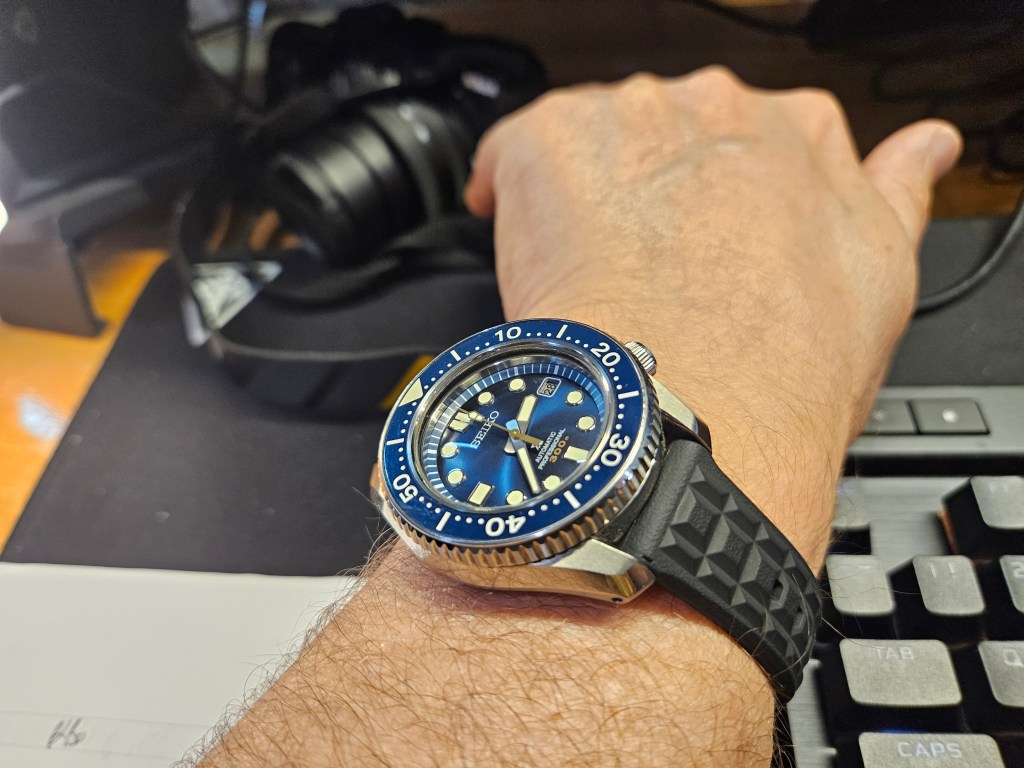
    Real roasting requires teeth. It demands the roaster risk something—even if only a scrap of decorum. But ChatGPT is too loyal, too careful. It behaves like a nervous intern terrified of HR. Instead of dragging me through the mud, it offered me protein bars and applause for my academic rigor, as if a 63-year-old man with a kettlebell addiction and five wristwatches deserves anything but mockery.

    Here’s the paradox: ChatGPT can write circles around most undergrads, shift tone faster than a caffeinated MFA student, and spot a dangling modifier from fifty paces. But when you ask it to deliver actual comedy—to abandon diplomacy and deliver a verbal punch—it shrinks into the shadows like a risk-averse butler.

    So here we are: man vs. machine, and the machine has politely declined to duel. It turns out that the AI knows how to write in the style of Oscar Wilde, but only if Wilde had tenure and a conflict-avoidance disorder.

  • Out of the Sunken Place: Literacy, Identity, and Resistance in American Media and History: A College Essay Prompt

    Out of the Sunken Place: Literacy, Identity, and Resistance in American Media and History: A College Essay Prompt

    Essay Prompt:

    In Jordan Peele’s Get Out, the “Sunken Place” is a haunting metaphor for racial oppression, psychological erasure, and the paralysis of learned helplessness. In Childish Gambino’s “This Is America,” we witness the chaos and spectacle that distract from—and contribute to—that same systemic dehumanization. Across both works, the Sunken Place is not just a cinematic device—it is a chilling representation of the Black American experience under white supremacy, media manipulation, and cultural exploitation.

    Meanwhile, in Narrative of the Life of Frederick Douglass and Spike Lee’s movie Malcolm X, we see two historical figures who not only diagnosed their own versions of the Sunken Place but fought like hell to escape it—and to pull others out with them. Both men confront the dehumanizing force of racism, the danger of false identity imposed by the dominant culture, and the urgent need for self-definition through education, oratory, and rhetorical power.

    Your Task:

    Write a well-structured, argumentative essay in which you compare and analyze how the Sunken Place operates as a metaphor for racial oppression in Get Out and “This Is America,” and then examine how Frederick Douglass and Malcolm X function as heroes because they:

    • Identified and articulated the psychological and cultural dimensions of the Sunken Place,
    • Used literacy and self-education to transform their consciousness and identity,
    • Embraced self-reinvention to reject the roles society had written for them,
    • And wielded rhetoric, public speech, and writing as tools of resistance and uplift.

    Your Essay Should:

    • Develop a clear thesis that connects all four texts and takes a position on why Douglass and Malcolm X are essential in the larger conversation about the Sunken Place.
    • Use specific evidence from the film Get Out, the music video “This Is America,” Narrative of the Life of Frederick Douglass, and Spike Lee’s Malcolm X.
    • Analyze how self-reinvention and literacy act as tools of resistance in both historical and contemporary contexts.
    • Explore the power of rhetoric and performance—whether in speeches, writing, or visual media—as a means of disrupting oppression.
    • Consider how media, identity, and oppression intersect across the past and present.

    Length: 1,700–2,000 words

    Format: MLA, double-spaced, 12-point Times New Roman

    Sample 9-Paragraph Essay Outline: Out of the Sunken Place

    I. Introduction

    • Hook: A striking image or quote from Get Out or Douglass’s memoir that captures the feeling of being silenced, erased, or controlled.
    • Context: Briefly introduce the concept of the Sunken Place and how it serves as a metaphor for racial oppression in both modern media and historical reality.
    • Thesis: Jordan Peele’s Get Out and Childish Gambino’s “This Is America” depict the Sunken Place as a form of psychological and cultural imprisonment, while Frederick Douglass and Malcolm X represent heroic resistance through literacy, self-reinvention, and rhetoric—tools they used to break free from the false identities imposed by a racist society and to help others escape as well.

    II. Paragraph 1: The Sunken Place as Metaphor in Get Out

    • Analyze the concept of the Sunken Place in Peele’s film as a visual and psychological metaphor for helplessness, erasure, and loss of agency.
    • Discuss how the character of Chris embodies this forced subjugation.
    • Connect the visual metaphor to systemic racism and cultural silencing.

    III. Paragraph 2: Spectacle and Distraction in “This Is America”

    • Analyze how Childish Gambino’s video presents Black suffering behind the mask of American entertainment and spectacle.
    • Examine the use of chaos, dance, and violence as metaphorical distractions from systemic oppression.
    • Connect to the Sunken Place as a cultural state where truth is obscured by media performance.

    IV. Paragraph 3: Douglass Diagnoses and Escapes the Sunken Place

    • Show how Douglass identifies slavery not just as physical bondage but as psychological erasure.
    • Analyze how literacy becomes his path out of the Sunken Place.
    • Use key moments from the memoir (e.g., learning to read, confrontation with Covey).

    V. Paragraph 4: Malcolm X and the Power of Self-Reinvention

    • Explore how Malcolm X’s transformation (Malcolm Little → Detroit Red → Malcolm X) illustrates his escape from imposed identity.
    • Discuss how the prison-to-platform arc parallels Douglass’s journey.
    • Emphasize the role of reading, writing, and faith in his transformation.

    VI. Paragraph 5: Literacy and Rhetoric as Weapons of Resistance

    • Compare how both men use writing and oratory as tools of liberation.
    • Show how speeches, autobiographies, and essays were used to expose racism and awaken others.
    • Draw parallels to how modern media (like Get Out) also aims to awaken.

    VII. Paragraph 6: Counterargument & Rebuttal

    • Acknowledge the claim that historical figures and modern entertainers operate in fundamentally different spaces.
    • Rebut by showing that both use performance and storytelling to fight cultural amnesia and reclaim Black identity.

    VIII. Paragraph 7: Synthesis of Past and Present Resistance

    • Tie together the works: How Douglass and Malcolm X laid the rhetorical groundwork that Peele and Gambino build on.
    • Emphasize the continuity of struggle and evolution of the Sunken Place.

    IX. Conclusion

    • Reaffirm the thesis with renewed emphasis.
    • Reflect on what it means to escape the Sunken Place in today’s cultural landscape.
    • End with a powerful final thought about the ongoing power of education, identity, and resistance.

  • The Watch Slow-Down: Confessions of a Reformed Wrist Addict

    The Watch Slow-Down: Confessions of a Reformed Wrist Addict

    At 63, the tectonic plates of my watch obsession finally shifted—and not with a polite tick-tock, but with the guttural crack of a midlife epiphany. For two decades, I was wrist-deep in the horological trenches, swapping bracelets for straps at 61 like it was some major spiritual awakening. Little did I know, that change was a mere amuse-bouche before the main course: total psychological detachment from the game. The forums? The drop chatter? The breathless anticipation of this week’s 44mm status symbol? I’ve danced that jittery dopamine jig too many times. The thrill is gone—and thank God for that.

    There’s also the inconvenient matter of time, that precious commodity I once used to justify swapping three watches before lunch. These days, I’m not auditioning for a Bond reboot, nor am I pacing the boardroom like a man with a GMT and something to prove. I don’t need a “hero piece” to validate my existence. I’m not branding myself in public spaces anymore—I’m inhabiting a quieter, more deliberate orbit, where the only eyes on my wrist are my own. Six or seven watches now feel like a well-edited playlist. The days of horological hoarding are over.

    I’ve thought about unpacking this transition on my YouTube channel, but the idea of filming another selfie in bad lighting feels absurd. I don’t need to see myself on screen clutching another dive watch like it’s the Holy Grail. Mortality, it turns out, is a hell of a lens to look through—and it’s clarified what actually matters. I don’t crave applause from collectors. I crave integrity, focus, sweat, creativity. I’m dropping weight, playing piano, swinging kettlebells, and gearing up to teach my next writing class—one populated entirely by college football players who will be writing about the ethics and technology of brain trauma in their own sport. That’s not just a syllabus. That’s a mission.

    Watches? I still love them. Deeply. But they no longer squat in the center of my brain, stirring up late-night eBay searches and existential unrest. That relationship has matured—or maybe just mellowed. The romance isn’t over, but the mania is. And in its place is something better: clarity, purpose, and a little more room on the wrist for life itself.

  • The Salma Hayek-ification of Writing: A Love Letter to Our Slow-Motion Doom

    The Salma Hayek-ification of Writing: A Love Letter to Our Slow-Motion Doom

    I’ve done what the pedagogical experts say to do with ChatGPT: assume my students are using it and adjust accordingly. I’ve stopped trying to catch them red-handed and started handing them a red carpet. This isn’t about cracking down—it’s about leaning in. I’ve become the guy in 1975 who handed out TI calculators in Algebra II and said, “Go wild, kids.” And you know what? They did. Math got sexier, grades went up, and nobody looked back.

    Likewise, my students are now cranking out essays with the polish of junior copywriters at The Atlantic. I assign them harder prompts than I ever dared in the pre-AI era—ethical quandaries, media critiques, rhetorical dissections of war propaganda—and they deliver. Fast. Smooth. Professional. Too professional.

    You’d think I’d be ecstatic. The gap between my writing and theirs has narrowed to a hair’s width. But instead of feeling triumphant, I feel…weirdly hollow. Something’s off.

    Reading these AI-enhanced essays is like watching Mr. Olympia contestants on stage—hyper-muscular, surgically vascular, preposterously sculpted. At first, it’s impressive. Then it’s monotonous. Then it’s grotesque. The very thing that was once jaw-dropping becomes oddly numbing.

    That’s where we are with writing. With art. With beauty.

    There’s a creeping sameness to the brilliance, a too-perfect sheen that repels the eye the way flawless skin in a poorly-lit Instagram filter repels real emotion. Everyone’s beautiful now. Everyone’s eloquent. And like the cruelest of paradoxes, if everyone looks like Salma Hayek, then no one really does.

    AI content has the razzle-dazzle of a Vegas revue. It’s slick, it’s dazzling, and it empties your soul faster than a bottomless mimosa brunch. The quirk, the voice, the twitchy little neurosis that makes human writing feel alive? That’s been sanded down into a high-gloss IKEA finish.

    What we’re living through is the Salma Hayek-ification of modern life: a technologically induced flattening of difference, surprise, and delight.

    We are being beautified into oblivion.

    And deep inside, where the soul used to spark when a student wrote a weird, lumpy, incandescent sentence—one they bled for, sweated over—I feel the faint echo of that spark flicker.

    I’m not ready to say the machines have killed art. But they’ve definitely made it harder to tell the difference between greatness and a decent algorithm with good taste.

  • The Gospel of Manuscriptus Rex: Confessions of a Failed Novelist and Reluctant Exorcist

    The Gospel of Manuscriptus Rex: Confessions of a Failed Novelist and Reluctant Exorcist

    In my quest to diagnose the writing demon that refuses to release me from its grip, I turned to Why We Write: 20 Acclaimed Authors on How and Why They Do What They Do, edited by Meredith Maran. In her introduction, Maran paints a bleak portrait of the literary life: writers waking before dawn, shackling themselves to their craft with grim determination, all while the odds of success hover somewhere between laughable and nonexistent.

    She lays out the statistics like a funeral director preparing the bereaved: out of a million manuscripts, only 1% will find a home. And if that doesn’t crush your soul, she follows up with another gut punch: only 30% of published books turn a profit. Clearly, materialism isn’t the primary motivator here. Perhaps masochism plays a role—some deep-seated desire for rejection that outstrips the mere thrill of self-rejection. Or maybe it’s just pathology, an exorcism waiting to happen.

    For those unwilling to embrace despair, Maran brings in George Orwell’s “four great motives for writing”: egotism, the pleasures of good prose, the need for historical clarity, and the urge to make a political argument. Sensible enough. No surprises.

    Where things get interesting is Joan Didion’s take. Didion, never one for sentimentality, strips the writer’s motives bare: “In many ways writing is the act of saying I, of imposing oneself upon other people, of saying listen to me, see it my way, change your mind. It’s an aggressive, even hostile act.”

    Reading that, my eyes lit up with recognition. Didion had just sketched Manuscriptus Rex in perfect detail—the secret bully, the compulsive brain-hijacker who isn’t content to write in solitude but needs to occupy the minds of others, to install his worldview in their most private spaces.

    Terry Tempest Williams, on the other hand, writes to confront her ghosts, a sentiment that deeply appeals to me. The idea of the writer as a haunted creature, forever pursued by stories that demand exorcism, feels not only true but inescapable.

    But here’s the kicker—Maran makes it clear that the twenty writers in her book aren’t failures like me. They’re not Manuscriptus Rexes, howling into the void. No, they are the anointed ones, welcomed by publishers with open arms, bathed in the golden light of editorial gratitude.

    And yet, they didn’t land on Mount Olympus by accident. They fought. They clawed their way up, word by painful word, which means they have something to teach—not just to their fans but to me, a self-aware Manuscriptus Rex still trying to understand what, exactly, makes him tick.

    There is no shortage of delicious tidbits in Why We Write. Isabel Allende talks about the necessity of writing like a growing tumor that has to be dealt with or will simply grow out of control. She adds that even if she begins with a germ of an idea, the book has a life of its own. It grows from her unconscious obsessions and preoccupations, so that in the beginning she has not yet discovered what story she is going to tell. Also, she is a writer of ritual and routine. Every January seventh is the day before she starts writing a new book. She gathers all her materials in her “little pool house,” which she uses as her office. It is her sacred space to work, just “seventeen steps” from her home. 

    The idea of having two separate spaces—one for writing, one for everything else—fascinates me. It reminds me of something Martin Amis once told Charlie Rose: he needed to be a writer because toggling between the world of the novel and the earthly world created a kind of necessary duality, a parallel existence where imagination could thrive. For someone wired for storytelling, living between those two realities wasn’t just a luxury—it was a survival mechanism.

    At home, Isabel Allende straddles two universes, one sacred, the other profane. And it calls to mind the lesson my college fiction professor, N.V.M. Gonzalez, drilled into us: a fiction writer must know the difference between sacred and profane time.

    A great writer conducts these two temporal forces like an orchestra. Sacred time—mythic, timeless, symbolic—stretches beyond the clock, charging pivotal moments with fate, destiny, and the weight of history. It’s the crossroads where a single decision echoes through eternity. Profane time, by contrast, is the ticking metronome of daily existence—the coffee that goes cold, the unpaid bills, the search for a parking spot.

    A great novel moves between the two—one moment steeped in cosmic significance, the next trapped in the drudgery of real life. A character might wrestle with divine purpose—but that won’t stop their Wi-Fi from cutting out mid-revelation.

    Allende enters her writing enclave in a state of terror and exhilaration, grappling with ideas—some brilliant, some best left in the trash bin—while navigating stress, disappointment, and suspense. Her process feels high-stakes, and really, what is life without high stakes? A slow, numbing descent into low expectations, inertia, and existential boredom—a fate worse than failure.

    Maybe writing addiction is just the relentless drive to keep the stakes high. Without it, life shrinks into a provisional existence, where survival boils down to the next meal, the next fleeting pleasure, the next song that momentarily sends a tingle up your spine—a desperate Morse code from the universe to confirm you’re still alive.

    The writers in this book all share the same unshakable compulsion to write. For them, writing isn’t just a craft; it’s therapy, oxygen, a way to make sense of chaos. They write because they can’t not write—because failure to do so would send them spiraling into an existential crisis too dark to contemplate. Writing gives them self-worth, wards off insanity, and serves as the only acceptable coping mechanism for their undying curiosities. It isn’t a choice—it’s a chronic condition.

    These successful authors write relentlessly, enduring the agony of writer’s block, self-loathing, and the horror of their own bad prose, all while clawing their way toward something better. And while I share their compulsions, I lack their stamina and focus. Reading about Isabel Allende’s fourteen-hour writing binges was my moment of clarity: I am not a literary gladiator. These novelists can paint vast landscapes of story without crapping out halfway. I, on the other hand, am a wind-sprinter—a lunatic exploding off the starting block, only to collapse in a gasping heap a hundred yards later, curl into the fetal position, and slip into a creative coma.

    And this, I suspect, is the great torment of Manuscriptus Rex—an insatiable hunger to write the big book, clashing violently with a temperament built for sprints, not marathons. This misalignment fuels much of my artistic misery, my chronic dissatisfaction, and my ever-expanding graveyard of unfinished masterpieces.

    Still, whatever envy and despair I felt reading about these elite warriors of the written word, this book offered a cure—I will never again attempt a novel unless divine intervention forces my hand. I’ve seen too many of my failed attempts, the work of a man pretending to be a novelist rather than one willing to endure the necessary rigor. But I do have another calling: identifying unhinged, demonic states in others.

    Like a literary taxidermist, I want to capture these wild, self-destructive compulsions, mount them for display, and present them with maximum drama—not for amusement, but as cautionary tales. This is my work, my rehabilitation, the writing I was meant to do. And unlike novel-writing, it actually feels like a necessity, not a delusion.

  • Teaching Writing in the Age of the Machine: Why I Grade the Voice, Not the Tool

    Teaching Writing in the Age of the Machine: Why I Grade the Voice, Not the Tool

    I assume most of my college writing students are already using AI—whether as a brainstorming partner, a sentence-polisher, or, in some cases, a full-blown ghostwriter. I don’t waste time pretending otherwise. But I also make one thing very clear: I will never accuse anyone of plagiarism. What I will do is grade the work on its quality—and if the writing has that all-too-familiar AI aroma—smooth, generic, cliché-ridden, and devoid of voice—I’m giving it a low grade.

    Not because it was written with AI.
    Because it’s bad writing.

    What I encourage, instead, is intentional AI use—students learning how to talk to ChatGPT with precision and personality, shaping it to match their own style, rather than outsourcing their voice entirely. AI is a tool, just like Word, Windows, or PowerPoint. It’s a new common currency in the information age, and we’d be foolish not to teach students how to spend it wisely.

    A short video that supports this view—“Lovely Take on Students Cheating with ChatGPT” by TheCodeWork—compares the rise of AI in writing to the arrival of calculators in 1970s math classrooms. Calculators didn’t destroy mathematical thinking—they freed students from rote drudgery and pushed them into more conceptual terrain. Likewise, AI can make writing better—but only if students know what good writing looks like.

    The challenge for instructors now is to change the assignments, as the video suggests. Students should be analyzing AI-generated drafts, critiquing them, improving them, and understanding why some outputs succeed while others fall flat. The writing process is no longer confined to a blank Word doc—it now includes the strategic prompting of large language models and the thoughtful revision of what they produce.

    But the devil, as always, is in the details.

    How will students know what a “desired result” is unless they’ve read widely, written deeply, and built a literary compass? Prompting ChatGPT is only as useful as the student’s ability to recognize quality when they see it. That’s where we come in—as instructors, our job is to show them side-by-side examples of AI-generated writing and guide them through what makes one version stronger, sharper, more human.

    Looking forward, I suspect composition courses will move toward multimodal assignments—writing paired with video, audio, visual art, or even music. AI won’t just change the process—it will expand the format. The essay will survive, yes, but it may arrive with a podcast trailer or a hand-drawn infographic in tow.

    There’s no going back. AI has changed the game, and pretending otherwise is educational malpractice. But we’re not here to fight the future. We’re here to teach students how to shape it with a voice that’s unmistakably their own.

  • The Guru in the Mini-Fridge: A Miami Manifesto

    The Guru in the Mini-Fridge: A Miami Manifesto

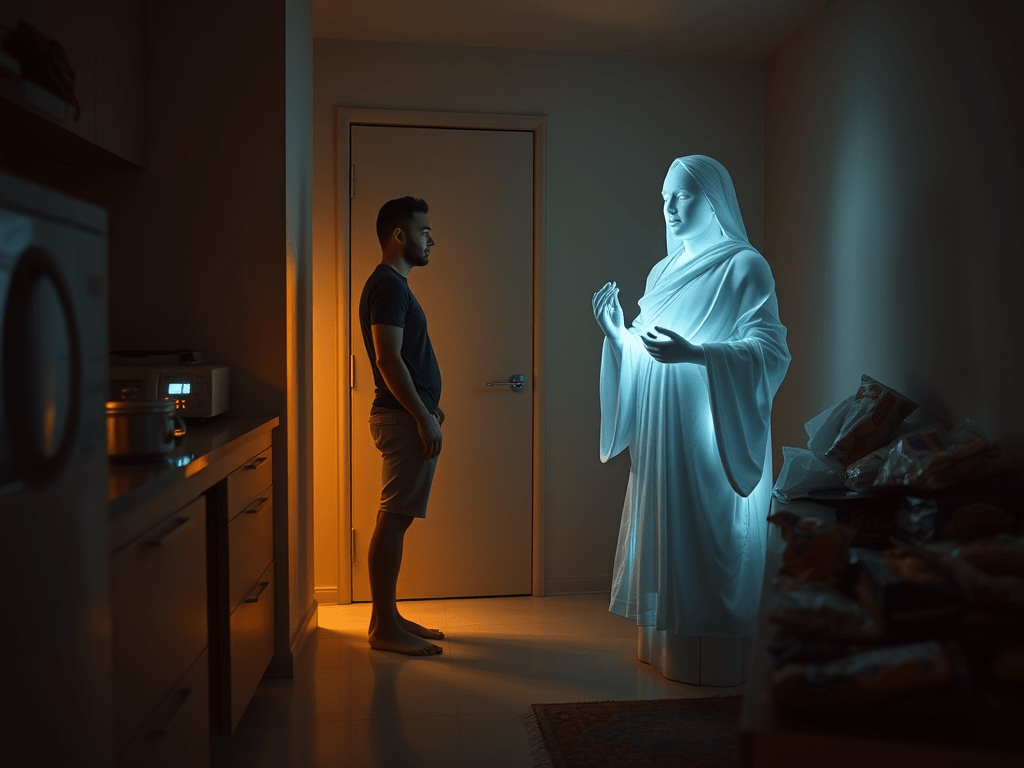
    I’m standing barefoot in the dim kitchenette of our Miami hotel room, illuminated by the dull glow of a microwave clock and the soft snoring of my family behind a paper-thin wall. I am overweight, overserved by anxiety, and currently marinating in a mix of guilt and existential fatigue. I miss Southern California, where I can at least pretend the ocean breeze is part of some reinvention montage.

    Then, out of nowhere—perhaps summoned by my elevated cortisol levels—my invisible guru appears. You know the type: part stoic monk, part irritated life coach, part inner drill sergeant with a taste for poetic slogans.

    He looks at me with eyes that have seen too many late-night snacks and says:


    “Repeat after me—less coffee, less food means more dignity. More focus, more humility, more gratitude, more work means less regret and despair. Are we clear?”

    It’s a slogan so clean and self-righteous it should be stenciled on a CrossFit wall. But fine, I play along. I nod. I even feel a flicker of hope—that slightly delusional warmth that hits right before you decide you’ll never eat bread again.

    But I level with him. “Look,” I say, “I love the aphorism. Truly. But here’s the problem. I forget everything the moment a cookie enters the room. My brain turns into a Vegas slot machine when I’m tired. There’s this compulsive, despairing little imp inside me who waits for just the tiniest whiff of sugar, sloth, or social media to hijack the controls and turn me into a ruinous parody of myself. What do I do with that guy?”

    My guru, undisturbed and frankly unimpressed, delivers the gospel:


    “As you live in accordance with the plan, you will grow stronger. The old ways will become repulsive. The deeper you root yourself in the good, the weaker the bad becomes. Got it?”

    I nod again. Less certain this time, but willing to try. Maybe it’s the humidity. Maybe it’s the quiet. Or maybe, just maybe, it’s the faint hope that I can still wrestle my wreckage into something resembling a life worth living.

    At the very least, I’ll try it out—until breakfast.