Tag: wwe

  • The Gospel of the Liver King

    The Gospel of the Liver King

    Brian Johnson, better known as the Liver King, is a steroidal cartoon who tried to sell himself as a prophet of “ancestral living.” In reality, he was just another hustler juicing his body with over a hundred grand a year in growth hormones and anabolic steroids. He strutted around Instagram in animal skins, bellowing like a berserk Viking, gnawing raw liver on camera, and flogging overpriced supplements. His entire empire collapsed the moment it was revealed that his shredded physique was less the fruit of caveman purity and more the handiwork of pharmacy-grade science.

    Instead of bowing out in disgrace, he doubled down. Unable to detach from the narcotic glow of internet celebrity, he documented his own unraveling in real time—YouTube became his padded cell, each video another entry in the world’s strangest public diary. He wanted to be remembered as a leader, a liberator from modern malaise, but he became a parody of himself, a sideshow Rambo gone rancid.

    Raw meat became his metaphor—masculinity, toughness, a primal rejection of processed life. But it was also cosplay, a carnival act built for the algorithm, because nothing feeds clicks like a maniac tearing into a bull testicle with his teeth. And young men, starving for meaning, saw not a fraud but a messiah: the steroidal savior who would flex them into the promised land.

    This was kayfabe 2.0. Vince McMahon taught wrestlers never to break character, and Liver King took that gospel straight to Instagram. Only he forgot the cardinal rule: kayfabe consumes you. Live in the gimmick long enough and the gimmick swallows the man. By the end, Liver King wasn’t selling a mask—he was the mask, devoured whole by his own performance.

    His collapse is bigger than one delusional influencer. It’s a commentary on the culture itself: a society so anesthetized by spectacle that it mistakes bombast for wisdom. Idiocracy predicted a wrestler-president peddling electrolytes; we got a shirtless Texan chewing raw liver and pushing HGH cocktails disguised as authenticity. Mike Judge wasn’t satirizing the future—he was reporting it early.

    And yet, there is something deeply American in the Liver King’s fall: the grift, the spectacle, the refusal to relinquish the stage even when the show is over. His tragedy is that of a man who wanted love, found instead an algorithm’s approval, and now cannot escape the cage of his own creation.
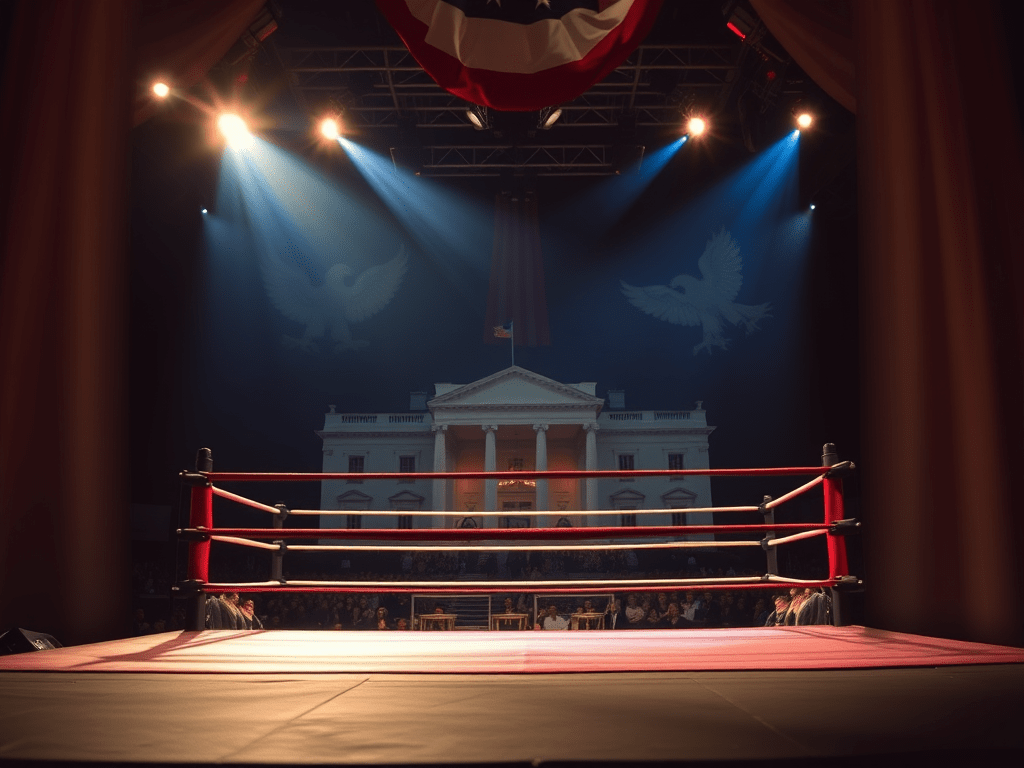
  • Kayfabe Nation: How Wrestling Pinned American Politics: Exploring the Blurred Line Between Performance and Reality in the Post-Truth Era: A College Writing Prompt

    Kayfabe Nation: How Wrestling Pinned American Politics: Exploring the Blurred Line Between Performance and Reality in the Post-Truth Era: A College Writing Prompt

    Prompt:
    In his essay “The Rise and Fall of Vince McMahon,” Vinson Cunningham examines how the theatricality and blurred lines between reality and fiction in professional wrestling have permeated American politics, leading to a culture where spectacle often trumps substance. This phenomenon raises concerns about the erosion of truth and the rise of performative politics.

    Drawing upon the Netflix docuseries Mr. McMahon, Cunningham’s insights and the following essays, analyze the extent to which professional wrestling’s narrative techniques have influenced contemporary political discourse. Consider the implications of this shift for democratic processes, public trust, and the role of media in shaping political realities.

    Related Readings:

    1. Cunningham, Vinson. “The Rise and Fall of Vince McMahon.” The New Yorker, October 21, 2024. 
    2. Greene, Dan. “How Much Does Pro Wrestling Matter?” The New Yorker, March 31, 2023. 
    3. Hendrickson, John. “How Wrestling Explains America.” The Atlantic, March 26, 2023.
    4. Hendrickson, John. “Trump’s WWE Theory of Politics.” The Atlantic, March 31, 2023. 
    5. Parker, James. “Viceland’s ‘Dark Side of the Ring’ Shows the Sleaze and Humanity of Wrestling.” The Atlantic, May 17, 2019. 
    6. Newkirk II, Vann R. “Jesse Ventura’s Theory of Politics.” The Atlantic, July 25, 2016. 
    7. Haidt, Jonathan. “Why the Past 10 Years of American Life Have Been Uniquely Stupid.” The Atlantic, April 11, 2022. 
    8. Garber, Megan. “Are We Having Too Much Fun?” The Atlantic, April 27, 2017.
    9. Beckerman, Gal. “A Book That Was Like Putting on ‘a New Set of Glasses.’” The Atlantic, November 3, 2023.
    10. Miller, Laura. “Still Amusing Ourselves.” Slate, March 25, 2025.

    Instructions:

    • Thesis Development: Formulate a clear, argumentative thesis that addresses the influence of professional wrestling’s narrative style on American political discourse.
    • Evidence Integration: Support your argument with specific examples and quotations from the provided readings. Analyze how these examples illustrate the blending of entertainment and politics.
    • Critical Analysis: Evaluate the consequences of this phenomenon for democratic engagement and public perception of truth. Consider counterarguments and address potential criticisms of your position.
    • Conclusion: Summarize your findings and reflect on the broader implications for the future of political communication and civic responsibility.

    Essay Requirements:

    • Length: 1,500–2,000 words
    • Citations: Use MLA format for in-text citations and the Works Cited/References page.
    • Submission: Typed, double-spaced, 12-point Times New Roman font

    Here’s a 9-paragraph essay outline for the prompt “Spectacle Over Substance: Wrestling’s Influence on American Political Discourse.” This outline follows a logical, argumentative structure that weaves together the assigned readings while encouraging students to build a cohesive, persuasive essay.


    I. Introduction

    • Hook: Begin with a vivid moment—perhaps Trump’s triumphant fist pump after the assassination attempt, or Vince McMahon strutting to the ring—blurring entertainment and politics.
    • Context: Introduce Vinson Cunningham’s claim that McMahon’s wrestling empire laid the foundation for modern American political spectacle.
    • Thesis Statement: American politics has adopted the narrative strategies of professional wrestling—flattening truth, elevating spectacle, and turning public discourse into a performance—creating a civic culture where democracy is treated less like a system of governance and more like a ratings game.

    II. The McMahon Doctrine: Kayfabe and the Politics of Performance

    • Define kayfabe (the wrestling term for presenting fiction as real) and show how McMahon’s WWE blurred the lines between villainy and heroism for the sake of crowd reaction.
    • Use Cunningham’s insights to show how this strategy has infiltrated American political identity: politicians as characters, scandal as storyline, truth as a flexible tool.

    III. Trump as Wrestling Archetype

    • Draw on John Hendrickson’s The Atlantic essays and Cunningham’s portrayal of Trump’s staged bravado.
    • Analyze how Trump models the heel-turned-babyface narrative, using defiance, cruelty, and performative grievance to cultivate loyalty.
    • Show how this political theater leaves truth irrelevant—as long as the audience is entertained.

    IV. The Algorithm Joins the Ring

    • Introduce the role of social media algorithms in amplifying performative politics.
    • Reference Haidt’s and other essayists’ concerns about how outrage and spectacle rise to the top of the feed.
    • Connect to WWE’s formula: escalation, emotional arousal, and moral oversimplification.

    V. Wrestling with the Truth: The Death of Nuance

    • Explore how the binary storytelling of wrestling—good guys vs. bad guys—maps onto political polarization.
    • Use Cunningham and Greene to illustrate how political complexity has been flattened for audience catharsis and tribal loyalty.
    • Show how this environment punishes nuance, deliberation, and compromise.

    VI. The Erosion of Democratic Discourse

    • Argue that when politics becomes performative, democratic institutions suffer: debates become promos, policies become props.
    • Use Vann R. Newkirk II’s piece on Jesse Ventura to show how long this has been brewing.
    • Analyze the consequences: diminished trust, manipulated electorates, and emotional extremism.

    VII. Counterargument: Populist Connection or Dangerous Spectacle?

    • Acknowledge the defense: wrestling-style politics connects to “the people,” makes issues accessible, and breaks elite control of discourse.
    • Rebut: accessibility without integrity breeds demagoguery, and emotional spectacle is not a substitute for civic truth.

    VIII. Cultural Addiction to Spectacle

    • Tie together the readings’ concern that Americans are now addicted to the drama of public life more than its consequences.
    • Show how wrestling trained audiences to want louder, meaner, simpler characters—and how democracy now suffers for it.
    • Cite Dark Side of the Ring or How Wrestling Explains America for evidence of how low the spectacle can go.

    IX. Conclusion

    • Reaffirm thesis: politics has become wrestling with better suits and worse consequences.
    • Reflect on Cunningham’s closing concern: if spectacle is the new substance, democracy is no longer deliberative—it’s kayfabe.
    • Close with a challenge to the reader: if we want a democracy rooted in reality, we’ll need to stop confusing entertainment with governance.
  • The Death of Truth: Vince McMahon, the Algorithm, and the Rise of Unreality

    The Death of Truth: Vince McMahon, the Algorithm, and the Rise of Unreality

    In “The Rise and Fall of Vince McMahon,” New Yorker writer Vinson Cunningham stares into the sideshow funhouse mirror of American public life and recoils at what stares back: a nation wading chest-deep in a swamp of “public unreality,” where reason drowns and absurdity floats like a bloated carnival prize. He paints a disquieting tableau: one political figure visibly unraveling into cognitive soup while handlers chirp, “Nothing to see here!”—and another candidate howling about alien intruders abducting and gobbling the nation’s household pets. As if things weren’t deranged enough, an assassination attempt unfolds before our eyes—and instead of ducking for cover, the former President rises like a messianic pro-wrestler, bloody and defiant, pumping his fist in glorious kayfabe triumph. In that moment, Cunningham writes, he isn’t just a politician—he’s a character on the WWE stage. And just like that, the cultural script is flipped: he’s the babyface, and his critics are heels.

    This unreality show has a ghostwriter, and his name is Vince McMahon. As Cunningham brilliantly argues, the Netflix docuseries Mr. McMahon is not simply the chronicle of a wrestling mogul—it’s a grim allegory for how American storytelling devolved into moral junk food. McMahon, the snarling CEO of WWE, pioneered a brutal formula: distort narrative, vilify truth, exalt spectacle. He didn’t just conquer the wrestling world—he scripted a worldview that has metastasized into the nation’s political bloodstream. The WWE, Cunningham reminds us, is the prototype of reality TV, the primordial ooze from which influencer culture, troll politics, and clickbait populism have crawled.

    In McMahon’s moral universe, lying is a skill, cruelty is charisma, and domination is the only virtue. So long as you win—and do it with flair—you’re golden. Sound familiar? This cartoon villainy, once confined to the ring, now governs the debate stage. It infects our civic discourse like a virus in a locker room. Cunningham doesn’t just lament this transformation—he diagnoses it with the precision of someone who’s watched democracy tap out to the roar of an overstimulated crowd.

    For Cunningham, Mr. McMahon is a documentary about wrestling in the same way Jaws is about fishing. It’s a cautionary tale about the American mind: how we’ve flattened good and evil into caricature, how we crave cheap catharsis and blood-soaked redemption arcs, how dopamine-dripping spectacle has replaced the hard work of truth and critical thought. WWE fans were just the beta testers—social media made us all marks. And if you think it can’t get worse, Cunningham points you to wrestling’s most grotesque era, the “Attitude Era,” when the distinction between hero and villain disintegrated entirely. No good guys, no bad guys—just degenerates in speedos vying for attention through escalating acts of moral collapse. A decade later, Twitter took notes.

    Cunningham’s alarm is more than justified. American politics isn’t just flirting with the WWE playbook—it’s plagiarizing it. We are no longer governed by statesmen but by characters playing to the cheap seats. When every tweet is a finishing move, every debate a promo, and every scandal a setup for the next storyline, democracy isn’t just weakened—it’s kayfabe’d. And Vince McMahon, smirking from his throne of steroid-soaked storylines, already wrote the script.