In June of 1999, I did what a college professor cannot do: I lost the classroom key. Yes, the sacred, university-issued key that was supposedly worth more than its weight in gold and was meant to be guarded as if it were the last surviving relic of Atlantis. After a frantic week of turning my Redondo Beach condo upside down—searching under couch cushions, rifling through laundry baskets, and even interrogating the houseplants—I had to admit defeat. I was summoned to face the wrath of the university’s ice queen of administration, who greeted me with a glare that could freeze lava. “The one thing a college instructor does not do,” she said, as if reciting an ancient curse, “is lose his key.” She inspected me as if I were a criminal in a bad noir film, and then informed me that I had to make a pilgrimage to the edge of campus, to the mythical and dreaded realm known as Plant Ops, to pay for a key replacement with cash only. I felt like I was being sent to Mordor to drop off a pizza.
So, I embarked on this perilous quest, driving east from campus. At first, the road was a decent pavement. But soon, it disintegrated into a wasteland of dirt, rubble, and potholes the size of small craters. My car bucked and jolted over the rocky path, like an old west wagon on a treasure hunt, as I passed ghostly rows of cow skulls and tumbleweeds rolling by in the wind like some grim, dusty parade. Above me, buzzards circled, perhaps in anticipation of a fresh meal or merely to witness my impending doom.
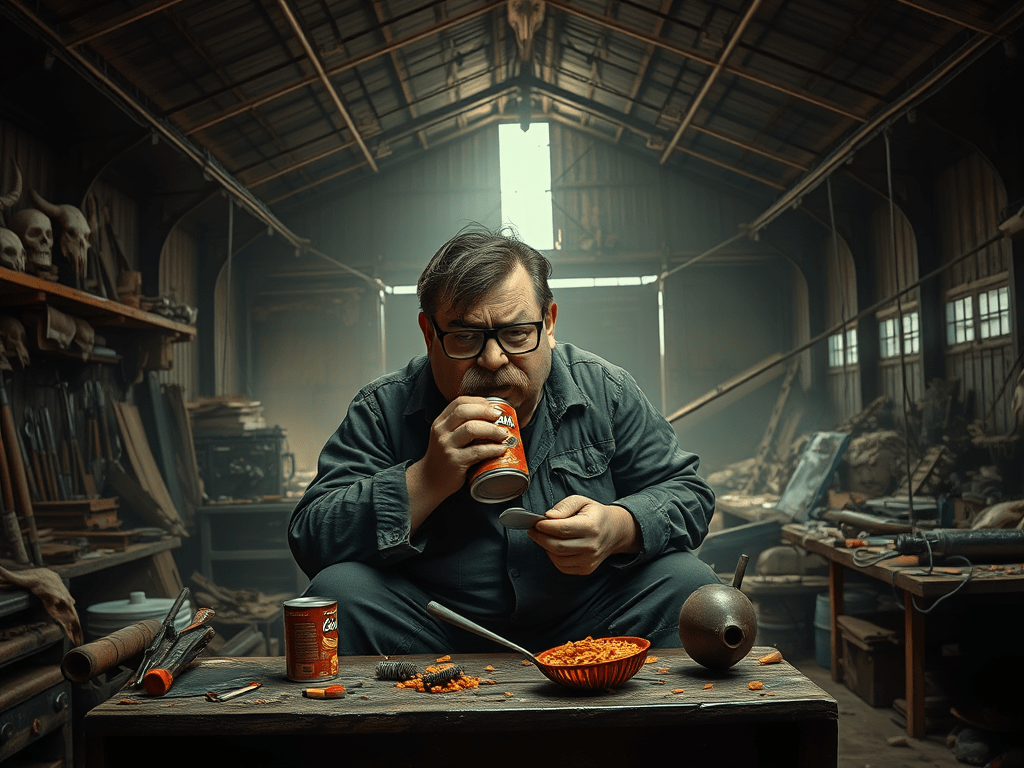
Just as despair was about to pull me under, a nauseating aroma of glue, pickles, and formaldehyde wafted through the air, signaling the arrival of my destination. I squinted through the gloom to see a structure emerge from the fog—a dilapidated hangar that looked like it had been plucked from a post-apocalyptic movie set. Inside was the world’s most disgruntled handyman, a short, rotund man with glasses thick enough to start a small library, a bushy mustache that looked like it was trying to escape his face, and a head bald enough to use as a landing strip for insects. He was hunched over a workbench, devouring SpaghettiOs straight from the can with the kind of focus usually reserved for nuclear codes. His irritation at being interrupted was palpable, like I’d crashed his private spaghetti party.
“Twenty dollars cash,” he grunted, extending his hand with the authority of a toll collector in the underworld. I handed him the bill with the reverence of a pilgrim offering gold to a god. He stuffed it into his grease-splattered apron, took another spoonful of his cold, canned meal, and scowled at me like I’d personally betrayed him. With the wind howling through the thin steel walls of the hangar, I half expected the place to take off and join Dorothy’s house in the sky. The handyman delivered his parting words with the gravitas of a crypt keeper: I must never lose a key again, lest I face the incompetence of his replacement, who was, according to him, a veritable nincompoop with the locksmithing skills of a potato. I thanked him, exited the hangar, and raced straight to the nearest hardware store. I bought a keychain made of Kevlar, equipped with a tether reel and a high-density nylon belt loop—basically, a key-keeping apparatus that could survive a nuclear blast. It was clear I’d never let my keys out of my sight again, lest I face another odyssey to the land of a disgruntled Plant-Ops overlord.
 Cinemorphosis
Leave a comment