Tag: short-story

  • The Visitor from the Abyss

    The Visitor from the Abyss

    On a bright spring afternoon in Southern California in 1998, my writing class was dissecting evil with the clinical confidence of people who believed it could be contained in literature. We were discussing The Painted Bird, a novel so saturated with human cruelty that it feels less like fiction and more like a dare. The room hummed with theories—evil as social construct, evil as pathology—until my students quietly dismantled the abstraction. They believed in evil not as metaphor, but as presence. Ghosts. Demons. Things seen and not forgotten.

    One single mother spoke of something that crawled beneath her bed at night. She said it plainly, without theatrics, which made it worse. Another student, a nurse in her forties who worked long shifts at UCLA, waited until after class. “I have a story,” she said, as if announcing a diagnosis that required privacy.

    She didn’t look like someone given to fantasy. She was compact, practical, her thick glasses enlarging eyes worn down by long hours and human frailty. Her stories usually involved difficult patients or her childhood in rural Louisiana—earthbound things. But as she began, her voice shifted, acquiring a distant cadence, as if she were tuning into a frequency not meant for daylight.

    She was six or seven at the time, roaming the backwoods with her cousin Carmen. No supervision, no schedule, no adult intervention. Their days were filled with the idle cruelty of children left alone too long—tormenting small animals, inventing games that escalated from mischief into something darker. There were no witnesses, no consequences, and so no brakes.

    Until one afternoon.

    They were inside the farmhouse, a sagging structure with a porch that complained with every step. The screen door creaked open. A man walked in and sat down in the living room as if he owned the place.

    But he wasn’t a man.

    She struggled to describe him without sounding ridiculous. He wasn’t clothed, but that detail felt irrelevant. His body was covered in coarse, matted fur. His skin—if it could be called that—had the pallor and texture of a rodent. Behind him trailed a long, muscular tail that slid along the floor and flicked against the doorframe like a living whip. He looked like something assembled from nightmare logic: a giant rat that had decided to stand upright and enter a house.

    The girls didn’t run. They couldn’t. Fear locked them in place, as if the room itself had thickened.

    He began to speak.

    For hours—she was certain it lasted hours—he sat in that chair and talked. His voice was low and abrasive, as if it scraped its way into the room. He told stories about the things he had done, the damage he had caused, the harm he had perfected. Time lost its structure. The afternoon stretched into something shapeless and suffocating.

    Then he turned his attention to them.

    “I’ve seen how bad you girls are,” he said. “I’ve seen what you’ve been doing.”

    And then he began to list their offenses. Not generalities—details. Every small cruelty, every secret act they had committed when no one was around. Things no adult had witnessed. Things no one could have reported.

    “I’m going to recruit you,” he said. “I’m going to make you mine.”

    The threat didn’t rise in volume. It settled into the room, thick and toxic, like something you could breathe in and never fully expel. His eyes stayed on them the entire time, unblinking, patient, certain. He described what would happen if they continued, not in vague moral warnings, but in precise, almost administrative terms—consequences rendered as inevitabilities.

    The girls sat frozen, their bodies no longer their own.

    And then, as casually as he had entered, he stood up and left. The tail followed him out like an afterthought, sliding across the threshold and disappearing into the heat.

    Silence rushed back into the house.

    Carmen finally whispered, “Did you see that?”

    My student nodded. Speech had abandoned her.

    From that day forward, their lives snapped into alignment. No more cruelty. No more experimentation with harm. They went to church. They prayed. They obeyed. Not out of virtue, but out of fear sharpened into obedience. Whatever had visited them had not suggested a path—it had enforced one.

    I would have preferred to dismiss the story as delusion, but that option didn’t fit the teller. This was a woman trained to assess reality, to separate symptom from fabrication. She spoke without embellishment, without the slightest interest in persuading me. She wasn’t selling a story; she was reporting an event that had rearranged her life.

    It unsettled me more than I expected.

    At the time, I was living alone in a condo in Redondo Beach, the kind of place that feels harmless until night gives it edges. One evening, I had a dream about the Cowardly Lion from The Wizard of Oz. Only this version had shed all pretense of cowardice. He chased me, snarling, his face twisted into something feral and wrong.

    I woke up, but the dream didn’t fully release me.

    At the foot of my bed, I felt it—presence. Not a thought, not a leftover image, but something that occupied space. The lion-man sat there, immense, silent, undeniable. Fear pinned me in place. Breathing became an effort, as if the air itself had thickened in protest.

    After several long seconds, I forced movement into my body. I stood, walked up the stairs on unsteady legs, poured a glass of water like someone performing a ritual they barely believed in. When I returned, I flooded the room with light, turned on the television, filled the silence with noise until the presence thinned and finally dissolved.

    Like pain receding from a crushed hand—slow, stubborn, but eventually gone.

    What stayed was the recognition.

    Evil is not just an idea we debate in classrooms or confine to novels. It has a way of presenting itself—not always dramatically, not always visibly, but with enough force to alter how you move through the world. Once you’ve felt it, even briefly, it leaves a residue. A knowledge that doesn’t argue its case. It simply waits, somewhere just beyond the edge of explanation.

  • The Night My Biceps Filed for Divorce

    The Night My Biceps Filed for Divorce

    My pride as a lifelong bodybuilder—still clinging to relevance in my sixties—met its demise one evening on the couch, where I lay in a slovenly posture and glazed-over eyes while watching the movie Road House. Calling it a film feels charitable. It’s more like a glossy shrine to the male physique, starring a Jake Gyllenhaal so surgically chiseled he looks as if Michelangelo started carving David, lost patience, and decided to make him punch strangers for a living.

    Gyllenhaal plays a brooding bouncer in Key West, a man whose job description consists of protecting a bar and its luminous owner, played by Jessica Williams, from the usual parade of cinematic degenerates. This inevitably summons the film’s apex predator: Conor McGregor, who appears less like a human being and more like a shaved grizzly bear that discovered performance enhancers and never looked back. Veins bulge with the enthusiasm of overinflated garden hoses. His performance oscillates between feral animal and man who hasn’t blinked since the Obama administration, and it’s oddly mesmerizing.

    The plot is a rumor—thin, fleeting, and functionally irrelevant. A stranger rides into town, restores order with his fists, and exits in a cloud of testosterone and broken cartilage. But let’s not pretend narrative is the point. The camera worships muscle with the reverence of a Renaissance chapel. Biceps gleam. Lats ripple. Every slow-motion shot feels like a commercial for pre-workout powder and substances that come in unmarked vials. This isn’t storytelling; it’s a two-hour flex.

    Somewhere between Gyllenhaal’s forty-seventh shirtless entrance and McGregor’s latest snarl—delivered like a man hydrated exclusively by rage—I reached for my phone. Not to check the time. To search McGregor’s diet. Because this spectacle doesn’t entertain; it indicts. It shines a harsh fluorescent light on your own soft edges and whispers, You, sir, are a sentient pudding cup.

    At sixty-two, I knew I wasn’t about to carve myself into Gyllenhaal’s likeness. But I was still in the fight—kettlebells in the garage four days a week, the exercise bike on the others. My diet remained high-protein, though compromised by opportunistic snacking. The result: less Greek statue, more a compact, perspiring version of Larry Csonka in a Hawaiian shirt, lingering too long at the Grand Wailea buffet.

    I entertained fantasies of becoming a skinny version of myself. Replace kettlebells with yoga. Trade meat-heavy sandwiches for two plant-based meals a day of steel-cut oats, bell peppers, and tofu. But a chorus of old convictions intervened: maintain the protein intake, preserve the muscle, defend the territory. Five servings of “bioavailable protein” a day. No surrender. Somewhere along the way, fitness had ceased being about health and hardened into doctrine.

    I hadn’t competed since finishing runner-up in the 1981 Mr. Teenage San Francisco, but the mindset endured: life as contest, existence as proving ground. That belief wasn’t accidental. It was inherited. My father—infantryman turned engineer—treated life like a problem to be solved and a battle to be won.

    In the early 1960s, stationed in Anchorage, he found himself competing with another suitor—John Shalikashvili—for my mother’s affection. When Christmas interrupted the contest, my father refused the ceasefire. He cut his holiday short, intent on beating his rival back to Alaska. His vehicle—a pale 1959 Morris Minor—chose that moment to revolt, its fuel system failing with impeccable timing.

    Lesser men would have conceded. My father reached for ingenuity. Lacking a proper part, he improvised with a prophylactic and a paperclip, fashioning a grotesque but functional fix. It was absurd. It was desperate. It worked. He made it to Seattle, boarded the ferry, and arrived in Alaska forty-eight hours ahead of his rival.

    Nine months later, I entered the world—the byproduct of competitive instinct, mechanical improvisation, and what must surely be the most unorthodox application of latex in automotive history. In that moment, my father didn’t just win a race. He set a standard: adapt, outmaneuver, prevail. And decades later, as I sat watching sculpted demigods on screen, I realized that standard was still quietly running my life.

  • The Sacred Thud and the Beachside Alibi

    The Sacred Thud and the Beachside Alibi

    Last night I dreamed I visited a man who lived in an apartment not with furniture, but with his fleet of Lexus sedans, each one folded into suitcase-sized cardboard boxes like obscene luxury origami. When he carried them outside, they bloomed into full-sized cars—sleek, silent, and faintly smug. One in particular arrested me. It was labeled “brown,” a word that should have condemned it to mediocrity, but this was no pedestrian brown. It shimmered with a platinum undertone, a molten, aristocratic hue that made every other color feel like a clerical error.

    But the color was only the prelude. The real seduction was auditory. The man insisted I open and close the door. I obliged. The door shut with a dense, ceremonial thud—the kind of sound that suggests not merely engineering, but finality. It was the closing argument of a life well lived. I felt it in my chest, in my bones. At that moment, I understood with humiliating clarity that I would never feel complete until I owned this exact car in this exact shade and could summon that sacred thud on command. This, apparently, was my apotheosis.

    Once the demonstration concluded, he ushered me into his living room, where a large television glowed like an altar. It was tuned to CNN. On the screen: live coverage of his wife undergoing surgery for a rare and aggressive cancer. The procedure was experimental, a medical moonshot that, if successful, would not only save her life but advance the entire field. Her body lay open to the future; her survival would be a headline.

    The man watched with a peculiar intensity, not the anxious devotion of a husband, but the focused anticipation of someone waiting for a green light. He explained, almost casually, that once she was cured, he intended to meet his mistress at the beach. A public affair, he admitted, would be considered “unethical,” but surely—he reasoned—if his wife survived, the moral calculus would soften. One good outcome would offset the other. Balance restored.

    I stood there, staring at the screen. The broadcast cut between the operating table and a glowing chart tracking her biomarkers in real time—green lines twitching, rising, negotiating with fate. He leaned forward, eager, almost buoyant, rooting for her survival so he could proceed, unburdened, to his afternoon of betrayal.

    The room was quiet except for the hum of the television and, somewhere in the distance of my mind, the echo of that perfect car door closing—clean, decisive, final.

  • My Life, Annotated; My Dinner, Missing

    My Life, Annotated; My Dinner, Missing

    Last night I dreamed I was back in a college dorm, the kind that confuses scarcity with philosophy. The place ran on grievance and empty shelves. The communal kitchen looked like it had been looted by graduate students—half a bottle of soy sauce, a fossilized lime, and the lingering odor of arguments. The factions were loud, doctrinaire, and permanently aggrieved; the refrigerator was quiet and permanently bare. I kept my mouth shut. Hunger is easier to manage than other people’s ideologies.

    A short walk away—dream geography is generous like that—sat my mother’s second husband, Baron, who has been dead since 2018 and therefore was very much alive. He wore a white football jersey and the expression of a man auditing eternity. He’d set up on a patio with a notebook and a stack of my YouTube videos, which he was mining for a college project. The topic: my life, the false stories I’ve told about it, the false stories about those false stories, and the small industry I’ve built turning all of it into myth. He watched, paused, rewound, took notes with clerical devotion. It was flattering in the way a tax audit is flattering.

    Part of me admired the rigor. Another part of me bristled at the freeloading. There he was, piggybacking on my past like it was a group project I didn’t sign up for. Still, the man was thorough. He unearthed old footage, journals, drawings—artifacts I’d misfiled in the archive of things I no longer had the energy to remember. If diligence were destiny, he was on his way to a summa.

    I wished him luck and went back to the kitchen, where luck goes to die. As I left, Baron called out that he’d put a beige bowl of hard-boiled eggs on the top shelf of the fridge. Help yourself. The promise of protein felt like a minor miracle. I elbowed through the crowd—everyone arguing, no one eating—opened the door, and there it was: the beige bowl, perfectly placed, impeccably empty. The eggs had been converted into theory.

    So I stood there, starving, while somewhere behind me my life was being reduced to footnotes. In the dream, as in the waking world, the analysis was abundant. The food was not.

  • The Travails of Horological Identity Drift

    The Travails of Horological Identity Drift

    To have a hobby is to cultivate an identity. The longer you grow in the hobby, the more you learn about yourself, your likes, dislikes, and inclinations. If you’re a watch collector, as I am, you gravitate to certain types of watches and retreat from others. You cannot explain your inclinations. When fellow watch collectors notice you share a proclivity for a type of watch, there is both a bond and a fellowship. When the fellow watch collectors notice your tastes clash with theirs, disappointment and even hurt feelings can ensue. Within the larger watch hobby, there are subcategories, where collectors branch off and form tight alliances, tribes, and deeply-forged bonds. A sense of loyalty ensues. We call this Taste Tribalism: the formation of tight-knit subgroups within a hobby, bound not by logic but by shared aesthetic instincts. These tribes generate loyalty, belonging, and, when challenged, a surprising capacity for disappointment.

    Woe, however, to the watch collector who, for reasons he can’t explain, departs from what was once his favorite watch type and ventures into fresh waters. Such a transition can bring disorientation and confusion. To abandon one watch category and embrace another creates what is called Horological Identity Drift: the slow, almost imperceptible shift in a collector’s taste in which objects once central to identity begin to feel like artifacts from a previous self. The watches haven’t changed; the wearer has. What once signaled meaning now feels like a costume left over from a role no longer being played.

    While this new adventure from “watch drift” gives fresh blood to his hobby, it leaves his fellow collectors feeling betrayed and abandoned. What offends them is their sense of Aesthetic Apostasy: the moment a collector abandons a once-defining preference—crossing from one horological faith to another—provoking confusion, quiet resentment, and the sense that something sacred has been violated.

    In my case, the “drift” occurred two months ago when I started wearing G-Shocks at the exclusion of my Seiko divers. I did all I could do to return to my mechanicals, including the act of putting steel bracelets on them, in the hope that giving them a luxury look would make them more appealing, but this measure failed. The Seiko divers remain in the box, largely unworn. As a result, I am a watch drifter. 

    What does this “drifting” collector do? Retreat to his old watch type and return to his fellow collectors? What folly. He would simply be betraying himself to please others. Such an act would be a violation of a hobby that brought him joy and authenticity. He must therefore let his true tastes govern his watch journey and the desire to please others take a back seat. Otherwise, his hobby will be a superficial affair, a desperate act to belong while his authentic self withers on the vine. 

  • Purple Toothbrushes and Other Acts of Quiet Genius

    Purple Toothbrushes and Other Acts of Quiet Genius

    I have a student who makes the rest of the room recalibrate. Her essays arrive fully formed—sharp, unshowy, and quietly devastating—and in discussion she does what most people only pretend to do: she thinks out loud with precision. If airtime were currency, she’d hold a majority stake. And the remarkable part is that no one resents it. The other students lean in. They listen. At eighteen, she carries herself with a kind of early-onset professorial clarity, but without the usual symptoms—no grandstanding, no ornamental jargon, no whiff of performance. Just a mind doing its work in public.

    Yesterday she told the class she’s neurodivergent. It landed without ceremony. No one froze, no one fumbled for a response. She simply kept going, threading her way back into our discussion of cruelty as entertainment in The Biggest Loser, dissecting it with the same steady intelligence she brings to everything. The label didn’t explain her; it just named the angle of her vision.

    Later that day, I watched Sheng Wang: Purple on Netflix and had a familiar thought within five minutes: here is another mind that refuses to see the world the way the rest of us have agreed to see it. Sheng Wang doesn’t manufacture jokes so much as he exposes the wiring. He takes the banal—the humble toothbrush aisle—and turns it into a referendum on identity. Faced with a rainbow of options, he chooses purple, not because it cleans better, but because it confers a temporary aura of purpose, as if pigment could rescue a life drifting toward mediocrity. It’s ridiculous, which is why it’s true.

    Wang, born in Taiwan and raised in Houston, delivers all this with a soft Southern cadence that suggests a Baptist sermon delivered by a man who wandered in from a parallel universe. He glides across the stage in flowing purple clothes and white sneakers, looking like a kindly prophet of low-stakes revelation. The dissonance works. His demeanor—gentle, unhurried, almost disarmingly sincere—feels less like an act and more like a refusal to harden into one. You don’t watch him perform; you eavesdrop on how he thinks.

    That’s the throughline between my student and Wang. The best comedians aren’t joke machines; they’re cartographers of attention. They map the ordinary at strange angles and invite you to follow. Sometimes they surface thoughts you didn’t know you had—your private negotiations with a toothbrush color, your quiet horror as a friend’s child demolishes a bowl of expensive berries with the appetite of a small animal. Sometimes the thoughts are entirely their own, but the vantage point is so exact you recognize yourself anyway.

    A good comedian, like a good student, doesn’t just entertain or impress. He builds a small porch between minds. You sit there for a while, listening, and realize you’re not being dazzled—you’re being let in. That’s rarer, and far more valuable, than a punchline.

  • The Man Who Refused to Retire and Learned to Fly at Costco

    The Man Who Refused to Retire and Learned to Fly at Costco

    You will be sixty-five in less than a year—fifteen months from your last day of work—and you would be wise to bury the word “retirement” before it buries you. It is a feeble, anemic term, a linguistic sedative that disguises the collapse of identity as leisure. Nothing about what lies ahead deserves that kind of small thinking.

    What you are approaching requires a name with altitude, velocity, and a touch of myth.

    You are entering the Sovereign Phase.

    In the Sovereign Phase, you do not keep a schedule—you issue one. You do not await approval—you render decisions. This is not an ending ceremonially dressed in khakis and early dinners; it is a coronation. You are not stepping away. You are stepping above.

    Your final act has begun, and it demands a certain boldness. The first order of business is symbolic but essential: you will upgrade your Costco membership to Executive. No committees. No approvals. No memos. You will simply decide—and it will be done.

    And then, one morning, before the doors officially open to the masses, you will enter.

    The aisles are empty. The pallets stand fresh and untouched. The air itself feels newly issued. You move through this cathedral of abundance with first access, first choice, first claim. Something happens to you here—something disproportionate to the act itself. A quiet but unmistakable inflation of the self. A sense that you have not merely arrived early, but ascended.

    You feel it in your chest first, then in your stride. The strange conviction that you are no longer bound by ordinary constraints. That you have, somehow, earned this.

    You have entered Executive Aisle Rapture.

    It is a near-mystical condition in which logistical privilege is mistaken for existential elevation, where empty aisles and shrink-wrapped towers of goods produce a sensation that borders on the divine. You begin to suspect that wings—actual wings—may be forming beneath your shirt, preparing you for a short, ill-advised flight toward the sun.

    This is not a side effect of the Sovereign Phase. It is a requirement.

    So when your last day of work arrives, do not mark it with melancholy or relief. Mark it with a transaction. Upgrade the membership. Secure your access. Step into the early light of the warehouse.

    And when the doors part and the aisles open before you, walk forward without hesitation.

    You are no longer a worker.

    You are sovereign.

  • The Tape Tyrant of Postmaster Plus

    The Tape Tyrant of Postmaster Plus

    I went to Postmaster Plus this morning to ship a defective camera back to Kodak—a routine errand, the kind you knock out between coffee and whatever comes next. I’ve been going there for years. The place is run by a family from Bombay, and over the last decade they’ve shipped more of my watches than I care to admit. It’s a familiar, efficient operation. Or at least, it usually is.

    When I walked in, the rhythm was off.

    At the counter stood a couple in their mid-sixties, locked in some elaborate transaction with M, the family patriarch, a man in his seventies who has the calm of someone who has seen everything and survived it. Behind the couple stood a woman clutching a stack of flattened cardboard, her face arranged in a quiet expression of despair. She looked at me as if to say, You’re seeing this too, right?

    I was.

    The woman at the counter—a redhead with severe bifocals and a face that seemed permanently braced against disappointment—had taken possession of M’s tape roller and was using it with the zeal of someone preparing artifacts for burial. Her husband hovered nearby, a classic Palm Springs Q-Tip: white hair under a baseball cap, mouth slightly open, limbs thin as dowels, torso betraying a fondness for buffets. He contributed nothing except presence.

    “I’ve seen these packages break before,” the redhead announced, as she wrapped the parcels in what could only be described as a second skin of tape. Not a practical layer—no, this was ceremonial. A kind of adhesive exorcism. When the tape ran out, she didn’t pause, didn’t apologize. She demanded another roll with the urgency of a field commander low on ammunition.

    The woman behind them caught my eye again. This time the look was unmistakable: We are both trapped here. I returned the glance with equal solemnity. Yes, we were sharing this moment. No, there was no escape.

    Then came the breaking point. The cardboard woman asked M when his son W would return from break.

    “Twenty minutes or so,” M replied.

    She nodded, made a decision, and fled. A wise woman. She chose freedom.

    I stayed.

    The redhead, now fully committed to her role as High Priestess of Packaging Integrity, began lecturing the room about the fragility of parcels and the absolute necessity of excessive tape. She spoke as if we were all negligent amateurs, one poorly wrapped box away from societal collapse.

    I opted out.

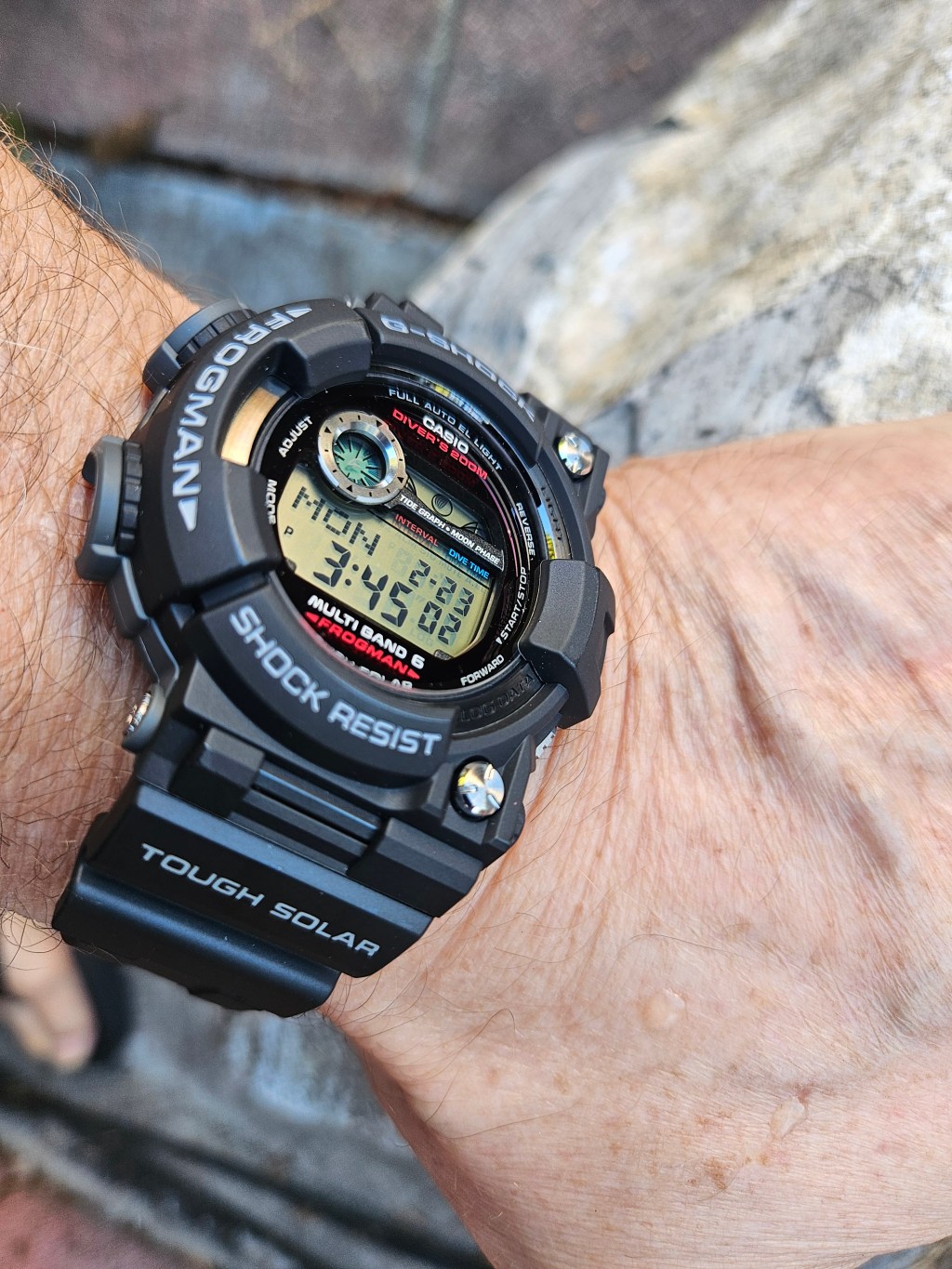
    I pulled out my phone, photographed my Casio G-Shock GW-7900, and posted it to Instagram. If I was going to be held hostage, I might as well document something worthwhile.

    Eventually—mercifully—the couple completed their transaction. Eighty dollars later, their packages were no longer parcels but laminated relics, ready to withstand not just shipping, but geological time. I stepped forward, paid for my own shipment, and shared a brief, knowing laugh with M about the spectacle we had just endured.

    We thought it was over.

    It wasn’t.

    The door opened. The couple returned.

    The redhead, unsatisfied with her previous efforts, declared that a third layer of tape was necessary for her “peace of mind.” At this point, the packages were less shipments and more mummies awaiting a sarcophagus.

    I gave M a look—the kind of look that conveys sympathy, disbelief, and resignation all at once. He nodded, the stoic veteran of countless such encounters.

    I left.

    As I walked out, I knew two things. First, those packages would survive anything short of a volcanic eruption. Second, I had just acquired a story—one that would be waiting patiently for me to tell my wife the moment I got home.

  • Escape from Seikotraz: Starring Jeff McMahon

    Escape from Seikotraz: Starring Jeff McMahon

    This morning I woke up with a small, undeserved victory. My second shingles shot had not flattened me into a feverish heap of aches and regret. No vaccine hangover. No sack-of-muscle soreness. Just a functioning body and a clear head. I glanced down at my Casio G-Shock GW-7900 before swinging my legs out of bed, and as I reached for the coffee ritual, a thought crept in—quiet at first, then strangely intoxicating:

    What if I owned only G-Shocks?

    What if I were free of my Seiko divers?

    Free from what, exactly? That part remains stubbornly undefined.

    Three years ago, the fracture began. I developed an aversion to bracelets—not a mild preference, but a full-blown irritation, as if every metal link were conspiring against my wrist. I moved my Seiko divers onto straps, experimenting like a man searching for ergonomic salvation, until I discovered Divecore FKM. Suddenly, everything clicked. The watches felt right—balanced, secure, almost inevitable. For a brief moment, I thought I had solved the problem.

    Then came the contamination.

    August 2025. A message. A study. PFAS—“forever chemicals”—lurking in FKM. The phrase alone sounded like a villain in a low-budget sci-fi film. Dutifully, almost piously, I removed the straps. The watches went back onto inferior substitutes, and with that small act, something essential drained out of them. They were no longer “just right.” They were tolerable.

    Divecore, to their credit, pivoted—hydrogenated rubber, safer materials, a new Waffle strap on the way. I’m waiting for it now, like a man waiting for a repaired marriage.

    But in that interim, I did something careless. Or revealing.

    On a lark, I bought a Casio G-Shock Frogman GWF-1000.

    And I didn’t just like it. I fell for it immediately.

    Its design wasn’t elegant—it was aggressively industrial, almost defiant. Its timekeeping wasn’t approximate—it was absolute. Atomic. Unquestionable. It didn’t ask for attention; it delivered certainty. One watch became three. The Rescue. The incoming Casio G-Shock GW-9500 Mudman. A quiet shift became a migration.

    This morning, still basking in my vaccine survival, I entertained a more radical thought: eliminate the Seikos entirely. Replace them with two final pieces—the sapphire Frogman D1000 and the GW-5000U Square, my so-called “dress watch,” a term that feels almost satirical in this context.

    At what point does a preference become a slide?

    Was it the PFAS scare that loosened the foundation? Or something deeper? Do the Seiko divers now carry the residue of an older obsession—one tied to acquisition, to the promise that the next watch would finally complete the picture? And if so, what exactly is this new G-Shock phase? Liberation? Or simply addiction in a more utilitarian costume?

    There are a few things I can say with certainty. I prefer atomic time to mechanical approximation. I prefer digital clarity to analog interpretation. Yes, the digital display demands a slight tilt of the wrist, a negotiation with the light, but I’ve made peace with that. It’s a small concession in exchange for precision.

    Maybe there is no grand psychological drama here. Maybe I’ve grown lazy in the most practical sense. I like convenience. I like certainty. I like not having to set the time like a monk tending to a ceremonial clock. Perhaps this is not a crisis of identity but a simple shift toward ease.

    But then I hear from others.

    Men who made this transition years ago. Men who, after watching my videos, bought a G-Shock out of curiosity and quietly abandoned their mechanical collections. No fanfare. No farewell. Just a gradual, almost polite disappearance.

    It suggests something larger. A quiet exodus.

    You could make a documentary about it: aging watch obsessives laying down their expensive mechanical relics and walking into the sunset wearing Squares and Mudmans, relieved, unburdened, and slightly confused about how it happened.

    Meanwhile, my own collection sits in a kind of purgatory. The Seiko divers wait, their fate undecided. Two have already been sold—the Captain Willard Ice Diver and the 62MAS—and their absence has not registered as loss. That’s the unsettling part. Watches that once felt essential have vanished without leaving a dent.

    And here I was, thinking of myself as a careful curator, a man assembling a coherent, meaningful collection.

    The truth is less flattering.

    My hobby is governed not by principle, but by impulse. By shifting preferences, passing anxieties, and the occasional well-timed scare about “forever chemicals.” I would prefer to believe in a deeper logic, a narrative of refinement and evolution.

    But honesty requires a different conclusion.

    I am not curating.

    I am drifting.

    I look into the mirror. “Oh my God,” I scream. “I am a capricious watch collector.”

    Meanwhile, my YouTube subscribers are making cogent remarks in the comment section. A gentleman who goes by the name of MDchaz recently wrote: “Coming to a theater near you “Escape from Seikotraz” starring Jeff McMahon.” I wrote back, “I’ll have to steal your idea for my next YouTube video.”

    And this blog post. 

  • The Boxes She Carried

    The Boxes She Carried

    This afternoon I dozed off after an hour of cardio, the body spent, the mind drifting, when a memory surfaced from the early nineties with unnerving clarity. I was around thirty then, teaching composition in a university town carved out of the California desert—a place where the light felt harsh and permanent, as if it refused to let anything hide. A loose circle of us—lecturers, adjuncts, hopefuls—would gather for dinners now and then, clinging to one another for a sense of community. Among us was an art professor, a woman in her mid-fifties. She wore her age without apology: short gray hair, angular features, and eyes the color of oxidized copper—blue-green, arresting, a little distant.

    I hadn’t seen her in months, and then one afternoon, in a neighborhood a few miles from my apartment—I was walking to my car after dropping off a date—I saw her again. A couple of houses over, I saw her unloading boxes from her SUV. The image is fixed in my mind with painful precision. Her head was wrapped in a scarf. Her frame had narrowed to something almost architectural, all angles and shadows. She was moving the boxes to her rental house, each trip measured, as if gravity had grown heavier for her alone.

    I remember I had a choice. I could walk to my car and drive away or walk toward the art instructor. I felt she needed me. So I walked over and stopped her—almost abruptly—and insisted I take over. She didn’t resist. There was no polite demurral, no social choreography. She simply yielded, nodded once, and lowered herself onto a nearby bench. Then she sat there, hands folded loosely, staring straight ahead—not at me, not at the house, but somewhere beyond both, as if the horizon held something she alone could see.

    I carried the boxes inside, one after another, trying to fill the silence with small talk that dissolved the moment it left my mouth. She didn’t answer. Not out of rudeness, but because the effort seemed beyond her. The air around her felt thinned out, as if speech itself required too much oxygen.

    Only now, decades later, does the obvious land with force: those boxes were likely the contents of her office. She wasn’t just moving houses. She was being removed—from her work, her routines, the life she had constructed. And she was doing it alone.

    Had I understood that, I would have done more than carry boxes from curb to doorway. I would have met her at the beginning of the task, at the office, at the place where the real loss was happening. I would have recognized the moment for what it was: not an errand, but an ending.

    When the last box was inside, I don’t remember much of what I said. A brief hug, probably. A few inadequate words. Then I left, as people often do when they sense something too large for them to face directly.

    I believe she died not long after. What remains with me is not just her frailty, though that alone was striking, but the expression she wore as she sat on that bench—an expression that seemed to belong not only to her but to all of us. It carried a quiet indictment: of time, of indifference, of the way we move past one another without truly seeing.

    I take a small measure of comfort in the fact that I stopped, that I helped in the only way I knew how in that moment. But that comfort is thin. What lingers is the recognition of how little I understood, how quickly I settled for the minimum, how unprepared I was to meet her where she actually was.

    She sat there, silent, looking past everything in front of her. And that look—plaintive, unguarded, already halfway gone—is something I have never been able to set down.