Tag: short-story

  • The Travails of Horological Identity Drift

    The Travails of Horological Identity Drift

    To have a hobby is to cultivate an identity. The longer you grow in the hobby, the more you learn about yourself, your likes, dislikes, and inclinations. If you’re a watch collector, as I am, you gravitate to certain types of watches and retreat from others. You cannot explain your inclinations. When fellow watch collectors notice you share a proclivity for a type of watch, there is both a bond and a fellowship. When the fellow watch collectors notice your tastes clash with theirs, disappointment and even hurt feelings can ensue. Within the larger watch hobby, there are subcategories, where collectors branch off and form tight alliances, tribes, and deeply-forged bonds. A sense of loyalty ensues. We call this Taste Tribalism: the formation of tight-knit subgroups within a hobby, bound not by logic but by shared aesthetic instincts. These tribes generate loyalty, belonging, and, when challenged, a surprising capacity for disappointment.

    Woe, however, to the watch collector who, for reasons he can’t explain, departs from what was once his favorite watch type and ventures into fresh waters. Such a transition can bring disorientation and confusion. To abandon one watch category and embrace another creates what is called Horological Identity Drift: the slow, almost imperceptible shift in a collector’s taste in which objects once central to identity begin to feel like artifacts from a previous self. The watches haven’t changed; the wearer has. What once signaled meaning now feels like a costume left over from a role no longer being played.

    While this new adventure from “watch drift” gives fresh blood to his hobby, it leaves his fellow collectors feeling betrayed and abandoned. What offends them is their sense of Aesthetic Apostasy: the moment a collector abandons a once-defining preference—crossing from one horological faith to another—provoking confusion, quiet resentment, and the sense that something sacred has been violated.

    In my case, the “drift” occurred two months ago when I started wearing G-Shocks at the exclusion of my Seiko divers. I did all I could do to return to my mechanicals, including the act of putting steel bracelets on them, in the hope that giving them a luxury look would make them more appealing, but this measure failed. The Seiko divers remain in the box, largely unworn. As a result, I am a watch drifter. 

    What does this “drifting” collector do? Retreat to his old watch type and return to his fellow collectors? What folly. He would simply be betraying himself to please others. Such an act would be a violation of a hobby that brought him joy and authenticity. He must therefore let his true tastes govern his watch journey and the desire to please others take a back seat. Otherwise, his hobby will be a superficial affair, a desperate act to belong while his authentic self withers on the vine. 

  • Purple Toothbrushes and Other Acts of Quiet Genius

    Purple Toothbrushes and Other Acts of Quiet Genius

    I have a student who makes the rest of the room recalibrate. Her essays arrive fully formed—sharp, unshowy, and quietly devastating—and in discussion she does what most people only pretend to do: she thinks out loud with precision. If airtime were currency, she’d hold a majority stake. And the remarkable part is that no one resents it. The other students lean in. They listen. At eighteen, she carries herself with a kind of early-onset professorial clarity, but without the usual symptoms—no grandstanding, no ornamental jargon, no whiff of performance. Just a mind doing its work in public.

    Yesterday she told the class she’s neurodivergent. It landed without ceremony. No one froze, no one fumbled for a response. She simply kept going, threading her way back into our discussion of cruelty as entertainment in The Biggest Loser, dissecting it with the same steady intelligence she brings to everything. The label didn’t explain her; it just named the angle of her vision.

    Later that day, I watched Sheng Wang: Purple on Netflix and had a familiar thought within five minutes: here is another mind that refuses to see the world the way the rest of us have agreed to see it. Sheng Wang doesn’t manufacture jokes so much as he exposes the wiring. He takes the banal—the humble toothbrush aisle—and turns it into a referendum on identity. Faced with a rainbow of options, he chooses purple, not because it cleans better, but because it confers a temporary aura of purpose, as if pigment could rescue a life drifting toward mediocrity. It’s ridiculous, which is why it’s true.

    Wang, born in Taiwan and raised in Houston, delivers all this with a soft Southern cadence that suggests a Baptist sermon delivered by a man who wandered in from a parallel universe. He glides across the stage in flowing purple clothes and white sneakers, looking like a kindly prophet of low-stakes revelation. The dissonance works. His demeanor—gentle, unhurried, almost disarmingly sincere—feels less like an act and more like a refusal to harden into one. You don’t watch him perform; you eavesdrop on how he thinks.

    That’s the throughline between my student and Wang. The best comedians aren’t joke machines; they’re cartographers of attention. They map the ordinary at strange angles and invite you to follow. Sometimes they surface thoughts you didn’t know you had—your private negotiations with a toothbrush color, your quiet horror as a friend’s child demolishes a bowl of expensive berries with the appetite of a small animal. Sometimes the thoughts are entirely their own, but the vantage point is so exact you recognize yourself anyway.

    A good comedian, like a good student, doesn’t just entertain or impress. He builds a small porch between minds. You sit there for a while, listening, and realize you’re not being dazzled—you’re being let in. That’s rarer, and far more valuable, than a punchline.

  • The Man Who Refused to Retire and Learned to Fly at Costco

    The Man Who Refused to Retire and Learned to Fly at Costco

    You will be sixty-five in less than a year—fifteen months from your last day of work—and you would be wise to bury the word “retirement” before it buries you. It is a feeble, anemic term, a linguistic sedative that disguises the collapse of identity as leisure. Nothing about what lies ahead deserves that kind of small thinking.

    What you are approaching requires a name with altitude, velocity, and a touch of myth.

    You are entering the Sovereign Phase.

    In the Sovereign Phase, you do not keep a schedule—you issue one. You do not await approval—you render decisions. This is not an ending ceremonially dressed in khakis and early dinners; it is a coronation. You are not stepping away. You are stepping above.

    Your final act has begun, and it demands a certain boldness. The first order of business is symbolic but essential: you will upgrade your Costco membership to Executive. No committees. No approvals. No memos. You will simply decide—and it will be done.

    And then, one morning, before the doors officially open to the masses, you will enter.

    The aisles are empty. The pallets stand fresh and untouched. The air itself feels newly issued. You move through this cathedral of abundance with first access, first choice, first claim. Something happens to you here—something disproportionate to the act itself. A quiet but unmistakable inflation of the self. A sense that you have not merely arrived early, but ascended.

    You feel it in your chest first, then in your stride. The strange conviction that you are no longer bound by ordinary constraints. That you have, somehow, earned this.

    You have entered Executive Aisle Rapture.

    It is a near-mystical condition in which logistical privilege is mistaken for existential elevation, where empty aisles and shrink-wrapped towers of goods produce a sensation that borders on the divine. You begin to suspect that wings—actual wings—may be forming beneath your shirt, preparing you for a short, ill-advised flight toward the sun.

    This is not a side effect of the Sovereign Phase. It is a requirement.

    So when your last day of work arrives, do not mark it with melancholy or relief. Mark it with a transaction. Upgrade the membership. Secure your access. Step into the early light of the warehouse.

    And when the doors part and the aisles open before you, walk forward without hesitation.

    You are no longer a worker.

    You are sovereign.

  • The Tape Tyrant of Postmaster Plus

    The Tape Tyrant of Postmaster Plus

    I went to Postmaster Plus this morning to ship a defective camera back to Kodak—a routine errand, the kind you knock out between coffee and whatever comes next. I’ve been going there for years. The place is run by a family from Bombay, and over the last decade they’ve shipped more of my watches than I care to admit. It’s a familiar, efficient operation. Or at least, it usually is.

    When I walked in, the rhythm was off.

    At the counter stood a couple in their mid-sixties, locked in some elaborate transaction with M, the family patriarch, a man in his seventies who has the calm of someone who has seen everything and survived it. Behind the couple stood a woman clutching a stack of flattened cardboard, her face arranged in a quiet expression of despair. She looked at me as if to say, You’re seeing this too, right?

    I was.

    The woman at the counter—a redhead with severe bifocals and a face that seemed permanently braced against disappointment—had taken possession of M’s tape roller and was using it with the zeal of someone preparing artifacts for burial. Her husband hovered nearby, a classic Palm Springs Q-Tip: white hair under a baseball cap, mouth slightly open, limbs thin as dowels, torso betraying a fondness for buffets. He contributed nothing except presence.

    “I’ve seen these packages break before,” the redhead announced, as she wrapped the parcels in what could only be described as a second skin of tape. Not a practical layer—no, this was ceremonial. A kind of adhesive exorcism. When the tape ran out, she didn’t pause, didn’t apologize. She demanded another roll with the urgency of a field commander low on ammunition.

    The woman behind them caught my eye again. This time the look was unmistakable: We are both trapped here. I returned the glance with equal solemnity. Yes, we were sharing this moment. No, there was no escape.

    Then came the breaking point. The cardboard woman asked M when his son W would return from break.

    “Twenty minutes or so,” M replied.

    She nodded, made a decision, and fled. A wise woman. She chose freedom.

    I stayed.

    The redhead, now fully committed to her role as High Priestess of Packaging Integrity, began lecturing the room about the fragility of parcels and the absolute necessity of excessive tape. She spoke as if we were all negligent amateurs, one poorly wrapped box away from societal collapse.

    I opted out.

    I pulled out my phone, photographed my Casio G-Shock GW-7900, and posted it to Instagram. If I was going to be held hostage, I might as well document something worthwhile.

    Eventually—mercifully—the couple completed their transaction. Eighty dollars later, their packages were no longer parcels but laminated relics, ready to withstand not just shipping, but geological time. I stepped forward, paid for my own shipment, and shared a brief, knowing laugh with M about the spectacle we had just endured.

    We thought it was over.

    It wasn’t.

    The door opened. The couple returned.

    The redhead, unsatisfied with her previous efforts, declared that a third layer of tape was necessary for her “peace of mind.” At this point, the packages were less shipments and more mummies awaiting a sarcophagus.

    I gave M a look—the kind of look that conveys sympathy, disbelief, and resignation all at once. He nodded, the stoic veteran of countless such encounters.

    I left.

    As I walked out, I knew two things. First, those packages would survive anything short of a volcanic eruption. Second, I had just acquired a story—one that would be waiting patiently for me to tell my wife the moment I got home.

  • Escape from Seikotraz: Starring Jeff McMahon

    Escape from Seikotraz: Starring Jeff McMahon

    This morning I woke up with a small, undeserved victory. My second shingles shot had not flattened me into a feverish heap of aches and regret. No vaccine hangover. No sack-of-muscle soreness. Just a functioning body and a clear head. I glanced down at my Casio G-Shock GW-7900 before swinging my legs out of bed, and as I reached for the coffee ritual, a thought crept in—quiet at first, then strangely intoxicating:

    What if I owned only G-Shocks?

    What if I were free of my Seiko divers?

    Free from what, exactly? That part remains stubbornly undefined.

    Three years ago, the fracture began. I developed an aversion to bracelets—not a mild preference, but a full-blown irritation, as if every metal link were conspiring against my wrist. I moved my Seiko divers onto straps, experimenting like a man searching for ergonomic salvation, until I discovered Divecore FKM. Suddenly, everything clicked. The watches felt right—balanced, secure, almost inevitable. For a brief moment, I thought I had solved the problem.

    Then came the contamination.

    August 2025. A message. A study. PFAS—“forever chemicals”—lurking in FKM. The phrase alone sounded like a villain in a low-budget sci-fi film. Dutifully, almost piously, I removed the straps. The watches went back onto inferior substitutes, and with that small act, something essential drained out of them. They were no longer “just right.” They were tolerable.

    Divecore, to their credit, pivoted—hydrogenated rubber, safer materials, a new Waffle strap on the way. I’m waiting for it now, like a man waiting for a repaired marriage.

    But in that interim, I did something careless. Or revealing.

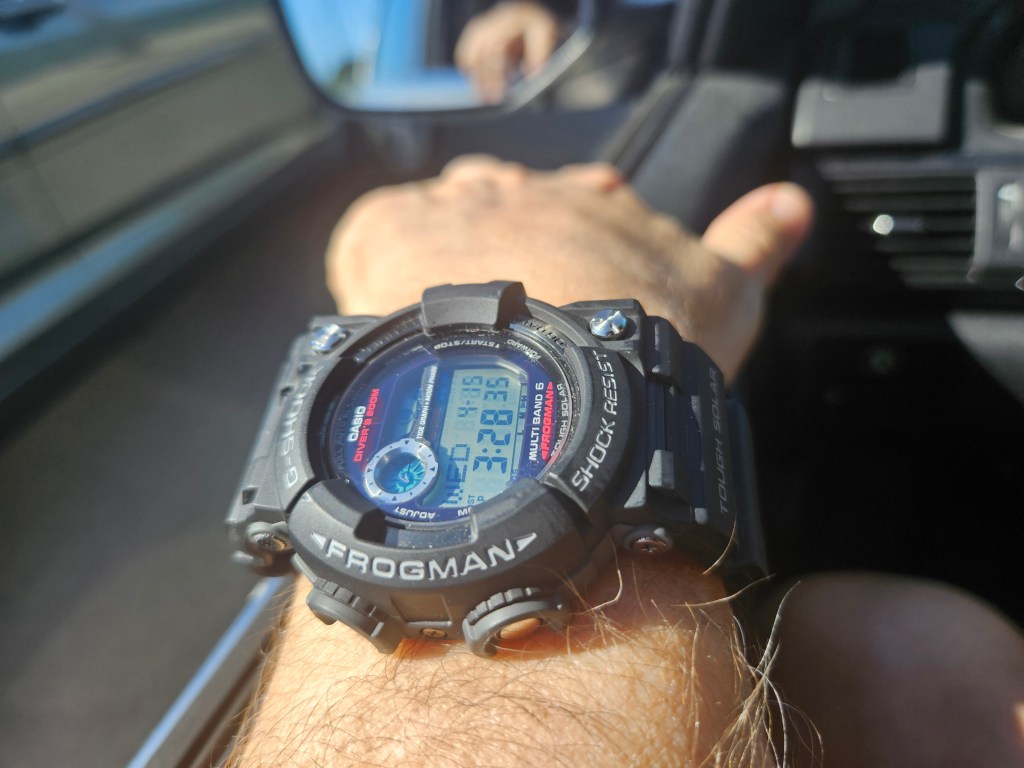
    On a lark, I bought a Casio G-Shock Frogman GWF-1000.

    And I didn’t just like it. I fell for it immediately.

    Its design wasn’t elegant—it was aggressively industrial, almost defiant. Its timekeeping wasn’t approximate—it was absolute. Atomic. Unquestionable. It didn’t ask for attention; it delivered certainty. One watch became three. The Rescue. The incoming Casio G-Shock GW-9500 Mudman. A quiet shift became a migration.

    This morning, still basking in my vaccine survival, I entertained a more radical thought: eliminate the Seikos entirely. Replace them with two final pieces—the sapphire Frogman D1000 and the GW-5000U Square, my so-called “dress watch,” a term that feels almost satirical in this context.

    At what point does a preference become a slide?

    Was it the PFAS scare that loosened the foundation? Or something deeper? Do the Seiko divers now carry the residue of an older obsession—one tied to acquisition, to the promise that the next watch would finally complete the picture? And if so, what exactly is this new G-Shock phase? Liberation? Or simply addiction in a more utilitarian costume?

    There are a few things I can say with certainty. I prefer atomic time to mechanical approximation. I prefer digital clarity to analog interpretation. Yes, the digital display demands a slight tilt of the wrist, a negotiation with the light, but I’ve made peace with that. It’s a small concession in exchange for precision.

    Maybe there is no grand psychological drama here. Maybe I’ve grown lazy in the most practical sense. I like convenience. I like certainty. I like not having to set the time like a monk tending to a ceremonial clock. Perhaps this is not a crisis of identity but a simple shift toward ease.

    But then I hear from others.

    Men who made this transition years ago. Men who, after watching my videos, bought a G-Shock out of curiosity and quietly abandoned their mechanical collections. No fanfare. No farewell. Just a gradual, almost polite disappearance.

    It suggests something larger. A quiet exodus.

    You could make a documentary about it: aging watch obsessives laying down their expensive mechanical relics and walking into the sunset wearing Squares and Mudmans, relieved, unburdened, and slightly confused about how it happened.

    Meanwhile, my own collection sits in a kind of purgatory. The Seiko divers wait, their fate undecided. Two have already been sold—the Captain Willard Ice Diver and the 62MAS—and their absence has not registered as loss. That’s the unsettling part. Watches that once felt essential have vanished without leaving a dent.

    And here I was, thinking of myself as a careful curator, a man assembling a coherent, meaningful collection.

    The truth is less flattering.

    My hobby is governed not by principle, but by impulse. By shifting preferences, passing anxieties, and the occasional well-timed scare about “forever chemicals.” I would prefer to believe in a deeper logic, a narrative of refinement and evolution.

    But honesty requires a different conclusion.

    I am not curating.

    I am drifting.

    I look into the mirror. “Oh my God,” I scream. “I am a capricious watch collector.”

    Meanwhile, my YouTube subscribers are making cogent remarks in the comment section. A gentleman who goes by the name of MDchaz recently wrote: “Coming to a theater near you “Escape from Seikotraz” starring Jeff McMahon.” I wrote back, “I’ll have to steal your idea for my next YouTube video.”

    And this blog post. 

  • The Boxes She Carried

    The Boxes She Carried

    This afternoon I dozed off after an hour of cardio, the body spent, the mind drifting, when a memory surfaced from the early nineties with unnerving clarity. I was around thirty then, teaching composition in a university town carved out of the California desert—a place where the light felt harsh and permanent, as if it refused to let anything hide. A loose circle of us—lecturers, adjuncts, hopefuls—would gather for dinners now and then, clinging to one another for a sense of community. Among us was an art professor, a woman in her mid-fifties. She wore her age without apology: short gray hair, angular features, and eyes the color of oxidized copper—blue-green, arresting, a little distant.

    I hadn’t seen her in months, and then one afternoon, in a neighborhood a few miles from my apartment—I was walking to my car after dropping off a date—I saw her again. A couple of houses over, I saw her unloading boxes from her SUV. The image is fixed in my mind with painful precision. Her head was wrapped in a scarf. Her frame had narrowed to something almost architectural, all angles and shadows. She was moving the boxes to her rental house, each trip measured, as if gravity had grown heavier for her alone.

    I remember I had a choice. I could walk to my car and drive away or walk toward the art instructor. I felt she needed me. So I walked over and stopped her—almost abruptly—and insisted I take over. She didn’t resist. There was no polite demurral, no social choreography. She simply yielded, nodded once, and lowered herself onto a nearby bench. Then she sat there, hands folded loosely, staring straight ahead—not at me, not at the house, but somewhere beyond both, as if the horizon held something she alone could see.

    I carried the boxes inside, one after another, trying to fill the silence with small talk that dissolved the moment it left my mouth. She didn’t answer. Not out of rudeness, but because the effort seemed beyond her. The air around her felt thinned out, as if speech itself required too much oxygen.

    Only now, decades later, does the obvious land with force: those boxes were likely the contents of her office. She wasn’t just moving houses. She was being removed—from her work, her routines, the life she had constructed. And she was doing it alone.

    Had I understood that, I would have done more than carry boxes from curb to doorway. I would have met her at the beginning of the task, at the office, at the place where the real loss was happening. I would have recognized the moment for what it was: not an errand, but an ending.

    When the last box was inside, I don’t remember much of what I said. A brief hug, probably. A few inadequate words. Then I left, as people often do when they sense something too large for them to face directly.

    I believe she died not long after. What remains with me is not just her frailty, though that alone was striking, but the expression she wore as she sat on that bench—an expression that seemed to belong not only to her but to all of us. It carried a quiet indictment: of time, of indifference, of the way we move past one another without truly seeing.

    I take a small measure of comfort in the fact that I stopped, that I helped in the only way I knew how in that moment. But that comfort is thin. What lingers is the recognition of how little I understood, how quickly I settled for the minimum, how unprepared I was to meet her where she actually was.

    She sat there, silent, looking past everything in front of her. And that look—plaintive, unguarded, already halfway gone—is something I have never been able to set down.

  • Chosen by the Frogman

    Chosen by the Frogman

    More than a decade ago, a seasoned watch obsessive told me something I dismissed at the time: you don’t hunt a Holy Grail—you stumble into it. It doesn’t arrive with fireworks or a four-figure invoice. It slips onto your wrist quietly, and then, without asking permission, it takes over. Everything else starts to feel like a costume. You try to rotate, you try to be fair, you give the others their appointed wrist time—but you feel a faint resentment, like you’re cheating on something that actually fits. Eventually the charade collapses. You stop negotiating. You wear the same watch because it works, and because you no longer have the patience for anything that doesn’t.

    When that happens, the chronophage loses its grip. The endless scroll of “must-haves,” the dopamine carnival of releases and reviews, the debates over marginal gains—all of it begins to look like noise generated by people who haven’t found their watch yet. You close the tabs. You ignore the hype. You retire from the rotation economy. Let the others keep spinning the wheel. You’re done. You’ve chosen, or more accurately, you’ve been chosen.

    If you had told me a year ago that a black resin digital watch would be the one to do this, I would have laughed you out of the room. My tastes, I thought, were too refined, too anchored in steel and mechanical romance to be hijacked by a plastic instrument. And yet, a month ago, the G-Shock Frogman GWF-1000 landed on my wrist and quietly began rewriting my habits. It doesn’t leave. The only thing that occasionally displaces it is another G-Shock—the GW-7900—which, if I didn’t have the Frogman, would be my undisputed daily driver. 

    Of course, I know the trap. The honeymoon phase has seduced better men than me. Give it six months, I tell myself. Let time do its work. If the Frogman is still there—if the others still feel like substitutes—then this isn’t infatuation. It’s alignment.

    The grail, it turns out, is not the watch you chase. It’s the one that makes you stop.

  • The Seiko Tuna Epiphany: A Late-Night Strategy for Escaping Watch Madness

    The Seiko Tuna Epiphany: A Late-Night Strategy for Escaping Watch Madness

    Last night, while watching television with my wife in a room lit about as brightly as a submarine corridor, I made a small but unsettling discovery: I am not always in the mood to press the G-Shock light button just to see the time. Not because the button is difficult—it isn’t—but because every tap reminds me that I’m siphoning a little solar life from the battery. For a normal person, this would register as trivia. For someone like me, it becomes a moral drama about energy management.

    Earlier that day both my G-Shocks—the Frogman and the GW-7900—were sitting at the dreaded Medium charge level. Medium is technically acceptable, but emotionally intolerable. So I placed them on the windowsill for four hours like two reptiles basking on a warm rock. By evening they had risen to the only status that calms my nervous system: High.

    Wanting to give their solar batteries a night of rest—and perhaps to give my brain a rest as well—I hung the GW-7900 on the industrial T-bar stand so it could quietly chase atomic signals overnight. In its place I strapped on my quartz Seiko Tuna SBBN049. The room was dark, but the Tuna’s lume glowed like a tiny lighthouse. No button pressing. No anxiety about draining solar reserves. Just the quiet satisfaction of luminous markers doing their job without negotiation.

    And something interesting happened: I rediscovered the Tuna.

    While I’ve been cooling off from my mechanical divers, this quartz brute suddenly felt…perfect. Reliable. Legible. Calm. A watch that does not demand emotional supervision.

    Then a second realization arrived.

    The Tuna—already equipped with sapphire—might quietly occupy the exact niche I’ve been trying to justify filling with the sapphire Frogman, the thousand-dollar titanium idol currently whispering to me from the internet.

    If the Tuna fills that lane, several pleasant consequences follow.

    First, I stop the collection at eight watches, a number that still resembles discipline rather than pathology.

    Second, I avoid introducing a sapphire Frogman that would inevitably start competing with my beloved Frogman GWF-1000, turning the watch box into a small arena of amphibious rivalry.

    Third, the Tuna—currently receiving about as much wrist time as a museum artifact—gets to live again.

    Fourth, I avoid spending nine hundred dollars on what is essentially a prestige upgrade: a watch whose improvements amount to slightly clearer digits and bragging rights for social media spectators.

    Fifth, I avoid paying nearly a thousand dollars for a watch that, if I squint hard enough and tilt my head toward the light like a suspicious jeweler, looks almost identical to the one I already own.

    What I’m really saying, ladies and gentlemen, is that I’m searching for an exit ramp.

    Not an exit from watches entirely, but an exit from the compulsion to keep expanding the collection as if the next acquisition might finally calm the storm.

    Because the truth is obvious. My eight watches already do everything a watch can possibly do. Another one at this point isn’t a tool—it’s an additional weight tied to the ankle of enjoyment.

    Another watch becomes an anchor.

    Another watch becomes kryptonite.

    Another watch dilutes the potency of the ones I already love.

    Of course, this is the speech I’m giving myself this morning. Whether I remain faithful to it is another matter entirely. A watch obsessive, after all, is simply a man locked in a polite but relentless argument with himself.

    And perhaps that is the broader human condition. The very pursuits that bring us joy—hobbies, ambitions, passions—also contain the seeds of excess. Mishandled, they curdle. What began as pleasure turns into agitation.

    These are the thoughts rushing through my brain today, pouring forward like a swollen river after heavy rain.

    If it weren’t watches, it would be something else.

    That much, I know for certain.

  • The Moral Danger of Divine Cheesecake

    The Moral Danger of Divine Cheesecake

    Last night I had a dream that unfolded with the logic and extravagance of a Fellini film set on a public beach. I discovered a stray dog wandering along the shoreline, a scruffy creature with the melancholy dignity of someone who had seen too much of the world’s indifference. The dog could speak. His first words were disbelief. He could not imagine that I, a random human loitering by the Pacific, intended to adopt him.

    To prove my sincerity—and perhaps to apologize for the miserable hand life had dealt him—I performed what can only be described as an act of culinary sorcery. With no apparent effort, I summoned two desserts out of thin air and placed them on a small café table facing the ocean. One was a mango cheesecake the size of a steering wheel, glowing with tropical radiance. The other was a monumental chocolate cake decorated with extravagant ribbons and shell-like ridges of frosting, the sort of cake that looks less baked than sculpted.

    The dog, clearly a creature of refinement, approached the cake with delicate reverence, nibbling with the restraint of a Parisian pastry critic. I told him not to worry—I knew of special utensils designed specifically for dogs who wished to eat cake with dignity. I would run downtown and return in minutes.

    That’s when the trouble began.

    When I returned to the café table, I found a woman plunging a bakery knife into my cake with the stealth of a pirate raiding a treasure chest. I launched into a lecture about theft and decency. Mid-sermon, another woman attempted a lightning strike on the mango cheesecake, hoping to slice off a piece before the moral police arrived. I drove her off as well.

    In that moment it dawned on me: these desserts were not ordinary desserts. They were supernatural artifacts. Something about their beauty radiated outward like perfume, alerting passersby that heaven had briefly opened a bakery on the beach. People could sense it. They were willing to bend their morals for a taste. And I had a darker suspicion—once someone tasted the cakes, the bending of morals might turn into a full collapse.

    The dog and I decided the beach was no longer safe for divine pastries. We relocated to the lobby of a nearby hotel, where the two of us quietly devoured the cakes like conspirators protecting a sacred relic. Strangely, the effect on us was the opposite of what I had feared. Each bite seemed to make us kinder, calmer, more decent versions of ourselves.

    Between bites, I told the dog he would never be homeless again. He would live with me forever. He thanked me with the solemn gratitude only a talking beach dog can muster.

    Then he asked the obvious question: how had I managed to summon cakes of such celestial quality?

    I admitted the truth. I had no idea what I had done or how I had done it. But one thing was clear: it was a one-time miracle. The bakery of heaven had closed its doors.

    The rest of our lives, the dog and I would have to live on ordinary meals—and the memory of that impossible dessert.

  • Late to the G-Shock Party

    Late to the G-Shock Party

    Even though I’ve been obsessed with watches for over twenty years, I arrived embarrassingly late to the G-Shock party. I didn’t plan the arrival. It felt more like this: I’m riding in the back seat of an Uber when the driver suddenly pulls up in front of a strange mansion glowing with neon light. The doors swing open. Inside are thousands of loud, jubilant G-Shock devotees who greet me like a long-lost cousin. Champagne appears. Confetti rains down. Someone hands me a microphone and asks for a testimonial.

    I have no prepared remarks. But I can tell the truth.

    For two decades I was perfectly happy collecting Seiko mechanical divers. They were my tribe. Yet somewhere in the back of my mind a particular watch kept whispering to me: the G-Shock Frogman. I had admired it on and off for over a decade. Amazingly, the same model was still available, so I finally ordered one from Japan. A watch that once would have cost me $400 now demanded $550, which is the sort of price inflation that causes a small twitch in the eyelid.

    When the Frogman arrived, something strange happened.

    I couldn’t take it off.

    The watch felt uncannily right, as if some committee of Japanese engineers had secretly studied my personality and designed a wrist instrument to match it. It was heroic, absurdly tough, and far more accurate than my mechanical divers. Within weeks I stopped wearing the mechanicals altogether. Three of them quietly left the collection. Whether I’m taking a mechanical hiatus or attending their funeral remains unclear.

    What I do know is that G-Shock has given my watch hobby a strange second life.

    At the moment I own two of them: the Frogman and the GW-7900. Viewers on my YouTube channel insisted the 7900 deserved a proper name. A subscriber named Dave solved the problem immediately. “Call it the Tidemaster,” he said, since the watch tracks tides.

    Perfect.

    So now I have the Frogman and the Tidemaster. One cost me $550. The other cost $110.

    Here’s the truth no luxury marketing department wants to hear: from a purely practical standpoint, the $110 Tidemaster is the better watch. Its numerals are larger, thicker, and darker. The contrast is superior. At night the backlight illuminates big bold digits that practically shout the time. The Frogman, by comparison, requires a small squint and a mild prayer.

    In other words, the cheap watch wins the legibility contest.

    A third watch is arriving next week: the G-Shock GW-6900. Like the 7900, it currently lacks a proper nickname. The watch has three round indicators above the display, which makes it look like a mildly deranged insect. I considered several possibilities. “Triple Graph” sounds like a geometry exam. “Militaire” sounds like a fragrance sold in an airport duty-free shop. So I’m going with the obvious choice:

    The 3-Eyed Monster.

    My goal is simple: settle into a stable Three-Watch G-Shock Trifecta. All three watches share the same genetic code—big heroic cases, atomic timekeeping, solar charging, digital displays, and rubber straps. That combination is my personal sweet spot.

    Now we arrive at the temptation.

    Many of you have suggested I should upgrade to the sapphire-crystal Frogman, a watch that lurks around the $1,000 mark. And believe me, that watch is occupying prime real estate in my brain. But I’d like to present a few rebuttals before I surrender to the credit card.

    First, price. The Tidemaster and the 3-Eyed Monster cost about $110 each. Even the Frogman stayed under $600. Part of the joy of G-Shock is that it delivers durability, accuracy, and ridiculous hero aesthetics without the emotional trauma of a four-figure purchase. Once you push a G-Shock toward a thousand dollars, you start undermining the very spirit that makes the watch fun.

    Second, technical overkill. The sapphire Frogman is loaded with features I will never use. Yes, the display is slightly more legible than my existing Frogman, but that problem is already solved by the Tidemaster and the 3-Eyed Monster.

    Third, rotational anxiety. Two Frogmans would cancel each other out. I doubt I could sell my current Frogman—it has already fused itself to my identity like a stubborn barnacle.

    Fourth, and perhaps most decisive, is age. If I were in my thirties or forties, building a large G-Shock collection might make sense. But I’ll be turning sixty-five this year. I don’t need a museum of watches. Between four Seiko mechanical divers, a quartz Seiko Tuna, and my three G-Shocks, I already have more watches than any reasonable human requires.

    In fact, I could easily imagine a future where I own nothing but the three G-Shocks and feel perfectly content.

    So there you have it.

    Will temptation vanish completely? Of course not. Tonight I may dream about the sapphire Frogman. In a moment of midnight weakness I might even sleep-walk to my computer and hover over the Buy Now button.

    But I like to believe that the reasonable part of my brain will prevail over the dopamine addict who lives next door.

    At least that’s the story I’m telling myself.