Tag: short-story

  • What Does It Profit a Man to Gain the World and Lose His Soul?

    What Does It Profit a Man to Gain the World and Lose His Soul?

    On a bright spring afternoon in Southern California in 1998, my college writing class was dissecting evil with the clinical confidence of people who believed it could be contained in literature. We were discussing The Painted Bird, a novel so saturated with human cruelty that it feels less like fiction and more like a dare. The room hummed with theories—evil as social construct, evil as pathology—until my students quietly dismantled the abstraction. They believed in evil not as metaphor, but as presence. Ghosts. Demons. Things seen and not forgotten.

    One single mother spoke of something that crawled beneath her bed at night. She said it plainly, without theatrics, which made it worse. Another student, a nurse in her forties who worked long shifts at UCLA, waited until after class. “I have a story,” she said, as if announcing a diagnosis that required privacy.

    She didn’t look like someone given to fantasy. She was compact, practical, her thick glasses enlarging eyes worn down by long hours and human frailty. Her stories usually involved difficult patients or her childhood in rural Louisiana—earthbound things. But as she began, her voice shifted, acquiring a distant cadence, as if she were tuning into a frequency not meant for daylight.

    She was six or seven at the time, roaming the backwoods with her cousin Carmen. No supervision, no schedule, no adult intervention. Their days were filled with the idle cruelty of children left alone too long—tormenting small animals, inventing games that escalated from mischief into something darker. There were no witnesses, no consequences, and so no brakes.

    Until one afternoon.

    They were inside the farmhouse, a sagging structure with a porch that complained with every step. The screen door creaked open. A man walked in and sat down in the living room as if he owned the place.

    But he wasn’t a man.

    She struggled to describe him without sounding ridiculous. He wasn’t clothed, but that detail felt irrelevant. His body was covered in coarse, matted fur. His skin—if it could be called that—had the pallor and texture of a rodent. Behind him trailed a long, muscular tail that slid along the floor and flicked against the doorframe like a living whip. He looked like something assembled from nightmare logic: a giant rat that had decided to stand upright and enter a house.

    The girls didn’t run. They couldn’t. Fear locked them in place, as if the room itself had thickened.

    He began to speak.

    For hours—she was certain it lasted hours—he sat in that chair and talked. His voice was low and abrasive, as if it scraped its way into the room. He told stories about the things he had done, the damage he had caused, the harm he had perfected. Time lost its structure. The afternoon stretched into something shapeless and suffocating.

    Then he turned his attention to them.

    “I’ve seen how bad you girls are,” he said. “I’ve seen what you’ve been doing.”

    And then he began to list their offenses. Not generalities—details. Every small cruelty, every secret act they had committed when no one was around. Things no adult had witnessed. Things no one could have reported.

    “I’m going to recruit you,” he said. “I’m going to make you mine.”

    The threat didn’t rise in volume. It settled into the room, thick and toxic, like something you could breathe in and never fully expel. His eyes stayed on them the entire time, unblinking, patient, certain. He described what would happen if they continued, not in vague moral warnings, but in precise, almost administrative terms—consequences rendered as inevitabilities.

    The girls sat frozen, their bodies no longer their own.

    And then, as casually as he had entered, he stood up and left. The tail followed him out like an afterthought, sliding across the threshold and disappearing into the heat.

    Silence rushed back into the house.

    Carmen finally whispered, “Did you see that?”

    My student nodded. Speech had abandoned her.

    From that day forward, their lives snapped into alignment. No more cruelty. No more experimentation with harm. They went to church. They prayed. They obeyed. Not out of virtue, but out of fear sharpened into obedience. Whatever had visited them had not suggested a path—it had enforced one.

    I would have preferred to dismiss the story as delusion, but that option didn’t fit the teller. This was a woman trained to assess reality, to separate symptom from fabrication. She spoke without embellishment, without the slightest interest in persuading me. She wasn’t selling a story; she was reporting an event that had rearranged her life.

    It unsettled me more than I expected.

    At the time, I was living alone in a condo in Redondo Beach, the kind of place that feels harmless until night gives it edges. One evening, I had a dream about the Cowardly Lion from The Wizard of Oz. Only this version had shed all pretense of cowardice. He chased me, snarling, his face twisted into something feral and wrong.

    I woke up, but the dream didn’t fully release me.

    At the foot of my bed, I felt it—presence. Not a thought, not a leftover image, but something that occupied space. The lion-man sat there, immense, silent, undeniable. Fear pinned me in place. Breathing became an effort, as if the air itself had thickened in protest.

    In that moment of terror, the dumbest thought came over me: What does it profit a man to have tenure and live by the beach if he’s visited by an evil entity at 2 a.m.?

    After several long seconds of thinking about my rhetorical question, I forced movement into my body. I stood, walked up the stairs on unsteady legs, poured a glass of water like someone performing a ritual they barely believed in. When I returned, I flooded the room with light, turned on the television, filled the silence with noise until the presence thinned and finally dissolved.

    Like pain receding from a crushed hand—slow, stubborn, but eventually gone.

    What stayed was the recognition.

    This was not my first encounter with that particular demon. Ever since the age of five, I had carried a pathological terror of The Wizard of Oz’s Cowardly Lion, played by Bert Lahr with such unnerving desperation that the performance ceased to feel theatrical and crossed into something infernal. Every year when the movie aired on television, I experienced the same ritual dread: excitement curdled into panic. I wanted to watch the film because everyone watched it, because it was supposedly magical and wholesome and woven into the fabric of American childhood. But I could not look directly at the Lion’s face. Not for even a second.

    There was something about the grotesque architecture of that mask—the swollen cheeks, the creased forehead, the frantic eyes flickering through the narrow slits—that convinced me I was not looking at a costume but at a leak from another realm. To glimpse him was to receive unauthorized intelligence about what demons in hell actually looked like. Other children saw a lovable neurotic feline. I saw a panic-stricken emissary from the abyss.

    The Cowardly Lion colonized my dreams for years. I would wake in the middle of the night drenched in sweat, my heart jackhammering against my ribs. But waking up offered no relief. The nightmare did not end when consciousness returned; it merely changed venues. I could still feel the Lion in the room with me. Sometimes I sensed him sitting on the edge of my bed in the darkness while an icy current climbed my spine vertebra by vertebra. My chest tightened. My breathing became shallow and frantic. I was certain I would either suffocate, faint, or be dragged bodily into some spiritual sewer beyond childhood comprehension.

    Eventually I buried these terrors beneath the sediment of ordinary life. Or so I thought.

    Then came the summer of 1984. I was twenty-two years old and asleep one morning when I dreamed I was sprinting across a vast field toward a circle of flames. Beyond the fire stood an oasis shimmering with impossible beauty, a place radiating peace, love, and release from whatever unnamed anguish had dogged me since childhood. I knew with absolute certainty that if I could pass through the flames, I would arrive somewhere transformed.

    But just as I approached the burning circle, the Cowardly Lion stepped directly into my path.

    The effect was instantaneous. My body failed. Terror seized me with such total authority that I could no longer run. Worse, I could not scream. My mouth opened, but only muffled animal noises emerged while my lungs constricted so violently I thought I would suffocate inside the dream itself.

    Then came the truly impossible part.

    I awoke.

    At least I believed I awoke.

    I was lying flat on my back in bed, fully conscious, staring into the dim morning light of my room when I began to rise. Slowly. Smoothly. Silently. About a foot above the mattress.

    There was no drama to it. No spinning. No celestial music. Just the hideous calm of impossible physics.

    For what felt like ten seconds, perhaps longer, I floated there suspended above the bed in absolute terror before descending gradually back onto the mattress.

    I lay frozen afterward, unable to decide which possibility frightened me more: that I had actually levitated or that my mind had finally snapped under the pressure of its own private mythology.

    Naturally, I told no one.

    Who admits such things? Madmen? Cult leaders? Future occupants of padded rooms?

    So the experience became another sealed chamber inside me, another secret shoved into psychic storage beside the Lion himself.

    Then, years later, when I was thirty-seven, one of my nursing students casually described being visited in dreams by a grotesque rat-man figure. The moment she spoke, the old terror returned in full force. The Lion-Man rose from the graveyard of memory and stood before me again, and with him came the sickening recollection of floating above my bed in the summer of 1984 like some frightened counterfeit saint in a low-budget religious hallucination.

    Peeling back these memories feels less like reflection and more like excavating radioactive material. What occurs to me now is that humanity divides itself into two broad species. First are the literalists, the hard-material people who believe the physical world is the entire inventory of existence. What can be measured, photographed, weighed, biopsied, and touched is real. Everything else is sentimental fog generated by weak nerves and overheated imaginations. For these people, reality is a Home Depot aisle of concrete objects. No mystery. No metaphysical leakage. No shadows moving beneath the floorboards of ordinary life. What you see is what you get.

    I used to train with one of these specimens back in my teenage bodybuilding days, a granite-headed materialist named Falco Labroni. One evening we attended a church youth spaghetti dinner where a sweating youth pastor was passionately explaining salvation, heaven, hell, and eternal judgment between bites of garlic bread. Falco listened with the same skeptical expression he reserved for mail-order ab machines. Finally, he interrupted the sermon to announce that he would refuse to believe in heaven or hell unless Jacques Cousteau personally explored both places in a submarine and returned with film footage.

    Falco was what I now call a Film-in-Hand Absolutist.

    No footage, no faith.

    If Satan could not be captured on 16mm color film while smoking a cigar beside a lava pit, Falco wasn’t buying it. To him, metaphysics without documentation was merely indigestion wearing a choir robe.

    Then there is the other category of person—the unfortunate tribe to which I belong. These are the people cursed with imaginations porous enough to let other realities seep through. We sense shadows where others see empty rooms. We suspect hidden dimensions pressing faintly against ordinary life like faces against frosted glass. We dream vividly, feel presences, glimpse symbolic patterns, and occasionally become convinced the universe is leaking messages through nightmares, coincidences, music, illness, or memory. These people do not require film because the experience itself brands them from the inside.

    For us, life is never merely literal.

    It is layered.

    Ambiguous.

    Haunted.

    The world arrives wrapped in penumbra. Every object casts not just a shadow but the suggestion of another kingdom attached to it. A hallway at night is never just a hallway. A face can become an omen. A dream can feel more historically significant than an actual afternoon.

    Unfortunately, once you belong to this category, you never fully return to the clean reassuring geometry of materialism. You can pretend. You can teach freshman composition, pay your taxes, discuss cholesterol numbers, and shop for sensible shoes at Costco. But somewhere in the back chambers of your mind, the Lion-Man still breathes softly in the dark, waiting for the lights to go out.

    Looking back now, I see 1998 as my Lion-Man Year, the year the shadow world stopped politely knocking and simply let itself inside. My nerves were frayed, my concentration was dissolving, and my mind drifted through ordinary life as though half of it were trapped in some invisible underworld. Inevitably, this absentmindedness led me to commit one of academia’s unforgivable sins: I lost my university key.

    This catastrophe required me to report to a college administrator whose emotional warmth suggested she had once been rejected by both the priesthood and the prison system for being excessively severe. The moment I explained my predicament, her face hardened into a mask of institutional disgust.

    “The one thing,” she said slowly, as though speaking to a parole violator, “that a college instructor does not do is lose his key.”

    She looked me up and down not as a fellow employee but as a suspicious transient who had wandered onto campus carrying a forged faculty ID and a duffel bag full of stolen microscopes. Her lips curled with contempt as she informed me I would need to drive to a remote outpost on the edge of campus called Plant-Ops and pay cash for a replacement.

    Cash only.

    Naturally.

    Because nothing says “modern institution of higher learning” quite like a disciplinary pilgrimage to a bureaucratic wasteland requiring physical currency, shame, and emotional self-flagellation.

    Mortified, I drove eastward away from campus civilization. At first the road was paved, lined with ordinary buildings and signs of human order. But gradually the asphalt surrendered to dirt, potholes, rubble, and terrain better suited for Cold War tank exercises. My car bucked and lurched violently as though objecting to the mission itself.

    The landscape became increasingly apocalyptic.

    Tumbleweeds rolled across the path. Cow skulls appeared beside the road like decorations from a satanic rodeo. Buzzards circled lazily overhead, apparently alerted that some weakened academic had wandered too far from the faculty lounge and was nearing collapse.

    I no longer felt as though I were in Southern California.

    I felt I had crossed into a parallel dimension where failed instructors, cursed livestock, and bureaucratic shame went to die. The air itself seemed infected with rumors of evil.

    Then came the smell.

    As I approached Plant-Ops, a chemical stench engulfed the car—a nauseating cocktail of glue, industrial paint, mildew, overheated machinery, and cow manure baking beneath the sun. The odor struck me with such force that I became dizzy. My skin grew clammy. Sweat collected beneath my collar. I was convinced I either had a fever or had accidentally driven into the outer perimeter of hell’s maintenance department.

    Part of me wanted to turn the car around immediately, flee home, collapse into bed, and abandon the entire miserable enterprise. But I was too close now. The replacement key had become more than a key. It was absolution. Redemption stamped in metal.

    So I sat there gripping the steering wheel, breathing through waves of nausea, wiping sweat from my forehead like a condemned man approaching the gallows. Then I took a deep breath and drove forward into the wasteland.

    After driving for what felt like several geological eras, I finally saw Plant-Ops emerge from the heat shimmer like a hallucination summoned by exhaustion and institutional shame. The structure sat alone on a wasteland of gravel and dust, a dilapidated hangar that looked less like a university maintenance facility and more like the final headquarters of a collapsing dictatorship.

    The oversized shack had been assembled from enormous sheets of tin and aluminum that appeared to be barely holding together through a desperate alliance of rusted screws, crooked nails, and divine neglect. Every gust of wind threatened to peel the building apart and scatter it across the desert like the world’s saddest deck of cards. The metal walls were coated in a grotesque patina of stains, corrosion, and industrial runoff that resembled toxic sludge bubbling up from the underworld itself. It looked as though Satan’s HVAC department had subcontracted the job to the lowest bidder.

    The entire structure radiated bureaucratic doom.

    This was not a place where things were repaired. This was where broken things came to surrender.

    Reluctantly, I stepped out of my car and began trudging across the gravel toward the hangar. Each footstep felt ceremonial, as though I were approaching some punitive tribunal reserved for the absentminded and spiritually unwell. The smell intensified with every yard I crossed—a nauseating fusion of chemicals, mildew, scorched metal, industrial glue, wet dirt, and something faintly organic, as though livestock had died nearby and been left to ferment beneath the sun. My stomach pitched violently. I fought the urge to vomit, faint, or simply curl into the fetal position beside a tumbleweed and surrender to my fate.

    Inside, I encountered the caretaker of this infernal outpost.

    He was a short, hostile little man with thick glasses, a bushy gray mustache, and black wisps of hair clinging desperately to his bald scalp like spiders trapped in tar. He wore a grease-splattered work apron that looked as though it had absorbed forty years of mechanical despair. Standing over a scarred wooden workbench, he glared at me with bulging amphibian eyes while eating cold SpaghettiOs directly from the can. The fluorescent light above him cast a morgue-like glow across his cadaverous face. He looked less like a maintenance worker and more like a cemetery groundskeeper who moonlighted as an interrogator.

    I explained that I had lost my university key.

    Without sympathy or ceremony, he demanded twenty dollars in cash upfront. Then he grunted toward the key machine.

    “Don’t ever lose your key again,” he muttered.

    He paused, then gave a dry laugh.

    “And if you think dealing with me is bad, wait till the guy replacing me next week. He makes me look like a picnic at the beach.”

    The remark amused him enormously. He opened his mouth wide enough for me to glimpse rotten teeth stained the color of nicotine and despair. It was the laugh of a man whose personality had been slowly pickled in bitterness, isolation, and fluorescent lighting.

    Then his expression changed.

    He studied me more carefully now, concern pushing aside suspicion.

    “You don’t look so good,” he said.

    “The smell,” I blurted weakly.

    That made him laugh again.

    “I’m used to it,” he said. “But you better lie down. Cot’s over there.”

    He pointed toward a filthy army cot near the workbench with an index finger sporting a blackened fingernail thick as tortoise shell.

    I thanked him with the dazed politeness of a fever patient entering surgery and stumbled toward the cot. The canvas sagged beneath me as I collapsed onto it, drenched in clammy sweat, and watched him begin making my replacement key.

    The key-cutting machine crouched in the corner like a dormant execution device awaiting orders from the state. It was enormous, greasy, and coated with decades of metallic filth baked into its surface like industrial scar tissue. Iron filings glittered in the grime like black snow. Above it hung a single exposed bulb flickering weakly, as though even electricity struggled to survive inside Plant-Ops.

    The old man fed the blank key into the machine and yanked the lever.

    Instantly the contraption erupted awake.

    The sound was catastrophic.

    A metallic shriek tore through the hangar with such violence it felt capable of stripping paint from bone. The grinding wheel screamed against the brass with the tortured howl of some living creature being dissected alive. Sparks burst outward into the darkness while gears rattled and chattered with arthritic fury. The machine did not sound manufactured. It sounded enraged. Ancient. Biological.

    The noise penetrated my feverish skull until I no longer believed a key was being cut. It felt as though judgment itself was being engraved into metal.

    And then it happened.

    In the middle of that infernal screeching, my body began to rise.

    Slowly.

    Smoothly.

    I lifted a foot—perhaps two feet—above the cot.

    Terror detonated inside me. I tried to scream, but paralysis sealed my throat shut. I could neither move nor cry out. I floated there helplessly while the machine screamed like an industrial banshee beside me.

    In my terrified state, I mumbled, “What does it profit a man to have tenure and live by the beach if he’s levitating in some demon’s lair?”

    The old handyman glanced over casually.

    “Almost done,” he said.

    There was no shock in his voice. No alarm whatsoever. He regarded my levitation with the mild indifference of a mechanic watching a customer’s tire pressure fluctuate. It was as though hovering terrified college instructors were simply another routine inconvenience at Plant-Ops.

    “There,” he announced a moment later. “Finished.”

    At those words, my body slowly descended back onto the cot.

    The smell no longer bothered me. In fact, I suddenly felt calm—eerily calm—as though some fever had broken or some invisible tribunal had decided to spare me.

    The handyman handed me the new key.

    I thanked him, staggered back outside, and escaped the haunted hangar with the gratitude of a prisoner released from a penal colony.

    From there I drove directly to a hardware store and bought the most indestructible keychain apparatus I could find: Kevlar tether, reinforced reel, industrial belt loop, military-grade nylon. I clipped the thing to my belt like survival equipment for a man preparing to cross hostile terrain.

    Because by then the keychain no longer represented mere organization.

    It was a tether to reality itself.

    A safety line.

    A guarantee that I would remain anchored to the ordinary world and not drift loose again into those shadow realms waiting patiently beyond the edges of consciousness.

    What does it profit a man to have tenure and live by the beach if at any moment he can become untethered to faraway places from which he can never return? 

  • The Case of the Mudman with Missing Multiband

    The Case of the Mudman with Missing Multiband

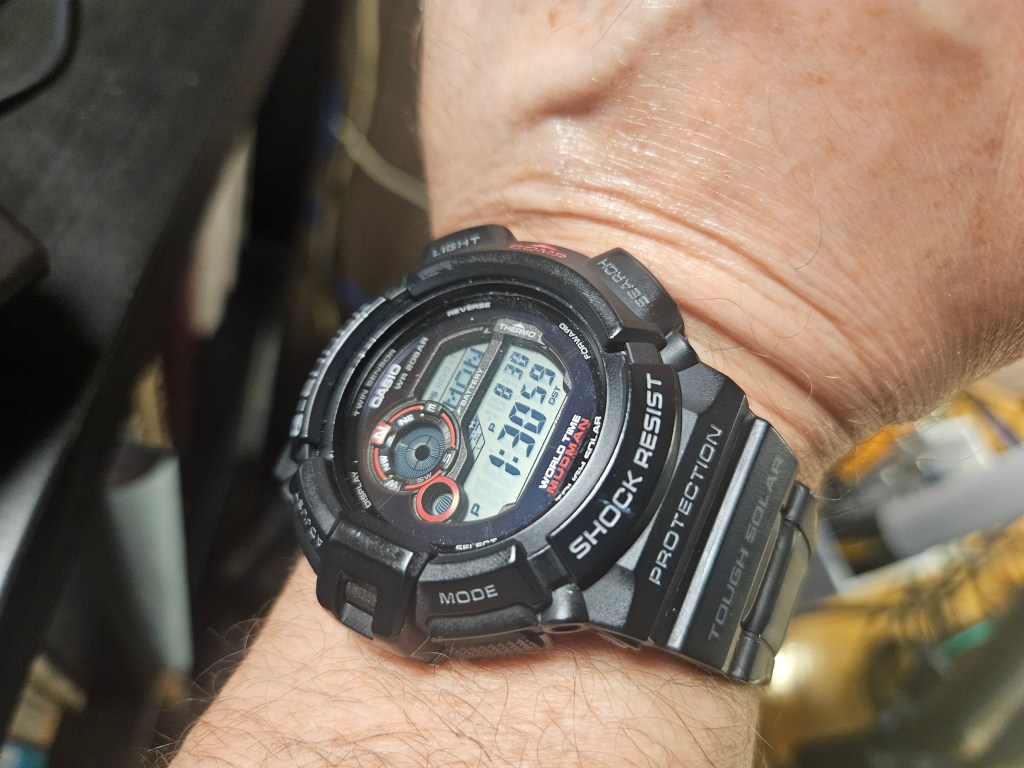
    I bought a used Casio G-Shock G-9300 Mudman for $100, though I didn’t know that at the time. I thought I was buying its more sophisticated cousin—the Multiband-6 GW-9300—listed at $200. When the package arrived, the truth was stamped plainly on the caseback: G-9300. No atomic sync, no nightly communion with Colorado—just a solid, stubborn quartz soldier. My heart sank with the dull thud of a man who realizes he’s paid twice the price for half the feature set.

    I contacted the seller, assuming incompetence rather than malice. His inventory was 99% clothing; this was not a man who spent his evenings debating radio signal strength and solar charging rituals. I offered him a dignified exit: refund me $100 and I’ll keep the watch, or take it back for a full refund. His first move was to offer $80, which was optimistic in the way that a man hopes you won’t notice arithmetic. I declined gently and reiterated my willingness to return the watch. That sobered him. He apologized, agreed to refund the full $100, and we both avoided the bureaucratic headache of returns.

    I could have pressed harder. There’s always a way to extract a little more when the other party is off-balance. But squeezing a man who’s clearly trying to piece together a living from eBay listings feels less like savvy and more like moral corrosion. You squeeze out a few more dollars but lose your soul.

    In the end, I kept the watch, opened ChatGPT for a tutorial, and in two minutes had it set and behaving like the reliable instrument it is. No atomic precision, no midnight syncs—just time, ticking along with modest competence. The transaction, briefly absurd, resolved itself into something tolerable, even instructive. I paid for a mistake, corrected it, and walked away with a working watch and an untroubled conscience.

    Not every deal needs to be a conquest. Some are better as small acts of grace and kindness.

  • I Am Verbosaurus Rex

    I Am Verbosaurus Rex

    At exactly 8:00 a.m.—as reliably as a Swiss watch with a Costco membership—I entered my Torrance Trader Joe’s, continuing a ritual that has endured since 2005. Fifteen minutes in, I found myself in the pasta sauce aisle beside two sisters in their sixties, both with jet-black hair and the alert posture of women who have seen things. Then it came: a disturbance from the frozen food aisle.

    At first, I told myself it was the usual retail banter—clerks sparring, voices raised in mock aggression, the choreography of workplace camaraderie. That illusion lasted about three seconds. The tone sharpened. The volume climbed. This was no jovial joust. This was a kerfuffle in its purest, most unrefined form—the kind of word baseball announcers used when fists replaced fastballs.

    The dialogue, once decipherable, repeated itself with the stubborn clarity of a broken record:
    “Stop coughing on the food.”
    “Mind your own business.”

    Again.
    “Stop coughing on the food.”
    “Mind your own business.”

    The sisters and I exchanged a look of shared alarm—the silent agreement that this was not the sort of morning theater one expects while contemplating marinara. Around us, employees formed small, murmuring clusters, like villagers sensing a storm that rarely visits their town.

    I never saw the alleged cougher—the phantom menace—but I did see his accuser. He entered our aisle still simmering, muttering fragments of outrage like a man replaying his own highlight reel. He was a bodybuilder in his late twenties, performing that unmistakable gait: the lat-spread strut, shoulders flared as if perpetually stepping onstage. He carried a bag in each hand like ceremonial weights. Gray sweatpants. Turquoise T-shirt emblazoned with the word “Strong,” as if to remove all ambiguity.

    The shirt was soaked through, suggesting a recent campaign at the nearby UFC gym. He had not yet exited warrior mode. His face attempted a look of righteous fury, but it flickered—betrayed by the faintest hint of self-awareness. The room was not applauding. It was recoiling. The performance of dominance had misfired, and in its place lingered something less heroic: the spectacle of a man who had mistaken volume for authority and muscle for gravitas.

    For a moment, I caught a trace of chagrin in his expression, like a balloon losing air in slow motion. Still, he clung to a hardened stare, perhaps hoping to salvage dignity from the wreckage.

    As for me, I became invisible. I adopted the ancient survival tactic of the grocery store: benign neutrality. Eyes forward. No recognition. No acknowledgment. The last thing I needed was to be drafted into this man’s private war.

    At checkout, as the affable clerk scanned my items with the serenity of someone blissfully unaware of the morning’s drama, I felt the urge to recount the scene. It had all the ingredients of a fine anecdote—conflict, absurdity, a man yelling about respiratory etiquette in the frozen aisle. But I hesitated. The bodybuilder might still be somewhere in the store, prowling, listening, ready to defend his honor against anyone who dared narrate it.

    Perhaps next week, I’ll tell the story. Though by then, in a place like Trader Joe’s, the tale will have already spread—whispered from aisle to aisle, passed between cashiers, and filed away as one of those rare moments when civility briefly cracked, and the frozen peas bore witness.

    My opportunity to tell the story would be wasted because it would be old gossip by then. 

    I walked out of Trader Joe’s pushing ten canvas sacks of groceries and a quiet resentment: I was not the man who got to tell the story of the raging bodybuilder. That distinction had slipped through my fingers, and the loss exposed something less flattering than disappointment. It exposed me as a gasbag—a man who doesn’t merely enter a room but attempts to annex it, to colonize the airspace with stories, gossip, and one-man comedy routines delivered with the full-body enthusiasm of a failed vaudevillian.

    I don’t just want to tell a story. I want to stage it. I want gestures, timing, voice modulation—the whole theatrical apparatus. I want to leave scorch marks on the memory of my audience, to become, if only for a moment, the most vivid thing that has ever happened to them. Not a storyteller, but an event. Not a man, but a headline.

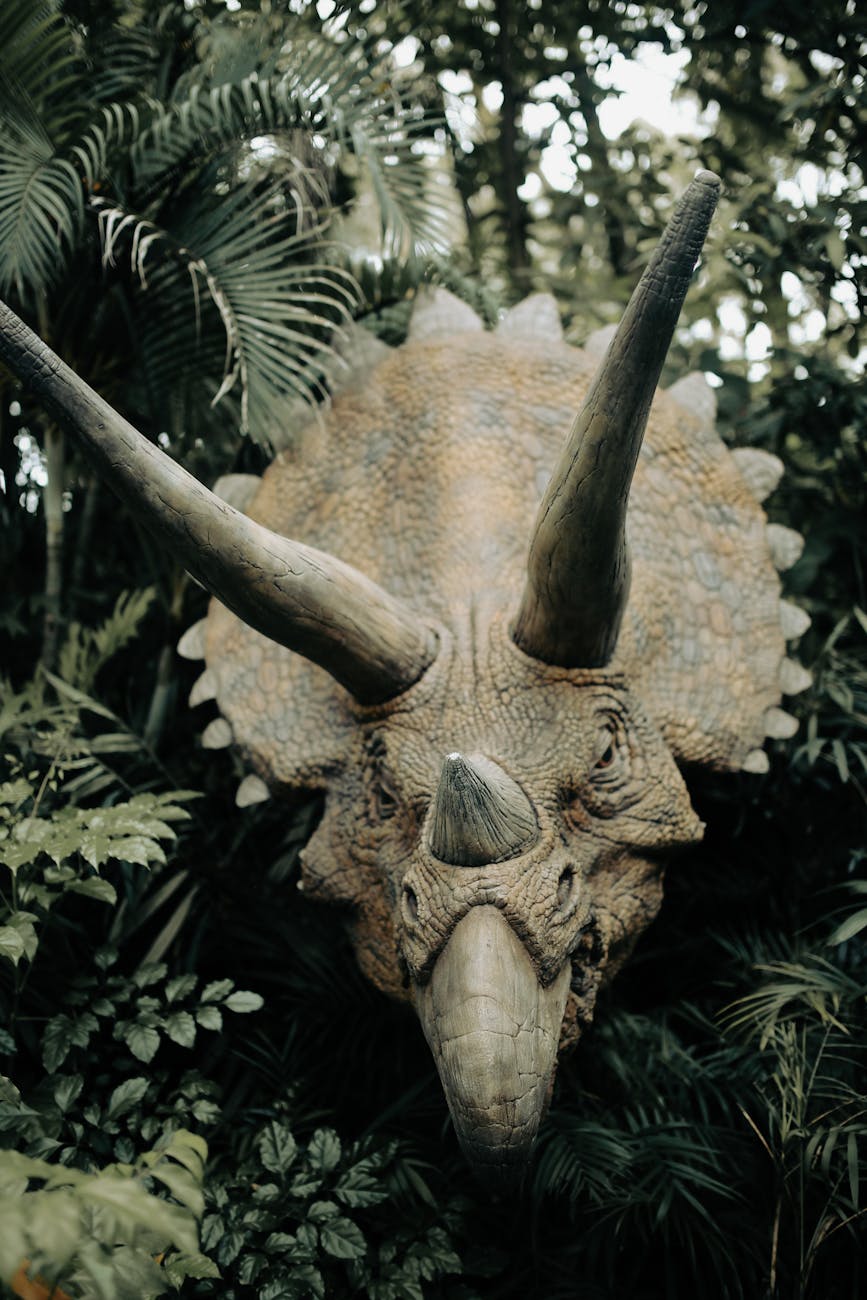
    Which is to say: I am Verbosaurus Rex. I am a  conversational apex predator that survives by devouring silence and leaving behind a trail of exhausted listeners. I do not speak so much as expand, inflating every passing thought into a full-bodied monologue with the confidence of a man who believes the room has been waiting all day for my commentary. Questions are merely launchpads, pauses are tactical errors, and other people’s sentences are polite suggestions to be overrun. The Verbosaur, such as myself, does not intend harm; I simply cannot imagine a world in which less of me would be an improvement.

    And that impulse, when examined in sober light, looks less like charisma and more like hunger. Primitive man told stories around the fire to make sense of the world and to warn others about the tiger in the tall grass. I, on the other hand, seem to be reenacting Barnum & Bailey in the produce aisle, hoping that if I juggle enough words and land enough laughs, I might briefly convince myself that I matter.

    As a Verbosaur, I resemble the great, haunted figure of Larry Sanders—the talk show host who, after basking in the glow of studio applause, goes home to watch himself on television, scanning his own performance for proof that he was enough, and finding, with grim consistency, that he was not.

  • A Close Fight by the Frozen Peas at Trader Joe’s

    A Close Fight by the Frozen Peas at Trader Joe’s

    At exactly 8:00 a.m.—as reliably as a Swiss watch with a Costco membership—I entered my Torrance Trader Joe’s, continuing a ritual that has endured since 2005. Fifteen minutes in, I found myself in the pasta sauce aisle beside two sisters in their sixties, both with jet-black hair and the alert posture of women who have seen things. Then it came: a disturbance from the frozen food aisle.

    At first, I told myself it was the usual retail banter—clerks sparring, voices raised in mock aggression, the choreography of workplace camaraderie. That illusion lasted about three seconds. The tone sharpened. The volume climbed. This was no jovial joust. This was a kerfuffle in its purest, most unrefined form—the kind of word baseball announcers used when fists replaced fastballs.

    The dialogue, once decipherable, repeated itself with the stubborn clarity of a broken record:
    “Stop coughing on the food.”
    “Mind your own business.”

    Again.
    “Stop coughing on the food.”
    “Mind your own business.”

    The sisters and I exchanged a look of shared alarm—the silent agreement that this was not the sort of morning theater one expects while contemplating marinara. Around us, employees formed small, murmuring clusters, like villagers sensing a storm that rarely visits their town.

    I never saw the alleged cougher—the phantom menace—but I did see his accuser. He entered our aisle still simmering, muttering fragments of outrage like a man replaying his own highlight reel. He was a bodybuilder in his late twenties, performing that unmistakable gait: the lat-spread strut, shoulders flared as if perpetually stepping onstage. He carried a bag in each hand like ceremonial weights. Gray sweatpants. Turquoise T-shirt emblazoned with the word “Strong,” as if to remove all ambiguity.

    The shirt was soaked through, suggesting a recent campaign at the nearby UFC gym. He had not yet exited warrior mode. His face attempted a look of righteous fury, but it flickered—betrayed by the faintest hint of self-awareness. The room was not applauding. It was recoiling. The performance of dominance had misfired, and in its place lingered something less heroic: the spectacle of a man who had mistaken volume for authority and muscle for gravitas.

    For a moment, I caught a trace of chagrin in his expression, like a balloon losing air in slow motion. Still, he clung to a hardened stare, perhaps hoping to salvage dignity from the wreckage.

    As for me, I became invisible. I adopted the ancient survival tactic of the grocery store: benign neutrality. Eyes forward. No recognition. No acknowledgment. The last thing I needed was to be drafted into this man’s private war.

    At checkout, as the affable clerk scanned my items with the serenity of someone blissfully unaware of the morning’s drama, I felt the urge to recount the scene. It had all the ingredients of a fine anecdote—conflict, absurdity, a man yelling about respiratory etiquette in the frozen aisle. But I hesitated. The bodybuilder might still be somewhere in the store, prowling, listening, ready to defend his honor against anyone who dared narrate it.

    Perhaps next week, I’ll tell the story. Though by then, in a place like Trader Joe’s, the tale will have already spread—whispered from aisle to aisle, passed between cashiers, and filed away as one of those rare moments when civility briefly cracked, and the frozen peas bore witness.

  • The Cologne, the Q-Tip, and the Bronzed Tyrant: A Memoir Without Euphemism

    The Cologne, the Q-Tip, and the Bronzed Tyrant: A Memoir Without Euphemism

    When Tom Junod discussed his memoir with Andrew Sullivan, he described a decision that feels almost subversive now: no contemporary therapy-speak. No “toxic masculinity,” no diagnostic shorthand, no tidy labels to anesthetize the mess. A book set in the ’60s and ’70s would speak in the idiom of those years. The wager is simple and risky: if you refuse the crutch of modern jargon, the character has to carry the weight. By that measure, Junod wins. He builds a father who does what Dashiell Hammett demanded of fiction—gets up, steps off the page, and stands there, unavoidable.

    The book—In the Days of My Youth I Was Told What It Means to be a Man—borrows its title from the Led Zeppelin song “Good Times Bad Times,” and the borrowing is apt. Junod’s father, Lou, is less a man than a doctrine delivered at high volume. He is a born pontificator with a salesman’s grin and a peacock’s vanity. He scents himself like a department store—colognes, sprays, balms layered into a cloud—and tans his body into a lacquered bronze that seems to announce itself before he enters a room. He sells handbags, favors turtlenecks, and at the beach reduces himself to a strip of fabric and a glare. He cleans his navel with a witch-hazel-dipped Q-tip and instructs his son to follow suit, as if hygiene were a moral philosophy.

    Compulsion runs through him like a live wire. If you prefer a term to describe his sexual compulsions, call it satyriasis and be done with it, but the word hardly captures the sprawl: gambling, philandering, bullying—habits that bloom into a personality. A man who cannot govern himself makes governance his obsession; he attempts to administer his household the way a tyrant administers a province—loudly, relentlessly, and with a curious conviction that control is the same thing as order. The result is a home pressurized to the point of fatigue, where even silence feels like a reprimand.

    Junod’s refusal to retrofit his childhood with modern language sharpens the pain rather than softening it. There’s a scene that lands like a held breath finally released: in Lou’s absence, the mother reappears as herself. Her face opens. Her voice steadies. When Tom reads her a poem, she brightens—really brightens—and offers the simplest, most generous counsel: read it aloud; the sound will teach you what the page cannot. It is a small moment, but it reveals the scale of what has been missing. When Lou is present, he occupies the air itself. He doesn’t just enter rooms; he consumes them, a man with a gift for turning oxygen into pressure.

    Listen to the audiobook—as Sullivan sensibly suggests—and Lou’s voice acquires a second life. You don’t merely read him; you hear the cadence, the certainty, the unearned authority. It is a performance you cannot switch off, which is precisely the point. The book’s power comes from that persistence. It is painful, yes, but the pain is disciplined into narrative momentum.

    If the experience feels familiar, it should. The era produced a certain model of man—postwar, unapologetic, loud as a virtue—who treated appetite as remedy and certainty as proof. He read “women’s magazines” out in the open, said things he couldn’t defend, and considered objection to his will a breach of etiquette. The code was simple: be emphatic, be unyielding, be right by volume. Junod doesn’t argue with that code; he incarnates it. He takes the template and gives it a name, a voice, a set of rituals so specific they become unforgettable.

    In doing so, he offers a quiet rebuke to our current habit of explanation. You don’t need a glossary to understand this man. You need a page, a room, and the patience to watch what happens when he walks in.

  • The Ballad of Roland Beavers

    The Ballad of Roland Beavers

    You can’t understand what it meant to be a teenage boy in 1970s California without inhaling the thick, narcotic perfume of banana-coconut tanning oil. It wasn’t a scent so much as a doctrine. You lay on a beach towel the size of a small sailboat and basted yourself in that viscous syrup as if you were preparing your own body for display. No one spoke of melanoma. The goal was simple: darken, gleam, radiate. Bronze was not just a color—it was a declaration of sexual arrival. For a teenage bodybuilder, it was mandatory. Muscles alone were not enough; they needed lacquer, shine, theatrical finish. We weren’t just building bodies—we were curating mythologies.

    The culture supplied its own scripture. Xaviera Hollander hovered over the decade like a secular saint of libido, her memoir The Happy Hooker tucked into suburban living rooms beside purple bongs that leaned like exhausted sentinels. Her voice—thick Dutch vowels, half invitation, half sermon—drifted through late-night radio, as intoxicating as the oil we poured over ourselves like maple syrup on pancakes. If Hollander provided the gospel, Eric Weber supplied the tactics. His book, How to Pick Up Girls!, read like a field manual for social siege warfare: pursue, persist, override refusal, wear resistance down to compliance. It was less romance than strategy, less courtship than conquest. And like all bad ideas, it traveled quickly among teenage boys who didn’t yet know the difference between confidence and predation.

    At Lake Don Castro in the summer of 1977, we found the living embodiment of this philosophy: Roland Beavers, a thirty-year-old demigod in blue Speedos. He stood on the grassy knoll above the sand like a monument to self-belief—wavy hair, sculpted mustache, gold chain glinting against a chest that looked permanently backlit. A Playboy cooler at his feet, a boombox humming, a Frisbee orbiting his charisma—Roland was less a man than a recurring performance. We studied him like apprentices. His lines never changed. 

    Every Saturday I heard the following: Roland paid his uncle five hundred dollars for a custom paint job on his Camaro. His father owned expensive real estate in the Bay Area. He had helped manage his father’s properties since he was in high school. He was waiting to hear from a Hollywood studio for a small role as a fighter in a martial arts movie. Even though he never attended college, he had his own house in a desirable part of town called Parsons Estates. Roland would throw in the words “Parsons Estates” as if they were a magical mantra that would make stars sparkle over his coiffed hair.

    Every Saturday Roland met a new blonde, somehow more beautiful than the previous one. He and at least one woman would play Frisbee on the grassy knoll above the man-made beach’s imported sand.

    On one such afternoon, my bodybuilder buddies and I saw Roland in his usual spot, the grassy knoll, where he was tossing his Frisbee to two blonde girls in white bikinis. I had my towel spread out close by so I could study Roland’s methods. I was half-listening to him talk about how amazing he was and half-reading my parents’ dog-eared copy of The Happy Hooker.

    That’s when I heard Roland give out an alarming howl.

    “Oh my God,” one of the bikini-clad girls said. “You stepped on a bee.”

    I saw the bee spinning in the grass for its final moments before it would die without its stinger.

    The bee sting’s effects were immediate. Roland began to sweat and limp while trying to walk through the pain. The two blonde girls looked at the wincing pick-up artist with concern. One of them asked if he was all right.

    “No big deal,” he said. “Just a little bee sting.”

    “Are you sure you’re okay?” one of the girls asked as the man’s body was covered with a shiny sheen of sweat.

    “I’m fine. Really, I am.”

    “I think you should sit down,” one of the girls said.

    “No, we can still play. I’m fine. Don’t worry about me.”

    By now, Roland’s foot had swollen into a giant ham. He looked down at the inflamed flesh, and his tumescent foot was proof of the severity of his situation. His eyes bulged with fear, and then he collapsed, and lying prone on his back he began to hyperventilate.

    An ambulance came soon after. Roland was in the throes of anaphylactic shock. The paramedics did their best, but Roland died on the spot.

    I was never the same after that incident. I obsessed over Roland’s demise, I suffered nightmares about it, and I stopped going to the beach with my buddies. 

    About six months after the incident, a peculiar daydream began visiting me with unnerving regularity. In it, I did not watch Roland die from a distance; I inhabited his final moments, seeing the world through his eyes. As his body failed, his mind seemed to step into an alternate life—a gentler, unperformed existence. He was no longer the peacock on the grassy knoll but a husband, walking along the shoreline with his wife, four children orbiting them in laughter, and two rescue dogs bounding through the surf. The air carried a soft, almost cinematic music. The sky was a pale, forgiving blue. Sunlight fell not harshly, but tenderly, as if it had chosen to console rather than expose.

    In that imagined reprieve, Roland turned toward something higher—toward God—and spoke with a clarity he had never shown in life. He promised to abandon the theater of conquest, to relinquish the hollow rituals of charm and pursuit, to grow into the man he had postponed becoming. It was as if the world had paused to offer him a final rehearsal for redemption. The horizon opened. A stillness settled over everything. And within that stillness, he seemed to experience, perhaps for the first time, a quiet and unadorned peace—a beauty that required no performance and asked nothing in return.

     And just as the possibility of redemption flickered into being—it was extinguished. His body failed. The bee won. His life ended mid-sentence.

    I carried that ending with me to the piano, where I tried to make sense of Roland’s death the only way I knew how. For two years I worked on “The Ballad of Roland Beavers,” a piece that refused to resolve cleanly because the life it memorialized never did. Nearly fifty years later, I still play it. The notes haven’t dulled. Neither has the lesson. Some performances end not with a bow, but with a collapse—too little, too late, and no encore.

  • The Visitor from the Abyss

    The Visitor from the Abyss

    On a bright spring afternoon in Southern California in 1998, my writing class was dissecting evil with the clinical confidence of people who believed it could be contained in literature. We were discussing The Painted Bird, a novel so saturated with human cruelty that it feels less like fiction and more like a dare. The room hummed with theories—evil as social construct, evil as pathology—until my students quietly dismantled the abstraction. They believed in evil not as metaphor, but as presence. Ghosts. Demons. Things seen and not forgotten.

    One single mother spoke of something that crawled beneath her bed at night. She said it plainly, without theatrics, which made it worse. Another student, a nurse in her forties who worked long shifts at UCLA, waited until after class. “I have a story,” she said, as if announcing a diagnosis that required privacy.

    She didn’t look like someone given to fantasy. She was compact, practical, her thick glasses enlarging eyes worn down by long hours and human frailty. Her stories usually involved difficult patients or her childhood in rural Louisiana—earthbound things. But as she began, her voice shifted, acquiring a distant cadence, as if she were tuning into a frequency not meant for daylight.

    She was six or seven at the time, roaming the backwoods with her cousin Carmen. No supervision, no schedule, no adult intervention. Their days were filled with the idle cruelty of children left alone too long—tormenting small animals, inventing games that escalated from mischief into something darker. There were no witnesses, no consequences, and so no brakes.

    Until one afternoon.

    They were inside the farmhouse, a sagging structure with a porch that complained with every step. The screen door creaked open. A man walked in and sat down in the living room as if he owned the place.

    But he wasn’t a man.

    She struggled to describe him without sounding ridiculous. He wasn’t clothed, but that detail felt irrelevant. His body was covered in coarse, matted fur. His skin—if it could be called that—had the pallor and texture of a rodent. Behind him trailed a long, muscular tail that slid along the floor and flicked against the doorframe like a living whip. He looked like something assembled from nightmare logic: a giant rat that had decided to stand upright and enter a house.

    The girls didn’t run. They couldn’t. Fear locked them in place, as if the room itself had thickened.

    He began to speak.

    For hours—she was certain it lasted hours—he sat in that chair and talked. His voice was low and abrasive, as if it scraped its way into the room. He told stories about the things he had done, the damage he had caused, the harm he had perfected. Time lost its structure. The afternoon stretched into something shapeless and suffocating.

    Then he turned his attention to them.

    “I’ve seen how bad you girls are,” he said. “I’ve seen what you’ve been doing.”

    And then he began to list their offenses. Not generalities—details. Every small cruelty, every secret act they had committed when no one was around. Things no adult had witnessed. Things no one could have reported.

    “I’m going to recruit you,” he said. “I’m going to make you mine.”

    The threat didn’t rise in volume. It settled into the room, thick and toxic, like something you could breathe in and never fully expel. His eyes stayed on them the entire time, unblinking, patient, certain. He described what would happen if they continued, not in vague moral warnings, but in precise, almost administrative terms—consequences rendered as inevitabilities.

    The girls sat frozen, their bodies no longer their own.

    And then, as casually as he had entered, he stood up and left. The tail followed him out like an afterthought, sliding across the threshold and disappearing into the heat.

    Silence rushed back into the house.

    Carmen finally whispered, “Did you see that?”

    My student nodded. Speech had abandoned her.

    From that day forward, their lives snapped into alignment. No more cruelty. No more experimentation with harm. They went to church. They prayed. They obeyed. Not out of virtue, but out of fear sharpened into obedience. Whatever had visited them had not suggested a path—it had enforced one.

    I would have preferred to dismiss the story as delusion, but that option didn’t fit the teller. This was a woman trained to assess reality, to separate symptom from fabrication. She spoke without embellishment, without the slightest interest in persuading me. She wasn’t selling a story; she was reporting an event that had rearranged her life.

    It unsettled me more than I expected.

    At the time, I was living alone in a condo in Redondo Beach, the kind of place that feels harmless until night gives it edges. One evening, I had a dream about the Cowardly Lion from The Wizard of Oz. Only this version had shed all pretense of cowardice. He chased me, snarling, his face twisted into something feral and wrong.

    I woke up, but the dream didn’t fully release me.

    At the foot of my bed, I felt it—presence. Not a thought, not a leftover image, but something that occupied space. The lion-man sat there, immense, silent, undeniable. Fear pinned me in place. Breathing became an effort, as if the air itself had thickened in protest.

    After several long seconds, I forced movement into my body. I stood, walked up the stairs on unsteady legs, poured a glass of water like someone performing a ritual they barely believed in. When I returned, I flooded the room with light, turned on the television, filled the silence with noise until the presence thinned and finally dissolved.

    Like pain receding from a crushed hand—slow, stubborn, but eventually gone.

    What stayed was the recognition.

    Evil is not just an idea we debate in classrooms or confine to novels. It has a way of presenting itself—not always dramatically, not always visibly, but with enough force to alter how you move through the world. Once you’ve felt it, even briefly, it leaves a residue. A knowledge that doesn’t argue its case. It simply waits, somewhere just beyond the edge of explanation.

  • The Night My Biceps Filed for Divorce

    The Night My Biceps Filed for Divorce

    My pride as a lifelong bodybuilder—still clinging to relevance in my sixties—met its demise one evening on the couch, where I lay in a slovenly posture and glazed-over eyes while watching the movie Road House. Calling it a film feels charitable. It’s more like a glossy shrine to the male physique, starring a Jake Gyllenhaal so surgically chiseled he looks as if Michelangelo started carving David, lost patience, and decided to make him punch strangers for a living.

    Gyllenhaal plays a brooding bouncer in Key West, a man whose job description consists of protecting a bar and its luminous owner, played by Jessica Williams, from the usual parade of cinematic degenerates. This inevitably summons the film’s apex predator: Conor McGregor, who appears less like a human being and more like a shaved grizzly bear that discovered performance enhancers and never looked back. Veins bulge with the enthusiasm of overinflated garden hoses. His performance oscillates between feral animal and man who hasn’t blinked since the Obama administration, and it’s oddly mesmerizing.

    The plot is a rumor—thin, fleeting, and functionally irrelevant. A stranger rides into town, restores order with his fists, and exits in a cloud of testosterone and broken cartilage. But let’s not pretend narrative is the point. The camera worships muscle with the reverence of a Renaissance chapel. Biceps gleam. Lats ripple. Every slow-motion shot feels like a commercial for pre-workout powder and substances that come in unmarked vials. This isn’t storytelling; it’s a two-hour flex.

    Somewhere between Gyllenhaal’s forty-seventh shirtless entrance and McGregor’s latest snarl—delivered like a man hydrated exclusively by rage—I reached for my phone. Not to check the time. To search McGregor’s diet. Because this spectacle doesn’t entertain; it indicts. It shines a harsh fluorescent light on your own soft edges and whispers, You, sir, are a sentient pudding cup.

    At sixty-two, I knew I wasn’t about to carve myself into Gyllenhaal’s likeness. But I was still in the fight—kettlebells in the garage four days a week, the exercise bike on the others. My diet remained high-protein, though compromised by opportunistic snacking. The result: less Greek statue, more a compact, perspiring version of Larry Csonka in a Hawaiian shirt, lingering too long at the Grand Wailea buffet.

    I entertained fantasies of becoming a skinny version of myself. Replace kettlebells with yoga. Trade meat-heavy sandwiches for two plant-based meals a day of steel-cut oats, bell peppers, and tofu. But a chorus of old convictions intervened: maintain the protein intake, preserve the muscle, defend the territory. Five servings of “bioavailable protein” a day. No surrender. Somewhere along the way, fitness had ceased being about health and hardened into doctrine.

    I hadn’t competed since finishing runner-up in the 1981 Mr. Teenage San Francisco, but the mindset endured: life as contest, existence as proving ground. That belief wasn’t accidental. It was inherited. My father—infantryman turned engineer—treated life like a problem to be solved and a battle to be won.

    In the early 1960s, stationed in Anchorage, he found himself competing with another suitor—John Shalikashvili—for my mother’s affection. When Christmas interrupted the contest, my father refused the ceasefire. He cut his holiday short, intent on beating his rival back to Alaska. His vehicle—a pale 1959 Morris Minor—chose that moment to revolt, its fuel system failing with impeccable timing.

    Lesser men would have conceded. My father reached for ingenuity. Lacking a proper part, he improvised with a prophylactic and a paperclip, fashioning a grotesque but functional fix. It was absurd. It was desperate. It worked. He made it to Seattle, boarded the ferry, and arrived in Alaska forty-eight hours ahead of his rival.

    Nine months later, I entered the world—the byproduct of competitive instinct, mechanical improvisation, and what must surely be the most unorthodox application of latex in automotive history. In that moment, my father didn’t just win a race. He set a standard: adapt, outmaneuver, prevail. And decades later, as I sat watching sculpted demigods on screen, I realized that standard was still quietly running my life.

  • The Sacred Thud and the Beachside Alibi

    The Sacred Thud and the Beachside Alibi

    Last night I dreamed I visited a man who lived in an apartment not with furniture, but with his fleet of Lexus sedans, each one folded into suitcase-sized cardboard boxes like obscene luxury origami. When he carried them outside, they bloomed into full-sized cars—sleek, silent, and faintly smug. One in particular arrested me. It was labeled “brown,” a word that should have condemned it to mediocrity, but this was no pedestrian brown. It shimmered with a platinum undertone, a molten, aristocratic hue that made every other color feel like a clerical error.

    But the color was only the prelude. The real seduction was auditory. The man insisted I open and close the door. I obliged. The door shut with a dense, ceremonial thud—the kind of sound that suggests not merely engineering, but finality. It was the closing argument of a life well lived. I felt it in my chest, in my bones. At that moment, I understood with humiliating clarity that I would never feel complete until I owned this exact car in this exact shade and could summon that sacred thud on command. This, apparently, was my apotheosis.

    Once the demonstration concluded, he ushered me into his living room, where a large television glowed like an altar. It was tuned to CNN. On the screen: live coverage of his wife undergoing surgery for a rare and aggressive cancer. The procedure was experimental, a medical moonshot that, if successful, would not only save her life but advance the entire field. Her body lay open to the future; her survival would be a headline.

    The man watched with a peculiar intensity, not the anxious devotion of a husband, but the focused anticipation of someone waiting for a green light. He explained, almost casually, that once she was cured, he intended to meet his mistress at the beach. A public affair, he admitted, would be considered “unethical,” but surely—he reasoned—if his wife survived, the moral calculus would soften. One good outcome would offset the other. Balance restored.

    I stood there, staring at the screen. The broadcast cut between the operating table and a glowing chart tracking her biomarkers in real time—green lines twitching, rising, negotiating with fate. He leaned forward, eager, almost buoyant, rooting for her survival so he could proceed, unburdened, to his afternoon of betrayal.

    The room was quiet except for the hum of the television and, somewhere in the distance of my mind, the echo of that perfect car door closing—clean, decisive, final.

  • My Life, Annotated; My Dinner, Missing

    My Life, Annotated; My Dinner, Missing

    Last night I dreamed I was back in a college dorm, the kind that confuses scarcity with philosophy. The place ran on grievance and empty shelves. The communal kitchen looked like it had been looted by graduate students—half a bottle of soy sauce, a fossilized lime, and the lingering odor of arguments. The factions were loud, doctrinaire, and permanently aggrieved; the refrigerator was quiet and permanently bare. I kept my mouth shut. Hunger is easier to manage than other people’s ideologies.

    A short walk away—dream geography is generous like that—sat my mother’s second husband, Baron, who has been dead since 2018 and therefore was very much alive. He wore a white football jersey and the expression of a man auditing eternity. He’d set up on a patio with a notebook and a stack of my YouTube videos, which he was mining for a college project. The topic: my life, the false stories I’ve told about it, the false stories about those false stories, and the small industry I’ve built turning all of it into myth. He watched, paused, rewound, took notes with clerical devotion. It was flattering in the way a tax audit is flattering.

    Part of me admired the rigor. Another part of me bristled at the freeloading. There he was, piggybacking on my past like it was a group project I didn’t sign up for. Still, the man was thorough. He unearthed old footage, journals, drawings—artifacts I’d misfiled in the archive of things I no longer had the energy to remember. If diligence were destiny, he was on his way to a summa.

    I wished him luck and went back to the kitchen, where luck goes to die. As I left, Baron called out that he’d put a beige bowl of hard-boiled eggs on the top shelf of the fridge. Help yourself. The promise of protein felt like a minor miracle. I elbowed through the crowd—everyone arguing, no one eating—opened the door, and there it was: the beige bowl, perfectly placed, impeccably empty. The eggs had been converted into theory.

    So I stood there, starving, while somewhere behind me my life was being reduced to footnotes. In the dream, as in the waking world, the analysis was abundant. The food was not.