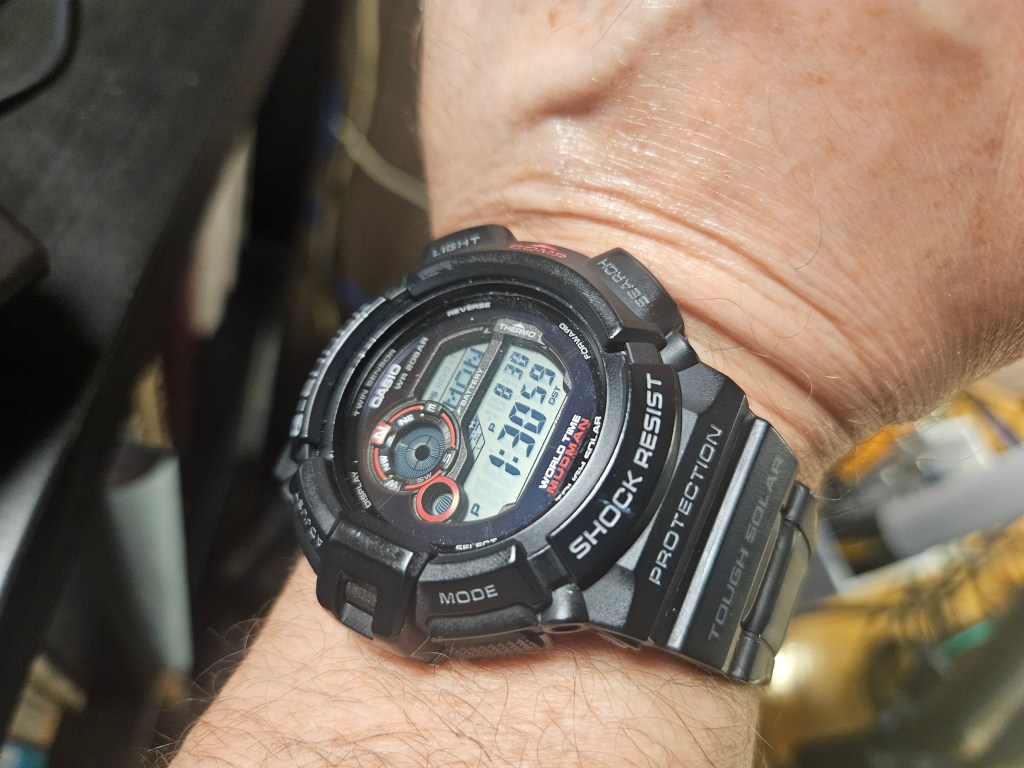
I bought a used Casio G-Shock G-9300 Mudman for $100, though I didn’t know that at the time. I thought I was buying its more sophisticated cousin—the Multiband-6 GW-9300—listed at $200. When the package arrived, the truth was stamped plainly on the caseback: G-9300. No atomic sync, no nightly communion with Colorado—just a solid, stubborn quartz soldier. My heart sank with the dull thud of a man who realizes he’s paid twice the price for half the feature set.
I contacted the seller, assuming incompetence rather than malice. His inventory was 99% clothing; this was not a man who spent his evenings debating radio signal strength and solar charging rituals. I offered him a dignified exit: refund me $100 and I’ll keep the watch, or take it back for a full refund. His first move was to offer $80, which was optimistic in the way that a man hopes you won’t notice arithmetic. I declined gently and reiterated my willingness to return the watch. That sobered him. He apologized, agreed to refund the full $100, and we both avoided the bureaucratic headache of returns.
I could have pressed harder. There’s always a way to extract a little more when the other party is off-balance. But squeezing a man who’s clearly trying to piece together a living from eBay listings feels less like savvy and more like moral corrosion. You squeeze out a few more dollars but lose your soul.
In the end, I kept the watch, opened ChatGPT for a tutorial, and in two minutes had it set and behaving like the reliable instrument it is. No atomic precision, no midnight syncs—just time, ticking along with modest competence. The transaction, briefly absurd, resolved itself into something tolerable, even instructive. I paid for a mistake, corrected it, and walked away with a working watch and an untroubled conscience.
Not every deal needs to be a conquest. Some are better as small acts of grace and kindness.


Leave a comment