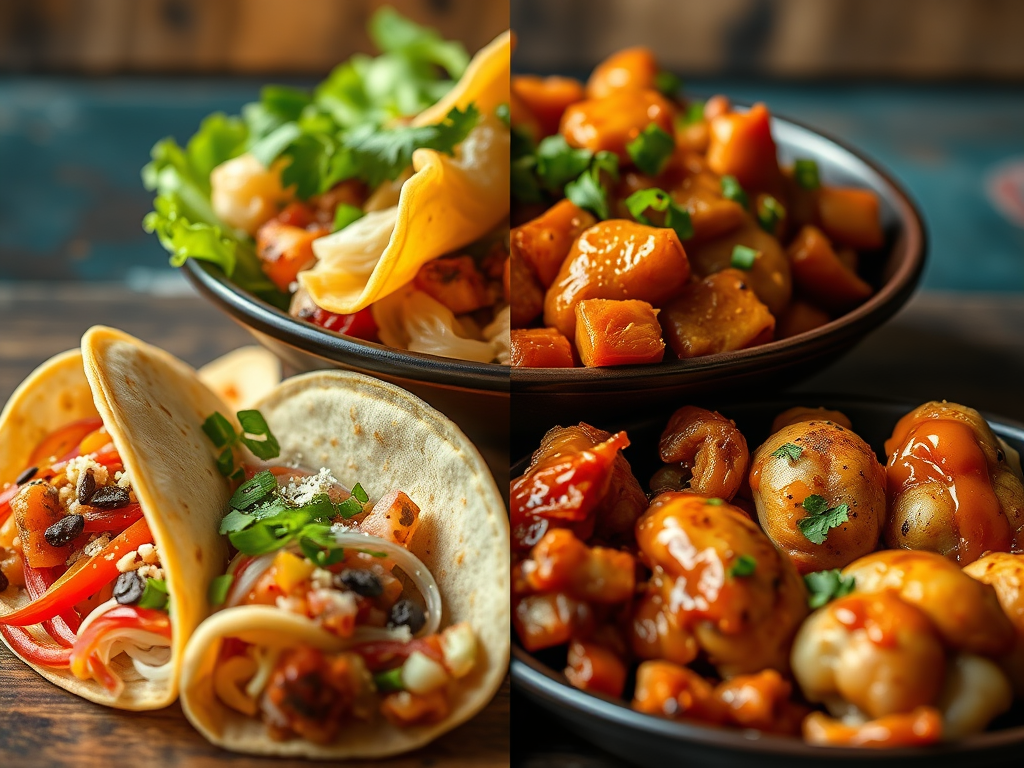
Here are three essay prompts suitable for 9-paragraph argumentative essays that challenge students to explore how cultural adaptation, authenticity, and survival intersect in the evolution of Mexican and Chinese cuisines in the United States. These prompts invite complexity, evidence-based reasoning, and personal insight.
Prompt 1: In Defense of Delicious Deviations
Essay Prompt:
Some critics dismiss American Chinese food and modern Mexican cuisine—like orange chicken or the Korean BBQ burrito—as watered-down, inauthentic versions of their cultural roots. Yet such critiques ignore the ways immigrant communities have used food as both survival strategy and creative resistance. In a 9-paragraph essay, argue whether the label “inauthentic” does more harm than good. Draw from The Search for General Tso, Gustavo Arellano’s “Let White People Appropriate Mexican Food,” and at least two of the following: Hayford’s “Who’s Afraid of Chop Suey,” Erway’s “More Than Just Takeout,” Kwok’s “‘Not Real Chinese,’” or Fan’s “Searching for America with General Tso.”
- Your task: Defend, refute, or complicate the claim that cultural adaptation in food should be celebrated, not shamed.
Prompt 2: Culinary Code-Switching or Cultural Betrayal?
Essay Prompt:
Is American Chinese and modern Mexican cuisine a brilliant example of culinary code-switching—adapting to survive and thrive in a new world—or does it betray the deeper flavors and values of its ancestral roots? In a 9-paragraph essay, take a stand on whether fusion and adaptation are a form of cultural resilience or erasure. Use The Search for General Tso, Arellano’s essay, and at least two supporting essays (Hayford, Erway, Kwok, or Fan) to develop your argument.
- Your task: Consider the historical and economic pressures on immigrant communities that helped shape these cuisines. Should these hybrid dishes be considered a vibrant part of American food culture—or a distortion of heritage?
Prompt 3: The Myth of Purity in the Melting Pot
Essay Prompt:
In both Chinese and Mexican American food traditions, authenticity has become a loaded term—used by foodies as a badge of honor, and by some critics as a bludgeon against change. In a 9-paragraph essay, examine how the myth of “authenticity” often erases the stories of innovation, hardship, and transformation that shaped these cuisines. Should authenticity be a rigid standard, or a flexible narrative that evolves with history and context?
- Your task: Analyze the role that racism, assimilation, and economic survival have played in shaping what Americans now call “Mexican” or “Chinese” food. Draw from The Search for General Tso, Arellano’s essay, and at least two others from the reading list.
 Cinemorphosis
Leave a comment