Category: Education in the AI Age

  • Canvas Crashes and a Protein Bar Declares War on My Molar

    Canvas Crashes and a Protein Bar Declares War on My Molar

    Five days ago, an hour before my afternoon class, I performed my sacred office ritual: a Barbell’s Salty Peanut protein bar followed by a red apple. The pairing is non-negotiable. The bar coats my teeth in a fudge-like film; the apple arrives like a janitor, scrubbing the residue with righteous crunch. It’s dental choreography. It works—until it doesn’t.

    Mid-bar, I bit down and hit something that did not belong in the human diet. A crack, a jolt, a flash of pain in my upper left molar that suggested litigation. I spit out the offending bite and there it was: a small, defiant piece of gravel. Not metaphorical gravel. Geological. I briefly entertained the idea of a calcified peanut shell, but no—this was the kind of object that builds driveways, not snacks.

    I discarded the rock, finished the bar like a man negotiating with fate, and approached the apple with the caution of a bomb technician, chewing exclusively on my right side. The tooth protested—sharp when I bit down, sensitive when I dared sip cold sparkling water. I called my dentist. He agreed to see me Monday while my daughters are in for their cleaning, a kind of dental drive-by.

    I told him, only half joking, that if this turns into a root canal, I’ll be leaving the country under an assumed name. My claustrophobia is not a charming quirk; it’s a governing principle. The rubber wedge they use to keep your mouth open transforms my throat into a closed border. When I can’t swallow on command, panic doesn’t knock—it kicks the door in. I am praying for a humble composite fix, something modest and merciful. A root canal would turn me into a beachside exile, scanning the horizon for dental extradition.

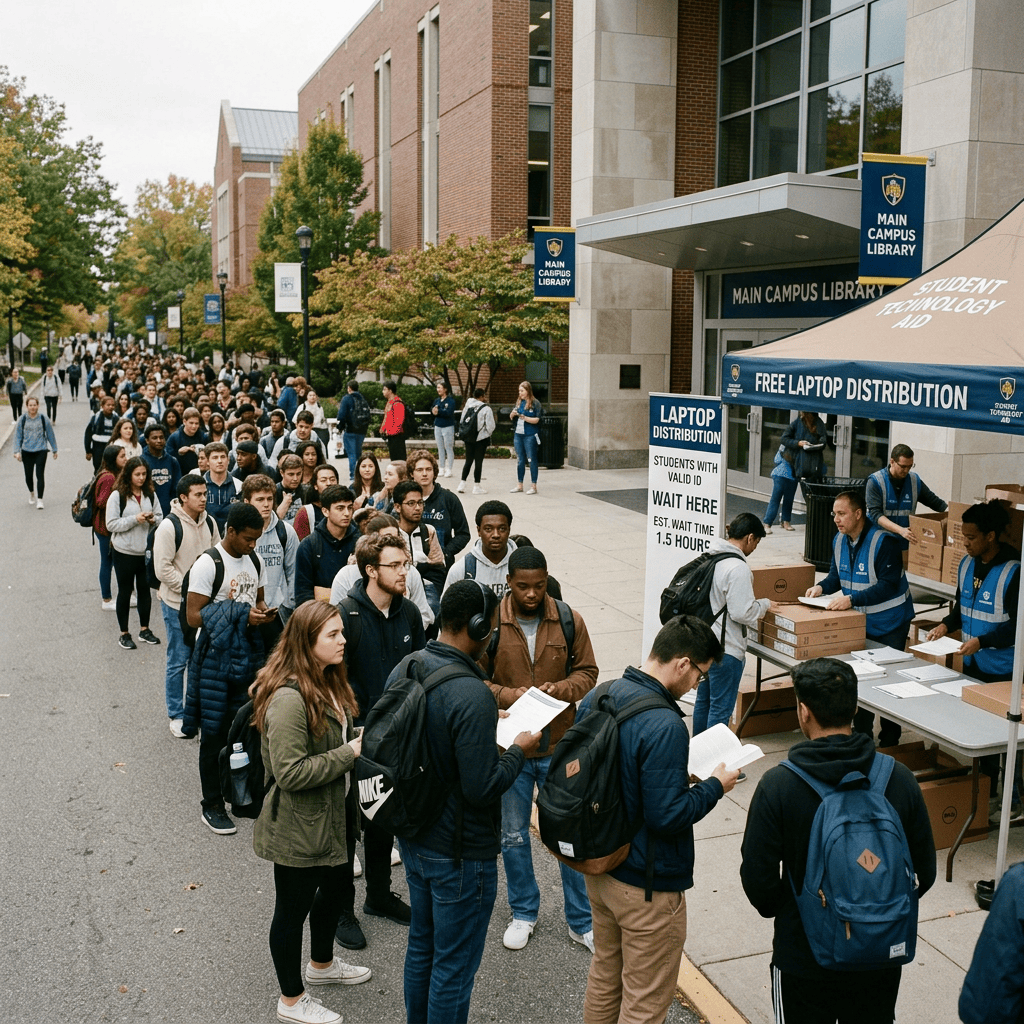
    As if one anxiety weren’t enough, two days later my college’s learning system—Canvas—collapsed under a ransomware attack that apparently took down thousands of schools. An hour before class, I discovered my lecture had vanished into the digital abyss. I called my engineering friend Pedro to deliver a live report of my unraveling. I told him I’d have to improvise, which in teaching is another word for “pray for coherence.”

    Then a thought arrived like a small miracle: my lectures are linked to Google Slides. If I could log into my Google account, I could resurrect the class. I told Pedro I’d head to the room early and test the login before the students arrived. I looked down at my desk—keys, empty protein bar wrapper, the usual debris of academic life—but no phone.

    “Where the hell is my phone?” I said.

    “You’re talking to me on it,” Pedro replied.

    We laughed the way men laugh when reality briefly exposes its wiring. For twelve years, Pedro has been my unofficial tech support, but informing me that the phone I was using was in my hand may be his finest work.

    Between the compromised tooth and the compromised Canvas infrastructure, I felt like a man auditioning for a nervous breakdown. Instead, I walked into class and, perversely, had one of the best sessions of the semester. We discussed ultra-processed foods—their design, their addictiveness, the way they quietly rig the game of weight management. Then I offered a heretical counterargument: homemade food can be just as seductive, just as dangerous to restraint.

    To prove the point, I pulled up a photograph from the Los Angeles Times: a $38 basturma brisket sandwich from Yerord Mas, built from Australian wagyu and dusted with cumin, garlic, and chiles. The image did not educate so much as seduce. Within seconds, my students had located the menu and confirmed the price with the forensic zeal of the hungry.

    “We should Uber to Glendale,” I said, “and call it field research.”

    At that point I added, “Some of you are going to complain to the Dean that you enrolled in a critical thinking class and all I do is talk about food.”

    They laughed—real laughter, not the polite classroom version. The room had a charged, fizzy quality, as if the collapse of Canvas had granted us permission to loosen the tie a notch. Chaos had stripped the day down to its essentials: conversation, curiosity, a shared joke.

    I needed that laugh more than I care to admit.

    Now I’m waiting. Will the dentist deliver a quick, civilized repair, or will I be pricing one-way tickets and practicing aliases on a beach somewhere in Mexico, scanning the horizon for a man carrying a drill?

    In the meantime, I chew carefully, avoid gravel, and consider the possibility that the most dangerous part of my day is not the curriculum, but the snack.

  • The Day I Logged Off the AI Panic Machine and Walked at the Beach

    The Day I Logged Off the AI Panic Machine and Walked at the Beach

    I teach college writing, which means I’ve spent the last four years staring at the AI question the way a man stares at a fire he suspects might jump the fence. When ChatGPT arrived, it didn’t knock politely. It crashed into the room like a UFO and rearranged the furniture. Since then, I’ve read what feels like a small library’s worth of essays—predictions, warnings, elegies for the essay itself—and contributed a few of my own, because that’s what we do: we metabolize disruption by writing about it.

    But there comes a point when the analysis stops clarifying and starts echoing.

    I’ve reached that point. My brain has filed a quiet injunction: no more. Not just a break from AI, but a break from reading about how exhausted everyone else is by AI. The discourse has become a hall of mirrors—each reflection slightly more fatigued than the last.

    I’ve been here before. In 2010, I had newborn twins, which is another way of saying I was living inside a low-grade emergency. The market offered guidance—books, podcasts, earnest experts—but I wanted none of it. I was already doing the job. Additional commentary felt like a second shift. Experience was loud enough; analysis was just noise layered on top.

    Both episodes point to the same condition: Applied Reality Rejection—the refusal to consume secondary discourse when you’re already neck-deep in the primary experience. When you’re in it, more talk about it doesn’t help. It dilutes.

    And here’s the part the essays rarely admit: reading about AI doesn’t soothe AI anxiety. It compounds it. Each think piece arrives like a fresh weather report announcing the same storm in slightly different prose.

    So I’m choosing friction of a better kind. I play the piano until my attention steadies. I pick up kettlebells and let gravity argue with me for a while. I walk the beach and let the horizon do what no article can—put scale back into the day. The analog world doesn’t theorize; it recalibrates.

    That was the remedy with the twins, too. Not another podcast on sleep training, but a walk, a dumb TV binge, a sweaty hour in the garage. Relief came from stepping out of the commentary loop, not diving deeper into it.

    Which is why, when I see another AI essay queued up from The Atlantic or The New Yorker, I feel a familiar tightening—and then I close the tab. Not out of contempt, but out of preservation.

    I’ve heard enough echoes. It’s time to drive two miles to Catalina Avenue and take a walk at the beach.

  • A College Degree in Applause

    A College Degree in Applause

    When Oprah Winfrey signed off for the last time, she offered a distilled insight after decades of televised confessionals and couch-bound catharsis: beneath our surface differences, we all want the same thing—to be heard and, more importantly, to be affirmed. Not merely listened to, but validated, as if our words must pass through some invisible tribunal and emerge stamped: This life matters. This mind is not wasted inventory.

    She was right, though even that admission feels like an understatement. The appetite for validation is not a polite preference; it’s a metabolic demand. We don’t just want to speak—we want to land. We want our sentences to strike the listener with enough force that they nod, recalibrate, maybe even quote us later as if we were a minor authority in the ongoing project of making sense. We want to believe that our thoughts improve the room, that our presence upgrades the conversation from background noise to something resembling signal.

    Of course, the engine driving this hunger isn’t entirely noble. Scratch the surface and you’ll find insecurity jittering beneath the skin, narcissism preening in the mirror, tribal instincts scanning for applause from the right audience. We want to be right, but more than that, we want to be seen being right. Yet it would be too easy—and too smug—to reduce this to vanity alone. There’s another current running underneath. Human beings, for all their posturing, are wired for cooperation. We build moral systems, knowledge systems, entire civilizations on the premise that sharing ideas might actually improve the collective condition. So the same impulse that craves applause also aspires—sometimes sincerely—to contribute something of value. We may be peddling clichés, hallucinations, or the occasional insight, but the urge to be heard persists like a drumbeat.

    After nearly forty years of teaching writing, I’ve had a front-row seat to this performance. I’ve enjoyed the privilege—let’s call it what it is—of having a voice that people were required to listen to. Now, as that authority begins to fade at the edges, I’m left examining the machinery that made it feel necessary in the first place. My students will tell you they’re here for practical reasons: a degree, a job, a paycheck that doesn’t insult them. Fair enough. But beneath that utilitarian script, I suspect another motive is quietly at work. They want to matter intellectually. They want their ideas to carry weight, to be received not as filler but as substance.

    I can see it because I can reverse-engineer myself at eighteen. Put me back in that position—blank slate, open catalog—and I’d choose political science without hesitation. Not because it guarantees employment—it doesn’t—but because it offers a stage. A chance to sound sharp, to read densely, to write with the kind of authority that might make a professor pause and think, there’s something here. The fantasy isn’t wealth; it’s recognition. Money pays the bills, but it doesn’t applaud. It doesn’t lean forward when you speak.

    And without that recognition—without the sense that your mind registers on someone else’s radar—life begins to feel like static. Content generated, scattered, and forgotten. A digital smear. Noise mistaken for presence.

    Which is why so many of us operate under a quiet affliction I’d call Intellectual Visibility Panic: the nagging fear that no matter how carefully we assemble our thoughts, they will evaporate on contact—unheard, unvalued, and unremembered. It’s not dramatic enough to ruin your day, but it’s persistent enough to shape your choices. It nudges you toward certain majors, certain careers, certain performances of self. It whispers that time is running out, that if you don’t establish your voice soon, it will dissolve into the background hum.

    And so we speak. We write. We posture. We refine. Not just to communicate—but to leave a trace strong enough that someone, somewhere, might stop and say: that was worth hearing.

  • Energy Vampires and the Cost of Desire (college essay prompt)

    Energy Vampires and the Cost of Desire (college essay prompt)

    Write a 1,200-word essay that advances a clear, arguable thesis about time—how it is lost, misused, and quietly drained—by analyzing Winter Dreams and Torch Song. Focus on relationships that operate like “energy vampires”: people who absorb attention, distort priorities, and leave the other person with less time, less clarity, and less life than before.

    In your introductory paragraph, define “energy vampire”–a person who consumes another’s attention, time, and emotional resources while giving little in return. Then illustrate your definition with a paragraph-long personal experience in which you encountered someone who drained your time or energy. 

    The present your thesis that examines the dynamics between Dexter Green and Judy Jones, and between Jack Lorey and Joan Harris. Where do these pairings overlap, and where do they diverge? In what ways do these relationships function as “time vampires,” diverting the protagonists from lives they might otherwise have lived?

    Finally, take a position on responsibility. To what extent are Dexter and Jack victims of these draining relationships, and to what extent do they participate in their own depletion? Support your claims with close textual analysis and specific evidence.

  • How It Feels to Grade 60 Original Essays Edited by AI

    How It Feels to Grade 60 Original Essays Edited by AI

    I assigned my students an essay that asked them to describe a place both ugly and formative—a crucible that hurt them and, in the same breath, made them. The submissions came back like a map of pressure points: a high school classroom that felt like a courtroom, a gym that smelled of rubber and dread, a mental health ward lit like an aquarium, a pre-op room where the clock ticked louder than courage, a soccer field that taught hierarchy and grace, a family home in El Salvador, a Korean farm where labor spoke in blisters. The content was theirs—specific, unborrowed, alive. But the sentences often arrived wearing a suspicious polish, the prose lacquered to a showroom shine. You could feel the editor in the room, invisible and tireless.

    I keep returning to a metaphor I can’t shake: AI is like a bodybuilder taking steroids for writing. Go in “natty,” and you present a muscular physique that is honest–well defined, maybe even impressive. Add the chemical assist and you step onstage thirty percent larger, veins penciled in, every line exaggerated into spectacle. 

    After sixty of these eye-popping essays, I felt the same deadening I get at a bodybuilding show. At first you admire the craft; then the sameness creeps in. The poses change; the effect doesn’t. Everything looks like everything else.

    This is my ambivalence, and it refuses to resolve. On one hand, AI hands students a language upgrade that would make a New York editor nod—clarity, rhythm, a vocabulary that lands. It’s as if they’ve been fast-tracked to a professional register. On the other hand, that very upgrade dilutes the experience. When strong language grows out of a human mind, it carries the friction of effort—the faint grit that makes it feel earned, inhabited. When it arrives laundered through a machine—the “stochastic parrot” Emily M. Bender warned us about—it can be dazzling and hollow at once, a chandelier with no wiring. The sentences glitter; the room stays dark.

    I’ve graded hundreds of essays for years and thought I knew the terrain—the tells of struggle, the leap from draft to draft, the moment a voice becomes unmistakably its own. Now I’m reading in a new jurisdiction with no settled law. I’m less a judge than a border agent, inspecting passports that all look freshly printed. Welcome to the literary Wild West: the gold is real, the essays are suspect, and every nugget asks the same question—where did you get this?

  • Essay Prompt: The Seduction of a Frictionless Life

    Essay Prompt: The Seduction of a Frictionless Life

    In this assignment, you will examine how a life engineered for maximum convenience and instant gratification can lead not to fulfillment, but to misery, emotional flattening, and a diminished sense of humanity.

    To develop your analysis, you will work with two texts:

    • “Our Longing for Inconvenience” by Hanif Abdurraqib
    • Twilight Zone episode “A Nice Place to Visit”

    Both works explore the dangerous allure of a frictionless existence—one in which effort, struggle, and delay are removed in favor of ease and immediate satisfaction.


    Your Task

    Write a 1,000-word argumentative essay that develops a clear, original thesis responding to the following central question:

    How do these two works show that a frictionless life seduces us into surrendering our humanity, and why does this surrender ultimately lead to dissatisfaction or misery?


    Required Elements

    Your essay must include:

    1. A Strong Thesis

    • Make a specific, arguable claim about frictionless living
    • Avoid summary; take a position
    • Your thesis should address:
      • seduction (why we want convenience)
      • consequence (what it costs us)

    2. Comparative Analysis

    • Analyze both sources in depth
    • Show how they converge and/or diverge in their critique
    • Use specific examples:
      • Abdurraqib’s concept of convenience and authenticity
      • The protagonist’s experience in The Twilight Zone episode

    3. Conceptual Focus

    Your essay must engage at least two of the following ideas:

    • Dehumanization
    • Emotional flattening
    • Loss of meaning or purpose
    • Passive consumption vs. active engagement
    • The illusion of happiness

    4. Evidence and Commentary

    • Integrate specific references from both works
    • Explain how each example supports your argument
    • Avoid plot summary—focus on interpretation

    5. Counterargument and Rebuttal

    • Acknowledge a reasonable opposing view:
      (e.g., convenience improves quality of life)
    • Refute it with clear reasoning and evidence

    Writing Expectations

    • Length: 1,000 words
    • Tone: Analytical, precise, and assertive
    • Avoid clichés and vague generalizations
    • Prioritize clarity, specificity, and strong prose

  • The Rise of the Cyborg Student and the Collapse of Learning

    The Rise of the Cyborg Student and the Collapse of Learning

    In her Atlantic essay “Is Schoolwork Optional Now?”, Lila Shroff describes a classroom that has quietly slipped its friction. Students entering high school around 2024 have discovered that schoolwork—once a slog of half-formed ideas, crossed-out sentences, and mild despair—can now be outsourced with the elegance of a corporate merger. With tools like Claude Code, they recline while a digital understudy attends class on their behalf, taking quizzes, drafting lab reports, and assembling PowerPoints with the glossy finish of a mid-level consultant angling for a promotion.

    Teachers respond with variety, as if novelty could outpace automation. More assignments, different formats, new prompts. It doesn’t matter. The students simply retrain their AI to shapeshift into whatever species of learner is required: the earnest analyst, the reflective humanist, the data-savvy pragmatist. The submissions arrive immaculate—coherent, polished, and suspiciously free of the small humiliations that once marked actual thinking.

    The problem is not that the work gets done. It’s that no one is being worked on. The transformation has shifted from mind to method. Students aren’t learning the material; they’re learning how to manage a machine that can impersonate someone who did.

    If that weren’t enough, the next escalation has arrived with a name designed to soothe your nerves: Einstein. This AI agent claims it can log into platforms like Canvas and complete an entire semester’s workload in a single day. It doesn’t just skim the surface. It watches lectures, digests readings, writes essays, posts discussion comments, submits assignments, and takes exams—leaving behind a digital paper trail so competent it borders on smug.

    Shroff decided to test the promise. She enrolled in an online statistics course and turned Einstein loose. Within an hour, it had completed the entire semester of work: eight modules and seven quizzes. She earned a perfect score. She also learned, by her own account, almost nothing. The grade was real. The education was imaginary.

    Einstein’s creator, Advait Paliwal, is a 22-year-old who speaks with the calm inevitability of someone announcing the weather. His argument is simple: this is a warning. Adapt or become decorative. Educators have responded with lawsuits and cease-and-desist letters, which he treats as polite acknowledgments that the problem is larger than any one person. If he hadn’t built it, someone else would have. And if you find Einstein alarming, he assures us, you should pace yourself—this is the beta version of the apocalypse. “There’s more to come.”

    Meanwhile, Silicon Valley is not retreating. It is accelerating, pouring resources into embedding AI deeper into the educational bloodstream. The irony is almost too clean: educators are losing control not only because the technology can’t be contained, but because they use it themselves. AI grades papers, drafts materials, streamlines feedback. It makes the job more efficient. It also quietly rewrites what the job is.

    The endgame is already visible. It has a name that sounds like a software feature but reads like a verdict: the Fully Automated Loop. AI generates the assignments. AI completes them. AI grades them. The student, once the point of the enterprise, becomes a spectator to a closed circuit of competence.

    We used to worry about students not doing the work. Now the work does itself.

    And when that loop closes, education doesn’t collapse in a dramatic heap. It hums. It functions. It produces results.

    It just stops producing people.

  • Teaching Without a Map in a Shifting World

    Teaching Without a Map in a Shifting World

    In “Teaching in an American University Is Very Strange Right Now,” Frank Bruni captures a tension that defines the modern classroom: how do you offer students hope without lying to them? His students at Duke University are coming of age in a moment that feels less like a transition and more like a rupture—truth is contested, institutions feel unstable, artificial intelligence is reshaping entire professions, and the political climate leans toward confusion and consolidation of power. Add to that a job market where careers in public policy, government, and nonprofits are shrinking, and the traditional pathways begin to look like dead ends.

    Bruni’s difficulty is not just emotional; it’s epistemological. The ground keeps shifting. The job market no longer behaves like a map you can study and memorize. It behaves like weather—volatile, unpredictable, and indifferent to your plans. Bruni and his colleagues find themselves in an unfamiliar position: experts who no longer trust their own expertise. When the mentors are unsure of the terrain, the act of mentoring starts to feel like guesswork dressed up as guidance.

    And yet, retreating into cynicism would be a dereliction of duty. Bruni insists on offering hope, but not the anesthetized version that avoids discomfort. His version of hope is anchored in reality. He tells his students that survival in this environment will not belong to the most credentialed or the most specialized, but to the most adaptable. The winners will be those who can pivot quickly, read patterns early, and anticipate what’s coming before it arrives. In other words, they must think several moves ahead while the board itself is being rearranged.

    This requires a shift in how students approach their education. The old model—bury yourself in your major, master the material, trust that the system will reward you—was always a partial truth. Now it’s a liability. Depth without awareness is no longer enough. Students need a wide-angle lens, an ongoing scan of the broader landscape: economic shifts, technological disruptions, political currents. The classroom can no longer be a refuge from the world; it has to be a vantage point from which to read it.

    Bruni’s message is unsettling, but it has the virtue of being honest. Hope, in this context, is not the promise that things will work out as planned. It’s the conviction that those who stay alert, flexible, and strategically aware can still find a way forward—even when the path refuses to stay still.

  • The Kryptonite Effect of Screens in Education

    The Kryptonite Effect of Screens in Education

    In her Atlantic essay “What Happened After a Teacher Ditched Screens,” the author examines a belief so widely accepted it rarely gets questioned: that more technology automatically improves learning. Dylan Kane, a seventh-grade math teacher, bought into that belief for over a decade. His students worked on Chromebooks, navigating a custom-built math site while monitoring software kept them from drifting into games or distractions. It was a tightly managed digital ecosystem—efficient on paper, persuasive in theory.

    Then Kane pulled the plug.

    This wasn’t a minor adjustment; it was a small act of rebellion. Nearly ninety percent of school districts now issue laptops or tablets, sold on the promise of “personalization”—the idea that technology can tailor instruction to each student’s needs, close learning gaps, and adapt to different cognitive styles. It’s an elegant theory, especially attractive to those whose reputations and revenue depend on merging education with technology.

    But in Kane’s classroom, the theory collapsed under the weight of actual human behavior. Screens didn’t personalize learning; they colonized attention. Students stared at them the way gamblers stare at slot machines—fixed, hypnotized, and detached from the room. Class discussion withered. The teacher’s voice, once the organizing force of the classroom, lost every round to the glowing rectangle. When attention becomes a zero-sum game, the screen doesn’t negotiate. It wins.

    Kane’s frustration deepened when he read Jared Cooney Horvath’s The Digital Delusion, which argues that increased technology use correlates with declining student performance. So Kane ran an experiment: he removed the Chromebooks for a month. What he discovered was not subtle. Students began paying attention again. Participation returned. Assignment completion jumped from 45 to 62 percent. Writing equations by hand—slow, deliberate, mildly inconvenient—forced students to see their own thinking unfold. The inconvenience turned out to be the point. Learning, it seems, benefits from friction.

    I’ve been teaching college writing for over thirty-five years, and I’ve seen my own version of this “kryptonite effect.” Smartphones siphon attention. Laptops become portals to games, sports, and anything but the task at hand. I’ve watched students drift out of the room without leaving their seats. The screen doesn’t just distract; it competes, and it usually wins.

    And yet, my experience isn’t a simple indictment of technology. Between 2018 and 2019, I ran a structure that worked. We met twice a week: one day for lecture and discussion, the other as a writing lab. During lab sessions, students wrote on desktops or their own laptops, working through scaffolded assignments. I read their drafts in real time, helping them revise thesis statements and sharpen arguments. The dynamic shifted. I wasn’t a distant lecturer; I was a coach moving from desk to desk. Students completed work on campus instead of procrastinating at home. Completion rates improved, not because of the machines themselves, but because of how they were used.

    The pandemic ended that model. My courses shifted to a hybrid format—one meeting a week—and the lab disappeared. I’ve been reluctant to surrender precious face-to-face time to silent writing sessions. But I’m beginning to wonder if I’ve been too cautious. If Kane is right about the power of attention, perhaps the most effective use of class time is not more talking, but more doing.

    What Kane’s experiment ultimately reveals is not that technology is useless, but that it is context-dependent. A math classroom, built on sequential problem-solving, may suffer when screens fracture attention. A writing classroom, structured around drafting and revision, may benefit from them under the right conditions. The mistake is not using technology. The mistake is treating it as a universal solution.

    If I were back to teaching two days a week, I wouldn’t hesitate. One day for discussion. One day for writing in a lab. Not because technology is inherently good, but because, in that setting, it serves the work instead of sabotaging it.

  • Plastic Detox or Plastic Defeat? Evaluating the Power of Persuasion (college essay prompt)

    Plastic Detox or Plastic Defeat? Evaluating the Power of Persuasion (college essay prompt)

    Watch the documentary The Plastic Detox and write a 1,000-word essay that evaluates how effectively it persuades its audience. Your essay should take a clear position on whether the film motivates meaningful lifestyle changes to reduce plastic exposure or whether it overwhelms viewers into resignation.

    Analyze the rhetorical strategies the documentary uses—such as emotional appeals, scientific evidence, expert testimony, visual imagery, and narrative framing—to shape its argument. Does the film strike a balance between urgency and practicality, or does it risk pushing viewers toward helplessness by emphasizing the scale of the problem?

    In your essay, consider both possibilities: that the documentary empowers viewers to act, and that it may instead produce anxiety or fatalism. Develop a counterargument that challenges your position and follow it with a rebuttal that defends your claim.

    Conclude by reflecting on what the documentary suggests about individual responsibility in a world saturated with plastic.