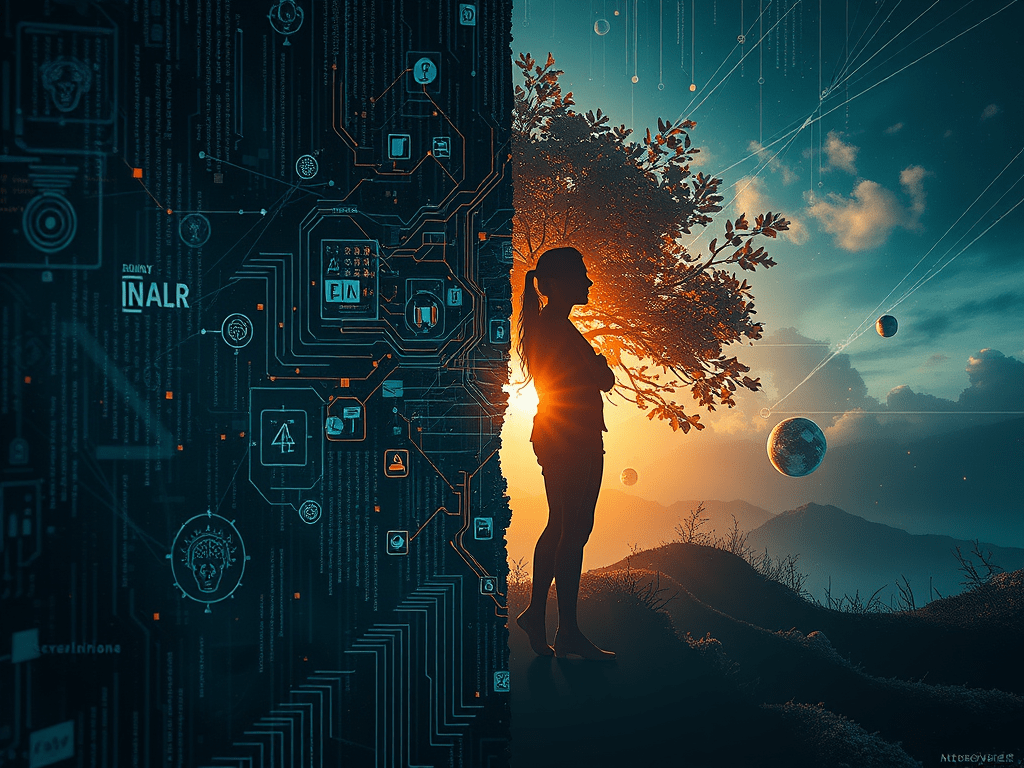
In today’s hyper-competitive, algorithm-driven world, many individuals are turning to powerful technological tools—not just for productivity, but for identity, control, and emotional stability. Weight-loss drugs like Ozempic offer users a sense of mastery over the body, often succeeding where willpower failed. Similarly, AI platforms such as ChatGPT, Gemini, and Claude are being used not only for academic support but also for managing personal emails, organizing life decisions, and even simulating companionship and therapy. Students increasingly describe these platforms as indispensable, citing them as sources of clarity, control, and confidence in a chaotic world.
But is this reliance empowering—or hollowing us out? This process, which we might call Ozempification, refers to the growing technological colonization of everyday life under the banner of self-improvement. While these tools promise control, they may also erode self-agency and authenticity, leaving us dependent on curated personas generated by algorithms rather than lived experience. The end result may be what some critics call technological totalization: a complete outsourcing of identity, decision-making, and emotional regulation to machines.
Using the Black Mirror episodes “Joan Is Awful,” “Nosedive,” and “Smithereens,” write a 1,700-word argumentative essay in which you analyze the unintended consequences of Ozempification. In your essay, explore how each episode dramatizes the trade-offs of living through machines—what is gained, what is lost, and what it means for the human self in an age of total tech dependence.
Your Works Cited page needs a minimum of 4 sources. You can choose from the following:
Works Cited
Black Mirror. “Joan Is Awful.” Directed by Ally Pankiw, season 6, episode 1, Netflix, 15 June 2023.
Black Mirror. “Nosedive.” Directed by Joe Wright, written by Charlie Brooker and Rashida Jones, season 3, episode 1, Netflix, 21 Oct. 2016.
Black Mirror. “Smithereens.” Directed by James Hawes, written by Charlie Brooker, season 5, episode 2, Netflix, 5 June 2019.
Newport, Cal. “What Kind of Writer Is ChatGPT?” The New Yorker, Condé Nast, 16 Jan. 2023, www.newyorker.com/tech/annals-of-technology/what-kind-of-writer-is-chatgpt.
Rothman, Joshua. “Why Even Try If You Have A.I.?” The New Yorker, Condé Nast, 6 Mar. 2023, www.newyorker.com/magazine/2023/03/06/why-even-try-if-you-have-ai.
Seymour, Richard. The Twittering Machine. The Indigo Press, 2019.
Shroff, Lila. “The Gen Z Lifestyle Subsidy.” The Atlantic, 3 Mar. 2023, www.theatlantic.com/technology/archive/2023/03/gen-z-lifestyle-subsidy/673298.
Tolentino, Jia. “My Brain Finally Broke.” The New Yorker, Condé Nast, 1 Apr. 2024, www.newyorker.com/magazine/2024/04/01/my-brain-finally-broke.
Turk, Victoria. “The Great Language Flattening.” Wired, 18 Apr. 2023, www.wired.com/story/ai-writing-style-language-flattening/.
Al-Sibai, Noor. “Something Bizarre Is Happening to People Who Use ChatGPT A Lot.” Futurism, 8 May 2023, www.futurism.com/chatgpt-users-strange-side-effects.
 Cinemorphosis
Leave a comment