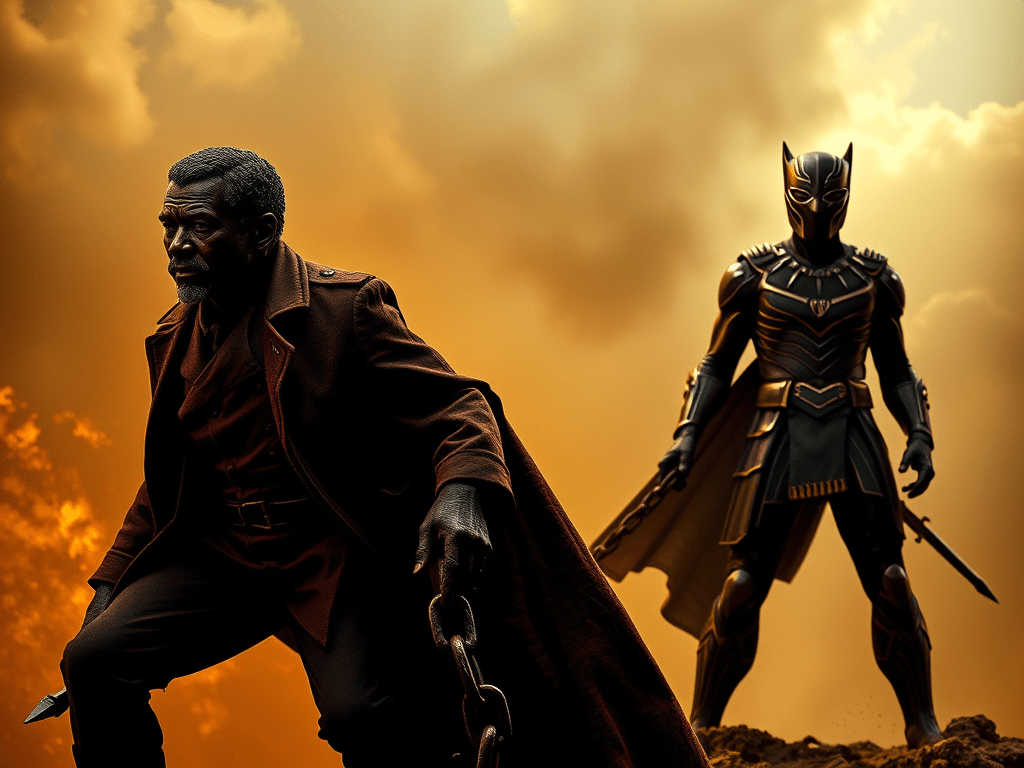
Essay Prompt:
In Frederick Douglass’ Narrative of the Life of Frederick Douglass, the protagonist fights not only for freedom from physical slavery but for a reclamation of his identity and voice. In Get Out (dir. Jordan Peele), Chris Washington must escape a literal and psychological “Sunken Place”—a symbolic void of powerlessness, silencing, and racial objectification. In Black Panther (dir. Ryan Coogler), T’Challa and the people of Wakanda face a choice: remain isolated in comfortable superiority or courageously intervene in global struggles for justice. Across these three works, we encounter individuals and cultures confronting moral inertia and existential erasure.
This essay asks you to consider the Bushido Warrior Code—with its emphasis on courage, loyalty, honor, and self-sacrifice—as a framework of moral resistance. How can Bushido function as a psychological, cultural, and ethical antidote to the Sunken Place—that metaphoric (and literal) realm where people are silenced, dehumanized, or seduced into passivity?
Your task is to write a 1,700-word argumentative essay that explores how Douglass, Chris and Rod from Get Out, and Wakanda in Black Panther demonstrate that adopting a moral code like Bushido is essential to resisting oppression, reclaiming agency, and transforming society.
Use close textual analysis, specific scenes, and well-supported reasoning. You are encouraged to include at least one counterargument—perhaps challenging whether Bushido fits all three stories—and offer a thoughtful rebuttal.
Three Sample Thesis Statements
- Frederick Douglass, Chris Washington, and T’Challa all embody the Bushido Warrior Code through their courageous defiance of systems that attempt to silence and control them; by embracing loyalty, honor, and self-sacrifice, they resist the moral numbness of the Sunken Place and reclaim agency for themselves and their communities.
- Though Bushido originates in a different cultural context, the warrior code’s emphasis on ethical action and personal sacrifice provides a powerful framework to understand how Douglass, the heroes of Get Out, and Black Panther all triumph over forces that seek to render them passive, complicit, or invisible.
- The Sunken Place in Get Out is not limited to that film; it is a universal metaphor for psychological captivity. Through their pursuit of truth, dignity, and moral clarity, the protagonists in Douglass’ memoir and Black Panther reflect Bushido’s core principles, showing that only a warrior’s mindset can break the chains of silence and conformity.
Definition of the Bushido Warrior Code (Relevant to Douglass, Get Out, and Black Panther):
The Bushido Warrior Code is a moral and spiritual framework rooted in Japanese samurai tradition, demanding loyalty, courage, honor, and self-sacrifice in the face of injustice. In the context of Frederick Douglass, Chris Washington and Rod Williams from Get Out, and the Wakandan principles in Black Panther, Bushido can be redefined as the unflinching resolve to resist dehumanization, speak truth to power, and protect others—even at great personal risk.
Douglass, once enslaved and denied his humanity, lived by a code of radical moral clarity: to reclaim his identity and liberate others through truth, intellect, and action. Chris’s escape from the Armitage estate—and Rod’s relentless pursuit to save him—embody Bushido’s call to act with bravery and loyalty against a system of manipulation and violence. In Black Panther, the leaders of Wakanda struggle between tradition and global responsibility, but T’Challa’s decision to share Wakanda’s resources to uplift oppressed communities aligns with Bushido’s ethic of using strength not for domination, but for justice.
Thus, Bushido in this contemporary and intercultural context becomes the warrior’s vow to confront moral cowardice, challenge systems of oppression, and hold fast to integrity—even when the world offers comfort in exchange for silence.
Suggested Outline
I. Introduction (150–200 words)
- Define the Bushido Warrior Code briefly (contextualized for this essay)
- Introduce the idea of the “Sunken Place” as symbolic of dehumanization, passivity, and moral disengagement
- Introduce the three works: Douglass’ memoir, Get Out, and Black Panther
- Thesis statement: Make a clear argument about how Bushido operates as a moral antidote to the Sunken Place across all three works
II. The Sunken Place: A Shared Metaphor for Oppression (200–250 words)
- Define and analyze the literal and metaphorical meaning of the Sunken Place in Get Out
- Briefly link this idea to Douglass’ experience of slavery and enforced ignorance
- Connect to Wakanda’s early isolationism and Killmonger’s anger as signs of a fractured moral stance
- Set up the argument that Bushido, or a similar moral code, offers a counter-force to this condition
III. Frederick Douglass as a Bushido Warrior (300–350 words)
- Discuss Douglass’ path from passive suffering to empowered resistance
- Explore moments in the narrative that exemplify Bushido traits:
- Courage (e.g., fighting Mr. Covey)
- Honor (his pursuit of literacy as self-respect)
- Loyalty (to his people and his mission, not the system that enslaved him)
- Courage (e.g., fighting Mr. Covey)
- Argue that Douglass reclaims his humanity and escapes the “Sunken Place” through an internal code of ethics
IV. Get Out: Chris and Rod as Modern-Day Bushido Figures (300–350 words)
- Analyze Chris’s slow awakening to the danger around him and his eventual decision to fight back
- Highlight Rod’s unwavering loyalty and moral clarity—his refusal to give up on Chris
- Argue that Chris’s violent escape is not just survival but a Bushido-like reclaiming of self-respect and autonomy
- Explore how Peele dramatizes the moment Chris “rises” out of the Sunken Place—both literally and ethically
V. Black Panther: Wakanda’s Ethical Crossroads and the Warrior Ideal (300–350 words)
- Examine Wakanda’s moral dilemma: comfort through isolation vs. courage through engagement
- Focus on T’Challa’s development—his shift from traditionalism to global responsibility
- Consider the Dora Milaje as examples of Bushido: duty, honor, sacrifice
- Argue that Wakanda’s decision to emerge and help others is a national application of Bushido ethics
VI. Counterargument and Rebuttal (200–250 words)
- Erik Killmonger presents a compelling counterargument to the Bushido Warrior Code by rejecting its emphasis on honor, restraint, and loyalty to tradition. For Killmonger, these values have failed the oppressed; they uphold systems that preserve power rather than challenge injustice. Unlike Bushido’s disciplined path of self-sacrifice for a noble cause, Killmonger pursues vengeance through domination and disruption. He sees mercy as weakness, diplomacy as delay, and tradition as complicity. His worldview is shaped by trauma and abandonment, and he believes liberation can only come through violent upheaval—not moral purity.
- Yet this rage-fueled rejection of Bushido ultimately collapses under its own weight. While Killmonger is right to expose the moral cowardice of Wakanda’s past isolation, his scorched-earth tactics mirror the very oppression he seeks to destroy. The Bushido Code, properly understood, is not about submission to broken systems but about disciplined, courageous resistance grounded in honor. T’Challa’s evolution proves this: he learns from Killmonger’s challenge but rejects his methods, choosing instead to open Wakanda to the world and lead with strength and conscience. In doing so, T’Challa shows that true justice does not abandon moral codes—it transforms them to meet the moment.
VII. Conclusion (150–200 words)
- Restate the central claim: These three works show that resisting oppression requires not just escape, but ethical transformation
- Reaffirm that Bushido, though ancient and foreign in origin, offers a moral blueprint for reclaiming agency in a dehumanizing world
- End with a powerful thought or question: What happens when more people choose a warrior’s courage over the comfort of silence?
 Cinemorphosis
Leave a comment