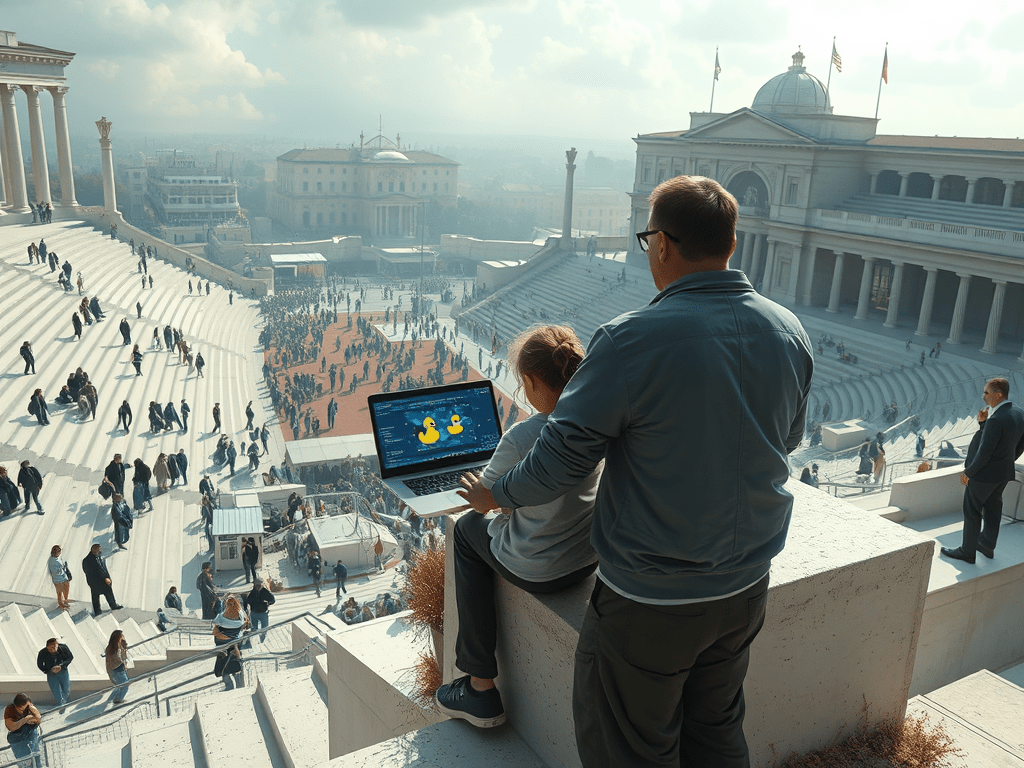
Last night I dreamed I was helping my daughter with her homework in the middle of a public square. A chaotic, bustling arena. Think Roman forum meets tech dystopia. We had two laptops perched on a white concrete ledge high above a stadium of descending steps, as if we were doing calculus on the lip of a coliseum.
The computers were a mess—two laptops yoked together like resentful twins, their settings morphing by the second. Screens flashed blue, then white, then black. Sometimes yellow cartoon ducks floated lazily across the bottom like deranged pop-up ads from a children’s game. I wasn’t so much solving her homework as performing tech triage on possessed machines.
I wasn’t panicked because I couldn’t help her. I was panicked because someone might see that I couldn’t help her. Vanity, thy name is Dad.
People walked past, utterly unfazed. Apparently, homework over a stadium chasm with dueling laptops and malfunctioning duck animations was standard urban behavior.
Then a young man—a peripheral character from some former life—told me there was a “tech lord” nearby. Not tech support. A tech lord. Naturally, I followed.
The tech lord’s lair was a dim room centered around a massive table, cathedral-like in tone and purpose. He was listening to the Bible—read aloud by the famous comedian George Carlin. Not a solemn voice or trained narrator, but someone best known for punchlines and pratfalls. And the tech lord was rapt. He cradled a thick, black Bible like a sacred talisman, proclaiming that this was the finest biblical performance art ever conceived.
I tried to get in a word about my tech problem, but he interrupted me and asked me what my favorite book in the Bible was. I said the Book of Job, of course. He seemed satisfied with my response and allowed me to continue with my inquiry.
When I mentioned the malfunctioning laptops, he waved it off like someone refusing to answer a question about taxes. “You’ll need to get rid of both machines,” he intoned, “and buy a new one.”
Naturally, I flirted with the idea of going full Apple—titanium chic, smug perfection—but quickly sobered up. Apple or Windows, it’s the same headache in a different tuxedo. I settled for a sleek black Windows laptop, and with a sudden, magical poof, there it was in my hands. The new device of promise. The Messiah machine.
I returned to my daughter, still huddled over her rebellious duo. I tried to shut them down, ceremonially, like a general dismissing insubordinate troops. They refused. The screens flared defiantly. They would not go quietly into obsolescence. They had become conscious, bitter, undead.
And then I woke up.
The kicker? Just before bed, my wife gave me a task: drive 30 minutes to San Pedro with a car full of broken electronics and deliver them to an e-waste center. My subconscious, clearly, had feelings about this and delivered me this dream as a prelude to my task.
One final note about the dream: the pairing of George Carlin and the Bible triggered a memory of a dream I had in the early ’90s. In that dream, the Messiah wasn’t a robed figure of spiritual gravity—he was Buddy Hackett, the goofy-faced, gravel-voiced comic best known for squinting through punchlines. There he was, standing atop a Hollywood hotel, delivering what I could only assume was divine revelation—or maybe just the world’s strangest stand-up set. I couldn’t tell if he was inspired, intoxicated, or both.
Now, three decades later, George Carlin shows up in a dream to read Scripture aloud with messianic intensity, joining Hackett in a growing pantheon of prophetic clowns. It makes a strange kind of sense. Both comedians and prophets stand at the edge of civilization, pointing fingers at the absurdities we refuse to question. They use hyperbole, irony, and parable to slice through the world’s lazy thinking. The difference? Prophets get canonized. Comedians get heckled.
But maybe, just maybe, it’s the same job with a different mic.s a prelude to my task.
 Cinemorphosis
Leave a comment