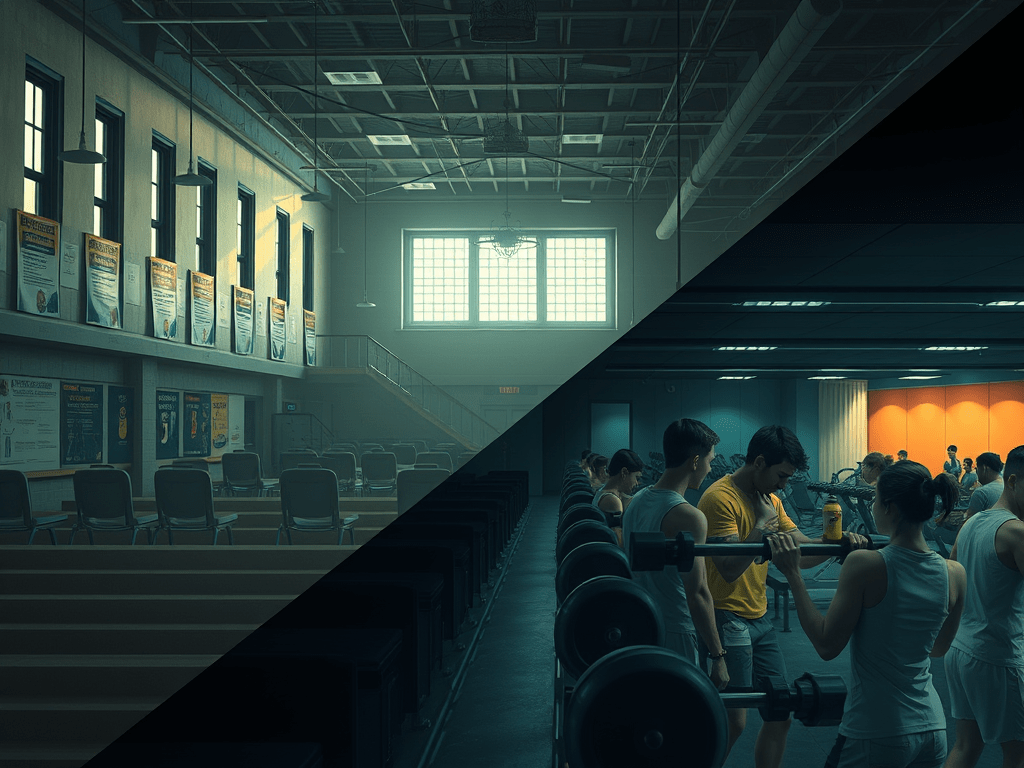
In Jordan Castro’s scabrous novel Muscle Man, the protagonist, English professor Harold, concludes that the American university is dead. It’s only alive in a creepy, sad sort of way–zombification–manifest in online posts for events that no one goes to. These events are announced in emails as “exciting,” “excited,” and “please join.” No one joins. Other emails announce “calls to action,” and no one acts. They just remain lizard-eyed and stolid. These events are exercises in soul-crushing banality. Rather than a place to nurture young minds, the American university is so encumbered by bureaucratic speak and irrelevant, esoteric academic theories, it is an impotent institution and a graveyard where people go to die.
Perhaps Harold just needs a hug. Or perhaps he has cracked the code. He sees in the constant flood of college email announcements a desperate plea to be heard and to be irrelevant while being buried by its own fecklessness.
The state of the college, especially the humanities, seems especially imperiled and moribund in the A.I. Age where students outsource writing, creativity, and “critical thinking” to machines and instructors are too feeble to stop the tsunami of these disrupting, revolutionary information and language tools.
As higher education looks more and more like a forlorn dinosaur and clings to stale identitarian platitudes and “progressive pedagogies” to cling to relevance, Harold surely must fret his own irrelevance and seek sanctuary in his bodybuilding dreams–curling iron as the cathedral of meaning and protein shakes as sacrament. In a world where the humanities have become the walking dead, at least the pump feels alive.
 Cinemorphosis
Leave a comment