College Essay Prompt
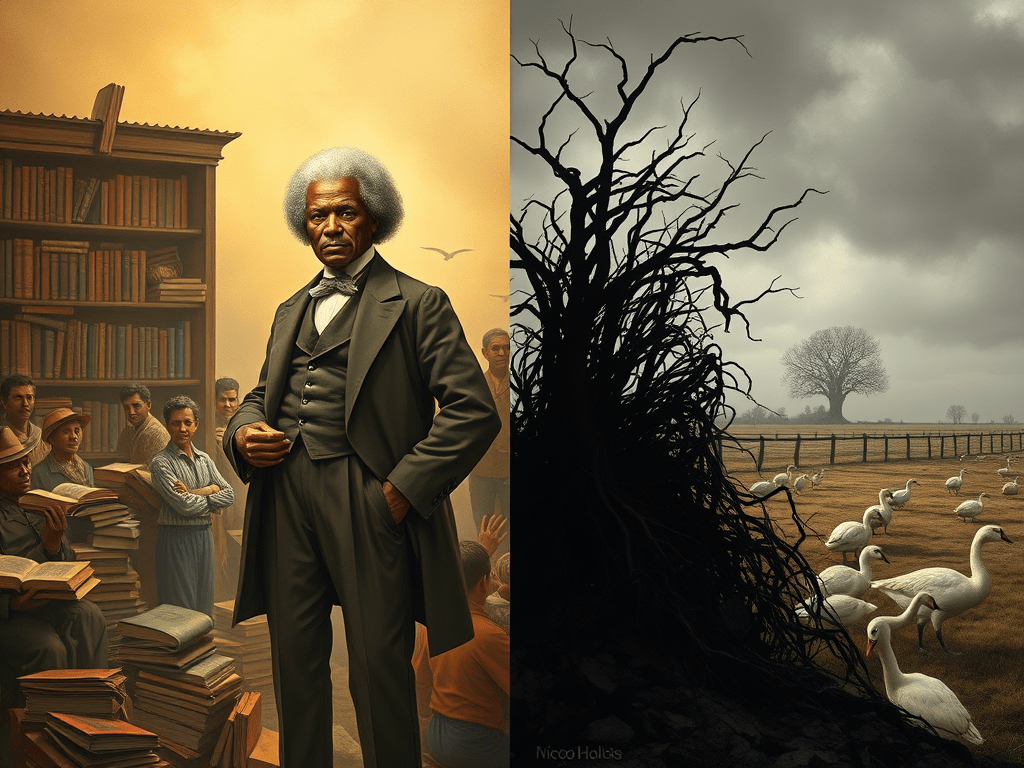
We often assume that the pursuit of freedom and happiness is a universal human impulse, shared across eras, cultures, and personal histories. Yet the paths individuals take toward those goals can be radically different, and those differences reveal whether one’s concept of happiness liberates or destroys. Few figures illustrate this divide more clearly than Frederick Douglass and Nikolai Ivanovitch from Anton Chekhov’s short story “Gooseberries.” Douglass’s character and trajectory embody a moral code that turns hardship into purpose: through literacy, community, courage, and a refusal to internalize oppression, he transforms enslavement into a platform for human dignity—not only for himself, but for others. By contrast, Nikolai pursues a narrow, adolescent fantasy of happiness, one built not on self-growth or empathy but on domination, comfort, and the myth of personal entitlement. His life becomes a grotesque parody of fulfillment—an existence of empty pleasures, self-deception, parasitic dependence, and spiritual decay beneath the veneer of material abundance.
In a 1,700-word essay, analyze how Douglass’s journey to freedom stands as a model of healthy, ethical happiness while Nikolai’s descent exposes a warped, toxic version of happiness rooted in narcissism and self-indulgence. Your essay should do the following:
- Compare the moral foundations of Douglass and Nikolai’s pursuits.
Explain how Douglass’s “Bushido-like” moral code—discipline, responsibility, representation, courage, and community—shapes his identity and empowers those around him. Contrast this with Nikolai’s rejection of accountability, his obsession with land ownership, and his willingness to deplete others—emotionally, financially, and spiritually—to maintain his fantasy of contentment. Discuss how each man’s vision of freedom manifests in their treatment of other people. - Analyze the role of community vs. isolation in each character’s development.
Douglass’s path is paradoxically individual and communal: he cultivates internal strength, but he locates freedom in solidarity—those who teach him to read, abolitionists who elevate his voice, and the enslaved people whose suffering he speaks for. Meanwhile, Nikolai constructs a private empire that excludes others, even the brother who once supported him. Consider how their relationships either amplify or erode their humanity. - Examine the symbolic images of transformation and degradation.
Use key passages from Douglass’s Narrative to show how literacy, speech, political action, and public representation transform him from an enslaved boy into a moral and political leader. Then show how Nikolai’s physical and spiritual decay—his swollen body, the petty rituals of comfort, the stagnant gooseberries—reflect the collapse of his inner self. Avoid plot summary; instead interrogate how each author uses these symbols to define what “freedom” looks like in practice. - Discuss how each figure embodies or violates a healthy definition of happiness.
What does Douglass’s version of happiness require? Effort, growth, sacrifice, connection, and the willingness to uplift others even when it hurts. What does Nikolai’s version require? Exploitation, avoidance of reality, refusal to change, and the delusion that comfort equals fulfillment. Describe how a life built on purpose creates meaning, while a life built on selfish gratification becomes spiritually unlivable. - Address at least one counterargument.
Consider why Nikolai might be appealing to some readers. Isn’t his dream of having a small estate, comfort, and peace understandable? Why might some view Douglass’s path as impossibly heroic—too demanding, too painful, or too noble for the average person? Engage with these viewpoints seriously, and rebut them using evidence from the texts. - End with a conclusion that points to broader implications.
Connect your contrast to the world we live in now. What do Douglass and Nikolai teach us about modern definitions of success, happiness, and the “good life”? Can happiness exist without social responsibility? Does personal freedom become toxic when it is purchased at the expense of others? Ask yourself what moral code has the power to sustain a person—and why some forms of comfort inevitably rot the soul.
Your essay should not merely compare two characters; it should interrogate the meaning behind their choices. You are ultimately making an argument about what counts as real freedom and real happiness. Your goal is to show that the paths we choose do not simply determine the lives we build—they determine the kind of people we become.
 Cinemorphosis
Leave a comment