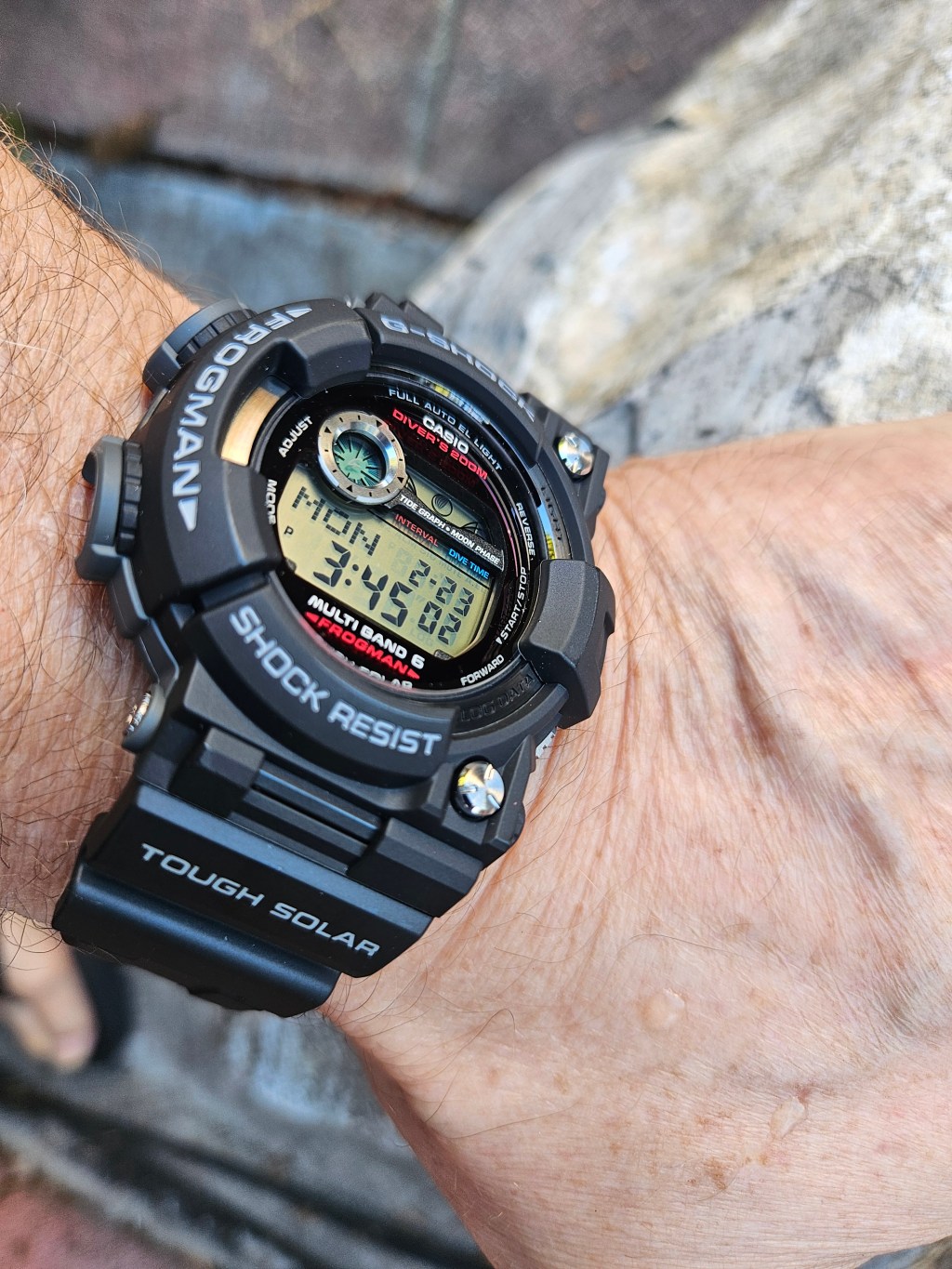
My G-Shock Frogman is the only digital watch in my collection, and lately it has been delivering an uncomfortable truth: accuracy and legibility beat romance.
Atomic time. Perfect clarity. No guessing. No squinting. No interpreting the vague position of a minute hand drifting between markers like a tired compass. The Frogman tells the truth instantly, and once you get used to that level of honesty, the charm of slightly inaccurate mechanical time begins to feel less like character and more like indulgence.
This is G-Shock’s genius. Not sapphire. Not titanium. Not luxury pricing. The magic is the display—bold, clean, readable at a glance, under stress, in motion, in the dark, in real life.
Which is why I’m baffled by the company’s recent flirtation with high-end analog Frogman and Mudmaster models.
Analog? From G-Shock?
No. Just no.
The legibility is compromised. The immediacy is gone. The very thing that made the brand indispensable—clarity—gets traded for something it was never built to do well: prestige analog aesthetics. And then the price climbs north of a thousand dollars, as if sapphire can compensate for the loss of purpose.
Why would anyone pay luxury money for second-rate analog from a company that built its reputation on digital superiority?
This is a category error. A brand identity crisis.
It reminds me of those hybrid fast-food experiments you see around Southern California—the Taco Bell–Pizza Hut combination. You pull into the parking lot expecting tacos. You walk inside and there’s pizza. Technically, both foods are fine. But together, something feels wrong. Confused. Compromised. Like two identities sharing a space without sharing a soul.
An analog G-Shock feels the same way.
For digital precision, I want my Frogman GWF-1000: atomic, solar, brutally legible.
For analog craftsmanship, I’ll take my Seiko Tuna: bright all-night lume, visual depth, the full romance package.
Two different worlds. Two different languages. Each excellent on its own.
What I don’t want is a brand forgetting what made it great.
This is the Lane Integrity Principle: a brand earns loyalty by mastering one thing and doing it better than anyone else. When a company built on uncompromising digital clarity starts chasing analog prestige, trust erodes. Enthusiasts don’t care how expensive the materials are. They care whether the product still honors the original promise.
G-Shock’s promise was never luxury.
It was certainty.
And certainty, like good design, works best when it stays in its lane.
 Cinemorphosis
Leave a comment