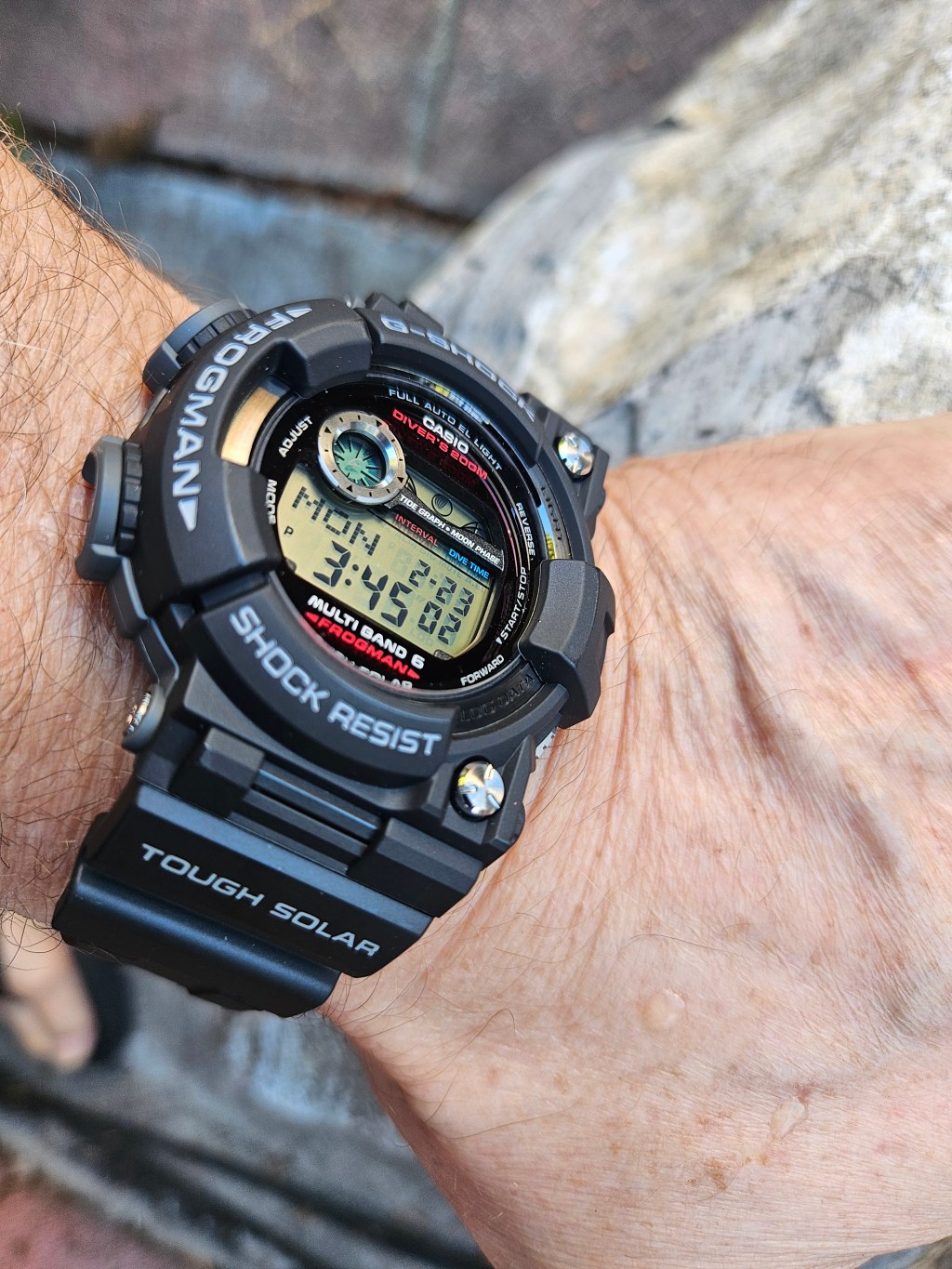
No watch is perfect. Not one. Even your sacred G-Shock Frogman has a flaw—if you’re motivated enough to find it.
Take those digital numerals. A little small, aren’t they? In daylight, no issue. But at night you notice something: your wrist drifting away from your face, then inching back, hunting for that sweet spot where the time snaps into focus.
Wouldn’t it be nice if those numbers were a little bigger?
There it is. The opening.
The Frogman isn’t infallible. And once that thought slips in, the machinery starts.
You begin harmlessly enough. Just research. Just curiosity. A quick look at other G-Shocks. Models with bigger digits. Cleaner layouts. Better night readability. Nothing wrong with being informed.
Then the tabs multiply. Comparisons. Reviews. Forum threads. You’re deep underground now, tunneling through specifications, convincing yourself you’re solving a problem.
You almost bought two.
Then something stopped you.
The promise.
You said the Frogman was the last watch this year. A spending freeze. A return to sanity. A clean break from the cycle.
Amazing how quickly that promise evaporated. Amazing how fast you went from restraint to full-throttle research, chasing the electric thrill of the next “perfect” solution.
And then the uncomfortable realization landed.
The Frogman was fine.
The numerals weren’t too small. You could read them yesterday. You’ll read them tomorrow. The problem wasn’t the watch.
You were hunting for a flaw.
Like the Princess and the Pea, you were scanning the mattress for a lump that didn’t exist. Because if the lump is real, the upgrade is justified. If the upgrade is justified, the purchase is reasonable. And if the purchase is reasonable, the addiction remains invisible.
In the clinical language of watch obsession, this is the Upgrade Rationalization Loop: a mental feedback system that inflates minor inconveniences into fatal defects, all conveniently pointing toward a new acquisition.
The loop doesn’t solve problems.
It manufactures them.
And here’s the harder truth: if you keep looking, every watch will fail. The standard will quietly rise until nothing you own feels complete.
That’s how the wheel keeps spinning.
So stop.
No more hunting for microscopic defects. No more late-night comparisons disguised as research. No more negotiating with yourself like a lawyer working both sides of the case.
The Frogman is the final watch of the year.
If the urge hits, bite your lip. Clench your jaw. Sit with the discomfort. Let the craving burn itself out instead of feeding it with another browser tab.
Because this isn’t about numerals.
It’s about extraction.
There’s a rotten tooth at the center of the habit, and it won’t come out gently. It takes pressure. It takes resistance. It takes the willingness to endure a little pain now so the ache stops running your life later.
The Frogman doesn’t need an upgrade.
Your impulse does.

 Cinemorphosis
Leave a comment