Category: Health and Fitness

  • The Man Who Refunded His Generosity

    The Man Who Refunded His Generosity

    There is a certain type of man who treats generosity like a minor injury—something to be iced, medicated, and quickly undone. When social protocol forces him to buy a gift for someone else, he doesn’t experience the faint glow of goodwill. He winces. The purchase lands like a deduction from a sacred account, and the only way to steady himself is to restore the balance immediately—by buying something for himself.

    This is not coincidence. It’s policy.

    He operates under a private accounting system I’d call Gift Offset Compulsion: every act of giving must be counterweighted by an equal or greater act of self-reward. The outward gesture is merely the opening move; the real transaction is internal. He hands over a wrapped token with one hand while quietly preparing a compensatory indulgence with the other.

    In his mind, this isn’t selfishness—it’s equilibrium. A world in which he gives without reclaiming would feel distorted, even unjust. So he corrects it. Every birthday present, every holiday obligation, every ceremonial nod to generosity is followed by a personal rebate. He doesn’t give; he circulates assets. He doesn’t sacrifice; he settles accounts.

    And once the books are balanced, he feels whole again—restored, reimbursed, and ready, if necessary, to give once more… provided he can be paid back promptly.

    So my challenge to all my watch-obsessive friends is this: Look deep inside and ask yourself if you’ve ever purchased a watch under this type of psychological distress. 

  • Normal Until It Isn’t: The Slow Collapse of a Social Life

    Normal Until It Isn’t: The Slow Collapse of a Social Life

    We acclimate to our routines the way a room acclimates to its own stale air—gradually, without protest—until the familiar starts to smell like something we’d refuse if it were new. Habit acquires the authority of identity. It tells us, “This is who you are,” and we nod, relieved not to argue. Then, occasionally, a crack opens. Something in the routine reveals itself as not just unusual, but quietly unhealthy. Six months ago, I noticed the crack: I have no active friendships. I can inventory names—P and T nearby, four sightings a year if the calendar is feeling generous; A an hour away, a phone call that arrives annually like a polite comet—but these are museum pieces, not relationships you live inside. By the only definition that matters—people you see and speak with regularly—I am operating at zero. I’ve built a life that functions without friends and then congratulated myself for the efficiency.

    I can dress the solitude up as a lifestyle. I can cite Laurie Metcalf and her apparent ease living alone, as if borrowing her poise could underwrite my own. But the analogy collapses on contact. Solitude is not the same as isolation, and thriving alone doesn’t imply the absence of active ties. The rationalization is elegant; it’s also evasive.

    What unsettles me is not the label—“friendless” is a blunt instrument—but the salience of it, the way the fact refuses to stay abstract. It lands on my family. A husband and father who lives in the Friendless Zone quietly shifts the social burden onto his wife and children. Every conversation, every need for connection, every idle hour leans on them. That’s not intimacy; it’s overreliance dressed as closeness. No one signs up to be an entire ecosystem.

    This wasn’t always the rhythm. Before marriage, my life had edges and movement. Meals with colleagues that stretched into second coffees, movies that required coordination, parties that produced stories, landline conversations that ran until your ear ached and you didn’t notice. Then 2010 arrived with twins and a schedule that ate the clock. Bottles, dishes, carpools, appointments—the logistics of care are relentless and, to be clear, necessary. Friendship became the expendable line item. I trimmed it “for now,” and “for now” matured into a policy.

    I’m not assigning blame. If anything, the demands of family life offered my inner recluse a beautifully plausible alibi. He’d been waiting for a reason to stay home; parenthood handed him a portfolio of them. The cave felt efficient, even virtuous. And then it felt normal. Now it feels narrow. Part of me still enjoys the quiet—the control, the absence of social friction. Another part sees the cost: fewer perspectives, fewer checks on your own thinking, fewer chances to be surprised into being more than you currently are.

    If I map the trajectory, my life  breaks into three eras: having friends and taking them for granted; losing friends and not noticing the loss; being without friends and finally noticing. Awareness is not a solution. It’s a diagnosis that arrives without a prescription. There’s no switch I can flip to become the convivial man who collects invitations like business cards. There is only the discomfort of seeing clearly—and the obligation to decide whether clarity is something you act on or merely admire.

  • From Coffeehouse to Clickbait

    From Coffeehouse to Clickbait

    Invoking the word democracy in an essay feels like trying to sell a ghost–intangible, shapeless, and increasingly irrelevant to an audience fixated on the price of eggs and the cost of gasoline. We live in a state of Democratic Abstraction Fatigue, where civic ideals have been repeated so often and defined so poorly that they’ve lost all emotional voltage. Democracy has become a word people nod at politely while checking their grocery receipts.

    Salience is the problem. Democracy competes poorly in a culture that values immediacy over abstraction, sensation over structure. A fluctuating gas price commands attention because it hurts now. Democracy, by contrast, whispers about norms, institutions, and procedures–important, yes, but bloodless in the moment. When everything urgent is concrete and everything essential is abstract, the essential loses.

    We can attempt a definition to anchor the word: a democracy is a system of fair elections, peaceful transfers of power, and a citizenry capable of resisting manipulation by charlatans, influencers, and political opportunists whose incompetence would, in a sane society, disqualify them on sight. But even this definition now feels aspirational, almost quaint.

    Because the truth is harder: those guardrails are eroding. Adam Kirsch, in “The Era of Rational Discourse Is Over,” reminds us that American wars have often been sold under false pretenses–the Spaniards sank the USS Maine, Iraq hoarded weapons of mass destruction. But what distinguishes the present is not deception; it is indifference. The machinery no longer bothers to persuade. There is no narrative to construct, no public to convince, no Congress to consult. The decision is the justification. We have entered a phase of Executive Drift, where power operates with minimal friction and even less explanation.

    How did we arrive here? Kirsch turns to Jürgen Habermas, who witnessed the collapse of Nazism and the fragile rebirth of democratic life in Germany. For Habermas, democracy depended on what he called “communicative action”–a culture of dialogue where ideas are tested, challenged, refined, and, occasionally, improved. Democracy was not just a system of voting; it was a system of thinking.

    That system now shows signs of collapse. We inhabit an era of Communicative Decay, where discourse has splintered into tribal fragments, each sealed off from contradiction, each sustained by outrage. Argument has been replaced by performance. Listening has been replaced by waiting for your turn to strike.

    In The Structural Transformation of the Public Sphere, Habermas imagined democracy as an expanded coffeehouse—a literate, engaged public exchanging ideas with rigor and civility. It was a world in which communication flowed in two directions: we spoke, and we listened. Today, we scroll. We absorb. We react. But we do not engage.

    The modern condition might be better described as a dopamine democracy, where public opinion is shaped not by deliberation but by stimulation. Algorithms reward the loudest, the angriest, the most unhinged voices. Complexity is punished. Nuance is buried. What rises instead is spectacle–content engineered to trigger, not to inform.

    The consequences are predictable. Citizens become passive, then inert. Critical thinking atrophies. Conspiracy theories flourish in the vacuum. Truth becomes negotiable, then irrelevant. We do not fall from democracy in a single dramatic collapse; we degrade into a version of ourselves that no longer demands it.

    Mass media and weaponized misinformation accelerate the decline. Lies are no longer liabilities; they are tools. Identity replaces evidence. Tribe replaces truth. You are not expected to think–you are expected to align.

    And so we arrive at the most unsettling feature of our moment: the people who ascend in this environment are not the most disciplined, the most thoughtful, or the most competent, but the most performative, the most shameless, the most willing to exploit the system’s weaknesses. Infantilism becomes a strategy. Narcissism becomes an asset.

    A culture that rewards such traits should provoke alarm. It should trigger a course correction. But instead, we drift–distracted, entertained, anesthetized.

    Democracy has not been overthrown.

    It has been neglected.

    And like anything neglected long enough, it begins to disappear–quietly, gradually, while most of us are still asleep.

  • The Night My Biceps Filed for Divorce

    The Night My Biceps Filed for Divorce

    My pride as a lifelong bodybuilder—still clinging to relevance in my sixties—met its demise one evening on the couch, where I lay in a slovenly posture and glazed-over eyes while watching the movie Road House. Calling it a film feels charitable. It’s more like a glossy shrine to the male physique, starring a Jake Gyllenhaal so surgically chiseled he looks as if Michelangelo started carving David, lost patience, and decided to make him punch strangers for a living.

    Gyllenhaal plays a brooding bouncer in Key West, a man whose job description consists of protecting a bar and its luminous owner, played by Jessica Williams, from the usual parade of cinematic degenerates. This inevitably summons the film’s apex predator: Conor McGregor, who appears less like a human being and more like a shaved grizzly bear that discovered performance enhancers and never looked back. Veins bulge with the enthusiasm of overinflated garden hoses. His performance oscillates between feral animal and man who hasn’t blinked since the Obama administration, and it’s oddly mesmerizing.

    The plot is a rumor—thin, fleeting, and functionally irrelevant. A stranger rides into town, restores order with his fists, and exits in a cloud of testosterone and broken cartilage. But let’s not pretend narrative is the point. The camera worships muscle with the reverence of a Renaissance chapel. Biceps gleam. Lats ripple. Every slow-motion shot feels like a commercial for pre-workout powder and substances that come in unmarked vials. This isn’t storytelling; it’s a two-hour flex.

    Somewhere between Gyllenhaal’s forty-seventh shirtless entrance and McGregor’s latest snarl—delivered like a man hydrated exclusively by rage—I reached for my phone. Not to check the time. To search McGregor’s diet. Because this spectacle doesn’t entertain; it indicts. It shines a harsh fluorescent light on your own soft edges and whispers, You, sir, are a sentient pudding cup.

    At sixty-two, I knew I wasn’t about to carve myself into Gyllenhaal’s likeness. But I was still in the fight—kettlebells in the garage four days a week, the exercise bike on the others. My diet remained high-protein, though compromised by opportunistic snacking. The result: less Greek statue, more a compact, perspiring version of Larry Csonka in a Hawaiian shirt, lingering too long at the Grand Wailea buffet.

    I entertained fantasies of becoming a skinny version of myself. Replace kettlebells with yoga. Trade meat-heavy sandwiches for two plant-based meals a day of steel-cut oats, bell peppers, and tofu. But a chorus of old convictions intervened: maintain the protein intake, preserve the muscle, defend the territory. Five servings of “bioavailable protein” a day. No surrender. Somewhere along the way, fitness had ceased being about health and hardened into doctrine.

    I hadn’t competed since finishing runner-up in the 1981 Mr. Teenage San Francisco, but the mindset endured: life as contest, existence as proving ground. That belief wasn’t accidental. It was inherited. My father—infantryman turned engineer—treated life like a problem to be solved and a battle to be won.

    In the early 1960s, stationed in Anchorage, he found himself competing with another suitor—John Shalikashvili—for my mother’s affection. When Christmas interrupted the contest, my father refused the ceasefire. He cut his holiday short, intent on beating his rival back to Alaska. His vehicle—a pale 1959 Morris Minor—chose that moment to revolt, its fuel system failing with impeccable timing.

    Lesser men would have conceded. My father reached for ingenuity. Lacking a proper part, he improvised with a prophylactic and a paperclip, fashioning a grotesque but functional fix. It was absurd. It was desperate. It worked. He made it to Seattle, boarded the ferry, and arrived in Alaska forty-eight hours ahead of his rival.

    Nine months later, I entered the world—the byproduct of competitive instinct, mechanical improvisation, and what must surely be the most unorthodox application of latex in automotive history. In that moment, my father didn’t just win a race. He set a standard: adapt, outmaneuver, prevail. And decades later, as I sat watching sculpted demigods on screen, I realized that standard was still quietly running my life.

  • In Defense of Gilded Consolation

    In Defense of Gilded Consolation

    Men in their fifties and sixties, catching the faint chill of irrelevance, often reach for a new toy the way a man reaches for a jacket he hopes still fits. The purchase is meant to keep them “in the conversation,” as if relevance were a room you could reenter with the right accessory. Call it Luxury Youth Prosthetics—cars, watches, cameras, gleaming devices strapped on like extensions of a younger self, engineered to suggest vitality even when the signal is weak. The Lexus SUV hums with quiet authority, the Nikon Z8 promises cinematic family memories, and the titanium G-Shock gleams like a tiny declaration that time, at least, is still under control. Yes, the performance can tip into self-parody. We’ve all seen the man trying too hard, his purchases shouting what his presence no longer whispers.

    But it would be cheap to dismiss the entire enterprise as vanity. Not every indulgence is a cry for help; sometimes it’s just a man making his days more agreeable. If the mortgage is paid, the kids are fed, and no one is pawning their future for a dashboard upgrade, then a little luxury can function as a civilizing influence. The Lexus SUV turns a Costco run into a pleasant experience. The Nikon Z8 captures the faces you’re suddenly aware you don’t have forever. The titanium G-Shock tells the time clearly, which is no small mercy when time feels increasingly abstract.

    Strip away the theater, and what remains is something quieter and more defensible. Call it Gilded Consolation: not a performance for others, but a private pact with comfort. The goal is not to look young, but to live well—within reason, within means, and without apology.

  • The Futility of Resisting Chronological Drift Syndrome

    The Futility of Resisting Chronological Drift Syndrome

    Eight years ago, at a funeral—an appropriate venue for truth disguised as humor—my cousin, a retired ophthalmologist and former hospital administrator, told me his greatest challenge in retirement was finding enough time to spend his money. It landed as a joke with a faint echo of confession. Back then, he was still visible—still a man whose time, opinions, and presence registered on the social radar.

    Now, in his mid-seventies, the joke has curdled. He tells me the most striking feature of aging is not pain, not decline, but disappearance. People look past him as if he were a smudge on the lens he once spent a career perfecting. He has entered Graylight Erasure: still present in the room, but no longer illuminated by attention, interest, or acknowledgment. The body remains; the spotlight moves on.

    I’ve tried to account for this vanishing act, and the first culprit is economic. Consumer culture is a young man’s game—desire, impulse, upgrade, repeat. When you fall out of that loop, you don’t just lose purchasing power; you lose narrative value. You become a spectator in a drama that no longer requires your participation. This is Market Exit Obsolescence: the quiet demotion that occurs when you age out of the demographic worth seducing. The ads stop speaking to you, and soon enough, so do people.

    The second cause is more primitive: denial. Aging is bad for morale. It interrupts the fantasy that time is generous and endings are negotiable. Youth is a fever dream in which mortality is a rumor; old age is the nutrition label you avoided reading—the one that ruins the snack. An older person carries inconvenient data: limits, deadlines, the unadvertised fine print of being alive. And no one likes a walking disclosure statement.

    So the culture develops a reflex. Call it the Mortality Contagion Effect—the quiet recoil from those who remind us, without trying, that the clock is not decorative. As if proximity might transmit the condition. As if attention were a kind of exposure.

    My cousin didn’t lose his competence, his intelligence, or his history. He lost his audience. And in a culture that equates attention with existence, that loss feels less like aging and more like erasure.

    Watching my cousin—healthy, financially well-off, and increasingly ignored—I see what aging really delivers: Chronological Drift Syndrome. It’s the moment you realize the culture has shifted into a higher gear while you’re still driving the same well-maintained car. The rhythms change, the references mutate, the priorities rebrand overnight, and suddenly you’re not wrong—you’re just out of sync. You haven’t stopped moving; the world has simply sped past you and called it progress.

    As you age, you may attempt to resist this growing misalignment with youth culture. You may try to make yourself youthful with potions, makeovers, and pharmaceuticals, but these measures will soon backfire. You will find that fighting Chronological Drift Syndrome is a bit like sprinting on a moving walkway that’s headed the other way—you burn calories, attract attention, and end up exactly where you started, only louder and slightly winded. The harder you try to keep up—deploying borrowed slang, auditioning for trends, nodding along to references you Googled ten minutes earlier—the more you resemble a man trying to crash a party he once hosted. 

    Desperation has a smell, and it pairs poorly with youth culture, which detects inauthenticity the way a smoke alarm detects toast. The irony is brutal: the effort to remain relevant is what renders you ridiculous. The more elegant move is to step off the conveyor, plant your feet, and accept the drift with a straight back and a sense of humor. Dignity, unlike trends, ages well.

  • The Appetite Recursion Loop

    The Appetite Recursion Loop

    Looking back, I can trace a clean, ugly line connecting my love of watches and my love of food: appetite, indulgence, anger, shame. It’s not a lifestyle. It’s a loop. I want more than I should, I give in, I punish myself for giving in, and then I reset the machine and start again. Call it the Appetite Recursion Loop—a closed system where desire feeds indulgence, indulgence feeds shame, and shame reloads desire with fresh ammunition. It feels inevitable because, most days, it is.

    Appetite and chaos are my factory settings. In the early ’90s, when I lived in a bachelor pad that smelled like basil and ambition, my Navy SEAL friend Mike would call and say, “McMahon, I can hear you chewing through the phone. Every time I call, you’re eating. What is it now, Fat Face?”

    “Angel hair pasta with pesto.”

    “Sounds dangerous. I’m coming over.”

    And he would—arriving just in time to annihilate whatever I’d cooked. His metabolism ran on military drills and Pacific swells; mine ran on fantasy and carbohydrates. He burned calories like a wildfire. I cultivated them.

    He once called with an offer: Santa Barbara, surfing, and a setup with a friend of his girlfriend’s. “Now can you surf?” he asked.

    That’s how I found myself on excursions that had nothing to do with waves and everything to do with spectacle.

    Mike lived with his father, Bob—a former Marine with a foghorn voice and a temper that could peel paint. Their daily routine was a ritualized war: shouting about lawns, garages, groceries—two men chesting up like rival roosters while spit flew. Five minutes later, ceasefire. We’d pile into Mike’s Toyota for Mongolian beef with Social Distortion rattling the doors. Back home, John Wayne on the TV, Bob opening his gun safe “in case the Duke needs backup.” To me, this wasn’t dysfunction. It was familiar. It was home.

    I was raised in a house where anger was the native language. Fathers barked, belts translated. When rage is your baseline, it’s like living with your brain tuned permanently to a Death Metal station. Eventually, you stop hearing it. You call it normal. It isn’t.

    I know that now because I married a woman fourteen years younger than me, and we have twin teenage daughters who have no interest in Death Metal Dad. They want something closer to Smooth Jazz—Bach, Earth, Wind & Fire—anything that doesn’t rattle the drywall. They’re right. Rage isn’t masculinity. It’s intoxication. A sloppy, corrosive one.

    My version of sobriety isn’t about alcohol. It’s about anger. That means tracking triggers like a customs agent. One of the biggest? New watches. Shiny objects flip a switch. The Death Metal station hums back to life. Desire spikes, anxiety follows, and then comes the familiar hangover: self-reproach with a side of irritability. I become a joyless man—Grandma Sour Pants in sneakers. My family doesn’t want to be around me. Frankly, neither do I.

    Money isn’t the problem. I can afford the watches. What I can’t afford is the noise. I own eight pieces worth about fifteen grand, and even that feels like mental bookkeeping—rotations, rationalizations, inventory control for a hobby that was supposed to be fun. If I owned twelve, I’d need a project manager and a therapist. My watch friends say, “Life is short. Buy what you want.” That’s not wisdom. That’s indulgence wearing a tie. A man-child with a credit card is still a man-child—and no man-child is happy. He buys to outrun loneliness, and the purchases lose every race.

    Ninety-five percent of my buys were impulsive. Which means ninety-five percent were evidence—exhibits entered into the case against my maturity. I sold most of them at a loss, not because I needed the cash, but because I needed to feel like I wasn’t owned by my own impulses.

    I’m a product of the Me-Generation—California, ’70s, self as deity. Stories I Only Tell My Friends captures it perfectly: the Counterculture as the Worship of the Self—whatever the Self wants, the Self gets. No brakes, no compass. Malibu as a sunlit laboratory for beautiful people making terrible decisions. When desire becomes sacred, reality becomes optional—and the bill comes due.

    When I see a watch I love, my brain lights up like I’ve just taken a hit of something illegal. Desire surges. Then anger—because the loss of control is the real offense. I don’t want rehab for watches. I want a hobby that fits inside reality instead of dragging me out of it. Pleasure without compulsion. Enjoyment without obsession. A life without permanent FOMO.

    And here’s the final punchline: even writing this makes me nostalgic for being sixteen in Santa Monica and Malibu in 1976. I start looking backward like Lot’s wife, feel the salt forming, the Death Metal station warming up again. That’s my cue. Change the channel.

    Which is why I wonder if the shift to the G-Shock Frogman was an attempt at self-surgery—a clean cauterization of the need for more. A reset. My G-Shock friends laugh. The Frogman isn’t the cure, they say. It’s Act One of a new addiction.

    If they’re right, then “I Am the Frogman” isn’t transformation.

    It’s mythology.

    And I’m the one who wrote it.

  • “I Am the Frogman”: The Last Shout Before the Door Seals

    “I Am the Frogman”: The Last Shout Before the Door Seals

    I’ve spent more than a decade documenting my watch obsession on YouTube—a pursuit that begins as hobby and ends, if you’re not careful, as behavioral conditioning. You think you’re making videos. You’re actually being trained. The algorithm dispenses rewards and punishments with clinical indifference: views, comments, silence. You adapt. Of course you adapt. That’s the job now.

    The trouble is that the algorithm has no interest in truth, balance, or restraint. It prefers spectacle. It rewards the emotional range of a teenager who’s just discovered caffeine: hyperbole, dread, euphoria, FOMO, regret—delivered with the urgency of a man announcing the end of civilization via bezel insert. You wake up one morning and discover you’ve succumbed to Algorithmic Persona Drift—a slow mutation in which your public self becomes a louder, shinier, more hysterical version engineered for attention rather than accuracy.

    Feed it, and it feeds you back. The cycle tightens. Every video must be more decisive, more apocalyptic, more “this changes everything.” You produce manifestos. You narrate epiphanies. You analyze your own obsession with the intensity of a man dissecting his own heartbeat. The result is predictable: you become a caricature of yourself—recognizable, marketable, and faintly absurd.

    If you can tolerate that, the system will reward you. The numbers rise. The revenue trickles, then flows. You build a small empire out of controlled exaggeration. But there comes a moment—quiet, unwelcome—when you no longer recognize the man delivering the lines. The performance has outgrown the person. At that point, the decision presents itself with unpleasant clarity: keep feeding the machine and let it finish the job, or step away and salvage what remains of your voice.

    That’s one exit.

    The other is less dignified. You don’t leave; you are expelled. The causes are familiar—burnout, self-disgust, ennui, health—but the most decisive is also the least negotiable: age. You wake up one day and realize the tempo has changed. The rhythms that once animated you now sound distant, like music leaking from another room. The new release, the hyped drop, the celebrity of the week—none of it lands with the old voltage. Mortality has entered the conversation and lowered the volume.

    You try to resist. You tell yourself enthusiasm is a choice. But the gap widens anyway. You find yourself oddly relieved that you no longer care about bracelet articulation or dial gradients or the fever dream that the “perfect collection” is one purchase away. The brotherhood reveals itself for what it always was: half fellowship, half support group. You no longer feel the urge to compare scars from impulse buys, to laugh at the madness, to whisper—half-serious, half-hopeful—that this watch will finally cure you.

    For me, the separation was unmistakable. Twenty years dissolved into a blur of rotating bezels and contingency divers. Then, at sixty-three, something tapped my shoulder. Not a crisis. A correction. The obsession didn’t die; it simply lost its authority. Desire dimmed, replaced by a quiet recognition that watches are exquisitely engineered ways of losing to time.

    The feeling calls to mind a scene from Battlestar Galactica: a traitor sealed behind glass, the airlock hissing, the crew watching with solemn finality. Not melodrama—procedure. That’s aging. Not tragic, not cruel—inevitable. At some point, those still inside the illusion of endless tomorrows begin to edge away from those who have seen the horizon contract.

    A pane descends. It isn’t hostile. It’s accurate.

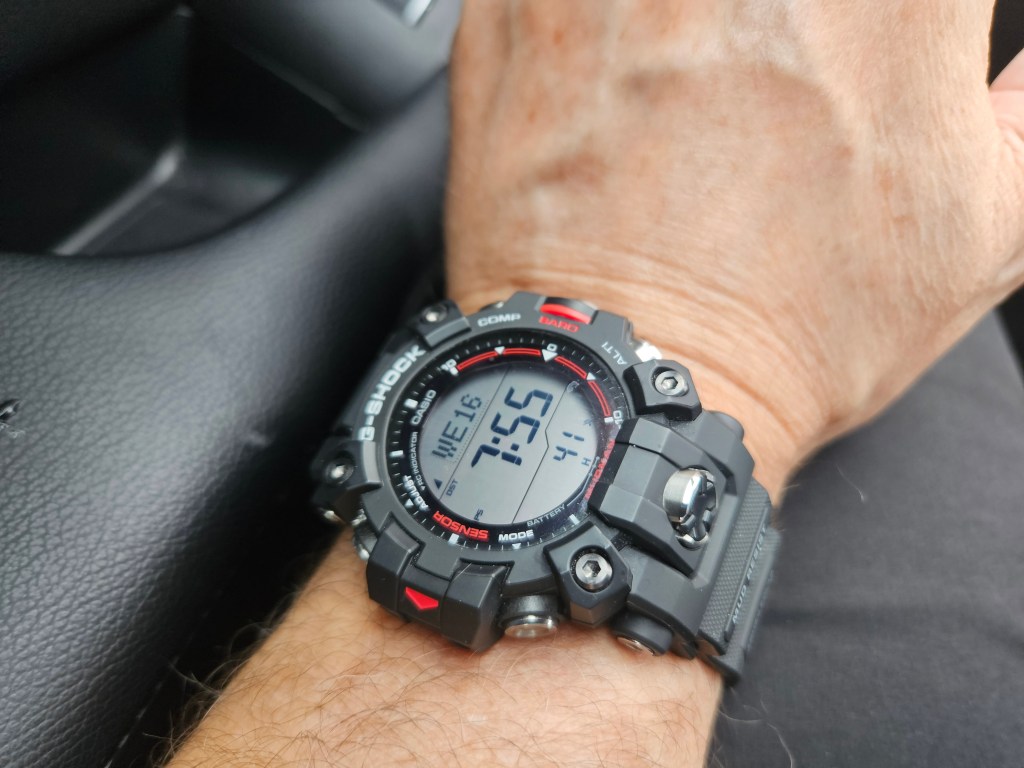
    You tap the glass, wave, try to rejoin the cockpit of youthful urgency. You even lift your wrist—your hulking G-Shock Frogman—and make your case. “Look,” you want to say, “I’m still in it.” But the seal has set. Reentry is not part of the design.

    What remains is less dramatic and more demanding: dignity. Accept the season you’re in. Build meaning instead of inventory. Offer something useful to those still racing ahead, even if they don’t yet see why it matters. They will. Everyone does, eventually.

    The algorithm fades. The noise recedes.

    And you are left, at last, with a quieter, harder question: not what you want next—but who you intend to be without the applause.

  • The Frogman and the Sandwich

    The Frogman and the Sandwich

    The Frogman is my aspirational self. He is courageous and disciplined. I am not. I am a coward. My self-recrimination is based on the fact that I allow fear to compromise my morals. For example, I am revolted by the way livestock is abused for our animal consumption so that philosophically I should not eat meat, eggs, or dairy, but I fear that a plant-based diet will not give me optimal nutrition. Nor will it quell my rapacious appetite, so I compromise my morals and “force myself” to eat steak, chicken, eggs, cottage cheese, and Greek yogurt. The Frogman is a man of conviction. He looks at a moral problem square in the face and behaves appropriately. Gluttony is not part of his lifestyle. My soul is tormented by my awareness of the Avatar Conscience Gap: the distance between one’s idealized self—disciplined, principled, unflinching—and one’s actual behavior under pressure. The wider the gap, the louder the internal indictment, as the imagined avatar (in my case, the Frogman) functions as a constant moral comparator. My Frogman sits on my wrist, silent, resin-clad, a metronome of judgment. I measure myself against him and come up short in ways that feel precise, almost clinical. 

    Which brings us to actual clinical measurements.

    My doctor wants bloodwork—the full audit: PSA, lipids, liver function, hemoglobin. A bureaucratic harvest of numbers designed to convert my bloodstream into a spreadsheet. I concede the PSA. The rest feels like theater. At 230 pounds—twenty over my preferred fiction—my numbers will behave, mostly. LDL will be slightly elevated, the biochemical equivalent of a raised eyebrow. Twenty extra pounds leaves fingerprints. It always does.

    At 210, those fingerprints disappear. At 210, my labs don’t just improve—they absolve. At 210, I become the Frogman, at least on paper. A man whose blood tells a cleaner story.

    But I don’t need a blood test to tell me what to do. I need to lose twenty pounds. And I will be told this, formally, in a tone of gentle inevitability. A “plan of action,” as if the problem were logistical rather than existential.

    I cannot promise compliance.

    I eat well. Whole foods. High protein. I abstain from alcohol. I perform all the rituals of discipline. And yet my appetite behaves like an unlicensed contractor—loud, insistent, unconcerned with permits or plans.

    Last night, after dinner, I swore the kitchen closed at six. A solemn vow, made with the confidence of a man who has not yet opened a lunch bag.

    Then I found it: an uneaten turkey and cheese sandwich in my daughter’s bag. Soft bread. Mild cheese. The faint scent of opportunity.

    There was no debate. No internal summit. I ate it immediately, gratefully, with the kind of focus normally reserved for religious experience. It was, without exaggeration, the best moment of my day.

    This is Sandwich Serendipity—the ecstatic discovery of unclaimed food, experienced not as leftovers but as providence. The afflicted man does not assess freshness, provenance, or caloric cost. He does not negotiate with tomorrow’s intentions. He receives the sandwich as a gift from the universe and responds with immediate devotion.

    You can moralize this if you like. I won’t. The joy is too pure.

    But it does raise an inconvenient question: how does a man like this—susceptible to ambush by deli meat and porridge bread—promise a physician that he will lose twenty pounds? On what authority? On which version of himself?

    Because the Frogman would not have eaten that sandwich.

    The Frogman would have zipped the bag, closed the kitchen, and gone to bed with the calm of a man aligned with his values. The Frogman does not forage. He does not improvise. He does not surrender.

    I put the watch on anyway.

    It sits on my wrist like a massive, indestructible accusation—resin, digital, exact. It broadcasts courage. It implies discipline. It suggests a man who has made his decisions and is living inside them.

    And beneath it, quietly, is the truth:

    I am not that man.

    Not yet.

  • The Business Model of Suffering and Abuse on Reality TV

    The Business Model of Suffering and Abuse on Reality TV

    We were discussing their current essay assignment: an excavation of cruelty masquerading as inspiration in the TV show The Biggest Loser. The facts alone read like satire written by a misanthrope: contestants more than 200 pounds overweight were pushed through eight-hour training days, incinerating close to 8,000 calories while being rationed roughly 800. Add caffeine pills, a chorus of screaming trainers, and the steady drip of public humiliation, and you have less a fitness program than a stress test for organ failure. That none of the contestants died feels less like good management and more like statistical luck. That millions watched—enthusiastically—says something unflattering about us.

    I show them Fit for Life documentary, which functions as a kind of aftermath report. Former contestants speak with the clarity that only distance provides. They describe trauma, yes, but also something more complicated: the show gave them structure, purpose, a narrative. It brutalized them and, perversely, steadied them. Most gained the weight back. Some now lean on GLP-1 drugs, their appetites chemically negotiated into submission. But all of them remember the same thing—the mercilessness was not incidental; it was the engine.

    I asked my students why I had assigned this essay. What, exactly, were they supposed to uncover?

    At the micro level, we peeled back the familiar myths. The cult of self-discipline—so comforting in its simplicity—lets us ignore biology, environment, and the sheer stubbornness of appetite. Bodies become symbols: power or failure, virtue or laziness, depending on who’s looking. We noted the obvious but rarely confronted statistic—most Americans are overweight—and the uncomfortable reality that GLP-1 drugs may be the only intervention that consistently works at scale.

    Then the room shifted. One student volunteered that she was on a GLP-1. The first weeks were a gauntlet of nausea and vomiting, but now the drug—Mounjaro—had quieted her hunger to a whisper. Thirty pounds gone in two months. Another student offered a counterpoint that landed harder: her father had been one of the exceptions. The drug didn’t help him lose weight. It helped him lose kidney function. As she spoke, she mentioned he was now on dialysis. The room absorbed that in silence. Miracle and risk, side by side, no clean narrative available.

    So we zoomed out.

    To design a show that courts physical danger and guarantees humiliation—for ratings, for merchandise, for the grotesque satisfaction of watching someone crack—is not an accident. It’s a business model. That’s the first kind of evil: deliberate, calculated, fully aware. Cynical evil. The producers know exactly what they’re doing. They understand the cruelty, and they monetize it.

    The second kind is quieter and more common. It belongs to the audience. Viewers sense the moral problem—on some level they know this is exploitation—but they file that knowledge away so it won’t interfere with their evening entertainment. They watch, they flinch, they keep watching. Call it willed ignorance. A cultivated habit of not asking questions that might ruin the pleasure.

    I told them, half-serious but not really joking, that if we were ranking things, cynical evil is a ten. Willed-ignorant evil sits comfortably at a seven—less flamboyant, more pervasive.

    Something clicked. The word evil—unfashionable, blunt, almost embarrassing in academic settings—cut through the fog. The discussion woke up. Students leaned in, argued, confessed discomfort, revised their positions in real time. The assignment stopped being an exercise and became a lens.

    That was the moment worth noticing. Sometimes you have to pull the camera back. Stop pretending the essay is about structure and sources and let students see the larger architecture: what the topic reveals about us, what it demands we confront, and why it matters that we do.