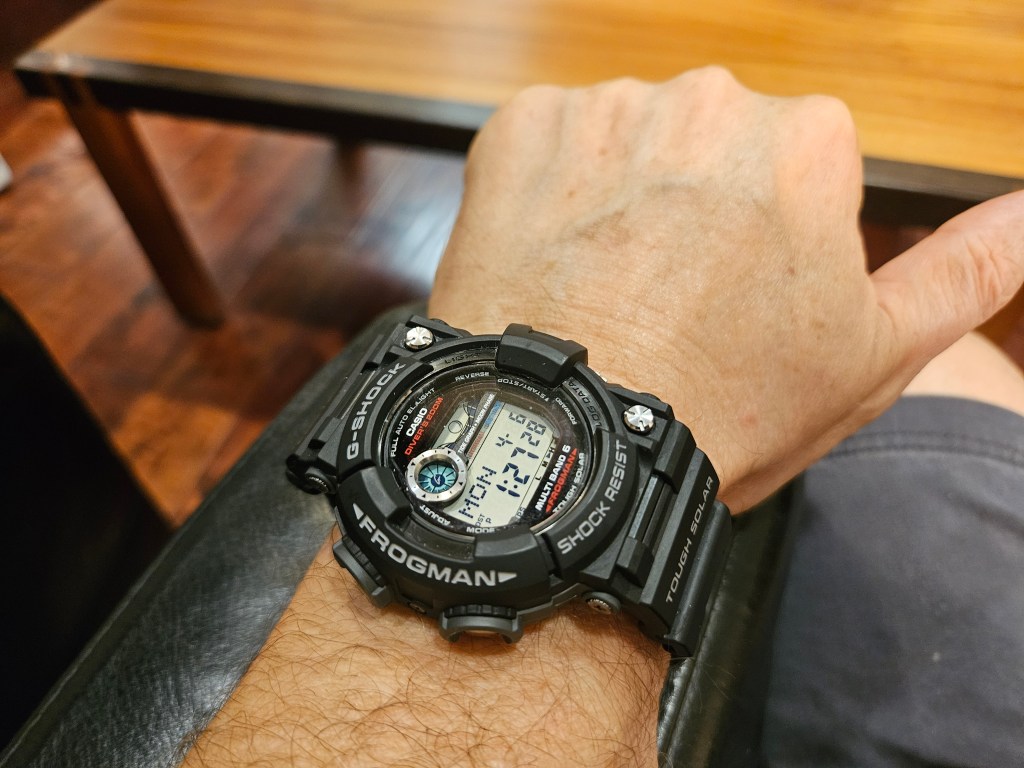
The Frogman is my aspirational self. He is courageous and disciplined. I am not. I am a coward. My self-recrimination is based on the fact that I allow fear to compromise my morals. For example, I am revolted by the way livestock is abused for our animal consumption so that philosophically I should not eat meat, eggs, or dairy, but I fear that a plant-based diet will not give me optimal nutrition. Nor will it quell my rapacious appetite, so I compromise my morals and “force myself” to eat steak, chicken, eggs, cottage cheese, and Greek yogurt. The Frogman is a man of conviction. He looks at a moral problem square in the face and behaves appropriately. Gluttony is not part of his lifestyle. My soul is tormented by my awareness of the Avatar Conscience Gap: the distance between one’s idealized self—disciplined, principled, unflinching—and one’s actual behavior under pressure. The wider the gap, the louder the internal indictment, as the imagined avatar (in my case, the Frogman) functions as a constant moral comparator. My Frogman sits on my wrist, silent, resin-clad, a metronome of judgment. I measure myself against him and come up short in ways that feel precise, almost clinical.
Which brings us to actual clinical measurements.
My doctor wants bloodwork—the full audit: PSA, lipids, liver function, hemoglobin. A bureaucratic harvest of numbers designed to convert my bloodstream into a spreadsheet. I concede the PSA. The rest feels like theater. At 230 pounds—twenty over my preferred fiction—my numbers will behave, mostly. LDL will be slightly elevated, the biochemical equivalent of a raised eyebrow. Twenty extra pounds leaves fingerprints. It always does.
At 210, those fingerprints disappear. At 210, my labs don’t just improve—they absolve. At 210, I become the Frogman, at least on paper. A man whose blood tells a cleaner story.
But I don’t need a blood test to tell me what to do. I need to lose twenty pounds. And I will be told this, formally, in a tone of gentle inevitability. A “plan of action,” as if the problem were logistical rather than existential.
I cannot promise compliance.
I eat well. Whole foods. High protein. I abstain from alcohol. I perform all the rituals of discipline. And yet my appetite behaves like an unlicensed contractor—loud, insistent, unconcerned with permits or plans.
Last night, after dinner, I swore the kitchen closed at six. A solemn vow, made with the confidence of a man who has not yet opened a lunch bag.
Then I found it: an uneaten turkey and cheese sandwich in my daughter’s bag. Soft bread. Mild cheese. The faint scent of opportunity.
There was no debate. No internal summit. I ate it immediately, gratefully, with the kind of focus normally reserved for religious experience. It was, without exaggeration, the best moment of my day.
This is Sandwich Serendipity—the ecstatic discovery of unclaimed food, experienced not as leftovers but as providence. The afflicted man does not assess freshness, provenance, or caloric cost. He does not negotiate with tomorrow’s intentions. He receives the sandwich as a gift from the universe and responds with immediate devotion.
You can moralize this if you like. I won’t. The joy is too pure.
But it does raise an inconvenient question: how does a man like this—susceptible to ambush by deli meat and porridge bread—promise a physician that he will lose twenty pounds? On what authority? On which version of himself?
Because the Frogman would not have eaten that sandwich.
The Frogman would have zipped the bag, closed the kitchen, and gone to bed with the calm of a man aligned with his values. The Frogman does not forage. He does not improvise. He does not surrender.
I put the watch on anyway.
It sits on my wrist like a massive, indestructible accusation—resin, digital, exact. It broadcasts courage. It implies discipline. It suggests a man who has made his decisions and is living inside them.
And beneath it, quietly, is the truth:
I am not that man.
Not yet.


Leave a Reply