For decades I carried a tidy prejudice: digital time was vulgar—soulless, phone-adjacent, a betrayal of my analog faith. I was a man of brushed steel and sweeping seconds, a parishioner in the Church of the Diver. Quartz was for commuters. Resin was for children.
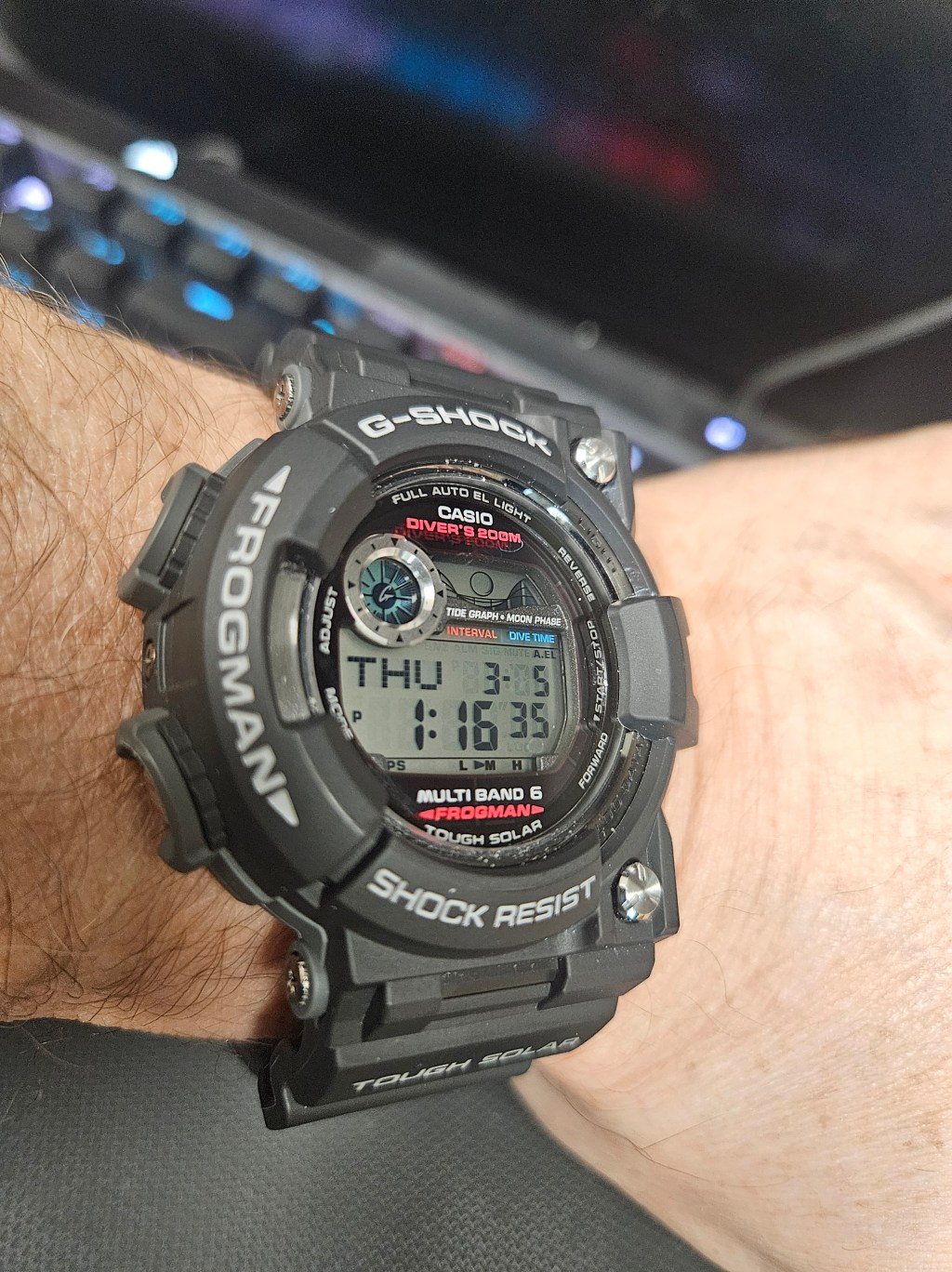
Then I strapped on the G‑Shock Frogman and looked down.
The numbers were unapologetic—big, bright, exact. No squinting, no interpretive dance with minute hands. Just time, delivered with atomic certainty. It wasn’t charming. It was correct. And I found myself loving it in the way you love a tool that does not negotiate.
The comparison arrived uninvited: the muscle cars of my youth—Mustangs, Barracudas—beautiful, yes, but also squeaking relics with climate control that felt like a rumor. You don’t drive them so much as you endure them. Then you slide into a modern car and the world seals itself around you—quiet, precise, obedient. That’s what the Frogman felt like. I hadn’t upgraded my watch; I had defected to a better century.
Here’s the heresy: I now resent my analog watches. I resent the squint, the guesswork, the artisanal inaccuracy sold at luxury prices. Why, exactly, is it acceptable that a watch costing thousands loses minutes while this rubberized amphibian syncs itself with the sky?
I don’t know what’s happening to me, and I no longer pretend to be in charge of it. What I do know is this: the Frogman isn’t leaving my wrist.
Colleagues of the watch faith, witness a Tribal Migration Event: the moment a collector crosses a border he swore was permanent—mechanical to quartz, analog to digital—and discovers he prefers the other side. It begins as a fling, a novelty purchase, a “let’s see.” It ends as a relocation. The shock is not the watch; it’s the realization that your identity was a costume with good lighting.
The casualties are lined up in a box. My high-end Seiko divers—polished, dignified, expensively nostalgic—sit like former lovers who’ve been ghosted without explanation.
“How could you?” they seem to ask.
“You’re dead to me,” I reply, with a briskness that surprises us all.
At this point the relationship is no longer metaphorical. It has crossed into the psychological, possibly the spiritual. There may be paperwork.
Let me concede the obvious: on a man my age, the Frogman is not flattering. It doesn’t whisper style; it shouts evidence. It looks like something a concerned relative might mention to a professional. And yet—there it remains, immovable.
Because something happened.
Not a gentle drift. Not a tasteful adjustment.
A break.
I felt it first in small betrayals of habit. My appetite tightened its belt. Three meals, no raids. No twilight foraging expeditions in the kitchen under the pretense of “just checking.” Focus sharpened. Discipline, that elusive houseguest, unpacked its bags.
Then the house itself changed.
No announcements were made, but the atmosphere shifted. The eye-rolling ceased. The quiet demotion—from patriarch to eccentric roommate—reversed itself without ceremony. I had, somehow, acquired gravity. Decisions began to look like decisions rather than impulses in costume.
And then—this is the part that refuses explanation—my nightmares stopped.
Not improved. Not reduced.
Stopped.
For years they ran nightly, a private cinema of dread with excellent attendance. Then the Frogman arrived and the theater closed. Lights out. Eviction. Now I sleep. I dream in color. I jog through fields of berries and, in a voice suspiciously like John Lennon, I sing, “I am the Frogman.”
Explain that.
A resin watch—battery, rubber strap, digital readout—accomplished what therapy, discipline, and time politely declined to do. Part of me wants to accept the miracle without inquiry. When something rescues you from overeating, ridicule, and nocturnal terror, you don’t interrogate it. You nod. You say thank you. You keep the artifact close and your questions at a respectful distance.
If it isn’t broken, don’t fix it.
If you don’t understand the blessing, don’t analyze it.
Unfortunately, I’m not built for reverence without curiosity. I want mechanisms. I want causes. I want a diagram that explains how a mass-produced object rewired my habits, upgraded my household rank, and shut down my night terrors like a switch.
That investigation is what lies ahead—the study of what I can only call the Frogman Elixir Effect: a transformation so complete the purchaser no longer quite exists.
I am not wearing the watch.
The watch is wearing me. I am the Frogman.
The migration is complete.
 Cinemorphosis
Leave a comment