Tag: love

  • A College Degree in Applause

    A College Degree in Applause

    When Oprah Winfrey signed off for the last time, she offered a distilled insight after decades of televised confessionals and couch-bound catharsis: beneath our surface differences, we all want the same thing—to be heard and, more importantly, to be affirmed. Not merely listened to, but validated, as if our words must pass through some invisible tribunal and emerge stamped: This life matters. This mind is not wasted inventory.

    She was right, though even that admission feels like an understatement. The appetite for validation is not a polite preference; it’s a metabolic demand. We don’t just want to speak—we want to land. We want our sentences to strike the listener with enough force that they nod, recalibrate, maybe even quote us later as if we were a minor authority in the ongoing project of making sense. We want to believe that our thoughts improve the room, that our presence upgrades the conversation from background noise to something resembling signal.

    Of course, the engine driving this hunger isn’t entirely noble. Scratch the surface and you’ll find insecurity jittering beneath the skin, narcissism preening in the mirror, tribal instincts scanning for applause from the right audience. We want to be right, but more than that, we want to be seen being right. Yet it would be too easy—and too smug—to reduce this to vanity alone. There’s another current running underneath. Human beings, for all their posturing, are wired for cooperation. We build moral systems, knowledge systems, entire civilizations on the premise that sharing ideas might actually improve the collective condition. So the same impulse that craves applause also aspires—sometimes sincerely—to contribute something of value. We may be peddling clichés, hallucinations, or the occasional insight, but the urge to be heard persists like a drumbeat.

    After nearly forty years of teaching writing, I’ve had a front-row seat to this performance. I’ve enjoyed the privilege—let’s call it what it is—of having a voice that people were required to listen to. Now, as that authority begins to fade at the edges, I’m left examining the machinery that made it feel necessary in the first place. My students will tell you they’re here for practical reasons: a degree, a job, a paycheck that doesn’t insult them. Fair enough. But beneath that utilitarian script, I suspect another motive is quietly at work. They want to matter intellectually. They want their ideas to carry weight, to be received not as filler but as substance.

    I can see it because I can reverse-engineer myself at eighteen. Put me back in that position—blank slate, open catalog—and I’d choose political science without hesitation. Not because it guarantees employment—it doesn’t—but because it offers a stage. A chance to sound sharp, to read densely, to write with the kind of authority that might make a professor pause and think, there’s something here. The fantasy isn’t wealth; it’s recognition. Money pays the bills, but it doesn’t applaud. It doesn’t lean forward when you speak.

    And without that recognition—without the sense that your mind registers on someone else’s radar—life begins to feel like static. Content generated, scattered, and forgotten. A digital smear. Noise mistaken for presence.

    Which is why so many of us operate under a quiet affliction I’d call Intellectual Visibility Panic: the nagging fear that no matter how carefully we assemble our thoughts, they will evaporate on contact—unheard, unvalued, and unremembered. It’s not dramatic enough to ruin your day, but it’s persistent enough to shape your choices. It nudges you toward certain majors, certain careers, certain performances of self. It whispers that time is running out, that if you don’t establish your voice soon, it will dissolve into the background hum.

    And so we speak. We write. We posture. We refine. Not just to communicate—but to leave a trace strong enough that someone, somewhere, might stop and say: that was worth hearing.

  • Normal Until It Isn’t: The Slow Collapse of a Social Life

    Normal Until It Isn’t: The Slow Collapse of a Social Life

    We acclimate to our routines the way a room acclimates to its own stale air—gradually, without protest—until the familiar starts to smell like something we’d refuse if it were new. Habit acquires the authority of identity. It tells us, “This is who you are,” and we nod, relieved not to argue. Then, occasionally, a crack opens. Something in the routine reveals itself as not just unusual, but quietly unhealthy. Six months ago, I noticed the crack: I have no active friendships. I can inventory names—P and T nearby, four sightings a year if the calendar is feeling generous; A an hour away, a phone call that arrives annually like a polite comet—but these are museum pieces, not relationships you live inside. By the only definition that matters—people you see and speak with regularly—I am operating at zero. I’ve built a life that functions without friends and then congratulated myself for the efficiency.

    I can dress the solitude up as a lifestyle. I can cite Laurie Metcalf and her apparent ease living alone, as if borrowing her poise could underwrite my own. But the analogy collapses on contact. Solitude is not the same as isolation, and thriving alone doesn’t imply the absence of active ties. The rationalization is elegant; it’s also evasive.

    What unsettles me is not the label—“friendless” is a blunt instrument—but the salience of it, the way the fact refuses to stay abstract. It lands on my family. A husband and father who lives in the Friendless Zone quietly shifts the social burden onto his wife and children. Every conversation, every need for connection, every idle hour leans on them. That’s not intimacy; it’s overreliance dressed as closeness. No one signs up to be an entire ecosystem.

    This wasn’t always the rhythm. Before marriage, my life had edges and movement. Meals with colleagues that stretched into second coffees, movies that required coordination, parties that produced stories, landline conversations that ran until your ear ached and you didn’t notice. Then 2010 arrived with twins and a schedule that ate the clock. Bottles, dishes, carpools, appointments—the logistics of care are relentless and, to be clear, necessary. Friendship became the expendable line item. I trimmed it “for now,” and “for now” matured into a policy.

    I’m not assigning blame. If anything, the demands of family life offered my inner recluse a beautifully plausible alibi. He’d been waiting for a reason to stay home; parenthood handed him a portfolio of them. The cave felt efficient, even virtuous. And then it felt normal. Now it feels narrow. Part of me still enjoys the quiet—the control, the absence of social friction. Another part sees the cost: fewer perspectives, fewer checks on your own thinking, fewer chances to be surprised into being more than you currently are.

    If I map the trajectory, my life  breaks into three eras: having friends and taking them for granted; losing friends and not noticing the loss; being without friends and finally noticing. Awareness is not a solution. It’s a diagnosis that arrives without a prescription. There’s no switch I can flip to become the convivial man who collects invitations like business cards. There is only the discomfort of seeing clearly—and the obligation to decide whether clarity is something you act on or merely admire.

  • The Appetite Recursion Loop

    The Appetite Recursion Loop

    Looking back, I can trace a clean, ugly line connecting my love of watches and my love of food: appetite, indulgence, anger, shame. It’s not a lifestyle. It’s a loop. I want more than I should, I give in, I punish myself for giving in, and then I reset the machine and start again. Call it the Appetite Recursion Loop—a closed system where desire feeds indulgence, indulgence feeds shame, and shame reloads desire with fresh ammunition. It feels inevitable because, most days, it is.

    Appetite and chaos are my factory settings. In the early ’90s, when I lived in a bachelor pad that smelled like basil and ambition, my Navy SEAL friend Mike would call and say, “McMahon, I can hear you chewing through the phone. Every time I call, you’re eating. What is it now, Fat Face?”

    “Angel hair pasta with pesto.”

    “Sounds dangerous. I’m coming over.”

    And he would—arriving just in time to annihilate whatever I’d cooked. His metabolism ran on military drills and Pacific swells; mine ran on fantasy and carbohydrates. He burned calories like a wildfire. I cultivated them.

    He once called with an offer: Santa Barbara, surfing, and a setup with a friend of his girlfriend’s. “Now can you surf?” he asked.

    That’s how I found myself on excursions that had nothing to do with waves and everything to do with spectacle.

    Mike lived with his father, Bob—a former Marine with a foghorn voice and a temper that could peel paint. Their daily routine was a ritualized war: shouting about lawns, garages, groceries—two men chesting up like rival roosters while spit flew. Five minutes later, ceasefire. We’d pile into Mike’s Toyota for Mongolian beef with Social Distortion rattling the doors. Back home, John Wayne on the TV, Bob opening his gun safe “in case the Duke needs backup.” To me, this wasn’t dysfunction. It was familiar. It was home.

    I was raised in a house where anger was the native language. Fathers barked, belts translated. When rage is your baseline, it’s like living with your brain tuned permanently to a Death Metal station. Eventually, you stop hearing it. You call it normal. It isn’t.

    I know that now because I married a woman fourteen years younger than me, and we have twin teenage daughters who have no interest in Death Metal Dad. They want something closer to Smooth Jazz—Bach, Earth, Wind & Fire—anything that doesn’t rattle the drywall. They’re right. Rage isn’t masculinity. It’s intoxication. A sloppy, corrosive one.

    My version of sobriety isn’t about alcohol. It’s about anger. That means tracking triggers like a customs agent. One of the biggest? New watches. Shiny objects flip a switch. The Death Metal station hums back to life. Desire spikes, anxiety follows, and then comes the familiar hangover: self-reproach with a side of irritability. I become a joyless man—Grandma Sour Pants in sneakers. My family doesn’t want to be around me. Frankly, neither do I.

    Money isn’t the problem. I can afford the watches. What I can’t afford is the noise. I own eight pieces worth about fifteen grand, and even that feels like mental bookkeeping—rotations, rationalizations, inventory control for a hobby that was supposed to be fun. If I owned twelve, I’d need a project manager and a therapist. My watch friends say, “Life is short. Buy what you want.” That’s not wisdom. That’s indulgence wearing a tie. A man-child with a credit card is still a man-child—and no man-child is happy. He buys to outrun loneliness, and the purchases lose every race.

    Ninety-five percent of my buys were impulsive. Which means ninety-five percent were evidence—exhibits entered into the case against my maturity. I sold most of them at a loss, not because I needed the cash, but because I needed to feel like I wasn’t owned by my own impulses.

    I’m a product of the Me-Generation—California, ’70s, self as deity. Stories I Only Tell My Friends captures it perfectly: the Counterculture as the Worship of the Self—whatever the Self wants, the Self gets. No brakes, no compass. Malibu as a sunlit laboratory for beautiful people making terrible decisions. When desire becomes sacred, reality becomes optional—and the bill comes due.

    When I see a watch I love, my brain lights up like I’ve just taken a hit of something illegal. Desire surges. Then anger—because the loss of control is the real offense. I don’t want rehab for watches. I want a hobby that fits inside reality instead of dragging me out of it. Pleasure without compulsion. Enjoyment without obsession. A life without permanent FOMO.

    And here’s the final punchline: even writing this makes me nostalgic for being sixteen in Santa Monica and Malibu in 1976. I start looking backward like Lot’s wife, feel the salt forming, the Death Metal station warming up again. That’s my cue. Change the channel.

    Which is why I wonder if the shift to the G-Shock Frogman was an attempt at self-surgery—a clean cauterization of the need for more. A reset. My G-Shock friends laugh. The Frogman isn’t the cure, they say. It’s Act One of a new addiction.

    If they’re right, then “I Am the Frogman” isn’t transformation.

    It’s mythology.

    And I’m the one who wrote it.

  • Cognitive Lag Drift Meets the Frogman’s Calm

    Cognitive Lag Drift Meets the Frogman’s Calm

    Camp Flog Gnaw sounds like the name of an enormous toothy cartoon monster, but it was a weekend-long bacchanal of sound and sweat for my wife and our twin daughters, two days of music and mayhem baked under the unforgiving Los Angeles sun. My wife braved the trip on Friday and came home looking like a survivor of a maritime disaster, muttering that leaving Dodger Stadium traffic was like trying to escape a collapsing pyramid. She begged me to handle Sunday drop-off and assured me they would Uber home like civilized people. Armed with a “Fast Pass” for the 110 North, I engaged Google Maps, which promptly betrayed me and sent me barreling into downtown—an urban obstacle course specifically engineered to destroy men my age. Pedestrians sprang into the street like feral pigeons, daring me to earn a manslaughter charge. Driverless Waymo cars drifted past me with pastel-lit antennae, cheerful like clown hearses guiding me into the underworld. The lanes themselves seemed painted by committee: solid, dashed, turning, not turning, red, green, “maybe stop,” “maybe don’t”—a psychedelic optical exam administered at 20 mph.

    I began to notice a quiet but unsettling shift in my driving. Two hazards arrived at the same time, like conspirators who had compared notes. First, the road itself had changed. It no longer presented information—it assaulted me with it. Screens glowed, dashboards pulsed, alerts chimed, and every passing car seemed to flash some new digital signature. The highway had become a carnival of LEDs.

    Second—and less forgiving—was what was happening inside my own head. My processing speed had slowed just enough to matter. Not dramatically. Not catastrophically. Just enough to turn split-second decisions into small negotiations. And driving is no place for negotiation. The convergence of these two developments created Cognitive Lag Drift: the subtle but consequential slowing of mental processing speed that impairs real-time decision-making in high-stakes environments like driving, where milliseconds matter.

    The result was a kind of sensory overload paired with cognitive lag—a bad marriage. What used to feel like a calm, controlled glide now felt like I was trying to play a video game while someone flicked the lights on and off in rapid succession. The margin for error hadn’t changed. I had.

    Driving was no longer serene. It was a test I hadn’t agreed to take.

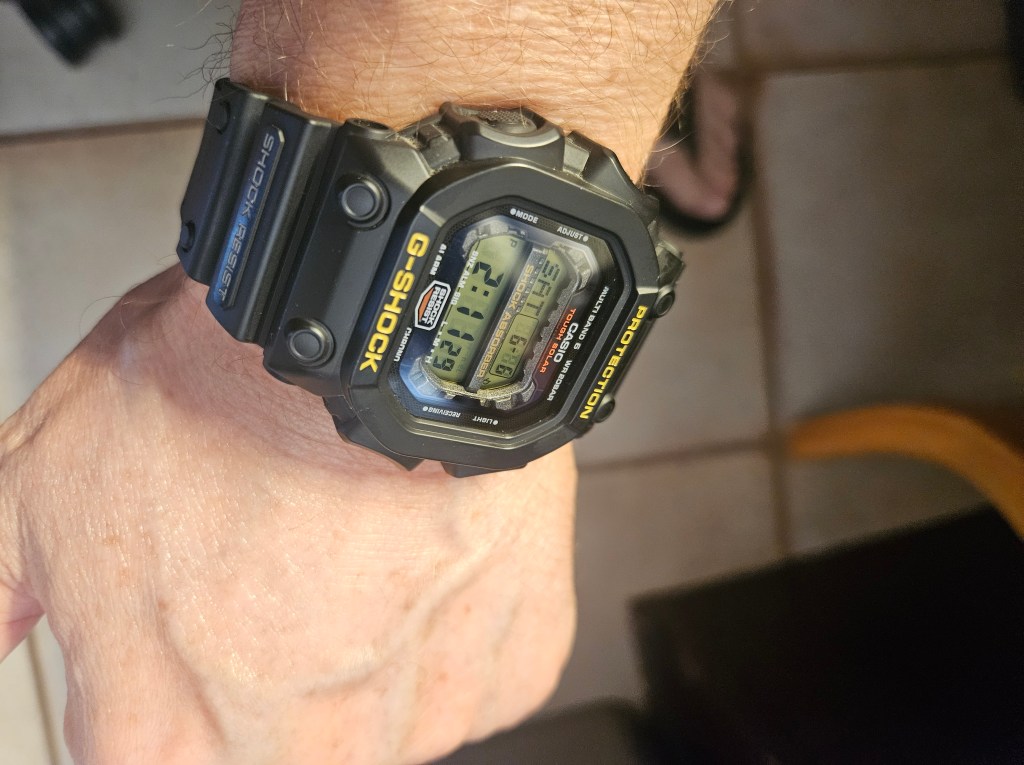
    And yet—strangely—on my wrist sat a counterargument. My Casio G-Shock Frogman did not flash, negotiate, or editorialize. It did not offer lane suggestions, heart rate, moral encouragement, or existential commentary. It simply displayed the time in large, unapologetic numerals, like a monk who has taken a vow of clarity. No animations. No alerts. No betrayal. In a world where every screen demands interpretation, the Frogman delivers a verdict: 5:42. That’s it. No subtext, no narrative arc, no committee-painted ambiguity. The road may have turned into a casino of stimuli and my brain into a cautious bureaucrat, but the watch remains a quiet tyrant of precision. I glance down and feel, for a fleeting second, that order is still possible—that somewhere in this strobe-lit madness, truth can be reduced to a number that does not argue back.

    When I finally dropped off my wife and daughters, I whispered a confession to my wife: “I’m done with this. I think I’m giving my Accord to you, and the other car to the girls. I’m retiring from the driving game.” They didn’t laugh; they’ve seen cracks in the armor. I’m a high-strung man, and at sixty-four, the neurons don’t fire like they used to. I can still handle a five-mile radius around my house—my personal demilitarized zone—but pull me into the wilds of Los Angeles traffic and I’m ready to hang up my driver’s jersey. Downtown LA isn’t a city. It’s a gladiatorial arena where the young come to dominate, and I say to myself, “This is no country for old men.”

  • The Horological Substitution Effect

    The Horological Substitution Effect

    I’ve long suspected that my late-night commiseration with other men about watches was not fellowship but camouflage. We called it passion—dial textures, lume performance, the moral superiority of mechanical over quartz—but beneath the jargon was something quieter and more embarrassing: loneliness.

    Lately, a more unsettling thought has taken hold. My transformation into the Frogman—the resin-clad apostle of atomic time—may not be about horology at all. It may be an attempt to imagine myself as a man who exudes the kind of charisma that draws an abundance of real friendships. Not forum acquaintances. Not usernames. Real people who might, inexplicably, choose to spend time with me.

    I have a name for this pathology: the Horological Substitution Effect. It’s the quiet exchange a man makes when real connection feels too risky—he trades the messy, unpredictable labor of friendship for the controlled ritual of online hobby talk. The watch becomes a proxy for intimacy. The forum becomes a stage where vulnerability is replaced with specifications. It looks like connection. It feels like connection. It isn’t.

    My suspicions hardened into something closer to fact when my wife began sending me short videos of comedy skits about a subject that has no business being funny: the epidemic of friendless adult men. The jokes land with the precision of an indictment. Get off your ass. Build a life that includes other human beings. Not for amusement. For survival. For the family.

    The problem is I don’t know how.

    My friendships didn’t end dramatically. They dissolved. Quietly. Gradually. Like hair circling a drain until there’s nothing left to catch. I haven’t met a friend for a movie and a meal in over a decade. Solitude didn’t arrive as a crisis; it moved in, rearranged the furniture, and declared itself permanent. Worse, it feels justified. I operate under a private assumption so efficient it barely needs words: no one would choose this. Why would they? Friendship is an investment, and I’ve already decided I’m a bad bet. Rejection is neatly avoided by never extending the invitation. It’s surrender, dressed up as self-respect.

    If I trace the origin, I land somewhere around 2005. Dinner with my cousin in downtown Los Angeles. Afterward, he wanted me to follow him to Silver Lake for coffee and more conversation. It wasn’t the original plan, just a spontaneous thought. I felt the anxiety spike, sharp and immediate. Dinner had been the contract; anything beyond it felt like a breach. I went along, but badly. He noticed. He never asked again. He went on to build a life dense with friendships, a calendar that requires pruning. I refined a different skill: leaving early. It’s part of my neurosis and a condition called Extension Anxiety Reflex: the immediate surge of discomfort triggered when a social encounter exceeds its original scope, prompting withdrawal, compliance-with-resistance, or emotional shutdown. The reflex prioritizes escape over connection, often at the exact moment intimacy might begin.

    I inherited the inclination to not maintain friendships. My parents spent the last decades of their lives without friends. My father outsourced social contact through his second wife but never rebuilt what he’d lost. My mother claimed acquaintances the way a diner claims rapport with a waiter—polite, transactional, ultimately imaginary. Loneliness wasn’t diagnosed in our house; it was modeled. It wore the mask of normalcy. I didn’t choose to avoid friendships so much as follow a script. 

    My parents weren’t bad people. They were self-involved, chemically dependent, emotionally unavailable. My father once told me, with the bluntness of a man who had stopped editing himself, that if he could do it over again, he wouldn’t have children. People recoil at that. I didn’t. It sounded like a sentence I’d already been living. My mother oscillated between warmth and collapse, her depressions so severe she vanished into hospitals while I vanished into my grandparents’ home. Childhood became less a place to grow than a place to endure.

    So I adapted. I became self-sufficient. I entertained myself. I removed the need for others before they could remove themselves from me. Isolation wasn’t a failure; it was a system—efficient, predictable, safe.

    In my twenties, desire disrupted the system. I wanted relationships, so I built a version of myself that could secure them. Talkative. Confident. Funny. A man with timing. It worked. Women believed in the performance. So did I. But the performance had no depth. It couldn’t support anything real. Relationships collapsed under the combined weight of my anxiety and self-absorption. I could attract; I could not attach. I had charisma without the anchor: the ability to generate attraction through confidence, humor, and social fluency while lacking the emotional grounding required to sustain a relationship. I could initiate connection but could not stabilize it, resulting in repeated relational collapse.

    That hasn’t entirely changed. I can still be charming in controlled doses. Colleagues enjoy me in passing. I generate conversation the way a barista generates foam—pleasant, temporary, decorative. But conversation is not friendship. Friendship requires escalation. Risk. The unthinkable act of asking someone to step outside the script and spend time with you. That’s where the system fails. I assume the answer will be no, so I never ask the question. It’s a perfect loop: I avoid rejection by guaranteeing isolation.

    This morning, sitting in my car waiting to take my daughters to school, I nearly performed another ritual. I reached for my watch, ready to photograph it for Instagram—a small sacrifice to the gods of trivial validation. For a moment, I considered it. Then the idea turned on me. The absurdity was too clean to ignore. As if a watch photo could compensate for a hollow social life. As if attention could masquerade as connection. It felt like eating sugar to cure hunger and calling the crash nourishment.

    So I sat there instead.

    I thought about those videos my wife keeps sending. They’re funny the way a diagnosis is funny—because it’s accurate. She’s worried. She should be.

    The truth is not complicated. It’s just unflattering. I have built a life optimized to avoid risk, and in doing so, I have optimized it to avoid connection. And here’s the irony that would be funny if it weren’t so exact: as the self-appointed Frogman—the man of action, the avatar of decisiveness—I am acutely aware of the contradiction. The Frogman is not a watch; it is an aspiration. Like Steely Dan’s suburbanite Deacon, dreaming of escape through saxophone and whiskey, I imagine a version of myself that moves, acts, engages—a man who shows up, who serves, who answers the call.

    A man who doesn’t leave early.

  • The Frogman Won’t Let the World Forget Me

    The Frogman Won’t Let the World Forget Me

    No one pulls you aside and says it plainly, so you discover it the hard way: approaching your mid-sixties is not a dignified procession but a slow-motion loss of fluency. Not in language—you still speak English—but in the dialect of the present. You drop references like breadcrumbs—Danish Go-Rounds, Screaming Yellow Zonkers, Tooter Turtle, Super Chicken, All in the Family—and watch them land with the soft thud of irrelevance. Blank faces greet you like unresponsive kiosks. You begin to understand that your cultural currency has been quietly demonetized.

    The misalignment spreads. You assume appliances are built with the stubborn dignity of the past, only to discover they’re engineered like disposable cutlery. You touch them wrong and they sulk; you look at them sternly and they fracture. Somewhere along the way, durability became a nostalgic rumor.

    Then the body joins the conspiracy. You can ingest oceans of omega-3s, lecture yourself about triglycerides, and still your short-term memory leaks like a cracked vessel. You misplace socks—on the couch. You forget the final episode of the crime series you were definitely going to finish. You overlook the Costco-sized battalion of trash bags stationed in the garage. You grind tomorrow’s coffee beans and wake up convinced you didn’t. Each lapse is trivial; together they assemble a quiet indictment. The evidence accumulates like unopened mail—thick, accusatory, impossible to ignore.

    At some point you recognize the composite image: a man slightly out of phase with the world, blinking as if the lighting has changed without notice. You flash your senior discount at the box office with a strange mix of pride and disbelief, like a badge you didn’t apply for but now must wear.

    Of course, you resist. You lift. You count protein with monastic zeal—two hundred grams a day, as if amino acids can negotiate with time. You clang kettlebells in the garage and polish your physique into a version that might pass for forty-four under forgiving conditions. It’s a valiant performance—convincing in daylight, flattering in mirrors.

    Then night driving happens.

    Depth perception turns traitor. Headlights arrive as surgical instruments. Streetlamps slice into your retinas with the precision of interrogation. The illusion collapses in a single commute. Biology, unimpressed by your discipline, resumes control of the narrative.

    And so you become, whether you like it or not, a public artifact of time passing—a walking reminder to the young that the clock is not theoretical. To them, you are the human equivalent of a neighbor’s dog barking at six in the morning: persistent, a little unnerving, impossible to mute. You do not mean to be instructive, but you are.

    Faced with this, I did what any reasonable man would do: I recruited a muse. The narrator of “Deacon Blues”—that suburban alchemist who turns disappointment into velvet—became my companion. I gave him a name, because a man like that demands one: Deacon. Each night he reinvents himself as a nocturnal artist, steeped in jazz and whiskey, sustained by the elegance of his own delusions.

    I don’t drink. I don’t haunt smoky rooms. My vice is different, and it is, in its own way, just as theatrical. I cosplay.

    My chosen persona is Action Man—the British cousin of G.I. Joe, the hero of my childhood in Nairobi, where toy stores stocked imperial variations of American fantasies. In those days, I directed epics in the backyard. I rigged a clothes hanger to a fishing line strung between trees and sent my plastic hero ziplining into danger, rescuing hostages from villains who existed only because I needed them to. The yard teemed with chameleons and carpenter bees; it might as well have been a jungle. I was the director, the stunt coordinator, the audience. Action Man never hesitated. Action Man did not forget where he put his socks.

    Now I find myself wondering whether my recent conversion to the G-Shock Frogman is less a purchase than a recall notice from that earlier life. A resin watch, oversized and unapologetic, arrives like a toy that learned how to tell time with atomic authority. Five hundred dollars for a device that looks like it escaped a childhood—but feels, on the wrist, like a command.

    The timing is suspicious. Irrelevance looms. Retirement whispers. The culture shrugs. And my unconscious, unimpressed by all of it, reaches backward and drags something forward. I did not want to dim. I wanted ignition. I wanted to be in my prime, or at least in the vicinity of it. I wanted, absurdly and sincerely, to be a man of action.

    So here I am, somewhere between Deacon’s barstool and a backyard zipline, imagining a descent into danger, hostages to save, a purpose that announces itself clearly and requires no explanation. The ravine is imaginary. The urgency is not.

  • From Analog Watch Devotee to Digital Convert

    From Analog Watch Devotee to Digital Convert

    For decades I carried a tidy prejudice: digital time was vulgar—soulless, phone-adjacent, a betrayal of my analog faith. I was a man of brushed steel and sweeping seconds, a parishioner in the Church of the Diver. Quartz was for commuters. Resin was for children.

    Then I strapped on the G‑Shock Frogman and looked down.

    The numbers were unapologetic—big, bright, exact. No squinting, no interpretive dance with minute hands. Just time, delivered with atomic certainty. It wasn’t charming. It was correct. And I found myself loving it in the way you love a tool that does not negotiate.

    The comparison arrived uninvited: the muscle cars of my youth—Mustangs, Barracudas—beautiful, yes, but also squeaking relics with climate control that felt like a rumor. You don’t drive them so much as you endure them. Then you slide into a modern car and the world seals itself around you—quiet, precise, obedient. That’s what the Frogman felt like. I hadn’t upgraded my watch; I had defected to a better century.

    Here’s the heresy: I now resent my analog watches. I resent the squint, the guesswork, the artisanal inaccuracy sold at luxury prices. Why, exactly, is it acceptable that a watch costing thousands loses minutes while this rubberized amphibian syncs itself with the sky?

    I don’t know what’s happening to me, and I no longer pretend to be in charge of it. What I do know is this: the Frogman isn’t leaving my wrist.

    Colleagues of the watch faith, witness a Tribal Migration Event: the moment a collector crosses a border he swore was permanent—mechanical to quartz, analog to digital—and discovers he prefers the other side. It begins as a fling, a novelty purchase, a “let’s see.” It ends as a relocation. The shock is not the watch; it’s the realization that your identity was a costume with good lighting.

    The casualties are lined up in a box. My high-end Seiko divers—polished, dignified, expensively nostalgic—sit like former lovers who’ve been ghosted without explanation.

    “How could you?” they seem to ask.

    “You’re dead to me,” I reply, with a briskness that surprises us all.

    At this point the relationship is no longer metaphorical. It has crossed into the psychological, possibly the spiritual. There may be paperwork.

    Let me concede the obvious: on a man my age, the Frogman is not flattering. It doesn’t whisper style; it shouts evidence. It looks like something a concerned relative might mention to a professional. And yet—there it remains, immovable.

    Because something happened.

    Not a gentle drift. Not a tasteful adjustment.

    A break.

    I felt it first in small betrayals of habit. My appetite tightened its belt. Three meals, no raids. No twilight foraging expeditions in the kitchen under the pretense of “just checking.” Focus sharpened. Discipline, that elusive houseguest, unpacked its bags.

    Then the house itself changed.

    No announcements were made, but the atmosphere shifted. The eye-rolling ceased. The quiet demotion—from patriarch to eccentric roommate—reversed itself without ceremony. I had, somehow, acquired gravity. Decisions began to look like decisions rather than impulses in costume.

    And then—this is the part that refuses explanation—my nightmares stopped.

    Not improved. Not reduced.

    Stopped.

    For years they ran nightly, a private cinema of dread with excellent attendance. Then the Frogman arrived and the theater closed. Lights out. Eviction. Now I sleep. I dream in color. I jog through fields of berries and, in a voice suspiciously like John Lennon, I sing, “I am the Frogman.”

    Explain that.

    A resin watch—battery, rubber strap, digital readout—accomplished what therapy, discipline, and time politely declined to do. Part of me wants to accept the miracle without inquiry. When something rescues you from overeating, ridicule, and nocturnal terror, you don’t interrogate it. You nod. You say thank you. You keep the artifact close and your questions at a respectful distance.

    If it isn’t broken, don’t fix it.
    If you don’t understand the blessing, don’t analyze it.

    Unfortunately, I’m not built for reverence without curiosity. I want mechanisms. I want causes. I want a diagram that explains how a mass-produced object rewired my habits, upgraded my household rank, and shut down my night terrors like a switch.

    That investigation is what lies ahead—the study of what I can only call the Frogman Elixir Effect: a transformation so complete the purchaser no longer quite exists.

    I am not wearing the watch.

    The watch is wearing me. I am the Frogman.

    The migration is complete.

  • The Frogman Conversion: When Lightning Strikes

    The Frogman Conversion: When Lightning Strikes

    One of the great American confessions disguised as a groove, “Deacon Blues” by Steely Dan, is not really about jazz or whiskey or late-night dignity. It’s about a suburban man who has quietly accepted his own smallness and now anesthetizes himself with a cinematic fantasy: he is, in his mind, an outlaw artist—unbought, ungoverned, beautifully doomed. In reality, he’s a man in a cul-de-sac rehearsing rebellion between errands.

    The song doesn’t mock him; it does something crueler and more elegant—it turns his self-deception into something hauntingly beautiful, a melody so smooth you almost miss the fact that it’s scoring a life half-lived. That’s why it lingers. It flatters the listener even as it exposes him.

    The song’s narrator is what we might call a Pinot Noir Outlaw: a man who performs a life of danger and artistic defiance through carefully curated indulgences—jazz, late-night drinks, vague melancholy—while remaining safely embedded in routine and privilege.

    And I’m not exempt. I recognize the man immediately because I am another citizen pacing the enclosure of my own habits, staging elaborate internal revolutions that never quite breach the walls. I don’t crave improvement; improvement is bureaucratic. I crave demolition. I want the current version of myself revoked, replaced, struck by lightning and rewritten. Spare me the incremental victories—slightly better blood pressure, a more respectable triglyceride count, LDL nudged into compliance. That’s not transformation; that’s paperwork.

    What I want is upheaval. I want to molt like something ancient and impatient. I want to peel off the familiar skin—cowardice, inertia, the soft compromises I’ve negotiated with mediocrity—and step out of it raw and newly assembled. Someone decisive. Someone difficult to bargain with. A man who doesn’t soften at the edges when it matters. A man who doesn’t flinch.

    But because that kind of transformation rarely arrives—no lightning bolt, no divine summons—we improvise. We cosplay. We assemble identities the way children assemble Halloween costumes: a prop here, a posture there, a new narrative stitched together from objects that flatter us. We don’t become new men; we accessorize the old one and call it progress.

    If you’re a watch collector, the illusion is particularly seductive. For twenty years, I lived inside a very specific mythology: polished steel, mechanical divers, the ritual of winding and setting, the quiet romance of gears and springs. I told myself I belonged to a certain tribe—men of discernment, men of patience, men who appreciated craft. It was a pleasing fiction.

    Then, in February of 2026, at sixty-four—an age when one is expected to consolidate, not detonate—I betrayed my own aesthetic. I bought the watch I had resisted for over a decade: the G-Shock Frogman. I had dismissed it for years as a resin aberration, a digital eyesore, a violation of everything I claimed to value. And yet, in a moment that felt less like a decision and more like possession, I ordered it from Sakura Watches in Japan.

    The acquisition was not elegant. It was a bureaucratic gauntlet. Emails. Texts. Tracking updates that read like dispatches from a stalled expedition. A sudden hostage situation in a Long Beach DHL facility until I paid a $100 ransom dressed up as an import fee. By the time the box arrived, I assumed the experience had poisoned the well. Surely the watch would arrive tainted by annoyance.

    It didn’t.

    I strapped it on, and something immediate and irrational occurred. Not admiration—bonding. A click deeper than preference. It triggered a memory I hadn’t summoned in years: the 1970s TV show Shazam!, where a boy named Billy Batson speaks a word—Shazam!—and a bolt of lightning splits the sky, transforming him into Captain Marvel. Child becomes hero. Hesitation becomes action.

    The Frogman was my word. Not spoken, but worn.

    And here is the part that resists tidy explanation: I did not feel like a man who had purchased a watch. I felt like a man who had crossed a threshold. As if some internal lever had been pulled without my consent. The old aesthetic, the old loyalties—they didn’t argue; they receded. Something else advanced.

    Call it delusion if you want. Call it consumer theater. But the experience had a force to it, a momentum that mocked the idea of careful, rational choice. It felt like being drafted by a version of myself I hadn’t authorized.

    I don’t know what comes next. I only know this: the change did not ask permission, and I did not resist it.

  • The Man Who Never Asked

    The Man Who Never Asked

    My wife has been sending me comedy skits about a subject that isn’t remotely funny: the epidemic of friendless adult men. The message arrives dressed as humor but lands as indictment—get off your ass and build a life that includes other human beings. Not for entertainment. For survival. For the family.

    The problem is I don’t know how.

    My friendships didn’t end with a bang; they evaporated. One by one, they thinned out, like hair in a drain, until nothing remained. I haven’t met a friend for a movie and a meal in nearly twenty-five years. Solitude didn’t ambush me; it settled in and redecorated. It became my default setting. Worse, it feels justified. I operate under a quiet but tyrannical assumption: no one would willingly spend that kind of time with me. Why would they? Friendship requires an investment, and I’ve already decided I’m not worth the return. Rejection is neatly avoided by never making the ask. A preemptive surrender disguised as dignity.

    When I think about how this calcified, I go back to 2005. My cousin and I met for dinner in downtown Los Angeles. Afterward, he wanted to extend the evening—drive twenty minutes to a coffee shop, linger, talk. I felt the anxiety rise like a fever. Dinner had been the contract; anything beyond it felt like trespass. I went along, reluctantly. He noticed. He never asked again. He moved on to a life crowded with friendships, a calendar he has to prune. I perfected the art of leaving early.

    I come by this honestly. My parents spent the last three decades of their lives without friends. My father borrowed social contact through his second wife but never rebuilt what he lost. My mother claimed friendships the way a customer claims familiarity with a waiter—pleasant, transactional, imaginary. Loneliness wasn’t diagnosed in our household; it was modeled. It looked normal. It felt inevitable.

    My parents weren’t bad people. They were self-involved, chemically compromised, and emotionally unavailable. My father once told me that if he could do it over again, he wouldn’t have children. People recoil when they hear that. I didn’t. It had the ring of truth I had already lived with. My mother, meanwhile, oscillated between warmth and collapse. Her depressions were so severe she disappeared into hospitals, and I disappeared into my grandparents’ house. Childhood became something to endure rather than inhabit.

    So I adapted. I became self-contained. I entertained myself. I eliminated the need for others before they could eliminate me. Being alone wasn’t a failure; it was a system.

    In my twenties, desire disrupted that system. I wanted relationships, so I built a version of myself that could get them. I became talkative, confident, funny—an actor with good timing and a decent script. It worked. Women believed in the character. So did I. But the performance had no depth. It couldn’t sustain love because it wasn’t built on vulnerability, only on impression. The relationships collapsed under the weight of my anxiety and selfishness. I could attract; I could not attach.

    That hasn’t entirely changed. I can still be charming in controlled environments. My colleagues enjoy me in passing. I can generate conversation the way a barista generates foam—pleasant, temporary, nonbinding. But conversation is not friendship. Friendship requires escalation, risk, the unthinkable act of asking someone to step outside the script and spend time with you. That’s where I freeze. I assume the answer will be no, and so I never pose the question. It’s a tidy system: I protect myself from rejection by guaranteeing isolation.

    This morning, sitting in my car waiting to take my daughters to school, I almost performed another ritual of avoidance. I reached for my watch, ready to photograph it for Instagram—a small offering to the gods of trivial validation. For a moment, I considered it. Then the idea repulsed me. The absurdity of it. As if a watch photo could compensate for a hollow social life. As if attention could substitute for connection. It felt like feeding a hunger with sugar and calling it nourishment.

    So I sat there instead, thinking about those videos my wife keeps sending me. They’re funny in the way a diagnosis can be funny—because it’s accurate. She’s worried. She should be.

    The truth is simple and unflattering: I’ve built a life that minimizes risk and, in doing so, minimizes connection. If I want to be less of a burden to my family, I have to become someone who can love beyond the walls of his own habits. That means doing the one thing I’ve spent decades avoiding.

    It means asking.

  • Frictionmaxxing in the Age of Ease

    Frictionmaxxing in the Age of Ease

    In “Our Longing for Inconvenience,” Hanif Abdurraqib diagnoses a modern sacrilege: we have streamlined the sacred. Love, once a slow collision of timing, nerve, and chance, has been repackaged as a swipe—faces flicked past like clearance items in a digital aisle. Courtship now resembles an online shopping spree, complete with filters, wish lists, and the quiet suspicion that you’re not choosing so much as being A/B tested. It raises an unflattering question: are we still falling in love, or have we become compliant participants in a well-designed experiment? Convenience has done what convenience always does—it removed the friction and took some of the humanity with it. What remains is efficient, scalable, and faintly hollow.

    The backlash has a name—call it frictionmaxxing. People, starved for something earned, are reintroducing resistance on purpose: analog rituals, delayed gratification, tasks that refuse to collapse into a tap. There’s nostalgia for the Before Convenience Times, when the self felt hammered into shape rather than 3D-printed from preference settings. The mythology is simple: meaning requires effort; effort requires inconvenience.

    I’m not moved by the usual props—turntables, VCRs, the museum of obsolete plastic. That feels like cosplay. But I do recognize the pull in two places of my own life that refuse to fake it: my acoustic Yamaha upright piano that answers only to touch and time, and my kettlebells that don’t care about my feelings or my notifications. Both demand presence. Both punish distraction. They’re small, stubborn antidotes to the screen’s narcotic ease.

    Abdurraqib’s warning is less about gadgets than about posture. Convenience doesn’t just lubricate life; it reclines it. We become passive, distractible, pleasantly numb—a polite version of Friedrich Nietzsche’s Last Man, optimized for comfort and allergic to striving. The tragedy isn’t that we have tools; it’s that the tools quietly train us to avoid anything that resists us.

    Here’s the confession that ruins the tidy narrative: I don’t need to blame screens for my preference for ease. I came that way. Given the choice between puttanesca and a bowl of oatmeal with protein powder, I will choose the path that requires fewer verbs. I love puttanesca in theory—the garlic, the brine, the argument it makes on the tongue. I do not love it enough to perform the liturgy required to summon it. Convenience didn’t corrupt me; it recognized me.

    The same instinct flared when at forty-eight I became a father–twins, no less. The prospect of nights broken into fragments, of diapers and pacing and the long choreography of care, filled me with a very modern dread: the dread of interruption. I complained. My cousin Garrett, who has the inconvenient habit of being right, told me that the friction is the bond—that the lost sleep and the repetition are not bugs but features, the forge where attachment is made. I believed him. Belief, however, did not improve my mood at three in the morning.

    None of this is going away. Convenience will continue to refine itself into invisibility, and our hunger for something earned will continue to nag at us like a conscience we can’t quite uninstall. The only workable response is not purity but partition: carve out blocks of time that refuse assistance, that insist on effort, that return you to the body and the task. Live, briefly, off the grid of your own habits.

    The irony, of course, is waiting for us with a smile. Give it six months and there will be a frictionmaxxing app to schedule your inconvenience, optimize your resistance, and remind you to be authentic at 4:30 p.m. You’ll tap “confirm,” and somewhere a server will congratulate you for choosing friction the convenient way.