No one pulls you aside and says it plainly, so you discover it the hard way: approaching your mid-sixties is not a dignified procession but a slow-motion loss of fluency. Not in language—you still speak English—but in the dialect of the present. You drop references like breadcrumbs—Danish Go-Rounds, Screaming Yellow Zonkers, Tooter Turtle, Super Chicken, All in the Family—and watch them land with the soft thud of irrelevance. Blank faces greet you like unresponsive kiosks. You begin to understand that your cultural currency has been quietly demonetized.
The misalignment spreads. You assume appliances are built with the stubborn dignity of the past, only to discover they’re engineered like disposable cutlery. You touch them wrong and they sulk; you look at them sternly and they fracture. Somewhere along the way, durability became a nostalgic rumor.
Then the body joins the conspiracy. You can ingest oceans of omega-3s, lecture yourself about triglycerides, and still your short-term memory leaks like a cracked vessel. You misplace socks—on the couch. You forget the final episode of the crime series you were definitely going to finish. You overlook the Costco-sized battalion of trash bags stationed in the garage. You grind tomorrow’s coffee beans and wake up convinced you didn’t. Each lapse is trivial; together they assemble a quiet indictment. The evidence accumulates like unopened mail—thick, accusatory, impossible to ignore.
At some point you recognize the composite image: a man slightly out of phase with the world, blinking as if the lighting has changed without notice. You flash your senior discount at the box office with a strange mix of pride and disbelief, like a badge you didn’t apply for but now must wear.
Of course, you resist. You lift. You count protein with monastic zeal—two hundred grams a day, as if amino acids can negotiate with time. You clang kettlebells in the garage and polish your physique into a version that might pass for forty-four under forgiving conditions. It’s a valiant performance—convincing in daylight, flattering in mirrors.
Then night driving happens.
Depth perception turns traitor. Headlights arrive as surgical instruments. Streetlamps slice into your retinas with the precision of interrogation. The illusion collapses in a single commute. Biology, unimpressed by your discipline, resumes control of the narrative.
And so you become, whether you like it or not, a public artifact of time passing—a walking reminder to the young that the clock is not theoretical. To them, you are the human equivalent of a neighbor’s dog barking at six in the morning: persistent, a little unnerving, impossible to mute. You do not mean to be instructive, but you are.
Faced with this, I did what any reasonable man would do: I recruited a muse. The narrator of “Deacon Blues”—that suburban alchemist who turns disappointment into velvet—became my companion. I gave him a name, because a man like that demands one: Deacon. Each night he reinvents himself as a nocturnal artist, steeped in jazz and whiskey, sustained by the elegance of his own delusions.
I don’t drink. I don’t haunt smoky rooms. My vice is different, and it is, in its own way, just as theatrical. I cosplay.
My chosen persona is Action Man—the British cousin of G.I. Joe, the hero of my childhood in Nairobi, where toy stores stocked imperial variations of American fantasies. In those days, I directed epics in the backyard. I rigged a clothes hanger to a fishing line strung between trees and sent my plastic hero ziplining into danger, rescuing hostages from villains who existed only because I needed them to. The yard teemed with chameleons and carpenter bees; it might as well have been a jungle. I was the director, the stunt coordinator, the audience. Action Man never hesitated. Action Man did not forget where he put his socks.
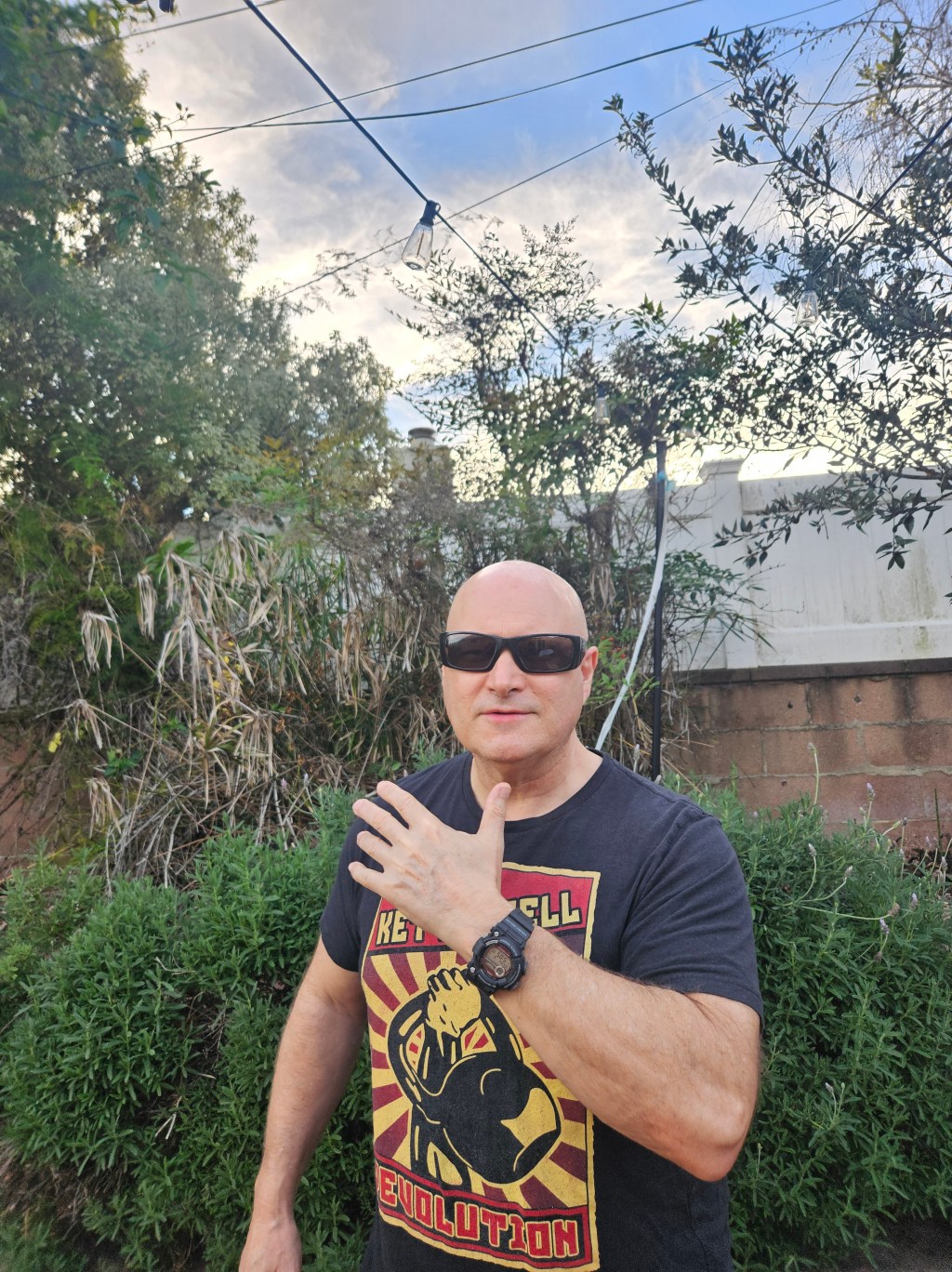
Now I find myself wondering whether my recent conversion to the G-Shock Frogman is less a purchase than a recall notice from that earlier life. A resin watch, oversized and unapologetic, arrives like a toy that learned how to tell time with atomic authority. Five hundred dollars for a device that looks like it escaped a childhood—but feels, on the wrist, like a command.
The timing is suspicious. Irrelevance looms. Retirement whispers. The culture shrugs. And my unconscious, unimpressed by all of it, reaches backward and drags something forward. I did not want to dim. I wanted ignition. I wanted to be in my prime, or at least in the vicinity of it. I wanted, absurdly and sincerely, to be a man of action.
So here I am, somewhere between Deacon’s barstool and a backyard zipline, imagining a descent into danger, hostages to save, a purpose that announces itself clearly and requires no explanation. The ravine is imaginary. The urgency is not.

 Cinemorphosis
Leave a comment