One of the great American confessions disguised as a groove, “Deacon Blues” by Steely Dan, is not really about jazz or whiskey or late-night dignity. It’s about a suburban man who has quietly accepted his own smallness and now anesthetizes himself with a cinematic fantasy: he is, in his mind, an outlaw artist—unbought, ungoverned, beautifully doomed. In reality, he’s a man in a cul-de-sac rehearsing rebellion between errands.
The song doesn’t mock him; it does something crueler and more elegant—it turns his self-deception into something hauntingly beautiful, a melody so smooth you almost miss the fact that it’s scoring a life half-lived. That’s why it lingers. It flatters the listener even as it exposes him.
The song’s narrator is what we might call a Pinot Noir Outlaw: a man who performs a life of danger and artistic defiance through carefully curated indulgences—jazz, late-night drinks, vague melancholy—while remaining safely embedded in routine and privilege.
And I’m not exempt. I recognize the man immediately because I am another citizen pacing the enclosure of my own habits, staging elaborate internal revolutions that never quite breach the walls. I don’t crave improvement; improvement is bureaucratic. I crave demolition. I want the current version of myself revoked, replaced, struck by lightning and rewritten. Spare me the incremental victories—slightly better blood pressure, a more respectable triglyceride count, LDL nudged into compliance. That’s not transformation; that’s paperwork.
What I want is upheaval. I want to molt like something ancient and impatient. I want to peel off the familiar skin—cowardice, inertia, the soft compromises I’ve negotiated with mediocrity—and step out of it raw and newly assembled. Someone decisive. Someone difficult to bargain with. A man who doesn’t soften at the edges when it matters. A man who doesn’t flinch.
But because that kind of transformation rarely arrives—no lightning bolt, no divine summons—we improvise. We cosplay. We assemble identities the way children assemble Halloween costumes: a prop here, a posture there, a new narrative stitched together from objects that flatter us. We don’t become new men; we accessorize the old one and call it progress.
If you’re a watch collector, the illusion is particularly seductive. For twenty years, I lived inside a very specific mythology: polished steel, mechanical divers, the ritual of winding and setting, the quiet romance of gears and springs. I told myself I belonged to a certain tribe—men of discernment, men of patience, men who appreciated craft. It was a pleasing fiction.
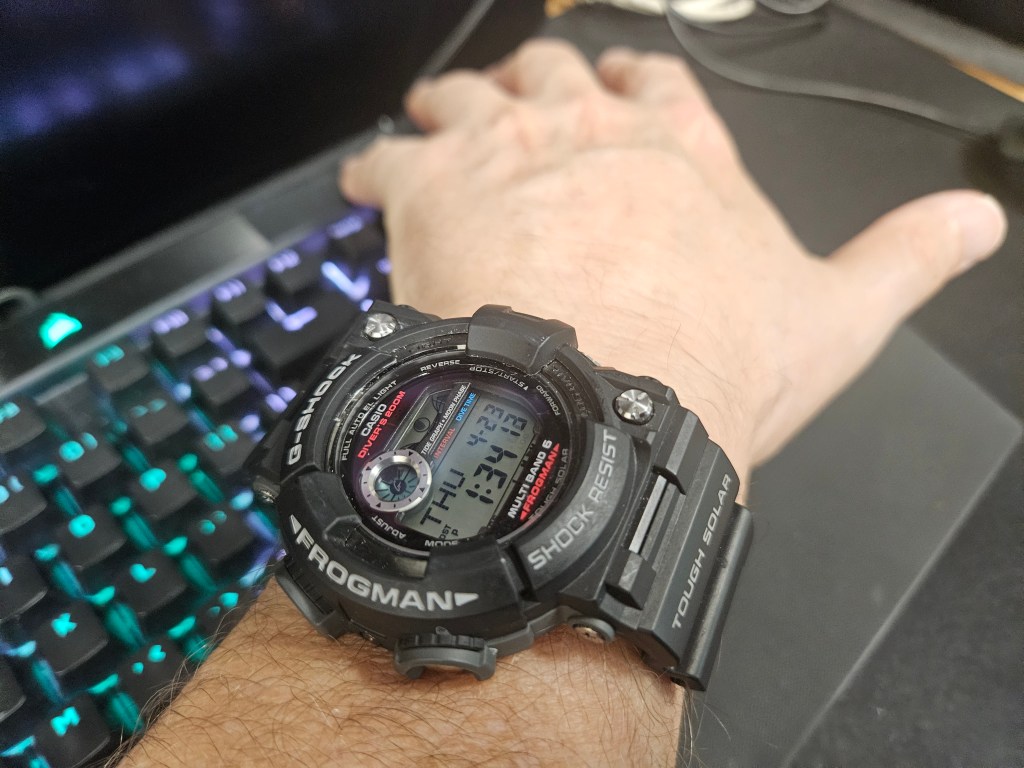
Then, in February of 2026, at sixty-four—an age when one is expected to consolidate, not detonate—I betrayed my own aesthetic. I bought the watch I had resisted for over a decade: the G-Shock Frogman. I had dismissed it for years as a resin aberration, a digital eyesore, a violation of everything I claimed to value. And yet, in a moment that felt less like a decision and more like possession, I ordered it from Sakura Watches in Japan.
The acquisition was not elegant. It was a bureaucratic gauntlet. Emails. Texts. Tracking updates that read like dispatches from a stalled expedition. A sudden hostage situation in a Long Beach DHL facility until I paid a $100 ransom dressed up as an import fee. By the time the box arrived, I assumed the experience had poisoned the well. Surely the watch would arrive tainted by annoyance.
It didn’t.
I strapped it on, and something immediate and irrational occurred. Not admiration—bonding. A click deeper than preference. It triggered a memory I hadn’t summoned in years: the 1970s TV show Shazam!, where a boy named Billy Batson speaks a word—Shazam!—and a bolt of lightning splits the sky, transforming him into Captain Marvel. Child becomes hero. Hesitation becomes action.
The Frogman was my word. Not spoken, but worn.
And here is the part that resists tidy explanation: I did not feel like a man who had purchased a watch. I felt like a man who had crossed a threshold. As if some internal lever had been pulled without my consent. The old aesthetic, the old loyalties—they didn’t argue; they receded. Something else advanced.
Call it delusion if you want. Call it consumer theater. But the experience had a force to it, a momentum that mocked the idea of careful, rational choice. It felt like being drafted by a version of myself I hadn’t authorized.
I don’t know what comes next. I only know this: the change did not ask permission, and I did not resist it.


Leave a Reply