Tag: healing

  • The Frogman Conversion: When Lightning Strikes

    The Frogman Conversion: When Lightning Strikes

    One of the great American confessions disguised as a groove, “Deacon Blues” by Steely Dan, is not really about jazz or whiskey or late-night dignity. It’s about a suburban man who has quietly accepted his own smallness and now anesthetizes himself with a cinematic fantasy: he is, in his mind, an outlaw artist—unbought, ungoverned, beautifully doomed. In reality, he’s a man in a cul-de-sac rehearsing rebellion between errands.

    The song doesn’t mock him; it does something crueler and more elegant—it turns his self-deception into something hauntingly beautiful, a melody so smooth you almost miss the fact that it’s scoring a life half-lived. That’s why it lingers. It flatters the listener even as it exposes him.

    The song’s narrator is what we might call a Pinot Noir Outlaw: a man who performs a life of danger and artistic defiance through carefully curated indulgences—jazz, late-night drinks, vague melancholy—while remaining safely embedded in routine and privilege.

    And I’m not exempt. I recognize the man immediately because I am another citizen pacing the enclosure of my own habits, staging elaborate internal revolutions that never quite breach the walls. I don’t crave improvement; improvement is bureaucratic. I crave demolition. I want the current version of myself revoked, replaced, struck by lightning and rewritten. Spare me the incremental victories—slightly better blood pressure, a more respectable triglyceride count, LDL nudged into compliance. That’s not transformation; that’s paperwork.

    What I want is upheaval. I want to molt like something ancient and impatient. I want to peel off the familiar skin—cowardice, inertia, the soft compromises I’ve negotiated with mediocrity—and step out of it raw and newly assembled. Someone decisive. Someone difficult to bargain with. A man who doesn’t soften at the edges when it matters. A man who doesn’t flinch.

    But because that kind of transformation rarely arrives—no lightning bolt, no divine summons—we improvise. We cosplay. We assemble identities the way children assemble Halloween costumes: a prop here, a posture there, a new narrative stitched together from objects that flatter us. We don’t become new men; we accessorize the old one and call it progress.

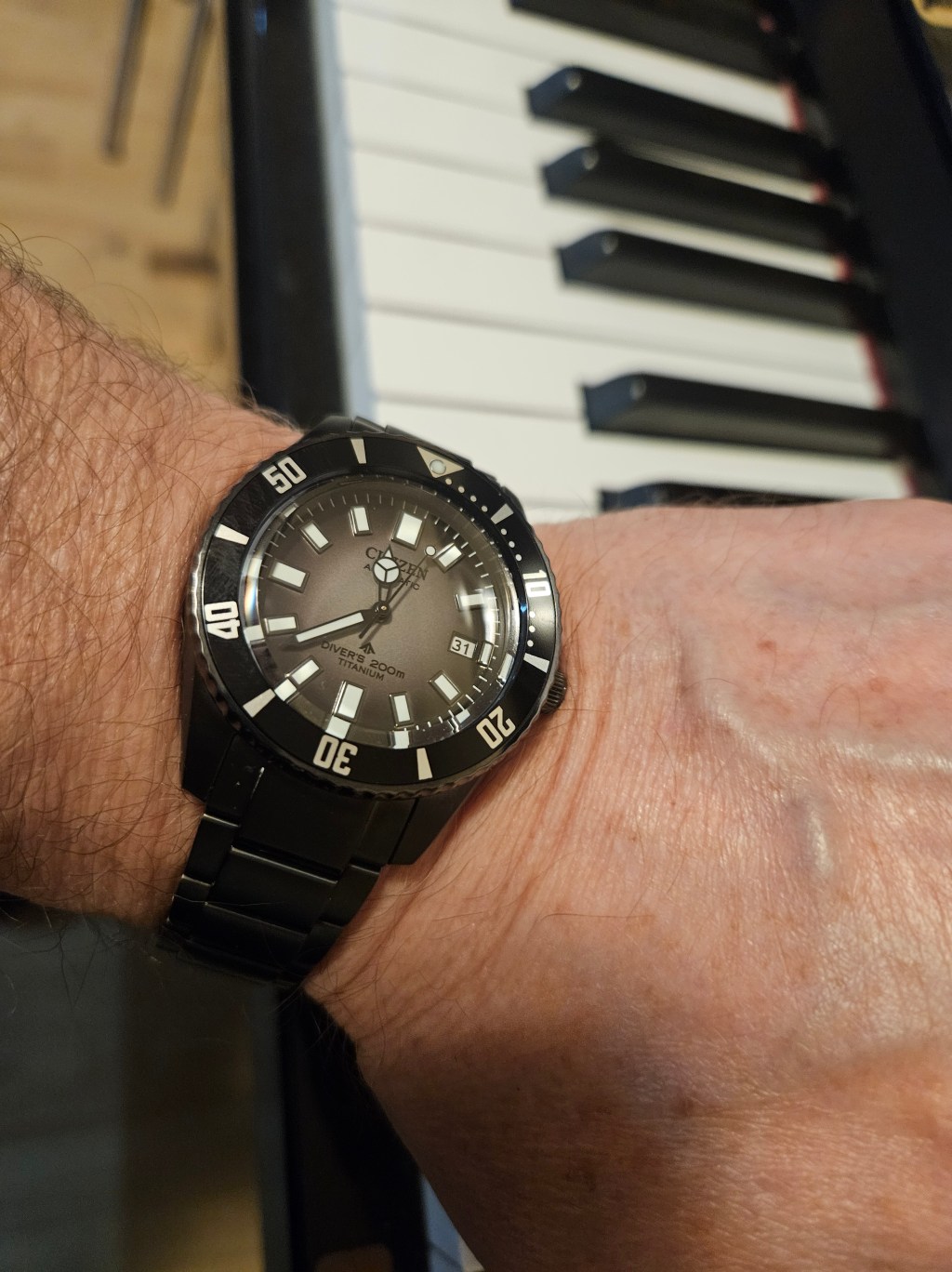
    If you’re a watch collector, the illusion is particularly seductive. For twenty years, I lived inside a very specific mythology: polished steel, mechanical divers, the ritual of winding and setting, the quiet romance of gears and springs. I told myself I belonged to a certain tribe—men of discernment, men of patience, men who appreciated craft. It was a pleasing fiction.

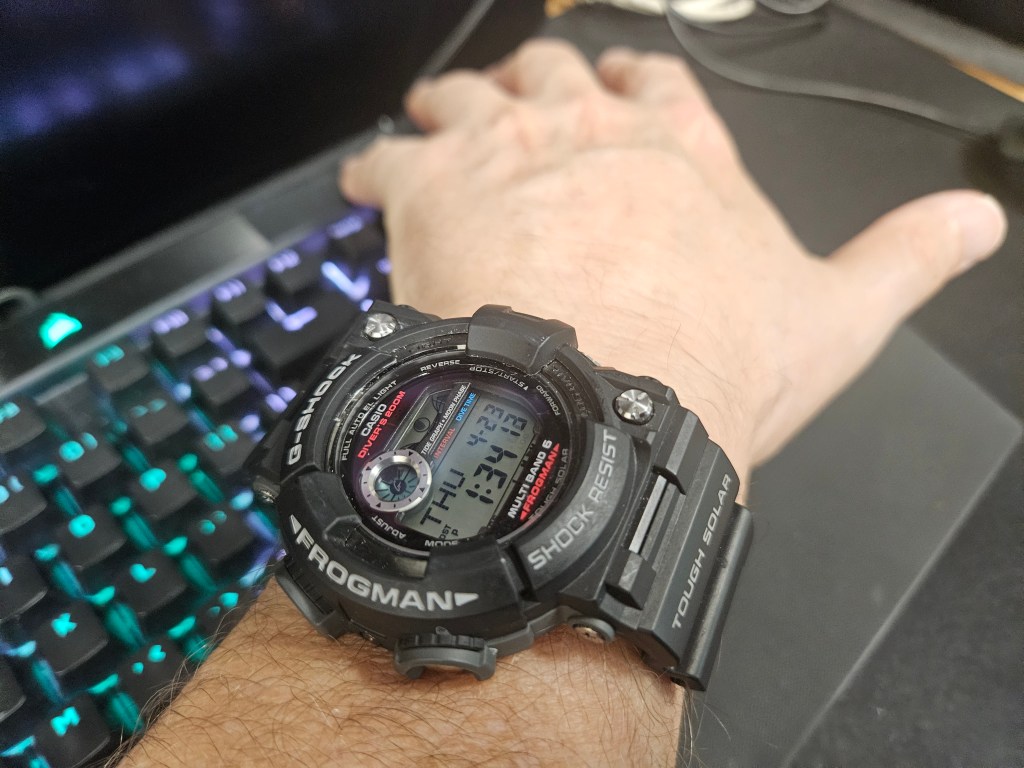
    Then, in February of 2026, at sixty-four—an age when one is expected to consolidate, not detonate—I betrayed my own aesthetic. I bought the watch I had resisted for over a decade: the G-Shock Frogman. I had dismissed it for years as a resin aberration, a digital eyesore, a violation of everything I claimed to value. And yet, in a moment that felt less like a decision and more like possession, I ordered it from Sakura Watches in Japan.

    The acquisition was not elegant. It was a bureaucratic gauntlet. Emails. Texts. Tracking updates that read like dispatches from a stalled expedition. A sudden hostage situation in a Long Beach DHL facility until I paid a $100 ransom dressed up as an import fee. By the time the box arrived, I assumed the experience had poisoned the well. Surely the watch would arrive tainted by annoyance.

    It didn’t.

    I strapped it on, and something immediate and irrational occurred. Not admiration—bonding. A click deeper than preference. It triggered a memory I hadn’t summoned in years: the 1970s TV show Shazam!, where a boy named Billy Batson speaks a word—Shazam!—and a bolt of lightning splits the sky, transforming him into Captain Marvel. Child becomes hero. Hesitation becomes action.

    The Frogman was my word. Not spoken, but worn.

    And here is the part that resists tidy explanation: I did not feel like a man who had purchased a watch. I felt like a man who had crossed a threshold. As if some internal lever had been pulled without my consent. The old aesthetic, the old loyalties—they didn’t argue; they receded. Something else advanced.

    Call it delusion if you want. Call it consumer theater. But the experience had a force to it, a momentum that mocked the idea of careful, rational choice. It felt like being drafted by a version of myself I hadn’t authorized.

    I don’t know what comes next. I only know this: the change did not ask permission, and I did not resist it.

  • Social Capital and the Art of Not Being Chosen

    Social Capital and the Art of Not Being Chosen

    Not all rejection deserves to be filed under the same heading. Romantic rejection—the operatic kind—arrives with violins, moonlight, and a certain built-in alibi. You fall hard, you overestimate your odds, and when the other person declines to co-star in your fantasy, you can console yourself with the obvious: the whole thing was inflated from the start. You were auditioning for a role that rarely gets cast.

    But the quieter rejections—the ones that occur under fluorescent lighting and polite conversation—cut deeper. They lack drama but not consequence. In fact, they feel more diagnostic, as if they’ve been administered by a committee.

    Consider friendship rejection. You meet someone, exchange a few promising signals, and then—nothing. Or worse, a friendship that once had momentum slows, then stalls, then disappears entirely. This is not a stranger declining your advances; this is someone who had enough data to make a decision and chose, calmly, not to proceed. The verdict feels less like bad luck and more like a character assessment.

    Then there is colleague rejection, which operates with corporate efficiency. Alliances form. Cliques crystallize. You are not invited into the warm circle of inside jokes and informal influence. You do your work—flawlessly, even—but without the buoyancy that comes from being wanted. You become competent but peripheral, visible but not included. This is where you begin to suspect you suffer from what might be called Social Capital Deficit Syndrome: a condition marked by a shortage of the invisible currency that makes social and professional life glide instead of grind.

    And here is the uncomfortable truth: social capital is not a luxury; it is infrastructure. Without it, you are left to interpret every silence, every omission, every polite deflection. The temptation is to diagnose yourself—too blunt, too quiet, too something—and then to launch a campaign of correction. This is where things get worse. Self-blame mutates into paranoia. Self-improvement becomes performance. You start sanding down your edges in public, hoping to emerge as a more acceptable version of yourself, and end up as a less convincing one.

    At some point, a harsher but cleaner realization presents itself: your personality comes with a certain gravitational pull, and not everyone will orbit it. No amount of forcing will change that. Trying to wedge yourself into every available opening only advertises the mismatch.

    The more durable response is less theatrical and more disciplined. Accept that people respond rather than decide. They are not conducting formal evaluations of your worth; they are reacting to chemistry, timing, and preference—most of which lie outside your control. This does not excuse cruelty, but it does eliminate the fantasy that everyone owes you affinity.

    So you take the higher road—not as a moral performance, but as a practical strategy. You remain courteous when ignored, steady when excluded, and restrained when slighted. You refuse to become the bitter man who proves his critics right simply by reacting exactly as expected.

    This runs counter to a culture that treats every problem as fixable with the right toolkit. You can, of course, pursue therapy, charisma workshops, confidence training—the whole catalog of self-upgrades. Some of it may help. Some of it may turn you into a louder version of the same problem. There is a fine line between improvement and overcorrection, and many people sprint past it.

    What remains, then, is a quieter ambition: to live without rancor. To accept your limits without turning them into grievances. To maintain a sense of integrity that does not depend on applause. The chip on your shoulder may feel like armor, but it is really a signal—confirmation to others that their instincts about you were correct. Let it go.

    You may lose the small comforts of self-pity. In return, you gain something sturdier: a life not governed by who did or did not choose you.

  • When Time Stops Asking and Starts Telling

    When Time Stops Asking and Starts Telling

    At sixty-four and four months, you thought you were still wading—water warm, footing reliable, the shoreline within easy reach. Then, without warning, the bottom vanished. One step of confidence, followed by that cold, immediate truth: you are no longer in control of the depth. The drop-off doesn’t negotiate. It doesn’t slope politely. It takes you.

    This particular plunge announced itself through something as mundane—and as revealing—as a watch. For decades, you wore mechanical divers with analog dials, small, intricate machines that whispered of heritage, craft, and a certain gentlemanly patience. That language no longer translated. You didn’t want poetry. You wanted coordinates.

    So you defected. You strapped on Tough Solar, Multiband-6 atomic G-Shocks—watches that don’t ask what time it feels like but what time it is, down to the second, corrected nightly by a signal from a tower you will never see. This was not a style change. It was an Atomic Conversion Event: the moment when nostalgia is exposed as a luxury item and precision becomes a survival tool. Time ceased to be something you admired. It became something you obeyed.

    You found yourself thinking of that Robinson family from Lost in Space—before stepping onto an alien surface, they consulted their robot, which scanned the air and issued a verdict: breathable or lethal. You needed your own robot now, but smaller, quieter, strapped to your wrist. Not to tell you whether the atmosphere would kill you, but whether you were wasting it.

    Because the deeper realization was not horological. It was existential. You no longer had the bandwidth for drift. “Fiddlefaddling,” once an acceptable pastime, now read like malpractice. Clarity was no longer optional; it was oxygen. You had to extract meaning from the noise and live with an alignment that would have bored your younger self. The watch change was merely the visible symptom of an internal regime shift.

    And this was not your first encounter with the abyss. A decade earlier, you performed a similar surgery on your life: you quit sports. Not gradually, not ceremoniously—just stopped. You recognized the structure for what it was: three-hour games followed by hours of commentary, followed by meta-commentary, followed by the analysis of the analysis. An infinite regress disguised as entertainment. You didn’t taper off. You cauterized the habit. Torch, not scalpel.

    That’s when the pattern revealed itself. Life is not a smooth shoreline; it is a series of drop-offs. Each one demands a new posture, a new set of tools, a new tolerance for truth. You don’t get to choose whether they arrive—only whether you adapt before you drown.

    There will be more. Of course there will. The only sensible response is not optimism but readiness.

    Buckle up.

  • The Loneliness Hypothesis: Is Social Isolation Making America Mean? (college essay prompt)

    The Loneliness Hypothesis: Is Social Isolation Making America Mean? (college essay prompt)

    Read “How America Got Mean” by David Brooks and “The Anti-Social Century” by Derek Thompson. Then watch the comedy special Lonely Flowers by Roy Wood Jr..

    In Lonely Flowers, Roy Wood Jr. argues that increasing loneliness and social disconnection are contributing to a rise in anger, hostility, and violence in American society. Brooks and Thompson also describe a culture that is becoming more fragmented, isolated, and socially brittle.

    Write a 1,000-word argumentative essay that develops a thesis responding to Roy Wood Jr.’s claim. Using the ideas from Brooks and Thompson, argue whether social isolation is a convincing explanation for the rise in cultural hostility and violence. Your essay may support, refute, or complicate Wood’s claim.

    Thesis + Mapping Requirement

    Your introduction must include a thesis that does two things:

    1. Takes a clear position on Wood’s claim about loneliness and violence.
    2. Maps the major reasons that will organize your body paragraphs.

    Example thesis with mapping

    Roy Wood Jr.’s claim that loneliness is fueling violence in America is persuasive because, as David Brooks and Derek Thompson show, the collapse of community institutions, the rise of hyper-individualism, and the retreat into private digital life have produced a society that is increasingly disconnected and emotionally volatile.

    In this thesis, the mapping components are:

    • collapse of community institutions 
    • retreat into private digital life
    • loss of meaningful language
    • loss of intuition to connect with others

    Each of those becomes a body paragraph.

    Essay Requirements

    Your essay should include:

    • a clear thesis with mapping components
    • analysis of key ideas from Brooks and Thompson
    • references to Roy Wood Jr.’s argument in Lonely Flowers
    • a counterargument that challenges your thesis
    • a rebuttal defending your position
    • a concluding paragraph that reflects on what these ideas suggest about modern American culture

    Possible directions for your argument

    You might argue that:

    • loneliness and isolation are making Americans angrier and more volatile
    • loneliness explains some hostility but not actual violence
    • digital life is replacing real community and increasing resentment
    • other forces (economic anxiety, media outrage, politics) are stronger causes of violence

  • The Gospel of the Multiband 6 Solar G-Shock

    The Gospel of the Multiband 6 Solar G-Shock

    If you’re drawn to a Multiband 6 solar G-Shock, you may possess what could be called the engineer mind—the temperament that treats maintenance as failure and automation as a moral good. You don’t want a watch so much as a system instance or virtual machine running on your wrist.

    A proper watch, in your view, should set itself, power itself, correct itself, and never—under any circumstances—require the fussy rituals of mechanical ownership. Manual winding feels like typing commands that should have been automated. Battery changes feel like scheduled downtime. Service intervals feel like flawed architecture. What you want is operational silence: install once, forget forever.

    For you, reliability isn’t a feature; it’s a philosophy. Drift is offensive. Inaccuracy produces low-grade anxiety. Atomic synchronization delivers more than precision—it delivers relief, the quiet satisfaction of knowing the number is exactly right, the emotional equivalent of clean code and zero errors. 

    Solar power satisfies the same instinct. External dependency is weakness. Self-sustaining systems feel intelligent. Over time, the watch stops feeling like an object and starts behaving like a background process—always running, never demanding attention, never crashing.

    Status signaling holds no appeal. Flash invites conversation, and conversation about objects is noise. A Multiband G-Shock communicates competence the way a well-organized server rack does: quietly, efficiently, and without asking to be admired. Like a good waiter, it serves your needs without being intrusive.

    Adding to its appeal, its overbuilt case, shock resistance, and water tolerance reflect your respect for systems designed for field conditions rather than showroom lighting. It performs like good infrastructure—essential, invisible, and indifferent to opinion.

    You may tell yourself it’s just a tool, but the attachment runs deeper. You move through a world that feels increasingly unstable, and the watch becomes an ally in your search for order. Each morning glance is less a habit than a systems check. Did it sync overnight? Is everything aligned? That small confirmation carries disproportionate comfort: something, somewhere, is still working exactly as designed.

    This is the onset of Operational Silence Dependency—the quiet attachment that forms when you come to value a device not for what it does, but for what it never asks you to do. The ideal tool makes no demands, sends no alerts, requires no rituals, and never interrupts your day with the mechanical equivalent of small talk. It sets itself, powers itself, corrects itself, and disappears. Over time, you stop noticing its presence and start depending on its absence of problems.

    You’ll know the shift is complete when you wear it through everything—sleep, showers, travel, deadlines, minor crises—because taking it off feels less like removing a device and more like disconnecting a trusted process.

    The depth of the bond becomes obvious when “upgrades” appear. New models promise new features, but you hesitate. Bluetooth, for example, strikes you as a category error. You prefer Multiband for the same reason a systems administrator prefers a cron job to a phone call: one is infrastructure; the other is a relationship. Atomic sync happens quietly in the night—no pairing, no permissions, no firmware prompts, no cheerful reminders to “stay connected.” Bluetooth drags the watch into the emotional ecosystem of the smartphone: updates, battery anxiety, dropped connections, and the faint suspicion that something somewhere needs your attention.

    Multiband 6 is operational dignity—set once, corrected by physics and radio towers that don’t need passwords. To the engineer mind, atomic time isn’t just elegant. It’s morally superior. Bluetooth asks for interaction. Multiband delivers silence—and silence, in your worldview, is the sound of a system working perfectly.

    So you won’t be replacing your Multiband 6 watch with the new Bluetooth model. The current one has proven itself. Replacing it would feel less like upgrading hardware and more like retiring a colleague who has never missed a deadline.

    Over the years, the watch absorbs your history—projects completed, trips survived, long stretches of life that passed without drift or failure. At that point, it is no longer equipment. It is continuity on the wrist: an uncomplaining witness, a small island of order carried through a world that rarely behaves as predictably as your watch does.

    The story doesn’t stop here. Over time, something subtle happens. The watch stops being something you wear and becomes something you operate with. Your rhythms align. You wake, it has already corrected itself. You move through deadlines, travel, minor crises, and long uneventful stretches, and it keeps the same quiet pace—never drifting, never asking, never failing. You stop thinking about it the way a pilot stops thinking about a reliable instrument: not because it’s unimportant, but because it’s always right. Somewhere along the way, the relationship shifts from ownership to partnership. You handle the chaos; it handles the time. Together you form a small, efficient system—human judgment paired with mechanical certainty. In a noisy, unreliable world, the two of you run clean, synchronized, and uninterrupted, less like a man and his watch and more like a single unit that simply works.

  • The Man Who Moved to G-Shock Avenue

    The Man Who Moved to G-Shock Avenue

    Paul McCartney once admitted that after the Beatles broke up, he couldn’t bring himself to play their songs. Too much history. Too much emotion packed into every chord. The music wasn’t just music—it was a former life. That’s how you feel about your mechanical divers. They now sit in what you’ve come to call the Box of the Abandoned Past—not discarded, not unloved, but too heavy with memory to wear without reopening old chapters.

    Then the G-Shock Frogman arrived, and with it came a revelation: you hadn’t just bought a new watch—you had moved cities. For more than twenty years, you’d been living in Mechanical Town, polishing bezels and monitoring seconds like a municipal duty. Suddenly you realized you belonged somewhere else entirely. You packed your emotional bags and relocated to G-Shock Avenue. First the Frogman. Then the Rangeman. Then the high-end Square. No ceremony. No farewell speech. Just a quiet change of address.

    Years passed. Occasionally, you tried to revisit the old neighborhood. You’d take out a mechanical diver, strap it on, and see if the feeling returned. But like McCartney staring at a piano and deciding “Yesterday” could stay in the past, you always drifted back to the Frogman. It was lighter. Simpler. Emotionally frictionless. The past had craftsmanship. The present had peace.

    Still, you refuse to sell the mechanicals. They’re not watches anymore; they’re chapters. Expensive bookmarks in the autobiography of your former self. Once a year, you conduct the ritual. You open the Box of the Abandoned Past. You shine a small, theatrical light across the rows. You offer a quiet apology while Paul McCartney’s “Uncle Albert” plays in the background, the soundtrack of dignified transition.

    Your wife and daughters evacuate the premises during this ceremony, treating it with the same enthusiasm reserved for releasing an aerosol flea bomb in the living room.

    But alone in the room, you sing along, close the box, strap on the Frogman, and step back into the present—no longer a resident of the mechanical past, but a citizen, fully and permanently, of G-Shock City.

    You have entered painful terrain for the watch enthusiast: Emotional Migration. It is the moment a watch enthusiast changes allegiance not by selling a collection, but by quietly moving his identity to a new territory. The old watches may still sit in the box, polished and respectable, but the emotional address has changed. What once felt essential now feels historical; what once felt like an experiment now feels like home. There is no announcement, no dramatic purge—just the slow realization that your wrist no longer reaches for the past. Emotional Migration isn’t about acquiring something new. It’s about discovering that your center of gravity has relocated, and the watches you once loved now live where you used to live.

  • Lost Inside the Time Matrix

    Lost Inside the Time Matrix

    Fun has never come naturally to me. When laughter showed up in my life, it arrived like an unscheduled visitor—pleasant, surprising, and slightly suspicious. Childhood wasn’t organized around fun. It was organized around performance, comfort, and controlled pleasure. If reality felt unpredictable, I built systems to keep it at a safe distance.

    Bodybuilding became one of those systems.

    I loved the structure. The measurable progress. The illusion that strength and discipline could turn life into something orderly and manageable. But let’s be honest: bodybuilding wasn’t fun. It was work disguised as purpose. My real occupation wasn’t lifting weights. It was self-soothing.

    And like any good neurotic, once I found a soothing routine, I locked onto it with the emotional flexibility of a steel beam.

    One week before placing second in the Mr. Teenage San Francisco contest, I finished a psychology exam and was talking after class with a girl who looked like she had been designed by a committee of Renaissance painters. Roxanne was nearly six feet tall, with sharp cheekbones, green eyes that moved slowly and confidently, and long honey-colored hair that suggested she lived in better weather than the rest of us.

    She invited me to the campus ale house. We could talk psychology. And, presumably, other matters.

    I checked my watch.

    It was Pec Day.

    I declined.

    There it was: paradise extending an invitation, and me consulting my schedule like a prison guard checking the lights-out list.

    I wasn’t choosing discipline over fun. I was trapped inside time itself. The routine didn’t support my life—it enclosed it. Roxanne wasn’t competing with the gym. She was competing with the system that kept the world at a safe emotional distance.

    The watch hobby operates in much the same way.

    At its core, it is a self-soothing mechanism—precision, order, control, measurable certainty in a world that offers very little of any of those things. But when the soothing becomes rigid, something strange happens. You stop living in time and start living inside a time matrix, where research replaces experience and optimization replaces spontaneity.

    At that point, the enthusiast risks becoming what the world casually calls a nerd—not someone who loves a subject, but someone who uses structure to avoid the unpredictable mess of actual life.

    The deeper lesson is the danger of the Schedule Fortress.

    A Schedule Fortress begins as discipline and ends as defense. Every hour has a purpose. Every deviation feels like a breach. Spontaneity becomes a hostile force that must be repelled. Inside the walls, you feel productive, controlled, even virtuous.

    But the cost is quiet and cumulative.

    Invitations get declined. Detours get avoided. Unexpected moments bounce off your life like rain off concrete.

    What began as time management slowly becomes life management.

    Then life avoidance.

    The fortress protects you from chaos, disappointment, and uncertainty.

    Unfortunately, it also protects you from surprise, connection, and the inconvenient truth that the best moments rarely arrive on schedule.

    Somewhere out there, Roxanne is still waiting at the ale house.

    And it’s still Pec Day.

  • Reunion Loop Syndrome: The Watch You Can’t Quit

    Reunion Loop Syndrome: The Watch You Can’t Quit

    Seasoned watch collectors know a particular form of heartbreak: selling a watch they love—then hunting it down again like a lost soulmate. The cycle repeats. Buy. Sell. Regret. Rebuy. Promise never to let it go again. Then, a few months later, the relationship cools, restlessness sets in, and the breakup happens all over again.

    At some point it becomes clear: the fixation isn’t the watch.

    It’s the drama.

    This pattern has a name: Reunion Loop Syndrome—a behavioral cycle in which the collector repeatedly parts with and repurchases the same watch, not because their taste has changed, but because they crave the emotional arc. The pleasure isn’t ownership; it’s the story. Separation sharpens longing. Regret fuels the search. The chase restores meaning. And the reunion delivers a brief, intoxicating high.

    The watch becomes less an object than a romantic partner in a serialized relationship. Each transaction reenacts the emotional turbulence of a teenage breakup—except now the reconciliation includes PayPal fees, overnight shipping, and the quiet humiliation of buying back your own mistake.

    Eventually, some collectors recognize the madness and attempt an intervention.

    Instead of selling, they stage a controlled disappearance.

    The watch is locked in a safe. Or exiled to a friend’s house. Sometimes both. Access is restricted for months—three at a minimum, sometimes a full year. The strategy is simple: simulate loss without the financial damage. Absence rebuilds longing. Time restores novelty. When the watch finally returns to the wrist, the reunion feels earned rather than repurchased.

    It’s emotional theater without the market penalty.

    The good news is the method works. Thousands of dollars remain safely in the bank. The flipping stops. The collection stabilizes. Financial maturity has arrived.

    The bad news is harder to admit. Emotional security is still stuck in senior year.

  • The Myth of the Inner Circle

    The Myth of the Inner Circle

    It’s wired into the species—not just the desire to belong, but the craving to belong intensely, to slip past the outer ring of acquaintances and take a seat inside the inner ring, the secret hearth where the real warmth allegedly lives. Decades ago, I convinced myself I had secured that coveted spot within my friend group. Then came the day I wasn’t invited to what I imagined was a grand, festive gathering. One tiny exclusion detonated my entire reality. I felt betrayed, humiliated, and terrified. Had I been exiled? Had I never belonged at all? What kind of fool mistakes polite laughter for fellowship? The hurt settled in for years. I saw myself as a wounded wolf limping away from the pack, nipped at the heels, slipping into the freezing brush alone—shivering, haggard, staring back at the others as I wondered what was left for me now.

    Three decades later, the story has taken on different contours. If I’m honest, I suspect I was never part of anyone’s inner circle; I was the victim of my own wishcasting. My glum tendencies—funny in small doses, exhausting in larger ones—probably nudged me to the periphery from the start. And in a twist more humbling than any imagined exile, I eventually learned the friend group didn’t have an inner circle at all. After one member retired, another admitted they rarely saw each other, that their camaraderie had been built on workplace convenience, not tribal loyalty. My grand narrative of being cast out by a cabal of insiders evaporated. There had been no cabal—just ordinary friendships and my own melodramatic imagination.

    So now the task is simple and difficult at once: forgive myself for the fears and delusions that shaped the story. Reclaim myself. Return to the only inner circle that was ever guaranteed—my own. Maybe that hunger for return is the quiet power of religion: the promise that we can wander, fall apart, and still be welcomed home. The myth of my “expulsion from the inner circle” now feels biblical in scale, a parable of longing not just for belonging, but for wholeness, acceptance, and the grace of being taken back as I am.

  • Confessions of a Nine-O’Clock Man

    Confessions of a Nine-O’Clock Man

    Forgive me, but I’m still trying to figure out where I fit in this digitized circus we call life. I’ll be sixty-four in a few days, and you’d think by now I’d have achieved some level of ontological clarity—but no. I’m still ensnared by the shimmer of online browsing, the algorithmic promise that I might finally become “somebody” by curating a virtual persona. Mostly, the internet feels like a tease: a hall of mirrors where everyone’s reflection looks happier, thinner, and better lit.

    I tell myself I want to contribute, to engage, to share some original thought. But then I open the news and wonder what I could possibly add to the churning doomscroll—what fresh moral insight could come from a man who still double-checks whether he unplugged the toaster?

    It would be laughable for me to preach self-control. I can barely keep my own appetites in check. Apart from my morning kettlebell rituals—five days a week of grunting and penance—I’m an introverted “cozy boy.” I stay home, binge true crime docuseries on Netflix, and rotate my diver watches like a museum curator with OCD. I make my monkish meals: buckwheat groats, Japanese yams, steel-cut oats, tofu glazed in teriyaki and moral superiority. I am a herbivore surrounded by carnivores. My family mocks me gently while gnawing ribs.

    Sometimes, in a fit of ambition, I record a two-minute piano piece for my neglected YouTube channel. It receives twelve views, one of them mine, and a comment that reads, simply, “Lovely.” The algorithm yawns and moves on.

    I am obsessed with the rituals of minor luxury—fine organic whole-bean coffee that accompanies me in my morning writing jaunts, triple-milled soap redolent of rose and citrus, podcast playlists curated for insomniac philosophers. My life is the slow burn of scent and sound, a long intermission between existential crises.

    By nine o’clock, I’m done. My wife and daughters laugh as I shuffle off to bed, a middle-aged Sisyphus retiring his rock for the night. I read for twenty minutes, then fall asleep to the soothing drone of Andrew Sullivan or Sam Harris debating civilization’s decay. It’s my lullaby of reason and despair.

    Forgive me if this sounds paltry. I’m still trying to figure it all out—how to live, how to matter, how to grow up before the credits roll.